Reducing Time to Productivity for New Employees with AI
AI agents that access your actual company data cut new hire ramp time in half.
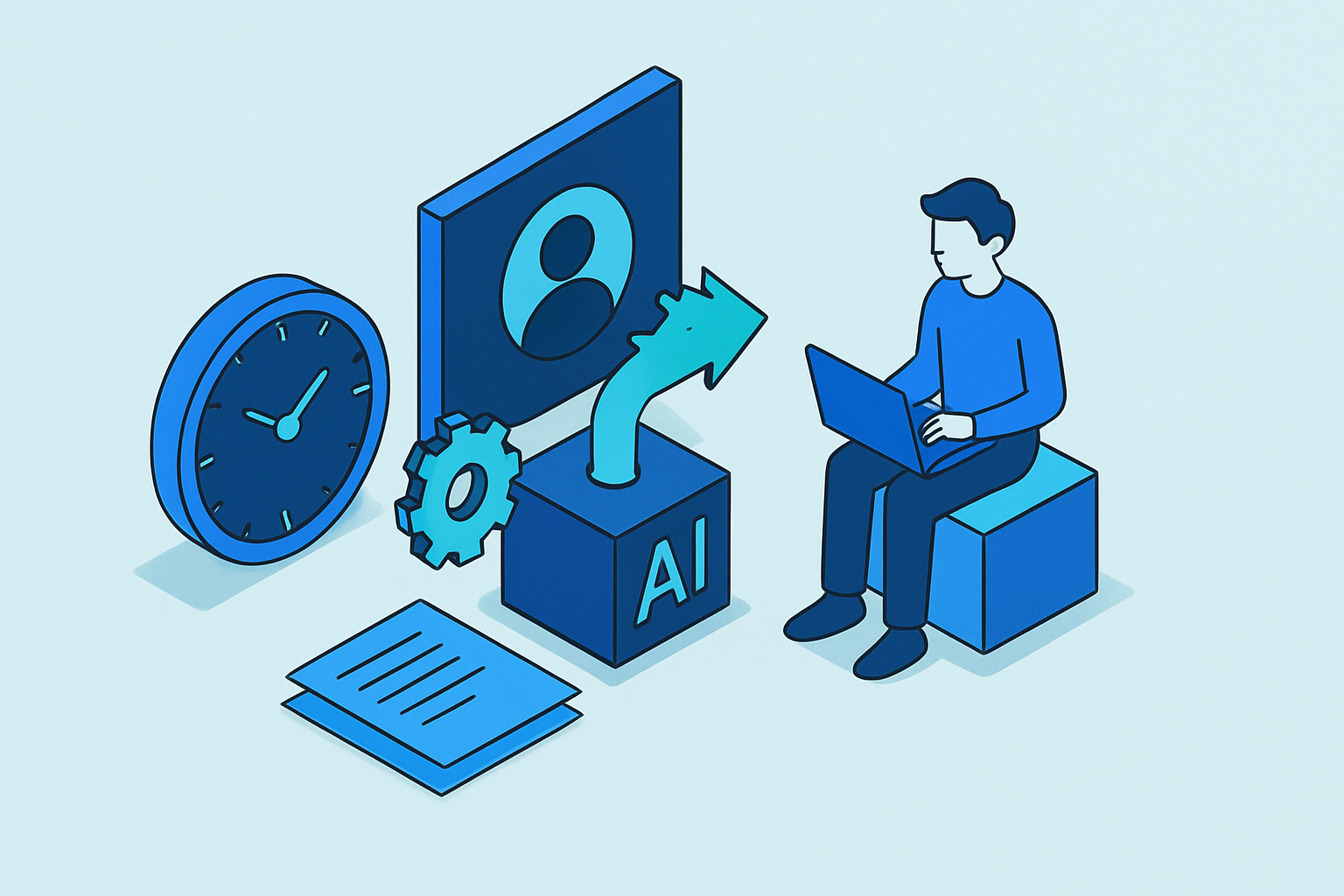
Anyone who has onboarded a new employee recognizes this immediately: too much information, and still not the right thing. New hires drown in handbooks while the context they actually need stays locked in someone else's head. (Why that deal fell apart, how this client prefers to communicate, which internal process is documented nowhere but everyone knows.)
The content exists. Institutional knowledge exists. It lives in old proposals, closed support tickets, CRM notes from deals won and lost before the new hire arrived, in the mental models senior colleagues spent years assembling. None of that is queryable. None of it surfaces when someone types a question into the HR portal.
So new hires do what anyone would do: they interrupt colleagues, send Slack messages, schedule thirty-minute calls to ask questions that already have answers somewhere in the system. This is a rational response to an access problem. The information exists; it's just locked. The real onboarding crisis isn't information overload. It's information under-reach.
KPMG deployed a Microsoft AI onboarding agent that gave new hires access to templates and historical references, and follow-up calls to senior staff dropped 20%, per Microsoft's published case study. That number is a proxy for something more material: senior employees staying in flow, new hires getting answers without waiting on a human. The bottleneck was never content volume. It was retrieval.
What AI-Assisted Onboarding Actually Compresses, with Evidence from Early Deployments
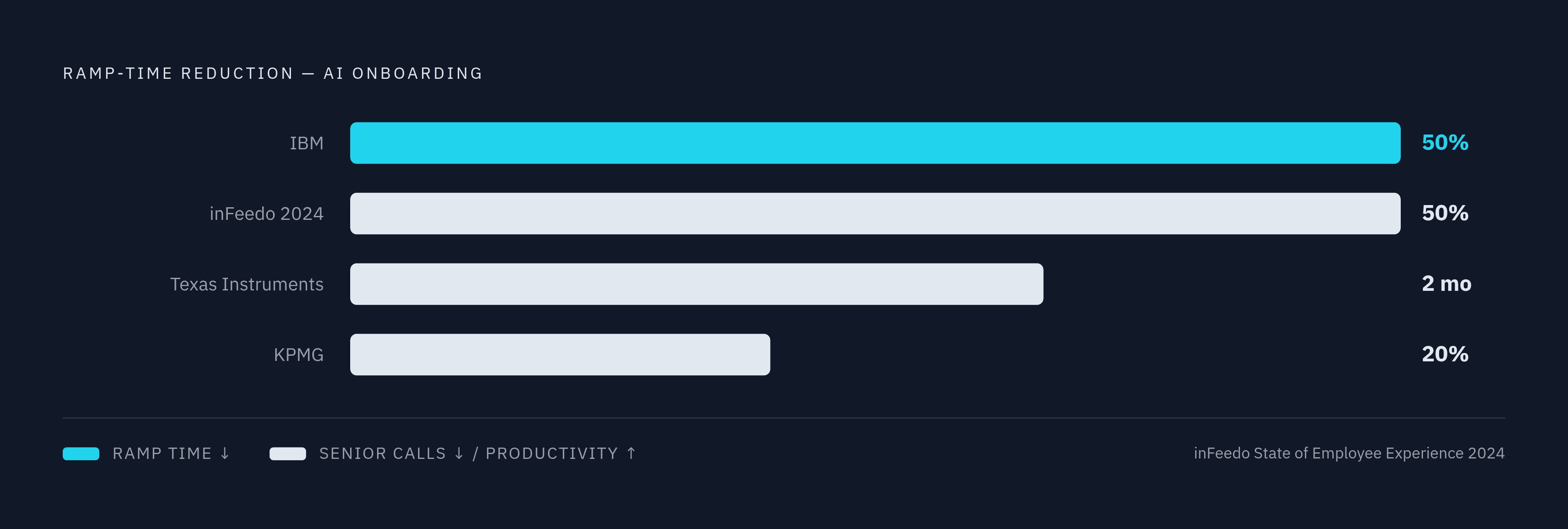
IBM cut ramp-up time by 50%, per internal case documentation. Texas Instruments moved new employees to full productivity two full months ahead of their previous baseline. Companies using AI-assisted onboarding complete the process roughly twice as fast, and new hires reach productivity significantly sooner, according to inFeedo's 2024 State of Employee Experience report.
Two months off a six-to-seven month ramp is not incremental. That's a structural shift in what the first year of employment looks like, financially and operationally. For a sales team, it's the difference between a new rep closing their first deal in Q2 versus Q4.
None of these are AI-for-AI's-sake projects. Each one routes around the same chokepoint: answering repetitive, context-dependent questions without requiring a human to be in the loop every time. The throughput gain isn't coming from more polished orientation modules. It's coming from reducing the latency between a question and a contextually grounded answer.
What these deployments share is agents grounded in actual company data, not generic training materials. A generative AI system with no access to real organizational context is like a consultant who's never read the brief. It produces coherent-sounding answers that are directionally wrong for that specific company, that specific role, that specific deal history. IBM's and Texas Instruments' gains came from specificity, not from language model sophistication.
What the published numbers rarely tell you: whether those gains hold when the agent only has access to sanitized, curated content, versus the full working context a senior employee would actually draw on. That question is where most onboarding AI deployments stall.
Why Most AI Onboarding Tools Stall at the Surface and Don't Reach Institutional Knowledge
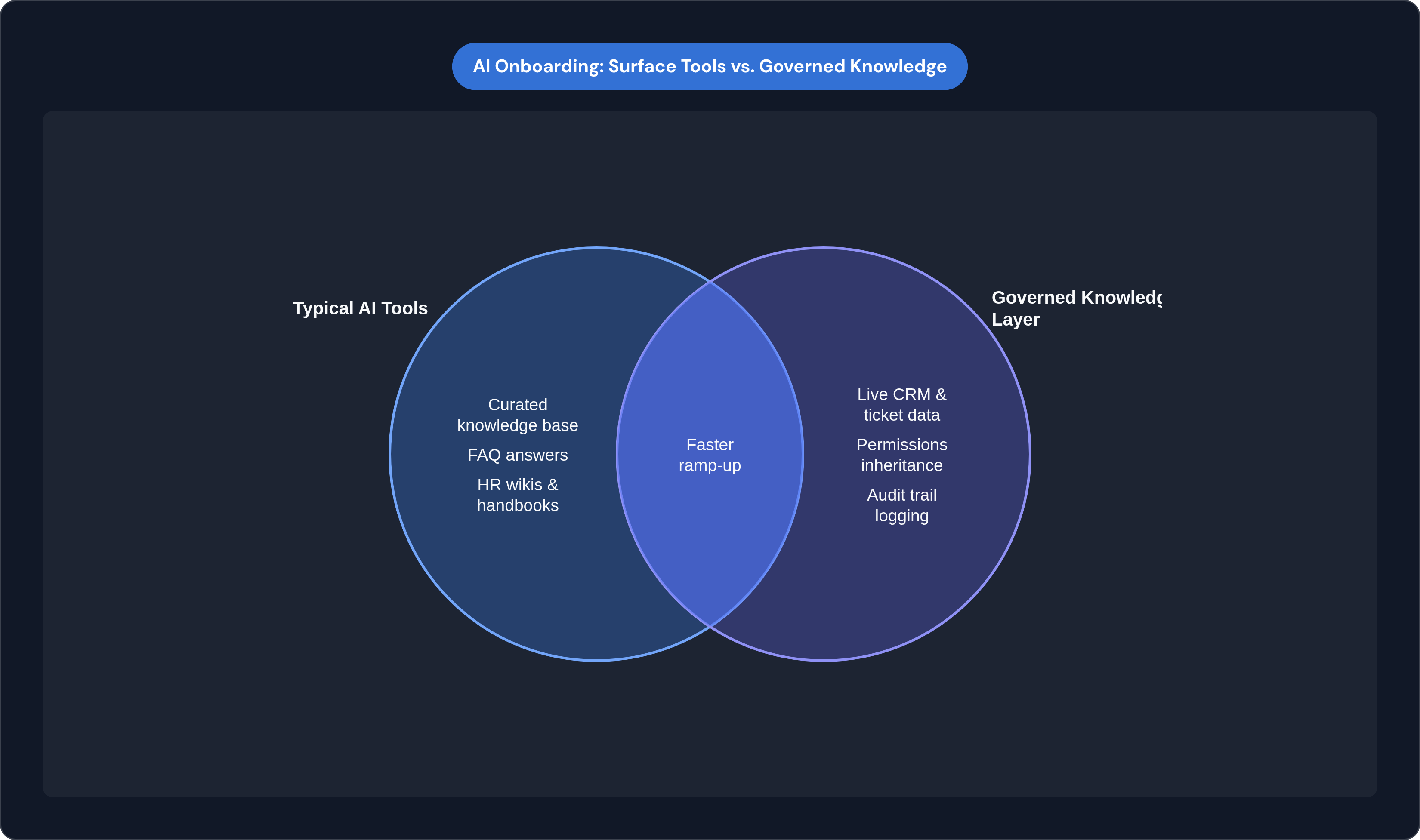
The typical AI onboarding tool operates on a curated knowledge base. Someone in HR spends weeks assembling a wiki, uploading a handbook, tagging documents, publishing a set of approved resources. The agent answers from that corpus. Fine for FAQs. Not a solution to the institutional knowledge problem.
Real institutional knowledge lives in CRM records, engineering tickets, past proposals, Slack threads, support histories, competitive intelligence notes. It's distributed across systems with different permission models, different data structures, different owners. Connecting an AI agent to that ecosystem without careful architecture creates a new problem almost immediately: the agent surfaces information the new hire isn't authorized to see, or pulls context from a domain entirely irrelevant to their role.
More than half of organizations have already experienced AI agents exceeding their intended permissions in agentic deployments, according to the 2024 Gartner AI Security Survey. Permission drift isn't a theoretical risk. It has happened, at scale, in production environments.
The gap between "AI that answers onboarding FAQs" and "AI that gives a new hire the working context a senior colleague built over years" is a permissions-inheritance and data-connectivity problem. The model capability exists. What most deployments haven't built is the architecture to constrain and scope it appropriately, and without that architecture, the institutional knowledge layer stays locked.
How a Governed Knowledge Layer Works: Connecting Sources, Inheriting Permissions, and Scoping Answers
The core design principle is straightforward, though the implementation rarely is: an agent connects to the systems a company already uses, inherits the access controls those systems already enforce, and answers only from what the querying employee is already authorized to see.
Permissions inheritance is what makes this work at scale. The agent doesn't create a new, parallel access model; it mirrors the one that already exists. When access is revoked in a source system because someone changes roles or leaves the company, that revocation propagates to the agent automatically. There's no secondary governance surface to audit separately, no access list that quietly goes stale.
Scoped answers follow from scoped access. A new sales hire's agent draws on CRM data, past proposals, competitive notes relevant to their territory. It doesn't surface engineering architecture documents or HR compensation data the employee has no authorization to view. That boundary isn't enforced by a prompt instruction asking the model to behave itself. It's enforced at the data layer, which is the only place it can actually hold.
This is where MCP, the Model Context Protocol launched by Anthropic in November 2024, becomes operationally relevant. Rather than building a custom integration between an AI agent and each source system, MCP provides a standard interface that any compliant agent can use to query any compliant source. BCG's analysis describes this as moving from an N×M problem to an N+M problem: instead of every agent needing a custom connection to every data source, each agent and each source connects once to the standard. By Q1 2025, roughly a quarter of Fortune 500 companies had implemented MCP servers in production, up from about half that the prior quarter, per BCG's enterprise AI adoption tracking. That adoption pace reflects a real integration pain point being addressed, not a trend chased.
What Governance Requirements Apply When an AI Agent Has Access to Employee-Facing Company Data
An AI agent querying HR records, customer data, or financial documents on behalf of a new employee is not a minimal-risk system. Treating it as one is a compliance liability.
Under the EU AI Act's risk classification framework, context and use case determine classification, not the underlying model. The intended use matters. The data accessed matters. The population affected matters. An onboarding agent touching compensation data or customer records sits in a different risk category than a chatbot answering questions about office parking, and the governance requirements differ accordingly.
GDPR's data minimization principle applies directly: the agent should surface only what is necessary for the task, not everything it can technically access. Enforcing this requires policy controls at the query layer, not just at the data layer. Limiting which databases the agent can connect to is insufficient if the query logic itself is unconstrained.
SOC 2 relevance is escalating. The majority of B2B buyers now require SOC 2 reports, and auditors are increasingly examining AI agent access to customer data as part of that assessment. The onboarding agent's access log is audit evidence. What it queried, on whose behalf, and what it returned are all questions a compliance team may need to reconstruct.
In regulated environments, audit trail requirements are specific: attributed records of prompts, tool calls, responses, and the context retrieved. The full chain, not just a log that the agent executed. A substantial portion of current deployments cannot tell you what a new hire's agent said last Tuesday, or what data it drew on to say it. That gap is not a minor operational inconvenience. It's the kind of thing that surfaces badly during an audit.
Human-in-the-loop is an architectural decision that has to be made before deployment, not something you revisit once the system feels trustworthy. Which agent actions require human approval, and from whom, must be defined upfront. Defaulting to full autonomy isn't a sign of a sophisticated deployment; it's a governance gap with a polished interface.
What It Takes Operationally to Share a Working Onboarding Agent Across Teams Without Rebuilding It Each Time
The most common failure mode in scaling AI onboarding across an organization isn't technical. One team builds an effective agent. Another team, two months later, builds a nearly identical one because there was no way to find or reuse the first. Two investments, two artifacts, compounding fragmentation. This is how AI sprawl actually happens, not from rogue experimentation but from legitimate work that no one can see.
A significant majority of HR leaders plan to increase AI investment in onboarding and training, per the 2024 Mercer Global Talent Trends report. If each investment produces a siloed tool with no discoverability or reuse path, aggregate spend creates sprawl. The capability doesn't compound; it just multiplies.
A governed agent registry addresses this directly. A skill built for the sales onboarding flow gets published, versioned, and findable. RevOps can adapt it for their context without starting from scratch. The core logic, the data connections, the permission scope: inherited and modified rather than rebuilt from the beginning.
Version control is not optional at scale. When an agent's prompt, data connections, or permission scope changes, every downstream team using that skill needs to know what changed and retain the ability to roll back. Software engineering applied this discipline to dependencies decades ago. It isn't exotic; it just isn't yet standard practice for AI agents.
Access to the registry itself is a governance surface most teams overlook. Read access and write access to registry entries are distinct permissions, and treating them as equivalent produces the same kind of drift that affects agents in production. Each team's agent should operate within its own permission scope, drawing only on sources relevant to that team. The new engineering hire's agent and the new account executive's agent share architecture but don't share data access. IT shouldn't need to rebuild the access model from scratch for each deployment; the registry and the permissions-inheritance layer handle that delegation, if they were designed to do so.
What a New Hire's First Day Looks Like When Institutional Knowledge Is Actually Queryable
A new account executive, three days into the role, wants to understand why a deal was lost six months ago. In the current default state, that question goes into a Slack channel, waits for whoever worked the deal to surface, returns a partial answer if they're available, and usually requires a follow-up call to fill in what memory missed. Best case, the new hire gets a coherent picture by the end of the week. More often, they get a version of events filtered through whoever had time to respond.
In a deployment where institutional knowledge is actually queryable, the account executive asks the agent. The agent surfaces the relevant CRM notes, the proposal that was submitted, the competitive context from that quarter: all scoped to what that employee is authorized to see. The senior colleague isn't interrupted. The answer isn't reconstructed from memory. The context was in the system; the agent retrieved it.
What changes for the new hire is not the volume of information available. It's the ability to ask a specific question and get a contextually grounded answer rather than a document dump or a partial recollection. That's an architectural property. It depends on whether the agent is connected to live, governed, scoped data, or to a static knowledge base that approximates what a productive employee actually draws on.
The six-to-seven month ramp is a default state, not a ceiling. It's produced by an environment where context is locked, the people who hold it are overextended, and new hires have no coherent mechanism for surfacing what they need. The capability to change that exists today. The governance and architecture required to deploy it responsibly are the variables that determine whether it actually works, and whether it holds up the first time someone audits it.