Employee Trust and Resistance as AI Productivity Barriers
Employee resistance stems from unresolved questions leadership never answered.
Resistance gets cited constantly as the primary barrier to enterprise AI adoption, and the word does real damage by flattening something that is actually several distinct behaviors with distinct causes.
The visible form is overt reluctance: someone who won't engage with the tool, skips training, pushes back in meetings. That's easy to see and almost always misread as obstinacy. The less visible form is the quiet workaround, employees who nod through the rollout and then simply don't change anything about how they work. Then there's the disclosure problem, which is subtler still. Research consistently finds that roughly half of individual contributors feel uncomfortable telling their manager they used AI. People use the tools, say nothing, and create a shadow layer inside what looks like compliant adoption. The org sees green on its dashboard and calls it a win.
Underneath all of this are specific, rational fears. Job security is concrete: entry-level job listings have fallen well below their five-year average, and Deloitte found roughly half of workers expect to need to change jobs because of AI's effect on employment. There is also social risk, the fear of looking incompetent by struggling with a tool, or being perceived as cutting corners by using one fluently. These are reasonable responses to genuinely ambiguous organizational conditions.
The worst thing leadership can do is treat this as a culture problem, something to be fixed through better messaging or a more enthusiastic change management campaign. When employees resist, they are almost always responding to real, unresolved questions: about their role, about what the AI can see, about whether use will be rewarded or penalized, about who is accountable when something goes wrong. That ambiguity is something the organization built. It can be dismantled.
The Ungoverned Middle, Where Shadow AI and Compliance Risk Breed
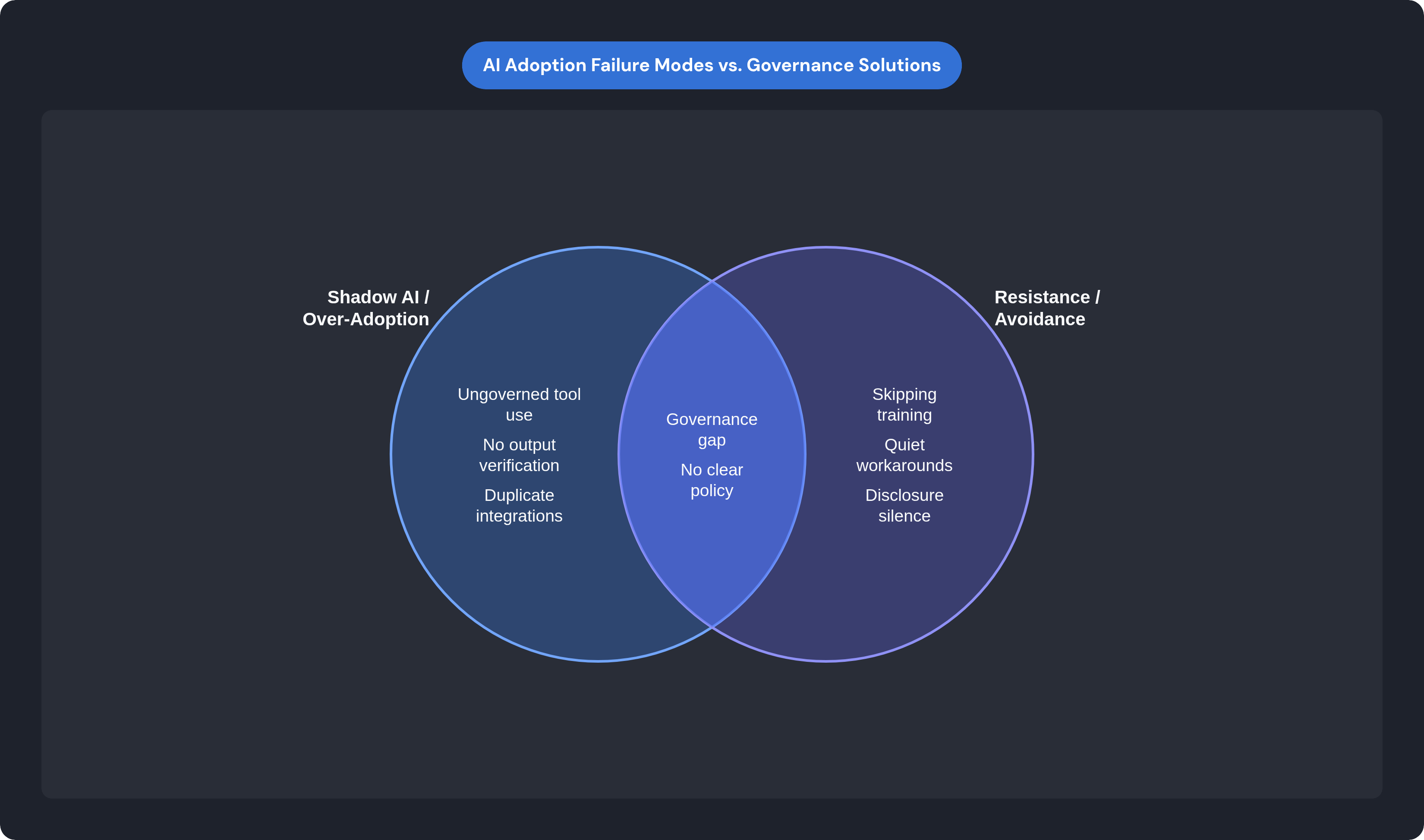
The binary between "AI resistance" and "AI adoption" is a fiction that lets organizations feel better than they should. KPMG's 2025 Global AI Study found that roughly half of the U.S. workforce reported using AI tools at work without knowing whether it was permitted, and more than four in ten reported knowingly using AI improperly. More than half admitted to relying on AI to complete work without properly evaluating the outputs.
So two failure modes coexist inside the same building. On one side, employees who distrust AI and avoid it. On the other, employees running AI constantly, outside any governance framework, without verification habits. Both are symptoms of the same condition: no clear, trusted structure for how AI should be used. The governing document doesn't exist, or it exists but nobody has read it, or it has been read but doesn't address the situations people actually encounter on a Tuesday afternoon.
What shadow adoption produces downstream is the kind of problem organizations discover too late to manage cleanly. Tools accessing systems they weren't provisioned for create data exposure. Agent actions that aren't logged create compliance liability. Teams building their own integrations independently create duplicate infrastructure and wildly inconsistent tooling. These aren't edge-case risks; they're predictable consequences of a governance gap that the organization left open during deployment and then forgot about.
Why Leaders Are the Real Bottleneck, Not the Workforce
McKinsey's 2025 research pointed directly at leadership as the primary constraint on AI scaling. Employees, in aggregate, are ready. Leaders are not steering fast enough. But it's worth being specific about what "not steering fast enough" actually looks like, because it rarely presents as inaction.
It looks like announcing a new AI tool without redesigning the workflow around it. It looks like layering AI onto a process that was built for a different rhythm, a different information structure, a different set of assumptions, and then waiting for output quality to improve. PwC's 2025 research identified piecemeal adoption as the biggest structural barrier to realizing productivity gains: overlaying AI on existing processes rather than rebuilding around them. MIT's manufacturing research on AI adoption frequently documents an initial productivity drop, a paradox that follows directly from that misalignment. The payoff materializes when adoption deepens; employees with substantial direct AI experience report average productivity improvements around 35%, concentrated on higher-value work. But the path from rollout to that outcome requires deliberate design, not just a deployment.
There is also the guidance vacuum. Microsoft's 2025 Work Trend Index documented a clear and widespread gap around performance evaluation: employees genuinely do not know how AI use affects how they are assessed. In that vacuum, the safest move is either to avoid the tool entirely or to use it quietly and say nothing. The Edelman Trust Barometer 2025 confirmed that institutional trust remains volatile, and that employees carry explicit expectations of transparency and accountability around emerging technologies. When that transparency is absent, suspicion is not irrational; it is the appropriate default.
The fix is structural, not motivational: clear policies, defined permissions, and visible oversight, all of it designed before the tools are announced.
What Actually Builds Trust: Participation, Transparency, and Clear Permissions
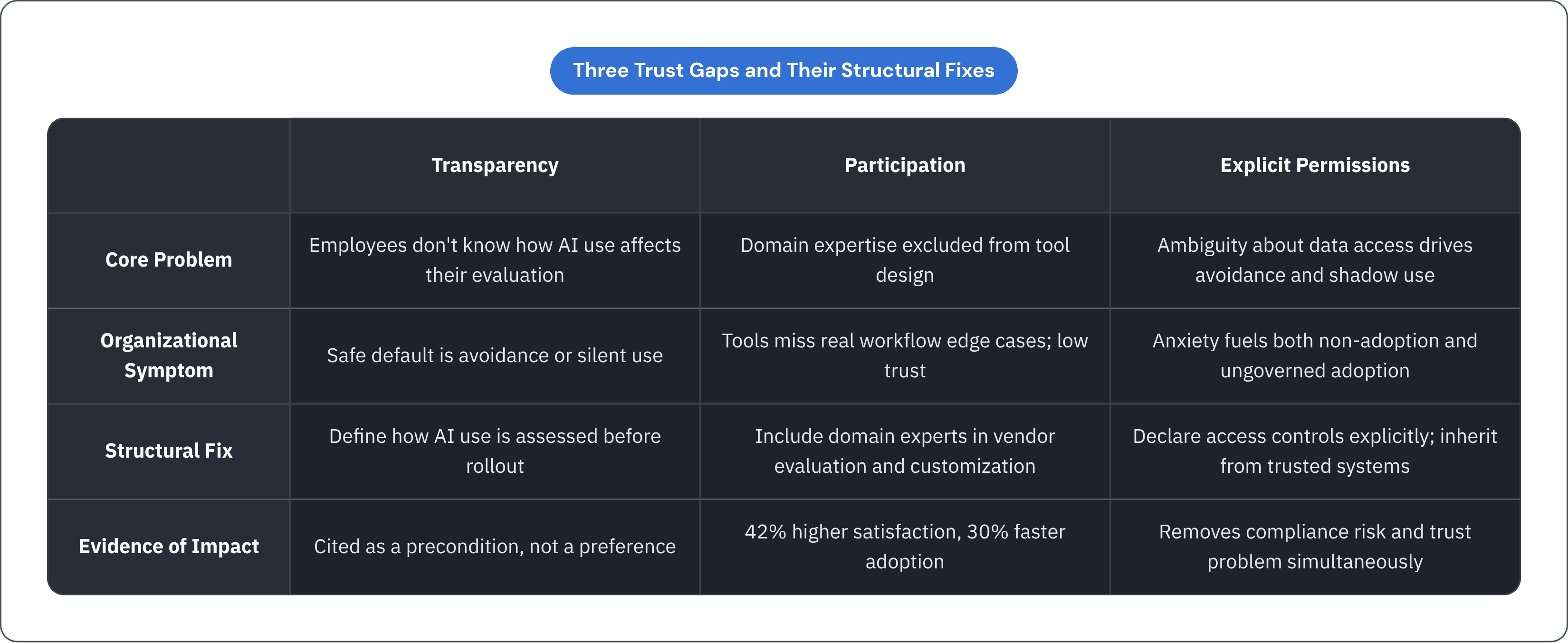
Three things reliably close the trust gap. None of them are complicated. All of them require actual organizational design, which is why so few organizations do them well.
Transparency is the baseline. Employees need to understand how AI tools function in their specific role and how their use of those tools is evaluated. Microsoft's 2025 Work Trend Index documented that expectation clearly; it isn't a preference, it's a precondition. Organizations that haven't met it haven't earned engagement; they've mandated compliance, which produces a different and far less durable outcome.
Participation is underrated and underused. KPMG's 2025 Global Study found that organizations that included employees in vendor evaluation and system customization reported 42% higher satisfaction rates and 30% faster adoption timelines. Domain experts carry the business context that determines whether an AI tool is actually useful: the edge cases, the workflow quirks, the data relationships that don't appear in any architecture diagram. Involving those people in shaping tools makes the tools more accurate and converts employees from subjects of a technology decision into stakeholders in something they helped build.
Explicit permissions matter more than most organizations realize. Employees need to know what the AI can see on their behalf, what it cannot see, and what it can take action on. Ambiguity around data access is a direct source of the anxiety that drives both avoidance and shadow adoption. When access controls are explicit and inherited from systems employees already trust, that ambiguity is removed. Knowing that AI actions are logged and reviewable changes the psychological calculus: there is a trace, a record, accountability running in both directions.
The Integration Fragmentation That Silently Undermines Governed AI Rollouts
There is a technical substrate to the governance deficit that rarely gets discussed directly, which is unfortunate because it explains most of why governed intent fails to produce governed reality.
Before any shared standards existed for connecting AI to enterprise systems, every integration was custom. An AI tool connecting to a CRM required its own integration. A ticketing system required another. A knowledge base required another. Five AI tools across three enterprise systems meant fifteen integrations to build, maintain, and secure independently. BCG has characterized the complexity growth in agentic environments as essentially quadratic: as AI agents multiply, the integration surface expands faster than any team can reasonably track.
What this produces in practice is a distributed, invisible infrastructure. Each team holds separate credentials in its own configuration. There is no shared inventory of which tools connect to which data under what permissions. There is no audit trail that spans the full surface. IT loses visibility through attrition rather than any single decision. Teams spin up their own servers because they cannot find out what already exists. Shadow AI infrastructure does not emerge from malice; it emerges from the absence of any shared layer to discover and reuse what others have already built.
This is the architectural root of the governance deficit. The same fragmentation that makes governance practically impossible also makes duplicate work inevitable.
How MCP Changes the Integration Math, and What That Means for Governance
Anthropic released the Model Context Protocol as an open standard in November 2024. The premise is direct: rather than building a custom integration for every AI-to-system connection, an organization builds one MCP server per data source, and any MCP-compatible AI client connects to it through the same protocol. Without a standard, integration complexity grows quadratically as agents multiply. With MCP, it grows linearly.
Forrester's 2025 research found that teams shifting from point-to-point API connections to MCP-based architectures reduced integration costs by 60 to 70%. The more significant implication is structural. A single, standardized layer through which all AI-to-system interactions pass is also a single layer where governance can be applied consistently. Permissions can be defined once at the MCP layer and inherited across tools, rather than redefined for each integration by each team. Every action is loggable at the protocol level, not selectively, not per configuration choice, but by default.
MCP's trajectory as infrastructure matters. Anthropic donated it to the Linux Foundation's Agentic AI Foundation in late 2025, with backing from AWS, Google, Microsoft, OpenAI, Bloomberg, and Cloudflare. OpenAI adopted MCP across its platform in early 2025; Google and Microsoft followed within months. Server downloads grew from roughly 100,000 in November 2024 to over 8 million by April 2025. This is not a bet on one company's roadmap. It is becoming the common layer, and that distinction has real consequences for how organizations should be planning now.
What Permission Inheritance and Access Control Look Like in an MCP Architecture
One of the most practically useful things MCP enables is granular, inherited access control. Not all AI access should be equal, and a well-implemented MCP architecture enforces that at the tool level rather than leaving it to individual team judgment.
Read actions and write actions are separated. Retrieving customer data, pulling transcripts, reading tickets: read operations. Updating account details, issuing refunds, changing record status: write operations with downstream consequences that may be difficult or impossible to reverse. In an MCP implementation, you can enable database reads while blocking writes, allow message retrieval while preventing sends, and configure those controls once at the server level rather than reproducing the decision for every tool and every team.
Critically, permissions are inherited from source systems. When someone queries an agent, the response draws only from data that person is already authorized to see in the underlying system. This closes a gap that caused significant trust problems in earlier AI deployments, where tools surfaced data employees did not have the organizational right to access. Explicit inheritance removes both the compliance risk and the trust problem in the same move.
Authentication architecture is where a lot of organizations cut corners and pay for it later. The recommended default for remote MCP servers is OAuth 2.1 with short-lived, scoped access tokens. Shared credentials across multiple MCP servers create what practitioners call a blast radius problem: one compromised credential exposes everything it touches. The November 2025 MCP specification added enterprise identity provider policy controls for OAuth flows, allowing users to authenticate once and access every authorized server without repeated prompts.
There is a gap worth naming directly. MCP adoption has outpaced MCP governance. Independent security scans of public MCP servers have found that exploitable vulnerabilities are common and that OAuth adoption as a default remains low. A critical vulnerability in Anthropic's own MCP Inspector, disclosed in 2025, exposed a browser-based path to remote code execution. Research published around the same period documented prompt injection and tool poisoning as vectors for data exfiltration through connected integrations. The architecture enables good governance; it does not produce it automatically.
The Registry as the Missing Piece Between Governed Intent and Governed Reality
A governed MCP architecture without a central registry is an intention, not a system. The registry is what makes the architecture function as a control plane rather than a collection of independently managed servers that nobody has a complete picture of.
Without it, teams wire their own MCP servers, integrations go undocumented, and IT has no reliable inventory of which agents connect to which data under what permissions. Audit logs exist at the individual server level but cannot be assessed meaningfully in aggregate because there is no map of what they are supposed to cover. You cannot govern a surface you cannot see.
A governed registry functions as the control plane for all AI assets: MCP servers, agents, skills, and custom integrations. AWS's open source documentation has described this architecture in reasonable detail. Central IT maintains a list of approved MCP servers and skills for the organization. Each line of business publishes its own assets to the registry, scoped to its team and, where appropriate, discoverable to the wider organization. Every agent connection is tracked: which agent, which server, what permissions, who owns the connection. The approval workflow for an MCP connection request mirrors an IAM role grant or service account provisioning request, the same rigor, the same approval trail, the same accountability.
The registry also dissolves the duplicate-work problem that fragmented integration creates. A skill built once by one team becomes discoverable and reusable by another team, rather than rebuilt independently by someone who had no way of knowing it already existed. Version control and per-agent identity are not optional at scale; they are what make audit logs actionable, allowing you to trace which agent acted, under which permissions, and which human approved the configuration.
How Department-Level Ownership Fits Inside a Governed Architecture
Central IT cannot own the business logic of AI deployment, and attempting to do so produces tools that are technically sound and operationally useless. A revenue operations team understands deal data nuances that don't appear in any system diagram. An engineering team understands code context at a level of granularity that general AI configurations miss entirely. A support team knows escalation logic, exception handling, and the specific edge cases that determine whether an AI action helps a customer or creates a new problem. Build without that context and you get lower-quality outputs and lower trust from the people whose daily work depends on getting it right.
The answer is scoped autonomy within governed infrastructure. Domain experts build and own the skills and context for their domain. Those skills are published to the registry: versioned, scoped, and auditable. Other teams can discover and reuse them without rebuilding from scratch. The unit of autonomy is the department-scoped MCP server, exposing only the tools and data relevant to that team's workflows, operating within the permission boundaries the registry enforces.
This is not decentralization in the chaotic sense. It is structured distribution. The infrastructure is governed centrally; the expertise is distributed to where it actually lives. The result is AI tooling that reflects real workflow context, access controls that reflect real organizational roles, and an audit trail that reflects real accountability. That combination is what closes the gap between AI investment and AI productivity, and it closes it at the architectural level, not through better communication, not through more training, not through a cultural initiative with a name and a logo.