SOC 2 Audit Requirements for Enterprise AI Agent Deployments
Enterprises now demand SOC 2 compliance before deploying AI agents into production.
A vendor without a current SOC 2 Type II report doesn't get a discovery call, let alone a contract. That marks a real shift in how procurement and security teams treat this category of software, with SOC 2 as the primary instrument of that gatekeeping. Three items must be in place before any deployment can start: a signed Data Processing Agreement, proof of SOC 2 certification, and audit logs detailed enough to survive internal or regulatory review. Missing any one of the three stalls the conversation before it starts.
This isn't uniform pressure across every industry, but it's close. Technology and SaaS companies face the steepest requirements, and financial services, healthcare technology, professional services, and e-commerce aren't far behind. Each of those sectors already carries its own layer of regulatory scrutiny, so an AI agent that touches customer records, financial transactions, or health data walks straight into whatever compliance regime already governs that data, with SOC 2 sitting underneath it as the baseline expectation.
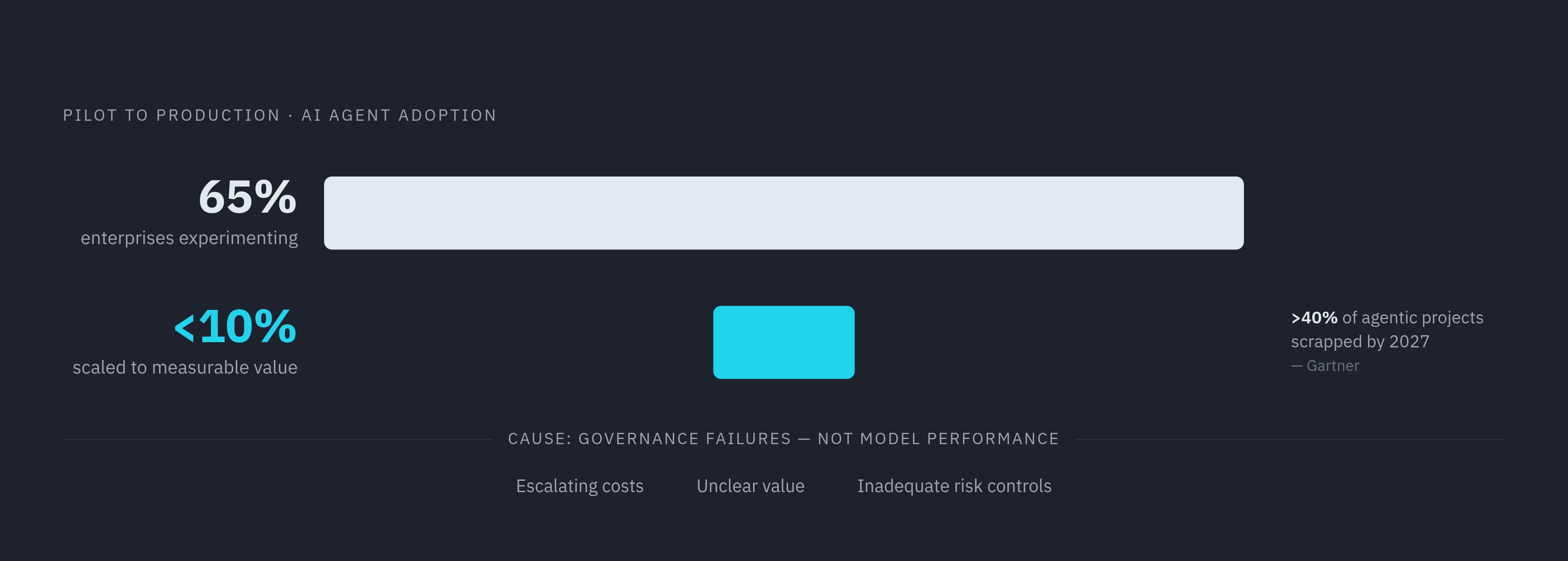
The stakes go beyond any single procurement cycle. Gartner projects that more than 40% of agentic AI projects will be scrapped by the end of 2027, and the causes are escalating costs, unclear business value, and inadequate risk controls, not weak model performance. Gartner's finding is striking because it shows the technology works well enough in most pilots, but the surrounding infrastructure, the governance, the logging, the access controls, doesn't hold up under the scrutiny that production deployment demands. McKinsey research points the same direction. Close to two-thirds of enterprises have experimented with AI agents, yet fewer than one in ten have scaled them into anything that delivers measurable value, and the barrier is poor data quality and governance rather than model performance.
Those two data points together show a clear pattern. Companies aren't struggling to build agents that work; they're struggling to build agents that can prove they work safely, consistently, and accountably, over the kind of extended timeframe an auditor actually checks. That proof runs through SOC 2, but not the version of SOC 2 built for static software with human operators clicking buttons. It has to be rebuilt around how agents actually behave, and that rebuild is what the rest of this piece works through.
The five Trust Services Criteria for autonomous agents
SOC 2 wasn't built with autonomous software in mind. It assumes static systems, human-mediated decisions, and controls that get documented once and stay valid until someone deliberately changes them. AI agents break three of those assumptions at the same time, so the criteria don't fail, they just don't transfer automatically. They have to be re-engineered, criterion by criterion, for how agents actually operate.
Start with the assumption that controls tested at a point in time stay effective until someone changes them on purpose. Controls can be documented and tested at a point in time and remain effective until intentionally changed, but AI agents produce non-deterministic outputs and can drift over time as they process new data. Add to that the assumption that humans make access decisions. When an agent makes its own access decisions, it can combine permissions in combinations nobody provisioned for, and standard role-based access control has no way to inspect or catch that in real time.
Teleport's analysis maps the breakdown to each of the five Trust Services Criteria. Security controls are built to govern who can deploy code, but an agent that writes and executes its own code at runtime sidesteps that model, since there's no human authorization step for each run. Confidentiality is squeezed by a tension unique to AI pipelines: logs must capture enough context and metadata to reconstruct an agent's intent for an auditor, yet risk leaking sensitive content if nobody scopes them carefully. Privacy runs into a lineage problem. If a company can't trace where personal data moved across training, fine-tuning, inference, and logging, it has no way to demonstrate compliant handling or disposal, and Teleport frames this as a structural block, not a documentation gap.
None of this means the control requirements themselves are unclear. Teleport's read is that defining the right controls isn't the hard part anymore; proving those controls operate correctly at the pace and frequency AI pipelines and ephemeral infrastructure run at is the real difficulty. An agent can execute thousands of actions in an hour. Traditional audit evidence, built around quarterly reviews and change tickets, was never built to keep pace with that volume.
The agentic failure modes that SOC 2 auditors are now scrutinizing
Three specific failure modes didn't exist in traditional SaaS audits at all, and now they sit at the center of every SOC 2 conversation about AI agents: prompt injection, unauthorized runtime code execution, and inherited permission sprawl. Each demands controls that go past the standard SOC 2 playbook, and each maps to a specific control area an auditor will name directly.
Prompt injection starts with something mundane: agents read emails, scrape web pages, and pull in external data as part of routine work. That exposure means adversarial content can redirect an agent's behavior in ways no access-control framework anticipated, because the attack doesn't come through a login screen, it comes through the content the agent was told to process. Auditors treat the resulting unintended actions as a serious accountability gap. SOC 2 expects every privileged action to trace back to an accountable individual, not to an autonomous agent acting under a generic system account. The relevant control area is logical access, CC6, alongside role-based permissions, also under CC6. Standard RBAC wasn't built to inspect agent behavior or apply context-aware policy in real time, so that's precisely where audits are finding gaps.
Runtime code execution raises a different problem. AI coding agents generate and commit code on their own, and they leave secrets embedded in that code more often than human developers do, all without a human approving each individual run. The fix isn't a policy memo, it's infrastructure: secret scanning has to run on every agent-generated pull request before merge, enforced through pre-receive hooks or required status checks in GitHub, GitLab, or Bitbucket. Isolation matters just as much. MicroVM sandboxing, meaning hardware virtualization with a dedicated kernel per agent workload rather than shared container isolation, is the baseline auditors and practitioners point to for containing what a compromised or misconfigured agent can reach. Agent PRs must pass the same policy gates as human PRs, owner review, coverage thresholds, lint, SAST, and secret detection, with no pilot exemptions and every override tied to a named role and logged, Northflank reports.
Permission sprawl is the quiet failure mode that compounds over time. As an agent processes new data across weeks and months, it can assemble permission combinations nobody anticipated when it was first provisioned. That's model drift acting as a permission risk, and it means the change management controls under CC8, built for human-authored systems, have to stretch to cover shifts in model behavior itself. The starting fix is identity: every agent session needs to map to a named human, and that means SAML SSO and SCIM provisioning configured before anything else gets built on top. Without that mapping, access reviews and offboarding simply don't function, because there's no person to review or offboard.
MCP architecture and the new compliance perimeter most SOC 2 programs have not drawn
Three hard blockers appear before any enterprise AI agent deployment can proceed: a signed Data Processing Agreement (DPA), evidence of SOC 2 certification, and granular audit logs, the Twin.so analysis found. An AI host talks to a server, and that server translates protocol requests into native calls against whatever business system sits behind it, so the client-server relationship keeps the AI layer separate from the infrastructure underneath. What MCP doesn't do is enforce security. The specification standardizes how a model discovers and calls tools, but authentication, authorization, and transport security are left entirely to whoever builds the host, the client, and the server. That gap is why most SOC 2 programs haven't drawn a boundary around MCP at all: the protocol was never designed to draw one for them.
Security researchers call this the shadow MCP server problem. Before any governance layer exists, organizations accumulate MCP servers across teams, each running its own credentials, none built on least-privilege authorization, none connected to existing identity systems. Clutch Security data cited in current research found 3,056 ungoverned MCP deployments running simultaneously inside a single large enterprise, and not one of them fell inside existing SOC 2 controls. Every one of those servers is a hole in the audit trail: no way to tie its actions back to a named identity, no central log, no mechanism for a security team to apply policy after the fact.
MCP has become the de facto standard for connecting AI agents to enterprise systems, but the protocol deliberately leaves authentication, authorization, and transport security to implementers, so MCP deployments create a compliance perimeter that most existing SOC 2 programs have not scoped. It looks contained because it sits behind the AI layer, but an auditor who finds an ungoverned MCP server has found a system with zero enforced access control and zero audit trail, connected directly to core business data.
The July 2026 MCP specification update addresses part of this. The protocol core became stateless, removing session management from individual server instances and making horizontal scaling cleaner, while the Enterprise-Managed Authorization extension adds centralized control over MCP server access through an organization's identity provider, a real fix for a real gap in MCP governance. But EMA gives an organization the tool to enforce policy; it doesn't enforce that policy automatically. A company still has to build the governance layer, register its servers, and route every connection through identity controls. Without that follow-through, the specification update closes a technical hole while the organizational hole stays wide open. The NSA's guidance on MCP security pushes the same point from a different angle, calling for full observability across every MCP environment, with every tool and model invocation logged, including exact parameters, the identities involved, and cryptographic hashes of results wherever feasible.
Audit-ready logging for agents operating across connected systems
Audit-ready logging is a set of structural choices made before an agent ever touches a production system, and the standard has gotten considerably more specific than "keep a log.
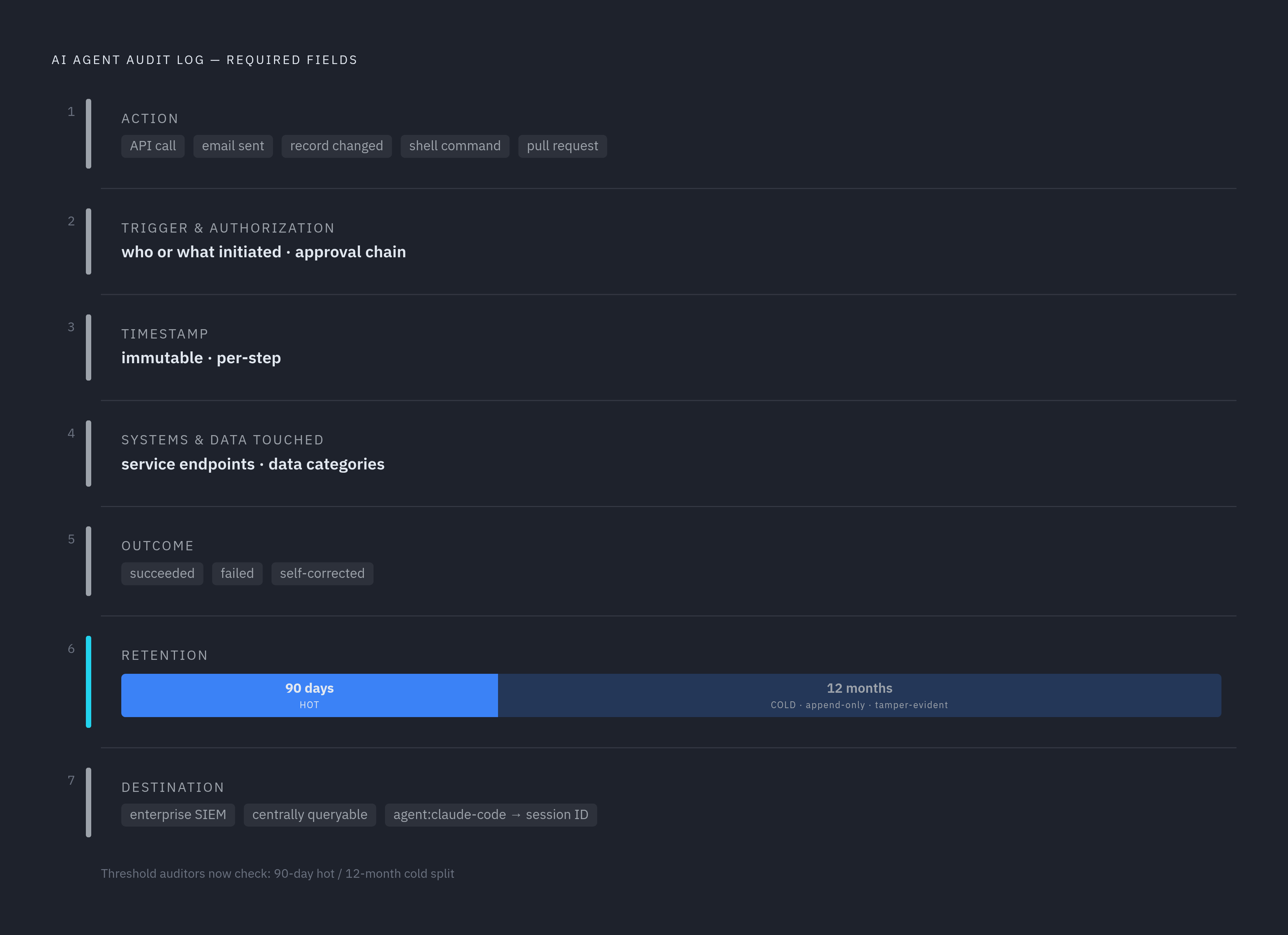
Twin.so's analysis lays out what a production-ready audit log for an AI agent platform has to capture. Every action the agent took needs a record: API calls, emails read or sent, records created or changed, web sessions opened, shell commands run, pull requests created. The log needs the trigger and the authorization behind each action, meaning who or what started the run and what permissions applied at that moment. It needs precise, immutable timestamps sequencing every step, a record of which systems and data categories the agent touched, and the outcome, whether the action succeeded, failed outright, or self-corrected mid-run.
None of that matters if it only exists as a snapshot. SOC 2 Type II auditors require proof that controls operated consistently across the full audit period, not proof that they existed on the day of the audit. A log pulled together the week before the auditor arrives doesn't satisfy that standard, no matter how complete it looks. The NSA's May 2026 guidance reinforces the same expectation from the security side: logs need exact parameters, the identities involved, and cryptographic hashes of results where that's feasible, because those records become the forensic backbone if a breach or anomaly ever needs to be traced.
Retention has a specific number attached to it now. SOC 2 auditors expect prompt and response logs kept 90 days in hot storage and 12 months in cold storage, held in tamper-evident systems such as append-only object storage with object lock, the working standard auditors check against.
Logs also need to land somewhere a human can actually query them. Agent activity, every file access, shell command, pull request, and API call, should flow into the enterprise SIEM and stay centrally searchable. Agent-generated pull requests should carry the tool name and session ID, something like agent:claude-code, so a security analyst can pivot from a suspicious PR straight to the session that produced it. Ownership has to be unambiguous, too. If a log shows only a tool name or a shared service account rather than a specific identity, an auditor has grounds to question who actually approved the action.
Logs need enough context and metadata to reconstruct intent for an auditor, but they can't leak sensitive content in the process, a tension that has to get solved at the schema level, before the audit period even starts, not patched in afterward. Regulated industries stack even more on top of the SOC 2 baseline: SOX and FINRA for financial services, HIPAA for healthcare, and GDPR supervisory authority review all treat audit logs as non-negotiable, full stop.
The governance architecture that makes agent deployments auditable at scale: registry, gateway, and inherited permissions
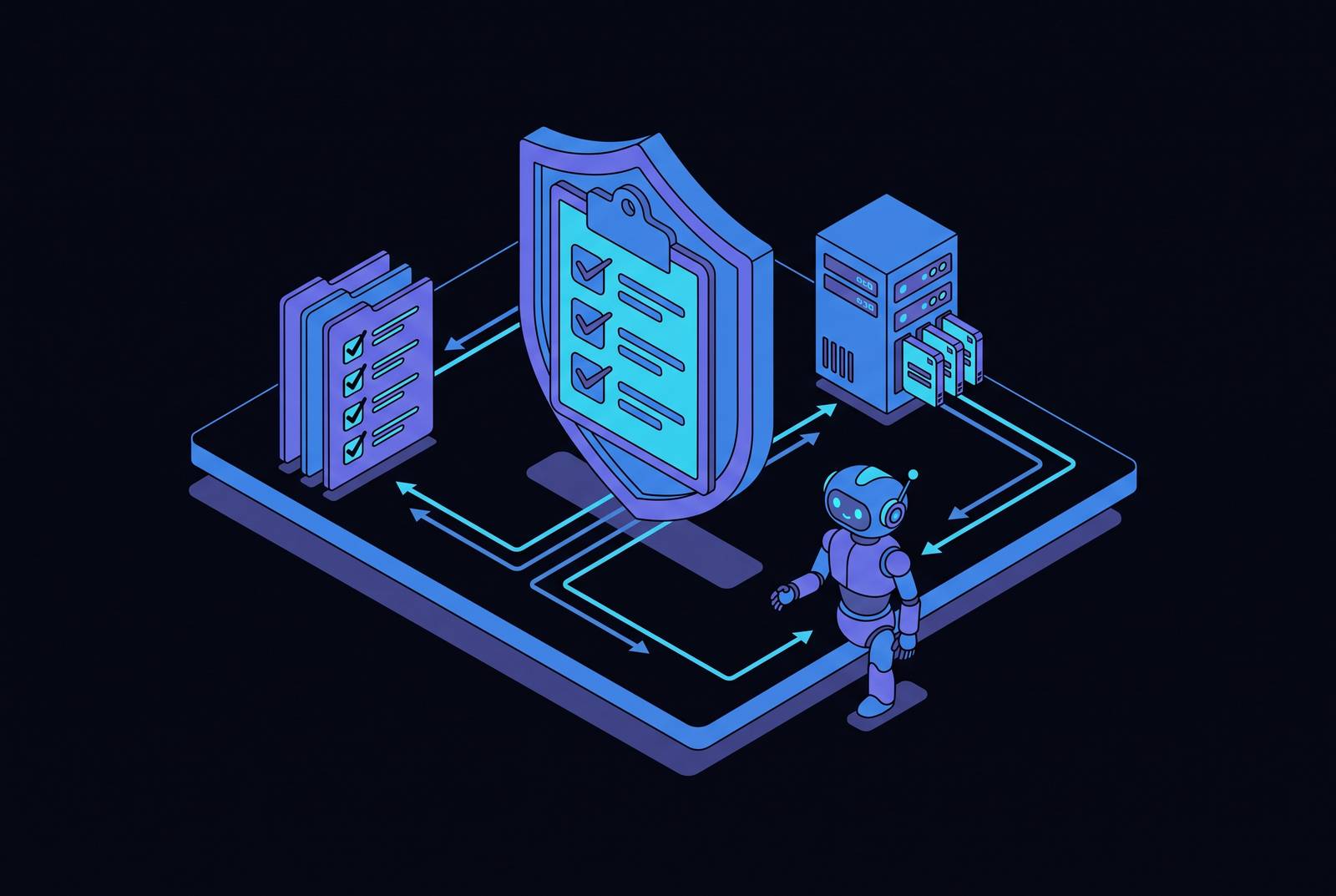
Everything described above, the logging discipline, the identity mapping, the MCP server governance, only holds together at scale if it's built as infrastructure rather than policy, which is how enterprises achieve audit-ready AI agent deployments at scale. A central registry does, because it becomes the only sanctioned path a new server can take into production.
That registry has to sit behind a gateway that every agent request passes through, checking identity, scope, and permission before a call reaches a business system, rather than trusting each individual server to enforce its own rules. Permissions need to inherit automatically from an organization's existing identity provider instead of getting provisioned by hand for each new agent or connector; manual provisioning is how a company ends up with thousands of ungoverned deployments and no way to reconstruct who has access to what.
None of this is a one-time build. Agents change behavior as they process new data, MCP servers multiply as teams find new use cases, and the registry, gateway, and inherited-permission model have to absorb that growth without losing the ability to answer a simple question for any given moment: which agent, acting under which identity, touched which system, and did anyone approve it. That question is what a SOC 2 auditor is going to ask. Companies that can answer it cleanly are the ones whose agent deployments survive the audit and reach production on schedule.