Departmental AI Rollout Sequencing for Maximum ROI
Deploy AI first where governance exists and reuse spreads.
Most organizations only count one type of value from an AI deployment, and it is the wrong one to optimize for first.
Terminal value is the obvious kind: time saved, errors caught, costs avoided within a single team. Real, worth having, completely contained. When that team's scope shifts or the deployment winds down, the value stops traveling.
Structural value is different. It is the governed context, the reusable agent skills, the permission architecture that every subsequent deployment inherits without rebuilding. When team B walks into an environment where team A already established data connections, access controls, and audit logging, the organizational cost per deployment drops. One prompt engineering investment serves five teams. One permission model covers eight data sources.
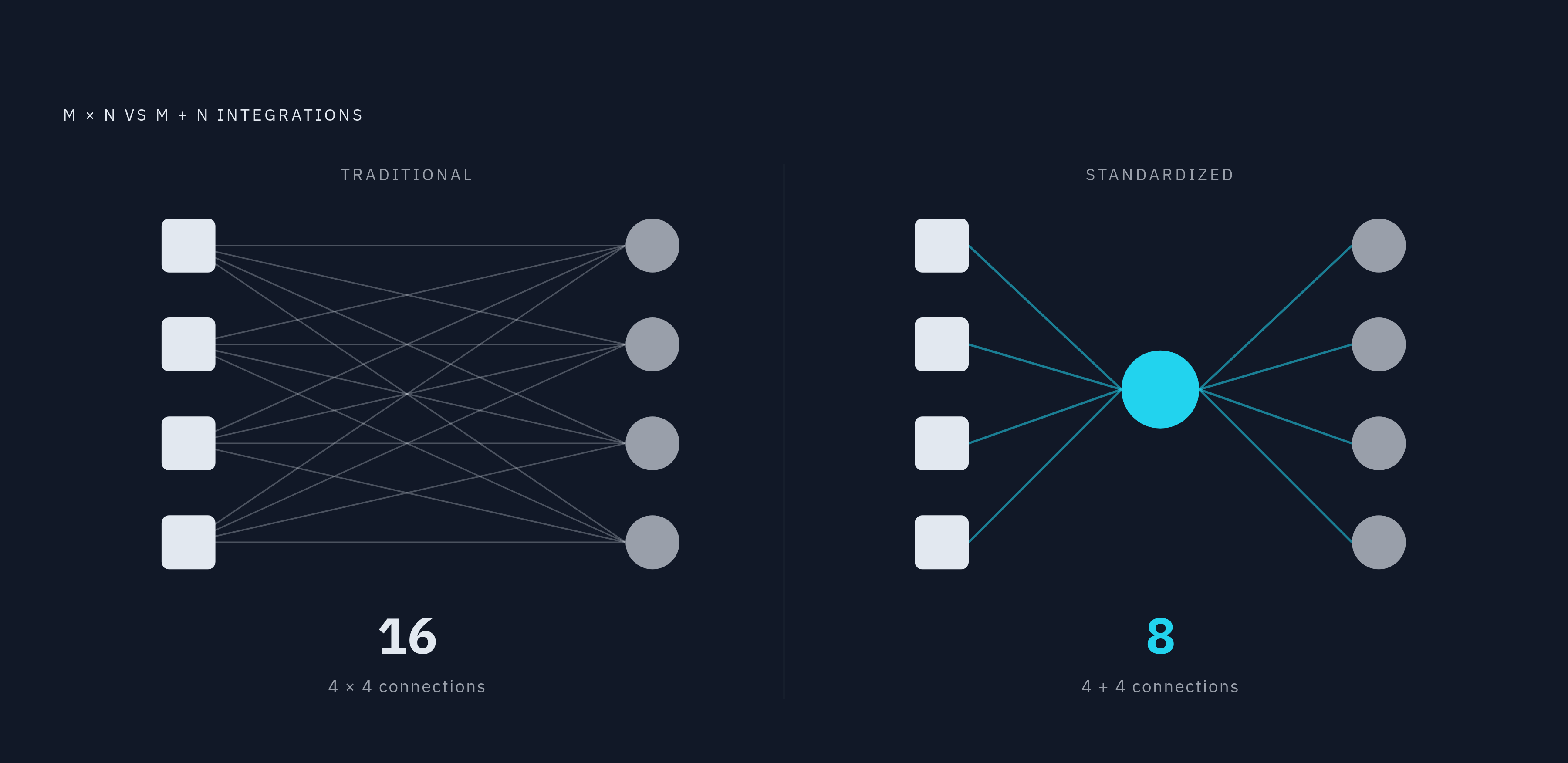
BCG's analysis of modern integration protocols illustrates how this plays out at the infrastructure level. The traditional approach to connecting AI applications to business systems scales as M times N custom integrations: every new tool multiplied against every existing data source. A standardized approach scales as M plus N. That arithmetic difference is not a marginal efficiency gain — it is like the difference between paving a new road for every driver versus building a highway everyone shares. It describes a fundamentally different architecture, and it is what separates rollouts that compound from rollouts that just accumulate cost.
Organizations that skip this logic usually do so because they defaulted to whoever had the loudest internal sponsor or the most obvious automation target. The result is the same: isolated wins, no shared foundation, and six months later someone is asking why the second department's deployment cost as much and took as long as the first. The compounding never happened because structural value was never the goal.
PwC's 2026 AI Agent Survey found that less than 20% of enterprises have mature governance frameworks in place, even though 78% have already deployed AI in at least one function. That gap reflects what happens when sequencing logic is never applied.
The Two Axes That Should Actually Determine Sequencing Order: Governance Readiness and Reuse Surface
Map every potential early deployment against two dimensions and the political arguments about who goes first largely dissolve. The decisions become defensible because they are structural.
Governance Readiness
Does a department already operate with conditions that make a safe, auditable AI deployment possible? Does it work with structured data? Are access roles documented, or do they live in someone's head? Are approval workflows formalized, or do decisions happen through Slack threads and hallway conversations? Can the team articulate what a correct output looks like and, more importantly, which outputs require a human to review before any action is taken?
Departments with existing controls are faster to deploy safely, and they generate the audit evidence that later teams will need. Retrofitting compliance after a deployment goes live costs significantly more than building it correctly from the start. The governance work does not disappear when you skip it; it just gets done under pressure, after something has already gone wrong, by people who are simultaneously trying to contain the damage.
Reuse Surface
How many other departments consume or produce the same data, workflows, or context this team works with? Finance touches every department's numbers. IT touches every system. A deployment in either function produces integrations, permission models, and agent skills that transfer directly to whoever comes next.
A deployment in a narrow, specialized function will produce excellent terminal value and almost no structural value. That is a reason to deploy it later, once the shared foundation exists and it does not have to build its own infrastructure from scratch, not a reason to never deploy there at all.
The Priority Map
Plotting departments on both axes produces a sequencing priority, not a ranked ROI list. High governance readiness combined with high reuse surface: deploy first, build the foundation. High ROI potential combined with low governance readiness: deploy after the infrastructure exists to contain it. Low reuse surface and low governance readiness: deprioritize, regardless of how compelling the automation target looks in a business case.
Three diagnostic questions pressure-test any department's placement. Which workflows can show measurable gains within one quarter? Which data sources can an AI layer reach without requiring unsafe copy-and-paste workarounds? Which approval and audit rules must be in place before usage grows? If a team cannot answer all three with specificity, it does not belong in wave one.
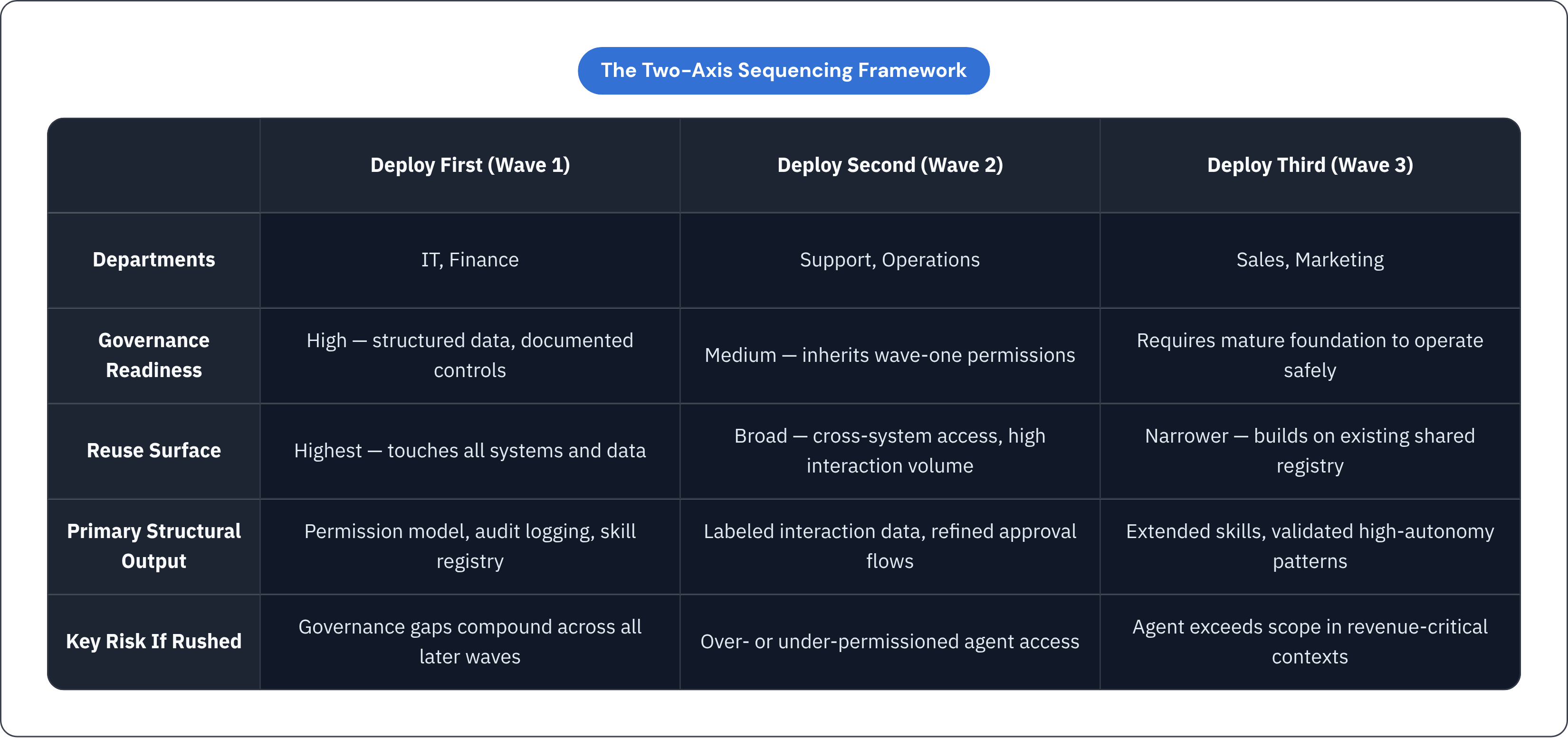
Why IT and Finance Earn the First Position in Most Enterprise Sequences
IT as the Structural Anchor
IT has the most advanced generative AI initiatives among large enterprises, per Deloitte's 2025 global survey. That reflects years of tooling investment, but more relevantly it reflects internal fluency with access controls, identity management, and system integration. These are peripheral considerations in isolation; they are the load-bearing infrastructure every other department will depend on.
An IT-first deployment establishes identity integration, role-based scoping, and audit logging before any domain team ever touches an agent. It builds the MCP server infrastructure and SSO integration that make subsequent deployments faster and safer. Engineering use cases, including IDE integrations, code review automation, and internal documentation generation, produce reusable context about internal systems that surfaces later across product, support, and operations.
The byproduct of building tools for engineers is institutional knowledge, structured and accessible, that compounds across every team that follows. You are not just deploying AI for IT. You are building the nervous system the rest of the organization runs on.
Finance as the Governance Template
Finance operates with the most structured data, the strictest approval hierarchies, and the clearest definitions of correct output of any department in the enterprise. That is not accidental; it is the product of regulatory obligations and financial controls that predate AI by decades.
Finance and accounting use cases report cost savings in the range of 26 to 31%, so the terminal ROI is real. But the structural argument is more consequential. A finance deployment forces the organization to build audit trails, human-in-the-loop approval flows, and access scoping — not because those things are philosophically appealing but because finance will not function without them. Those governance artifacts become reusable primitives for every deployment that follows.
Finance's data access requirements are also complex enough to genuinely stress-test permission inheritance before higher-risk or more ambiguous deployments come online. That stress-testing is not incidental; it is the point. You want to find the gaps in your governance architecture when the stakes are regulatory, rather than when an agent has just drafted an unauthorized customer communication. Think of it as finding the leaky pipe before you turn on the water main — not after the basement is flooded.
What Deploying IT and Finance First Actually Produces
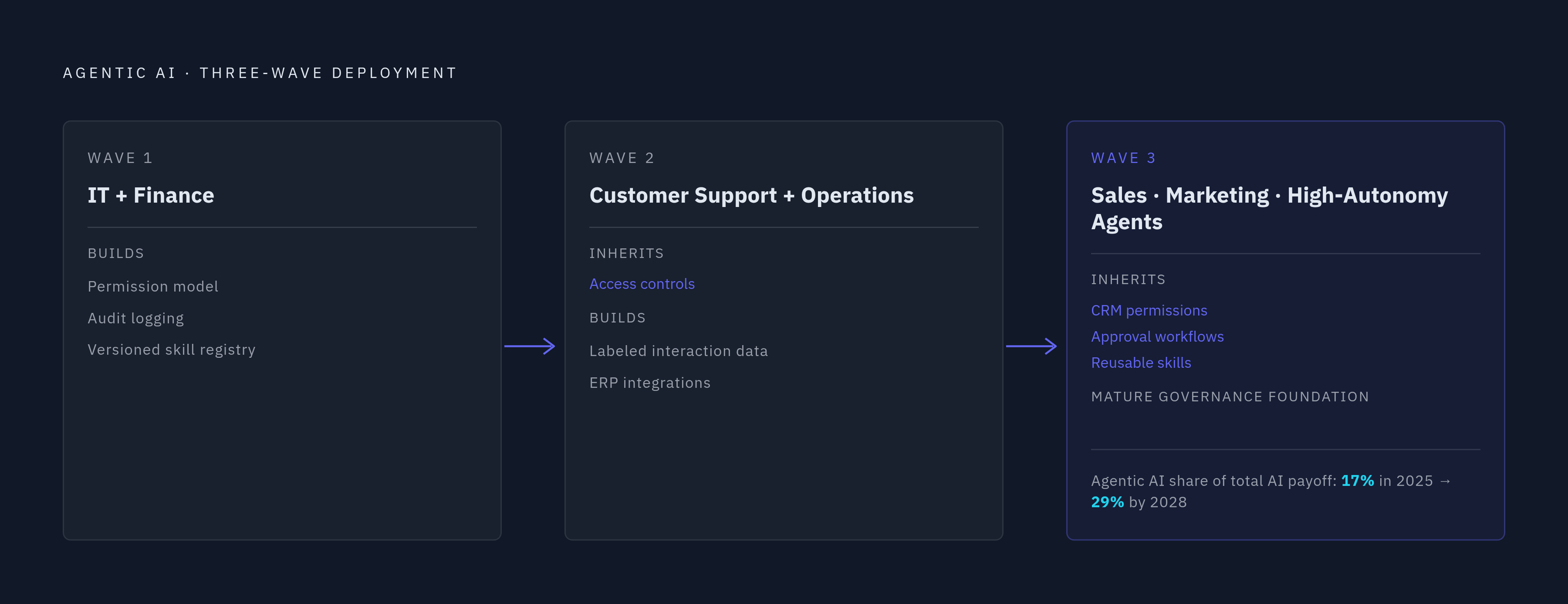
By the end of wave one, the organization has three things it lacked before: a permission model other departments inherit rather than rebuild; operational audit evidence that will matter for SOC 2 and other compliance frameworks, collected before scale makes evidence gathering prohibitively expensive; and a working agent registry with versioned, governed skills that teams in waves two and three can extend rather than reconstruct from scratch.
That is the infrastructure wave two runs on. Without it, wave two is just another set of isolated deployments, equally expensive, equally disconnected, and equally unlikely to compound into anything.
How Customer Support and Operations Fit Into the Second Wave
Why Support Comes After the Foundation Is Set
Support agents touch customer data, ticketing systems, product documentation, and billing records simultaneously. That cross-system access profile requires the permission model IT built in wave one. Without inherited access controls, support AI deployments face a choice that is unpleasant in either direction: over-permission the agent and create a security risk, or under-connect it and produce a capability limitation that makes the deployment feel like a failure. Neither outcome is the technology's fault.
With inherited access controls, support deployments can be scoped precisely, connected to the right systems, and governed from the first day. What support contributes back to the shared registry is also substantial. High-volume, labeled interaction data refines context for later sales and marketing deployments. Skills for ticket classification, knowledge retrieval, and escalation routing can be reused directly by RevOps and customer success teams. Real-world edge cases from support workflows also sharpen the human-in-the-loop approval rules before agents begin operating in revenue-critical contexts where the cost of an error is considerably higher.
Operations as a Natural Mid-Sequence Candidate
Operations is the second most advanced generative AI function after IT, per Deloitte's 2025 data. Supply chain and procurement workflows are measurable enough to validate ROI and structured enough to build governance on top of. Operations reports cost savings in a similar range to finance, making the terminal value real while the structural contribution runs in parallel.
Operations integrations, including ERP systems, procurement platforms, and inventory management, expand the data layer available to finance agents built in wave one. The cross-functional context deepens in both directions, enriching what subsequent agents can access while also making existing wave-one deployments more capable. This is the compounding effect becoming visible in practice rather than just in an architecture diagram.
By the end of wave two, the shared registry has governed skills across IT, finance, support, and operations. The declining cost of each new team's onboarding is measurable. The compounding is no longer a promise.
When to Bring In Sales, Marketing, and Higher-Autonomy Agents
Why High-Autonomy, Customer-Facing Deployments Belong in Wave Three
Sales and marketing agents operate on customer data, external communications, and revenue-critical decisions. That is the highest-consequence action space in the enterprise, and it requires a mature governance foundation before any agent touches it.
PwC's 2026 AI Agent Survey found that 53% of organizations have already experienced AI agents exceeding their intended permissions, and 47% have faced a security incident involving an AI agent in the past twelve months. Those numbers represent the cost of moving autonomy ahead of governance. They are not edge cases. They are the predictable result of deploying agentic systems before the infrastructure exists to constrain them. In other words, skipping governance is a bit like giving someone the keys to a car before teaching them to drive — the accident was always part of the plan.
Deploying sales AI on top of a mature permission model and a tested human-approval workflow is a fundamentally different risk profile than deploying it into a system that has never had to govern agent behavior before. Same technology, radically different exposure.
What Wave-Three Deployments Inherit
CRM and customer data access are already scoped and permissioned from support deployments in wave two. Human-in-the-loop approval patterns have been validated on lower-stakes workflows first; the approval choreography is familiar and the edge cases have been worked through. Agent skills for knowledge retrieval and document generation can be extended rather than rebuilt.
Wave three is not starting from zero. It is the logical culmination of the structural work that preceded it, which is what makes it possible to deploy higher-autonomy agents with confidence rather than the ambient anxiety that characterizes most enterprise AI rollouts.
Why Sequencing Is Non-Negotiable for Agentic AI
Agentic AI accounted for 17% of total AI payoff in 2025 and is projected to reach nearly 29% by 2028. Gartner projects that 40% of enterprise applications will be integrated with task-specific AI agents by the end of 2026, up from less than 5% today. The governance question cannot be tabled until the technology matures further. The technology is already here.
Agents that write, delete, pay, or communicate externally require the full governance stack before they touch production systems: audit logging, role-scoped permissions, version-controlled skills. For enterprises operating under the EU AI Act's Annex III classifications, including recruiting decisions and credit assessment, the sequencing argument is simultaneously strategic and legal. Sequence high-risk deployments after the governance infrastructure is mature and compliance becomes a natural outcome. Sequence them before and compliance becomes an emergency retrofit, expensive, disruptive, and occasionally impossible to complete without rolling back work already done.
What the Governance Infrastructure Between Waves Actually Has to Include
Permissions Inheritance as the Load-Bearing Requirement
Every new deployment should inherit access controls from the source systems it connects to, rather than redefine them. Manually redefining permissions for each new tool or agent is the precise mechanism by which 53% of agents end up exceeding their intended scope. It is not a failure of intent; it is a failure of architecture.
Modern authorization extensions, OAuth client credential flows for machine-to-machine interactions and enterprise identity provider policy controls, make permissions inheritance technically tractable at scale. Users authenticate once and access every authorized server without repeated authorization prompts. The permission model travels with the agent rather than being reconstructed at each new integration point. This is the technical implementation of the M plus N architecture, unglamorous to build and essentially invisible when it works correctly, which is exactly what you want from infrastructure.
Audit Logging as Continuous Evidence, Not a Compliance Event
SOC 2 Type II auditors require months of operational evidence. That logging must begin with the first deployment; it cannot be added retroactively when an audit is imminent. Every tool call, its inputs, and its outcome should be logged from day one, both for security incident response and for regulatory obligations under GDPR, CCPA, and the EU AI Act.
Organizations that treat audit logging as something you set up before the auditor arrives are the ones scrambling to reconstruct evidence they never collected. The goal is for compliance to be unremarkable, a natural byproduct of how the system has always operated, rather than a periodic crisis.
A Versioned Skill Registry as the Reuse Mechanism
Without a skill registry, reuse in practice means shared drives and Slack messages. No version history, no rollback, no governance, no reliable way to know which version of a skill any given team is actually running. Skills captured in a governed registry with version control, ownership, and access scoping can be discovered and extended by any team, eliminating the situation where five departments rebuild the same prompt independently, each spending real time and budget to produce something that already exists elsewhere in the organization.
The registry also enforces a division of ownership that matters at scale. Domain experts own the skills and context relevant to their function. Central IT owns the infrastructure those skills run on. That separation keeps the system from becoming a bottleneck without leaving individual teams to manage underlying infrastructure they have no business managing.
Human-in-the-Loop Approval on Consequential Actions
Writes, deletions, payments, and external communications should route through confirmation workflows before executing. This is not a UX friction question or a philosophical stance on human oversight. It is the structural boundary that separates auditable AI from unauditable AI. An agent that can send a customer email without a human checkpoint is a categorically different risk than one that queues the email for review. That distinction must be built into the architecture from wave one and inherited by every subsequent wave, rather than bolted on after an incident makes it urgent.
How to Measure Whether the Sequence Is Working Before You Reach the Later Waves
S&P Global's 2025 analysis found that only a small fraction of companies actually measure the impact of their AI initiatives. Most organizations have no empirical basis for knowing whether their sequence is working, which is precisely how pilot purgatory perpetuates itself. Measurement is not an audit function; it is how you know whether the strategy is producing the structure you intended.
What to Measure in Wave One
Four metrics determine whether IT and finance laid the right foundation. Permission model coverage: what percentage of downstream data sources have inherited access controls versus manually redefined ones. Audit log completeness: is every agent action logged with inputs, outputs, and actor identity from day one. Skill registry adoption: are skills being published and reused, or is each team still building independently.
And then there is the signal that gets overlooked, because it requires patience to observe: time to deploy wave-two teams. If the foundation was built correctly, subsequent department rollouts should be measurably faster than the first wave. If they are not, the foundation has gaps, and those gaps compound into problems at a rate that becomes increasingly difficult to address the longer they go unexamined.
What to Measure Across Waves
Three cross-wave metrics reveal whether compounding is actually occurring. Reuse rate: what fraction of skills deployed by wave-two and wave-three teams were inherited from earlier waves versus built net-new. Incident rate: permission violations and security incidents per deployment should fall as governance infrastructure matures, rather than remain flat or rise. Cost per deployment: if compounding is working, the marginal cost of each new department's rollout declines. If cost stays constant or climbs, the organization is deploying in sequence and calling it a strategy, which is a different thing entirely.
The ROI Signal That Validates the Whole Sequence
AI produces bottom-line impact when it is embedded in redesigned processes, not when it is layered on top of existing ones as a supplementary tool. Measurement should track process-level outcomes: throughput, error rate, cycle time, cycle cost. Usage metrics, including sessions, queries, and active users, tell you adoption. They do not tell you value, and conflating the two is responsible for a lot of optimistic dashboards attached to stalled programs.
The enterprises that reach production scale and report genuine return on investment are tracking the process, not the tool. The ones still in pilot purgatory are the ones that never built the structural foundation to get there. Sequencing is how you get there; measurement is how you know you are on the right path before the evidence becomes undeniable in either direction.