Measuring AI Technical Debt Accumulation Across Decentralized Enterprise Deployments
Measuring AI technical debt across decentralized enterprise deployments means tracking what it costs when teams build on their own, as well as the costs of aging code or model drift. Fragmented governance, duplicated workflows, and inconsistent permissions make debt compound. The framework must track those structural costs together to show when a team can fix the debt on its own and when the deployment model itself must change.
Why AI technical debt accumulates differently than software technical debt
Conventional software debt could remain a background cost for years. Slow releases, higher maintenance budgets, and lingering security gaps, each on its own, did not force executives to act. AI agents make that debt visible in multi-step autonomous workflows because those workflows depend on the systems beneath them. Aging code, undocumented systems, and siloed data become hard stops when a workflow needs clean, accessible, well-governed data.
That creates a different problem from simply having more software to maintain. Older reporting systems could tolerate underlying disorder while summarizing historical data on a schedule. An autonomous workflow exposes that disorder as an immediate operational failure. Meanwhile, rushed AI deployments add debt through systems that cost more to maintain, are hard to scale, and break easily outside a controlled pilot. Debt management therefore has to account for both the weaknesses AI inherits and the new ones its deployment creates.
How decentralized deployment turns a manageable debt problem into a compounding one
Ensono Chief Technology Officer Tim Beerman identifies “decentralized AI adoption” as a common pitfall. Departments independently deploy generative AI tools to solve similar problems, creating overlapping capabilities and conflicting outputs. Each tool has its own way of using data, its own limits, and its own security posture. The resulting liabilities accumulate in parallel, so the enterprise inherits more than the sum of individual shortcuts.
Duplication makes that compounding visible. A prompt, workflow, or integration rebuilt by five teams carries five times the maintenance burden, inconsistency risk, and permission surface to govern. Each team may see a tool that meets its needs, while the organization pays again and again for the same capability. Tool sprawl exposes the pattern through the number of active tools, their actual usage, and their connection to strategic goals.
Yet the governance needed to trace those costs is often missing from the deployments themselves. Without it, leaders cannot clearly see what returns AI spending brings or where debt is building before it harms production. Decentralization is the primary debt accumulator.
The four structural costs that a measurement framework must track
Duplicated workflow cost measures how many teams have independently built equivalent prompts, integrations, or agent workflows. Conventional IT accounting can treat every version as a legitimate asset without exposing the redundancy. The burden then scales with team count. Money goes toward rebuilding and maintaining existing capability.
Permission inconsistency cost tracks how many access-control definitions there are for the same data source. When an AI tool does not inherit source-system permissions, its team has to keep a separate local definition up to date. That definition can drift from the source of truth over time. Different deployments then reach the same sensitive data under different effective permissions, making fragmentation a security problem as well as a maintenance problem.
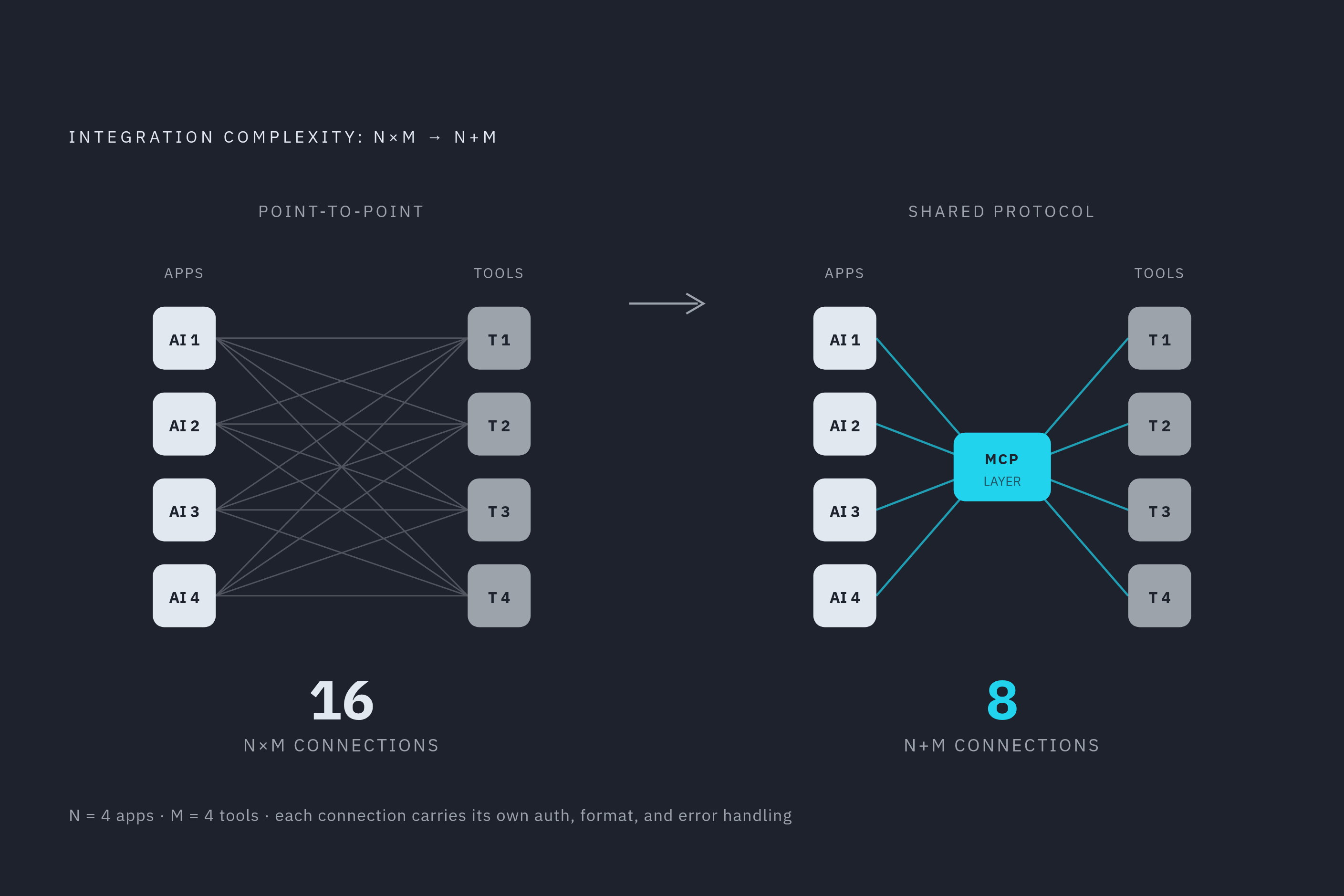
Integration fragility cost measures the point-to-point connections between AI applications and tools or data sources. In the N×M problem, N AI applications and M tools require N×M custom integrations, each with its own authentication, data format, and error handling. Those connections break easily, cost a lot to maintain, and are hard to audit in the same way. Phantom dependencies, which are AI-fabricated connections between systems that do not actually exist, belong here because they create maintenance work before anyone recognizes the fiction.
Governance opacity cost measures the fraction of agent actions that are auditable, including who approved them, when, and under what policy. It is the cost that hides the others, because duplication, permission drift, and integration fragility cannot be measured reliably without traceability. All four costs must therefore be tracked together. The EU AI Act reaches its general application date in August 2026, with high-risk AI rules phased in through 2027–2028, making this opacity a compliance liability too.
Why data debt and technical debt require separate measurement signals
Yodaplus distinguishes between technical debt that slows systems down and data debt that breaks outcomes. Data debt is the long-term operational cost of outdated, inconsistent, fragmented, or poorly structured data. It grows when disconnected or unreliable data accumulates faster than the organization improves the systems managing it. The distinction matters because repairing an integration does not repair the information moving through it.
Modern architectures, including data mesh, data fabric, MLOps, and AI orchestration frameworks, assume clean, governed data as a starting condition. When that condition is absent, each layer inherits the underlying fragility. The manufacturing pattern is concrete. Manufacturing execution systems and enterprise asset management platforms over a decade old cannot produce the clean, integrated data AI requires, so projects built on them underdeliver regardless of model capability. In that pattern, the model is not the problem.
Independent deployments multiply exposure to this weakness. Each department connects AI to its own data sources under its own governance, so data debt spreads across the organization and stays hard to see in one place. Integration counts and tool inventories can reveal structural sprawl while missing the data-quality problems undermining outputs. The framework therefore needs a separate signal for data readiness and governance maturity in each deployment. Otherwise, a technical repair can leave the outcome just as unreliable as before.
What a rigorous measurement framework looks like in practice
The framework starts by treating decentralization itself as the independent variable. First, audit the deployment surface by team and function, recording which AI tools are active, which are actually used, and which support strategic goals with traceable value. Unused tools still carry licensing and maintenance overhead, so they belong in the debt picture. This inventory establishes where independent adoption has outrun governance before the measurement moves inside individual deployments.
Next, map integration topology by finding data sources that teams reach through separate integrations and flagging connections whose authentication, data-format specifications, or error handling have not been documented. MCP, the Model Context Protocol open-sourced by Anthropic, has a shared protocol layer that cuts the integration structure from N×M to N+M. The July 2026 MCP spec release moved the protocol core to a stateless architecture over Streamable HTTP, making remote MCP servers as auditable as other API workloads.
Permission measurement then needs a time-series. Record how each deployment received access at launch and compare it with the source system’s current controls. Track credential sprawl across individual laptops, shared configuration files, CI variables, and agent runtimes as a proxy for permission debt. Enterprise-Managed Authorization, now stable as an MCP extension, enables centrally provisioned MCP server access through an identity provider, reducing drift by replacing local access definitions with inherited permissions.
Steering committees need a regular cadence for auditing the tool portfolio and validating recommendations, with emerging technologies evaluated against the current stack on a 12-to-18-month forward cycle. Those reviews depend on evidence that survives changes in tools and teams. Auditability must therefore be a prerequisite for production, with every agent action traceable to its approval, policy, and time.
Why governance infrastructure — not governance policy — is what makes the measurement framework hold
A written policy passes the same rules to every department, but each department still has to implement them. Under independent deployment, that produces local interpretations of identity, access, approvals, and logging. The framework then depends on teams maintaining comparable evidence while their systems change separately. Its measurements decay with the fragmentation they are meant to expose.
An MCP gateway changes where those controls operate. Sitting between AI clients and MCP servers, it provides a single control plane for identity, authorization, secrets, policy, approvals, and audit. Team-based provisioning makes that concrete. An administrator can give Sales CRM read/write and Slack tools, Engineering GitHub, Jira, and CI tools, and Finance accounting read tools. Developers then find available servers through an internal portal, which frees them from managing raw server access themselves.
A registry makes that governed discovery durable, but it must be more than a shared directory. An enterprise MCP registry adds access control, dev, staging, and production support, policy-based visibility, allowlisting, and audit trails that public and community registries lack. Azure API Center provides one enterprise path through a centralized MCP server registry whose endpoint can be configured in Visual Studio Code, GitHub Copilot, or other tools. Every change to a skill, workflow, or agent configuration must also be versioned in the registry. Without that history, the framework cannot distinguish accumulated debt from a deliberate architectural change.
How department-specific deployments generate debt differently and why measurement must account for that variation
Salesforce MCP servers, generally available since April 2026 for every Enterprise Edition org and above, provide reads, mutations, deletes, full CRUD, SOQL queries, and search. The debt mechanism is not the range of operations but inconsistent enrichment when teams independently connect AI tools to CRM and enrichment sources. Each connection can use its own normalization logic, so account and contact records can conflict. Measurement must track the separate read/write connections to the same CRM objects and check whether their field-mapping and data-validation rules agree.
Engineering accumulates a different kind of redundancy. Atlassian MCP connects Jira, Confluence, and other Atlassian products to AI clients including Cursor and Claude. When teams add MCP connections without retiring old ones, equivalent tools create redundancy and context-window bloat. AI coding tools also produce duplicated code and phantom dependencies, which measurements designed for sales would miss. The signals to track are how many equivalent operations are registered against the same system in the gateway and the rates of code duplication introduced through AI-assisted generation.
Support shifts the focus from duplication to effective access. Slack’s Real-Time Search API and MCP server are now generally available, and Slack MCP servers honor the underlying user’s permissions. When support engineers connect agents individually, an agent can gain access to the full channel set available to the person connecting it. That inherited access can go beyond what any governance decision has expressly allowed, even though the connection follows the user’s existing permissions. Measurement therefore has to audit all the channels and data each agent can reach as well as the permissions assigned directly to it.
These differences do not call for unrelated departmental scorecards. CRM inconsistency, engineering redundancy, and support permission exposure all arise from independent deployment, but they leave different evidence. A single organization-wide signal would systematically undercount the debt it was not designed to detect.
What the measurement framework reveals about when to remediate versus when to standardize
The framework’s most useful output is a choice. Localized debt, such as one team’s duplicated workflow, one integration’s credential sprawl, or one agent’s undocumented access, can be remediated without restructuring enterprise deployment. When teams working on their own run into the same pattern, they need standardization. That repetition points to the deployment model as the cause, beyond a mistake in how one team built its system.
The financial distinction follows from that diagnosis. Cleaning up repeated failures without changing their structural cause puts the organization on a cycle of recurring remediation. Standardization prevents each new deployment from recreating the same liability. Human checkpoints remain necessary on both paths because automated analysis of code, integrations, and usage still needs regular audits and validation of its recommendations.
That work becomes more urgent as agents embed themselves in workflows that are hard to unwind. Debt measurement looks ahead by mapping how agents interact and securing endpoints before workflows come to depend on them. A governed skill registry allows workflows to be captured once, versioned, scoped by team, and discoverable across the organization. This is governed centralization of reusable capability. The shared infrastructure must travel with the organization regardless of which AI surface a team uses.