Total Cost of Ownership for In-House vs. Platform AI Deployments
Most AI deployments cost far more than organizations budget for.
Organizations budget for what they can see, and AI deployments are mostly underwater. Research commissioned by DataRobot in late 2025 found that the overwhelming majority of organizations deploying generative or agentic AI faced higher-than-expected costs. Not a bad quarter of poorly run projects. The majority. That is not a planning failure you can attribute to unsophisticated buyers; it is a structural problem with how these deployments get scoped and sold.
So what are they failing to count?
Traditional software TCO is manageable. Licenses, implementation, support contracts, internal administration. The categories are stable, most costs are fixed or gently recurring, and the math is not hard. AI breaks that model in at least three places simultaneously: compute costs are variable and can spike without warning, talent is scarce in ways that distort every hiring assumption you bring in from your last technology cycle, and data engineering sits underneath everything and almost never gets priced correctly.
The categories worth mapping are these. Compute, which includes cloud inference and, where relevant, on-premises training and inference hardware. Integration: the engineering work of wiring AI to existing data sources and systems. Data engineering: preparation, cleaning, labeling, versioning, and the ongoing quality maintenance that nobody talks about because it is unglamorous. Talent: hiring, retention, and contractor costs for specialists who are expensive and slow to become productive in a new environment. Governance and compliance: access controls, audit trails, policy enforcement. And ongoing maintenance: model refresh cycles as foundation models continue evolving at a pace that has no real precedent in traditional software.
Data engineering deserves emphasis disproportionate to how often it appears in vendor proposals, which is almost never. Vendors pitch models and platforms. Nobody leads with the months of work required to make your data actually usable. That work accounts for the largest single share of total spend on most enterprise AI deployments, and it is consistently missing from the initial number.
Compute carries a different risk profile than most software costs. A SaaS license is fixed. Inference workloads running on rented GPU instances are not. Usage patterns that are difficult to forecast produce bills that are difficult to absorb, and the variability is manageable only when it is anticipated.
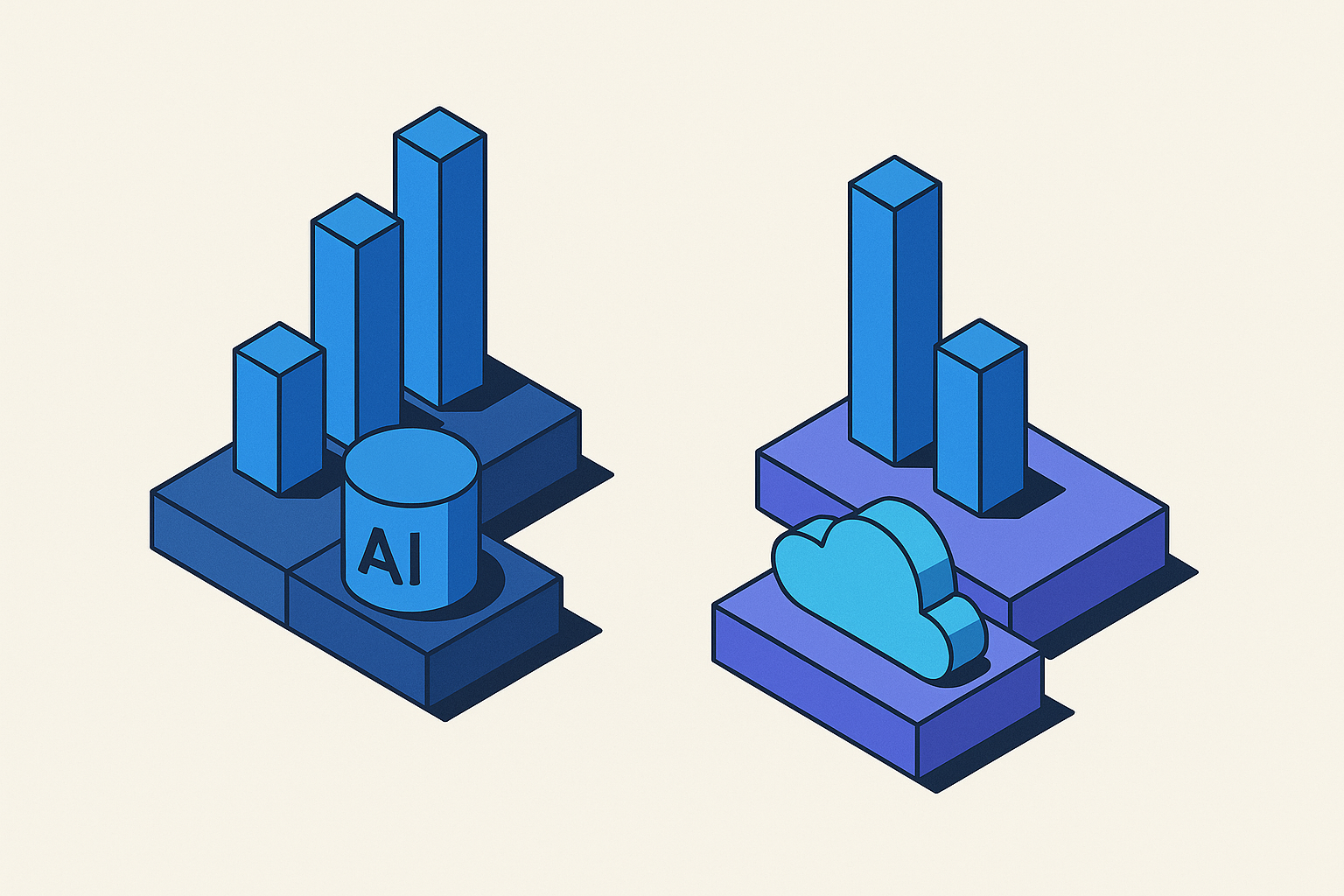
The in-house and platform paths diverge most sharply in how costs are structured across time. Builds are front-loaded; most heavy spending precedes any operational output, and those costs amortize slowly. Platforms have smoother curves but carry different traps that are invisible in year one. Most initial budget conversations are anchored to a twelve-month horizon. The three-year view looks substantially different.
The Hidden Cost Stack Inside an In-House Build
A mid-scale in-house deployment of genuine scope can run to multiples of what a comparable platform engagement costs over three years. This is the pattern that emerges once you account for what rarely appears in initial build estimates.
Talent is the dominant driver, and it compounds in ways that catch organizations off guard. Data scientists, ML engineers, and platform engineers are expensive, slow to hire, and slow to reach productive output in an unfamiliar environment. A realistic team for a meaningful deployment will consume the annual run rate before a single model ships. Unlike a software license, you cannot pause a salary because the project hit a delay.
Integration complexity is where build projects accumulate debt quietly. Custom connectors for every data source, every downstream system, every tool an agent needs to touch. No standardization means each new model or capability triggers another bespoke build. The cost does not scale linearly with the number of integrations; it scales closer to quadratically, because each new connection potentially touches every existing one. I have watched this problem erase the savings that justified the in-house decision in the first place.
Data infrastructure is the work that is invisible until something breaks. Pipelines that need to be built, monitored, and maintained. Labeling workflows. Versioning systems. Quality checks that run continuously, because data quality degrades over time and nobody tells you when it does. Organizations underestimate this cost consistently, partly because it does not feel like AI work even though it is the substrate the model depends on entirely.
For self-hosted deployments, you add hardware, power, cooling, and refresh cycle costs on top of everything else. Renting GPU capacity in the cloud avoids that capital expenditure but introduces billing unpredictability at scale that requires its own operational discipline.
Governance debt is deferred cost, which makes it feel like no cost until it is not. Access controls built ad hoc for a single team rarely survive contact with a multi-team deployment. Retrofitting governance after the fact is expensive, time-consuming, and almost always incomplete, which means compliance exposure arrives alongside the cost overruns rather than separately.
Time is a cost the in-house path imposes that almost never appears in any financial model. A full build cycle commonly exceeds a year before delivering operational output. During that period the organization is paying salaries without capturing returns. That opportunity cost is real even when it is invisible.
The economics do have a genuine bright side. High-utilization workloads can reach infrastructure breakeven in under four months, and per-token costs at scale can reach a significant advantage over cloud API pricing. These numbers hold, but they require sustained, consistent throughput. Most organizations overestimate their utilization at planning time. The in-house path is not wrong; the conditions that make it right are narrower than they appear when the conversation starts.
The Hidden Cost Stack Inside a Platform Deployment
Platform pricing feels predictable in a way that in-house estimates rarely do. That predictability is precisely where the risk hides.
Usage-based pricing means compute and API costs track demand curves that are difficult to forecast. Inference workloads are prone to billing surprises when traffic is bursty, when idle resources are left running, or when a use case scales faster than the model anticipated. The license fee is a fraction of total compute cost, not a proxy for it.
Integration and onboarding costs exist even when a platform abstracts the model, because the platform does not abstract the surrounding plumbing. Connecting to the organization's actual data sources, permissions structures, and operational workflows requires real engineering effort. That effort gets underestimated consistently, because the platform's marketing correctly emphasizes what it handles and implicitly understates what it does not.
Training and change management are costs that rarely receive adequate budget. Licensing a tool that nobody uses effectively still costs the license fee. Getting people to use AI well, reliably, and in ways that produce organizational value is a sustained investment, not a one-time deployment task.
Vendor dependency has a TCO dimension that does not appear on any invoice. Business logic, prompts, and workflows built on a single vendor's abstractions accumulate switching costs over time. If pricing changes, if the model degrades, if the vendor is acquired, those switching costs scale with how deeply the vendor's specific abstractions are embedded. It is a structural feature of platform relationships that compounds silently until a contract renewal makes it visible.
The governance gap is where platform buyers encounter the most pointed surprises. Many platforms do not include granular permissions management, comprehensive audit logging, or cross-team skill governance as native features. Those capabilities must be sourced separately or built on top, adding cost at a point when the organization has already committed.
Specifically: if the platform does not inherit permissions from source systems automatically, someone has to build and maintain a parallel permissions layer. That is not a one-time cost. It scales with the number of teams using the platform and the number of data sources connected to it. Every new team member, every access change, every new source creates maintenance work in two places instead of one. That is not an edge case; it is the default state for most enterprise platform deployments.
Platforms that deliver operational output in weeks rather than a year or more provide a genuine, measurable advantage: returns begin accruing earlier. That advantage is contingent on the platform's scope actually matching the organization's use case, which requires honest evaluation rather than optimistic projection.
How Integration Architecture Determines Which Cost Stack Dominates
If one cost category consistently derails otherwise sound AI investments, it is integration complexity. Projects that assume clean system connections, well-documented APIs, and cooperative data sources regularly encounter a reality that adds a significant multiplier to total cost. It is a structural feature of how enterprise systems are actually built and maintained over time.
The traditional approach to integrating AI agents with tools and data sources produces a point-to-point architecture: one custom connector per model-tool pair. Every new agent requires its own custom connector to every tool it needs; every new tool requires connectors to every agent. The cost does not add; it multiplies. Every new connection is a thread in a knot that only grows tighter.
Model Context Protocol changes this structural problem. A standardized protocol means each new tool or source is connected once and becomes available to any compliant agent. Forrester's 2025 review found integration cost reductions of roughly two-thirds in teams that shifted from point-to-point API connections to MCP-based architectures. That is not a marginal efficiency gain. That is a structural transformation in the cost category most likely to cause an AI project to exceed budget.
The architectural implication applies to both deployment paths. For in-house builds, MCP eliminates the need to rebuild connectors each time a new model or agent is introduced, which directly reduces the integration labor that compounds over time. For platform deployments, MCP determines whether the platform's integrations are portable to other vendors or locked to that vendor's specific ecosystem. That distinction has direct TCO consequences when contracts come up for renewal, and it is almost never discussed during initial procurement.
MCP has moved from a differentiator to a procurement baseline. Major vendors, including OpenAI, Google, and Microsoft, adopted it through 2025, and it is now appearing in enterprise RFP requirements rather than optional feature lists. Organizations evaluating vendors who have not adopted standard integration protocols should price the migration risk explicitly.
A gateway-based MCP implementation creates a single point for access control, credential management, and audit logging: three separate cost categories, each of which would otherwise require its own infrastructure and maintenance overhead, collapsed into one. That consolidation compounds in value as the number of agents and tools scales.
What AI Sprawl Costs Organizations That Skip Centralized Governance Early
A pattern has played out across enterprise AI deployments over the past two years with enough consistency to be instructive rather than anecdotal. Individual teams or developers adopt AI tools, wire up integrations locally, and capture real productivity gains. The gains are genuine. The infrastructure they create is invisible to platform engineering, ungoverned, and accumulating risk that nobody is tracking.
The governance debt from this pattern has four distinct cost dimensions.
Shadow AI infrastructure is the first. Agents connecting to internal systems without oversight create data exposure that nobody can audit. When a compliance or security review eventually happens, and it will, remediation costs orders of magnitude more than proper governance would have.
Duplicated effort is a direct, measurable budget leak. Multiple teams independently building the same prompt, connector, or workflow because there is no shared registry to discover what already exists. Five teams each building the same capability means the organization pays for the same thing five times, with nothing left for genuinely new work.
Fragmented permissions are the third dimension. Access controls defined separately for each tool, not inherited from source systems, fall out of synchronization as people join the organization, leave, or change roles. The result is a permissions state that nobody can fully describe and that nobody fully controls. That is not a theoretical compliance concern; it is a liability.
Configuration drift compounds everything above. Teams managing their own server configurations and credentials spend a meaningful fraction of their operational time on authentication troubleshooting and drift correction rather than building anything. A centralized architecture would have made most of that work unnecessary.
Building governance into AI architecture from the beginning has a cost. Retrofitting it onto a fragmented AI estate after the fact costs substantially more, with compliance implications that no development budget anticipated. This is technical debt with a faster accumulation rate than most software debt, because the underlying models and their capabilities are moving faster than the governance frameworks trying to catch up.
Gartner projects that the majority of software engineering teams building multimodal applications will use AI gateways by 2028. Organizations that defer this investment are not avoiding cost. They are deferring it with interest while simultaneously accumulating the remediation liability that ungoverned growth produces.
The TCO Decision Framework: Matching Deployment Model to Organizational Reality
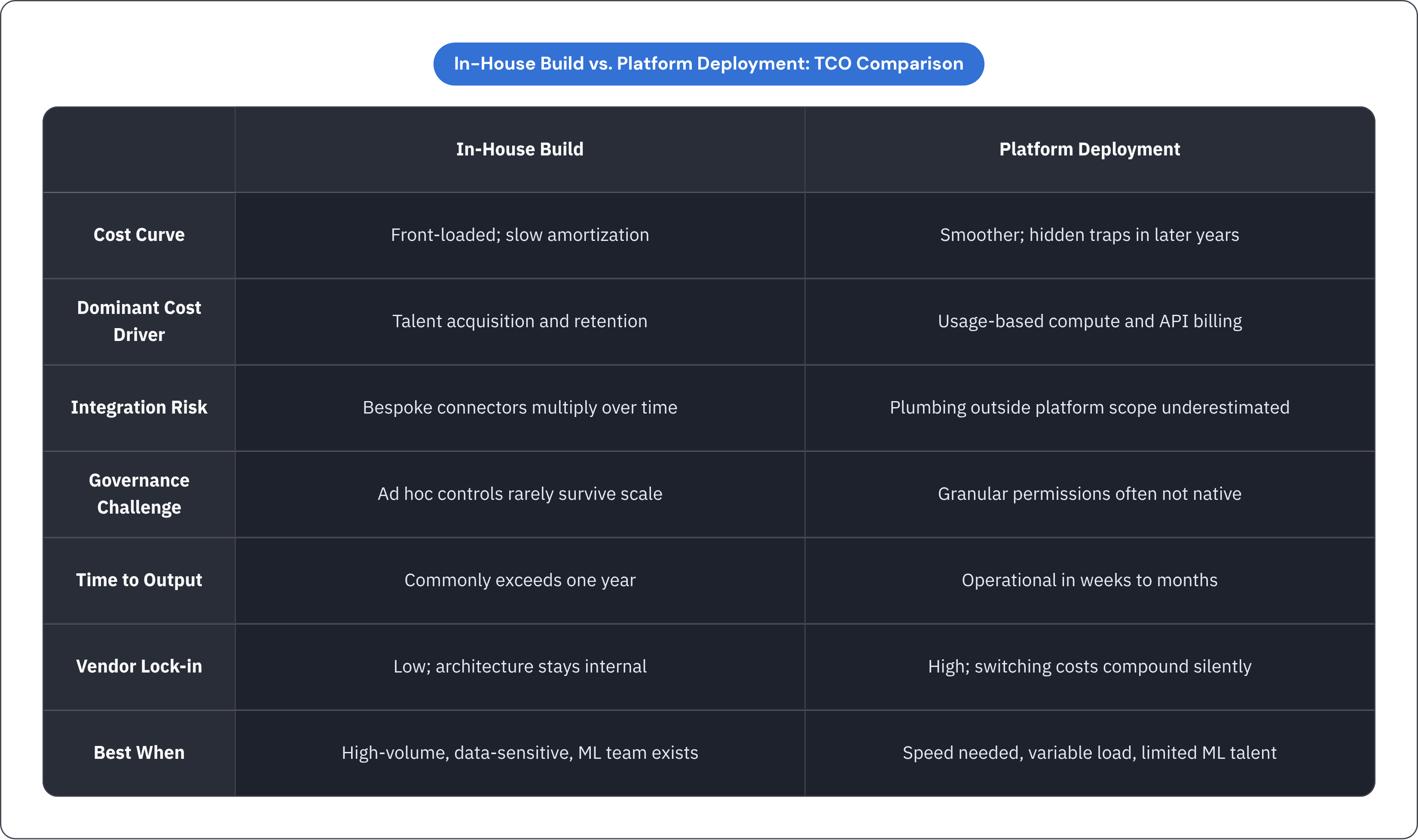
The right answer depends on conditions that vary by organization, and those conditions are empirical.
The conditions that shift the math toward an in-house build are specific and all must actually be true: sustained, high-volume inference workloads where per-token economics at scale outweigh setup costs; data sensitivity requirements that make external APIs untenable for regulatory or contractual reasons; existing in-house ML engineering capability that substantially reduces talent acquisition cost; and planning horizons of three or more years, where front-loaded setup costs have sufficient time to amortize. The on-premises token-cost advantage and infrastructure breakeven only materialize at consistent utilization. Most organizations overestimate that utilization at planning time. Aspirational conditions do not produce actual savings.
The conditions that shift the math toward a platform are equally specific: need for operational output in months rather than a year or more; variable or unpredictable workload patterns where cloud elasticity provides genuine value; limited internal ML talent without a near-term plan to build it; and a requirement to deploy across many teams and surfaces quickly, where a shared governed registry is more valuable than a custom build.
Governance is not a variable in this framework. It is a requirement that applies to both paths, and the only real question is whether it is built in from the start or bolted on later at higher cost. Any deployment that requires the organization to maintain a parallel access control layer, separate from existing systems, adds a recurring operational cost that compounds with team count and data source count. That cost does not appear in any vendor's initial proposal. It appears in the budget.
Model portability is a TCO factor that buyers consistently underweight until a contract renewal forces the issue. Business context, prompts, and workflows built against a single vendor's abstractions accumulate switching costs over time. Architectures that separate context and governance from the underlying model preserve negotiating leverage and keep options open. Salesforce's Headless 360 platform processed more than 4.5 million MCP calls since launch, which illustrates how quickly standardized integration infrastructure accumulates volume once deployed at enterprise scale. The integration architecture decision compounds rapidly, in whichever direction you choose.
Map actual utilization projections, governance requirements, and talent reality before accepting any vendor's TCO framing. The categories that determine the right answer are rarely the ones any vendor leads with. Compute is visible; data engineering is not. License fees are visible; integration architecture is not. Year-one cost is visible; year-three governance debt is not.
The cost will be higher than the estimate. The variable is which costs you failed to count, and whether your organization can absorb them when they surface.