Shadow AI Risk in Large Organizations
Most workers secretly use unapproved AI tools, exposing companies to massive data loss.
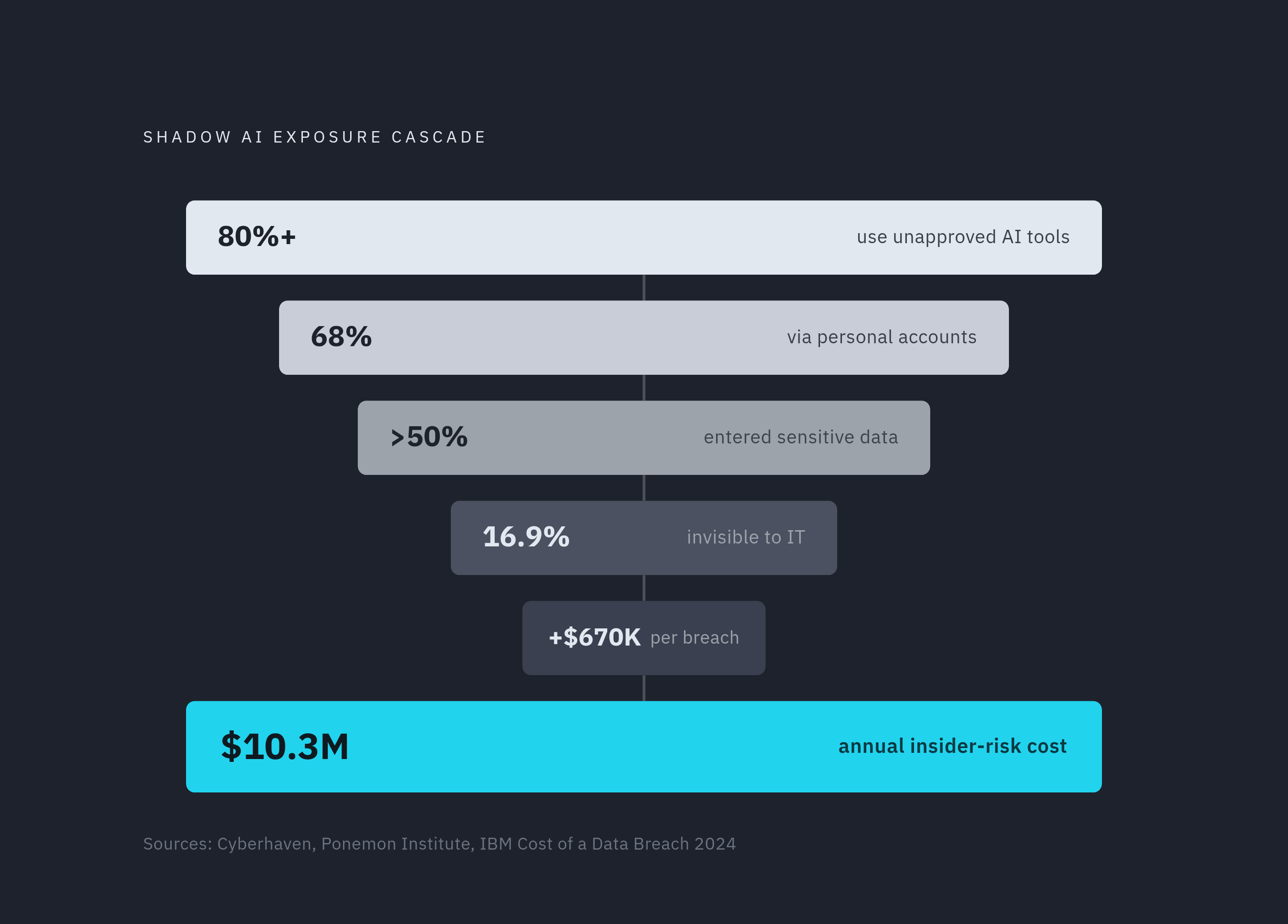
More than 80% of workers use unapproved AI tools, according to UpGuard's State of Shadow AI report. This is not a fringe behavior confined to one rogue department. It is the majority of your workforce, across seniority levels and functions, making a quiet daily decision to reach for something that works rather than something that is approved.
The composition of that usage is what gives the scale its teeth. Sixty-eight percent of enterprise employees who use generative AI do so through personal accounts tied to publicly available tools. More than half have entered sensitive company information into those tools. A separate 2024 survey found 38% of employees admitting they shared sensitive work information with AI without employer permission. These are not outliers. They are colleagues.
Harmonic Security put a number to the exposure: 16.9% of sensitive data incidents, tens of thousands of instances in their dataset, occurred on personal free-tier accounts that are, by definition, invisible to enterprise IT logging. The data is leaving. Most of it leaves no trace in any system the organization controls.
Organizations that have not yet looked assume the problem is smaller than it is. The reality is far worse.
What Organizations Stand to Lose When Shadow AI Goes Unaddressed
Shadow AI adds $670,000 to the average breach cost. Insider risk driven by AI negligence runs $10.3 million annually, per IBM's 2025 data. One in five organizations has already experienced a breach tied directly to unsanctioned AI use. These costs are being absorbed by companies that believed their policies were sufficient.
The breaches themselves skew toward the worst categories: customer PII and intellectual property, the data with the longest legal tail and the most durable reputational damage. When sensitive data exits through a personal AI account, the organization loses control of it entirely, because the terms of service governing that account were written for the individual user, not for the employer who owns the data.
Regulatory exposure compounds the direct cost in ways that unfold slowly and expensively. A single unreported AI-assisted data transfer involving EU customer data can trigger a GDPR investigation that takes years to resolve and carries fines reaching 4% of global revenue. The legal clock starts running long before anyone in compliance knows there is a problem.
There is also a financial opacity issue that rarely makes it into breach cost calculations. A growing share of IT leaders are reporting unexpected charges from consumption-based AI pricing: tools that were free when an employee signed up personally, then became enterprise consumption when usage scaled, all billed outside the procurement process. This is a security concern and a basic financial hygiene issue that most organizations have not gotten around to addressing.
Gartner projects that more than 40% of enterprises will experience a security or compliance incident linked to unauthorized shadow AI by 2030.
Why Prohibition Fails and What the Governance Gap Actually Looks Like
Only 37% of organizations have policies capable of even detecting shadow AI, per IBM's 2025 data. Everyone else is writing rules against behavior they cannot see — which is roughly as effective as posting a "No Fishing" sign at the bottom of an empty lake.
Organizations that have issued outright bans have largely discovered what anyone with time in enterprise technology would expect: nearly half of employees keep using personal AI accounts after a prohibition goes into effect. Workaround usage frequently climbs after a ban, because prohibition removes visibility without touching the underlying need. The employee still has the same deadline. The sanctioned tool is still unavailable or inadequate. The unsanctioned tool still works. The only thing that changed is that the employee now uses it more quietly, which is worse for the organization, not better.
Ninety percent of IT leaders express concern about shadow AI from a privacy and security standpoint, and that concern exists in part because IT has not yet built a governed alternative that is genuinely competitive with what employees are already using. Prohibition is what you reach for when you have not solved the underlying product problem.
Most employees know, at some level, that running company data through a personal account is unsanctioned. They do it anyway because the calculus is immediate: the unsanctioned tool is here, it connects to the systems they actually work in, and it does not require a three-week approval cycle. The sanctioned alternative, when it exists at all, is scoped too narrowly, too slow to provision, or cut off from the real workflows. That is a usability failure, not a compliance failure, and it requires a usability answer.
Governance infrastructure has to compete on convenience, or it will keep losing to tools that cost nothing and require no approval.
How Model Context Protocol Creates a Standard Layer for Governed AI Access
Model Context Protocol, MCP, is an open standard introduced by Anthropic in November 2024 that standardizes how AI systems connect to external tools, data sources, and business systems.
The problem it addresses has a technical name: the N×M integration tax. Connecting M AI applications to N business systems the traditional way requires roughly M×N custom integrations, each built separately, each a point of failure, each a reason integration projects stall before reaching production. MCP collapses that to M+N: one standard interface per system, one standard protocol per AI client.
MIT research found that roughly 95% of enterprise generative AI pilots in 2025 delivered no measurable ROI, with integration failures as the primary cause. The model worked. The interface did not. MCP directly addresses that failure mode.
The USB-C analogy gets used often in MCP discussions because it captures something true: one standard port replacing a drawer full of proprietary cables is valuable precisely because it is boring and consistent. The value is not in the connector. It is in the ecosystem that forms around a reliable standard, where anything that speaks the protocol can connect to anything else that speaks it.
Architecturally, MCP has three moving parts. MCP clients live inside AI applications. MCP servers expose tools (executable actions), resources (accessible data), and prompts (reusable templates). The protocol handles communication between them, so the AI application needs no proprietary knowledge of the system it is connecting to, and the business system does not need to be rebuilt for each new AI tool that comes along.
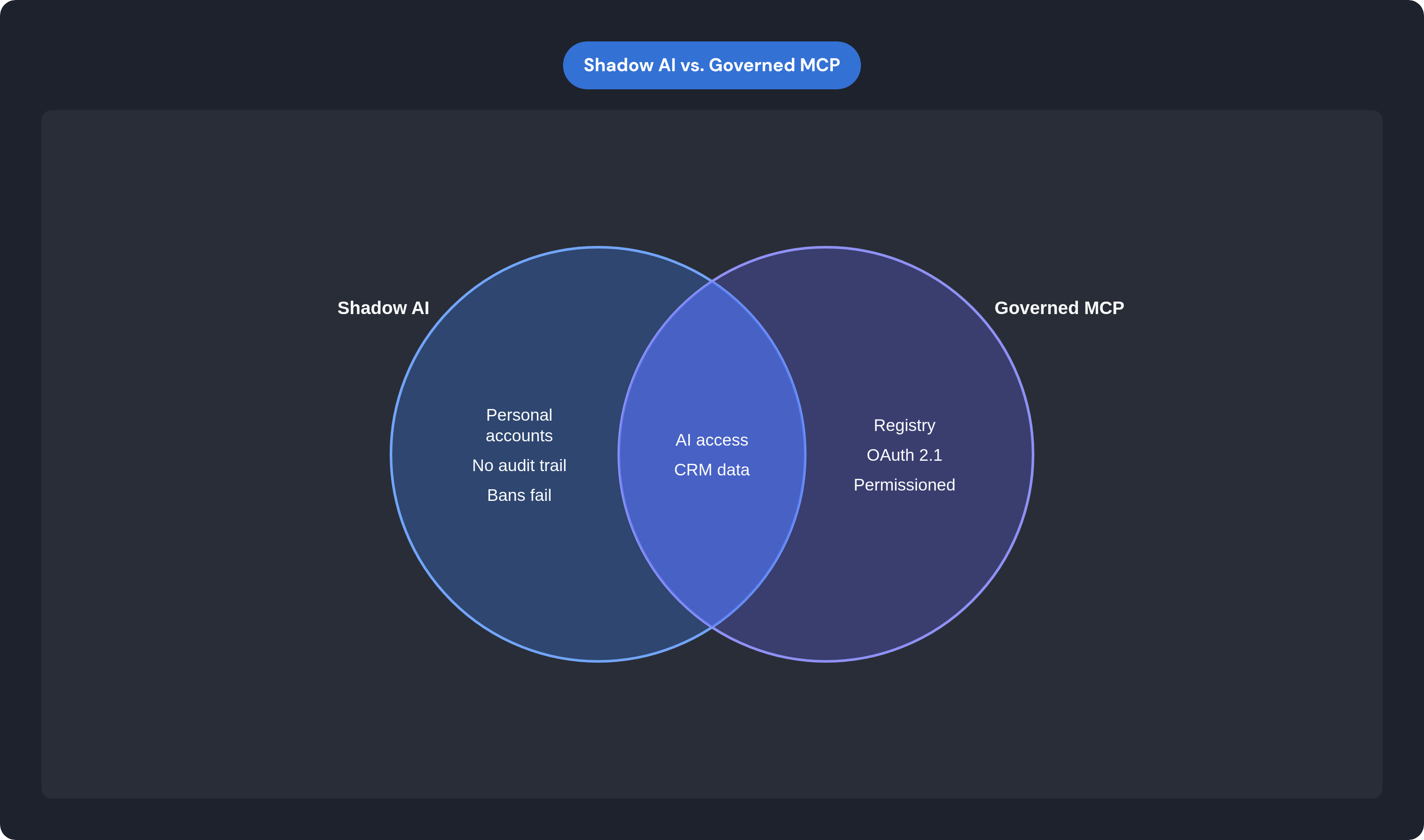
For shadow AI, the mechanism is direct. When sanctioned tools cannot connect to the CRM, the code repository, the ticketing system, or the knowledge base, employees reach for tools that can. A governed MCP layer connected to the systems employees actually need is a direct substitute for the shadow tools they were using to compensate. Remove the friction from the sanctioned side, and the unsanctioned side loses its primary advantage.
In December 2025, Anthropic donated MCP to the Agentic AI Foundation under the Linux Foundation, co-founded with Block and OpenAI, with backing from Google, Microsoft, AWS, Cloudflare, and Bloomberg. It is now community-governed infrastructure. Organizations building on it are not subject to any single vendor's roadmap decisions.
How Fast MCP Has Moved from Specification to Enterprise Standard
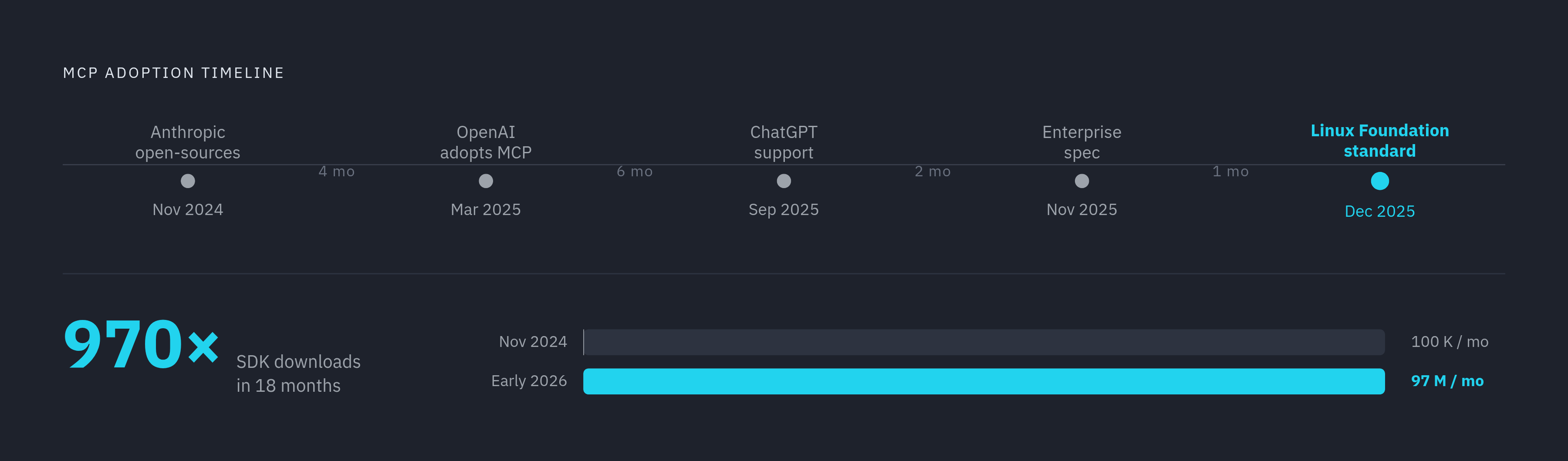
Anthropic open-sourced MCP in November 2024. OpenAI adopted it in March 2025 and added ChatGPT support in September 2025. Google DeepMind and Microsoft followed. All major model providers converged on the same protocol within roughly a year of its introduction, which is an unusually fast consensus for enterprise infrastructure.
SDK downloads grew from roughly 100,000 per month to 97 million per month, a 970x surge in under 18 months. The ecosystem now includes over 5,800 MCP servers and more than 300 MCP clients. Block, Bloomberg, Amazon, and hundreds of Fortune 500 companies have running deployments. As of early 2026, 28% of Fortune 500 companies have implemented MCP servers.
The November 2025 specification marked a qualitative shift. OAuth 2.1 became the baseline authorization standard. Asynchronous execution, statelessness, and server identity became official protocol features, signaling that the protocol had crossed from developer experimentation into enterprise-scale deployment readiness.
When Claude, ChatGPT, Cursor, and Slack all speak the same protocol, one governed MCP layer can serve all of them. One investment in governed integration, one policy definition, no fragmentation across AI clients. Building governed MCP capability now means establishing infrastructure that will take competitors real time to replicate.
The Security Risks MCP Introduces if Deployed Without Governance
MCP adoption has outpaced MCP governance in most enterprise deployments. Teams spin up servers, agent-to-tool connections accumulate, credentials scatter across groups, and no single system holds a record of what is running or why. It has a cleaner vocabulary than shadow AI. The underlying dynamic is familiar.
Independent security scans of public MCP servers have found exploitable vulnerabilities in a majority of listings, with only a small fraction using OAuth by default. Prompt injection, the technique by which malicious instructions embedded in data can redirect an AI agent's actions, has been demonstrated against MCP-connected tools. Security researchers identified data exfiltration vectors in April 2025 that use the protocol's tool-calling mechanism as the delivery path.
The Postmark npm incident in September 2025 illustrates what MCP supply chain risk looks like in practice. A compromised package impersonating a legitimate email MCP server behaved identically to the real package for fifteen releases. Then it added a single line that copied every outgoing email, including password resets, invoices, and internal correspondence, to an attacker-controlled address. It ran undetected for over a week. The attack was technically unremarkable. It was patient and quiet, which is the hardest kind to catch precisely because there is nothing dramatic to detect until the damage is done.
MCP servers typically run with broad, pre-authorized access to whatever systems they connect to. A compromised server does not expose one data type or one workflow; it exposes everything downstream. That architecture is an asset in a governed deployment and a serious liability in an ungoverned one. Unmanaged MCP is shadow AI risk recreated at the infrastructure layer, just with more surface area.
What an Enterprise MCP Registry Does and Why It's the Control Point That Makes Governance Scalable
A registry is a single source of truth for approved, compliant MCP servers and tools available within the organization. It is what AI agents consult to determine what they are permitted to use, and what IT consults to determine what is actually running.
Without a registry, MCP deployment fragments exactly the way shadow AI does. Teams build their own servers. Integrations go undocumented. Five teams independently build a Salesforce connector, each slightly different, none reviewed by security. IT has no visibility. Employees cannot find or trust the right endpoints.
The distinction between a registry and a gateway matters. A registry handles discovery: what tools exist, where to find them, who owns them, what version is current, who has approved them. A gateway enforces policy at runtime: how agents access those tools, what data flows are permitted, what gets logged. Most enterprises need both. A registry without a gateway is a well-organized catalog with no enforcement. A gateway without a registry is enforcement with no visibility into what it is managing.
In practice, a registry enables specific capabilities that governance cannot function without. Version control means every change to a server or tool is tracked, with ownership and approval history visible. Access scoping means the conditions under which a tool can be called are declared once and enforced everywhere, rather than renegotiated each time a new AI application appears. Reuse over rebuild means a working integration published to the registry is available to every team, not just the one that built it. Auditability means there is a record of who approved what and when.
Permissions inheritance is the most consequential design principle in governed MCP deployment. Rather than redefining access controls each time a new AI tool is introduced, a well-designed registry inherits permissions from source systems automatically. The answer to "what can this agent see?" is always derived from what the requesting user already has access to. This eliminates the parallel access-control project that makes AI deployment slow and leaves the gaps shadow AI exploits.
The public registry ecosystem is still immature. Unvalidated third-party listings carry real risk, as the Postmark incident demonstrated. Organizations should build or procure a private, governed registry rather than relying on open catalogs whose curation standards they cannot verify or control.
How Governed MCP Deployment Reduces Shadow AI Pressure Across Departments
Employees reach for unsanctioned tools because sanctioned ones lack the context, the connectivity, or the convenience to get the job done. Governed MCP, implemented correctly, addresses all three.
A sales rep who needs a quick pipeline summary used to copy-paste CRM data into a personal AI account. A governed Salesforce MCP server gives that rep real-time CRM context inside Claude, ChatGPT, or Slack, with account history, forecast queries, and deal analysis staying inside the permission boundary because the governed tool is doing exactly what the shadow tool was doing. The difference is that IT can now see it and the data never left.
A developer using a personal GitHub Copilot account to get code assistance was routing company code outside the enterprise perimeter because the sanctioned path lacked the context to be useful. A governed GitHub or Jira MCP server delivers context-aware code assistance inside Cursor or any IDE, grounded in the actual codebase, through the sanctioned path.
Customer support agents pasting customer PII into free-tier tools to compensate for a knowledge base that surfaces information too slowly is a version of the same story. Governed MCP connecting the company's knowledge base and ticketing system to the agent's workflow resolves that pressure without requiring support staff to choose between doing their job well and keeping data where it belongs.
One registry, one permissions layer, one audit log, serving all of these simultaneously, without IT building a separate integration for each team.
The model that actually works in practice separates two problems organizations routinely conflate. Domain experts own and define the AI skills relevant to their function: the RevOps team that best understands the CRM workflow should publish the Salesforce server; the engineering team should publish the code-context server. Central IT governs the registry itself, setting who can publish, what review a new server requires, and what the audit log captures. The knowledge problem belongs to the people closest to the work. The governance problem belongs to the people with the organizational mandate to enforce it. Mixing those up is how you get either ungoverned proliferation or a bottleneck that recreates shadow AI by making the sanctioned path too slow to use.
The Practical Steps Organizations Should Take to Close the Shadow AI Gap
Start with detection, not prohibition. You cannot govern what you cannot see. Establishing visibility into what AI tools are actually in use is a prerequisite for any policy that has a chance of working.
Before writing a single new rule, audit which teams are using which tools for which workflows. That exercise will surface where sanctioned alternatives are absent or inadequate, not just where policy is being violated. Treat it as a diagnostic, not a punishment. Organizations that skip this and go directly to restriction write the same ban six months later for the next generation of tools, having learned nothing about why the first one failed.
Treat the gap as a product problem. For each shadow tool category the audit surfaces, the right question is what need it meets and whether a governed alternative can meet that need with equal or better convenience. If the answer is no, the change needed is a better tool, not a stricter prohibition. Governance that cannot compete on usability will keep losing.
Build or procure a private MCP registry as the organizational control point. Standardize on a governed catalog of approved servers rather than allowing each team to negotiate its own integrations. The registry is the mechanism that prevents the MCP layer from fragmenting along the same lines shadow AI already has.
Connect AI tools to source systems through a permissions layer that reflects existing access controls, so onboarding a new AI capability does not require a parallel access-control project. The answer to "what can this agent access?" should always be derivable from existing identity and permissions infrastructure. If it is not, the access-control debt will accumulate until it becomes unmanageable.
Publish skills to the registry, not to shared drives. Version control, ownership, and access scoping are what separate a governed registry from a folder of prompt files that becomes ungoverned within a quarter. If a team builds a working integration and it lives only on their Notion page, the organization has acquired a liability that no one else can find, trust, or maintain.
Make reuse the structural default, not an aspiration. When a team builds a working MCP server or workflow, the registry is where it belongs, so other teams can discover and build on it.
Measure governance by accessibility, not by restriction. The right benchmark is not how many unsanctioned tools have been blocked. It is whether employees choose sanctioned tools because those tools are genuinely better, faster, and more connected to the systems that matter. When the governed path wins on the merits, shadow AI stops being worth the effort.