MCP vs API for Enterprise Agent Integrations
MCP solves the integration complexity that has stalled enterprise agent deployments.
REST APIs are stateless by design. Each request carries its own authentication and context. The server holds no memory of the caller between calls. For a developer-coded automation script or a data sync job, this is exactly right: the developer knows what to call, knows when to call it, and has defined inputs and outputs in advance. Statelessness is a feature because the developer is the reasoning layer.
That assumption collapses the moment an agent becomes the consumer.
An agent running a multi-step workflow must re-authenticate and re-establish context at every single step. Latency stacks. Logic bloats. And more fundamentally, APIs expose endpoints, not intent. Think of it like a library with no card catalog: the books are all there, physically present on the shelves, but finding the right one requires someone who already knows the collection. An agent cannot discover what is available or what a tool does without documentation written for humans, which means every tool the agent needs has to be pre-coded into the integration by a developer who anticipated the need beforehand. That assumption of anticipation is the core mismatch, and it compounds.
What follows from this is the N×M problem. M AI applications, N business systems, M×N bespoke connectors, each hand-coded, each maintained in isolation. Audit logs scatter across dozens of separate services. There is no coherent picture of what an agent touched during a workflow, or in what sequence. Every new tool access request restarts the cycle.
None of this is a flaw in API design. APIs were built for a different consumer: a human-authored program with deterministic behavior, not a reasoning system deciding at runtime what to call next. The mismatch only became impossible to ignore as agent counts grew and the number of tools each agent needed grew alongside them. Integration debt compounded faster than teams could address it. That friction, not safety concerns and not cost, is what has been stalling enterprise agent deployment.
The Structural Idea Behind MCP and How It Changes the Integration Model
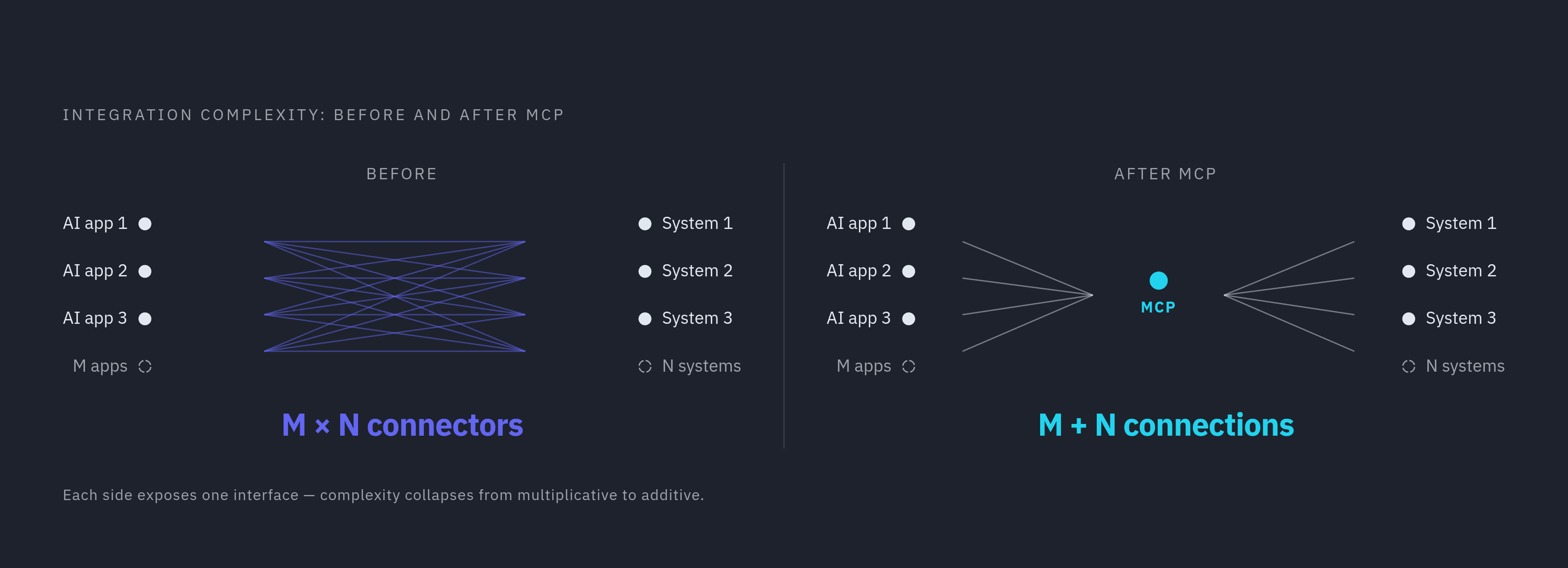
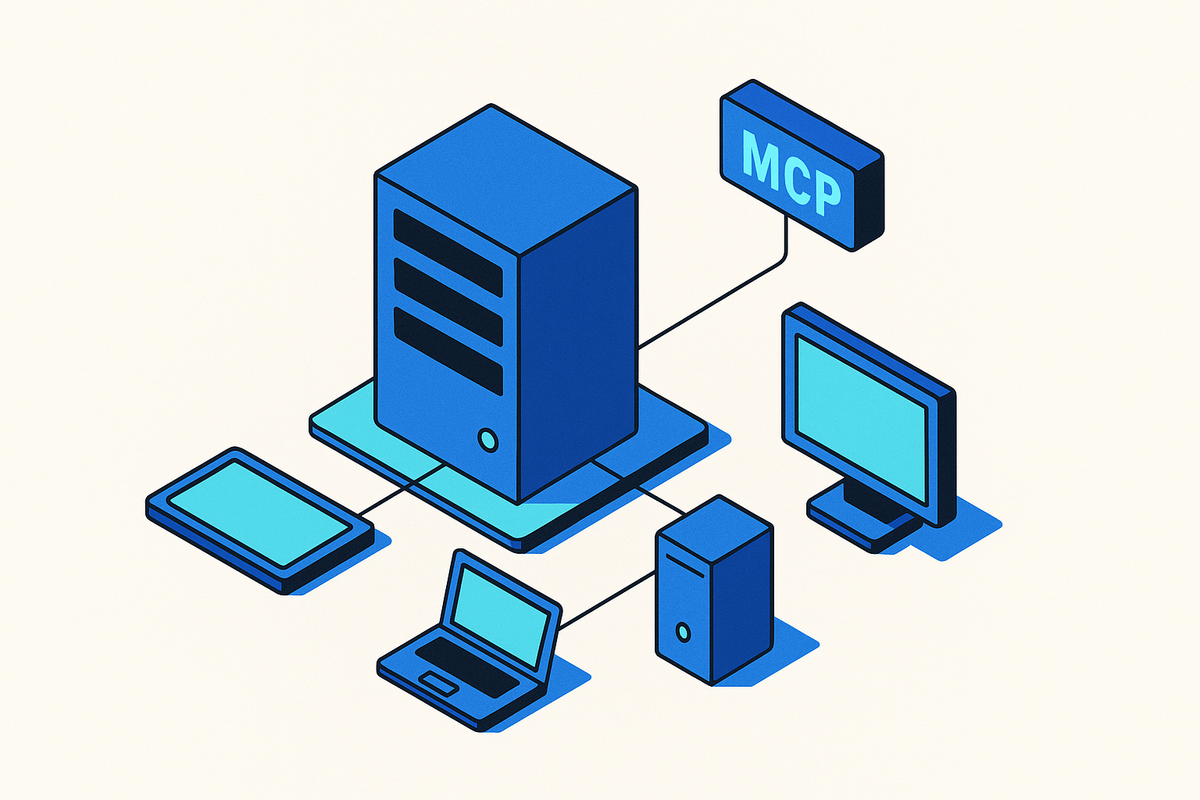
In November 2024, Anthropic introduced the Model Context Protocol as an open standard governing how AI systems connect to external tools, data sources, and services. The framing that stuck, and that actually earns its keep as an analogy, is "USB-C for AI applications." One universal connector. Any compliant AI client talks to any MCP-compatible server through a single standard interface, regardless of what underlying system that server wraps.
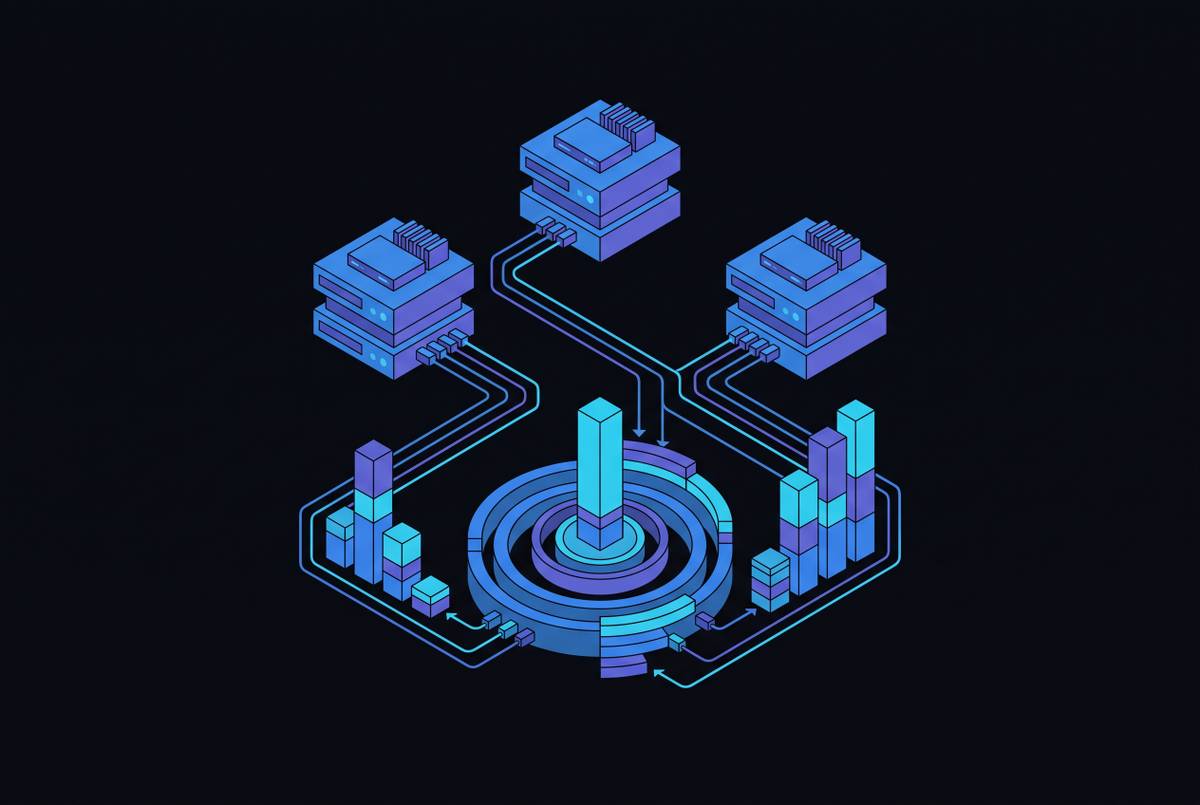
The arithmetic consequence of that universality is the reduction from N×M to M+N. Each system exposes one MCP interface. Each AI client speaks one protocol. The combinatorial integration problem collapses, at least on paper, which is further than most proposed solutions get.
MCP defines three primitives. Tools are functions the agent can invoke: reading a Salesforce record, updating a Jira ticket, querying a database. Resources are data the agent can read. Prompts are reusable, templated interactions. Those three cover the vast majority of what an agent actually needs to do in a real workflow, and the fact that three categories suffice is itself a signal that the abstraction is well-chosen.
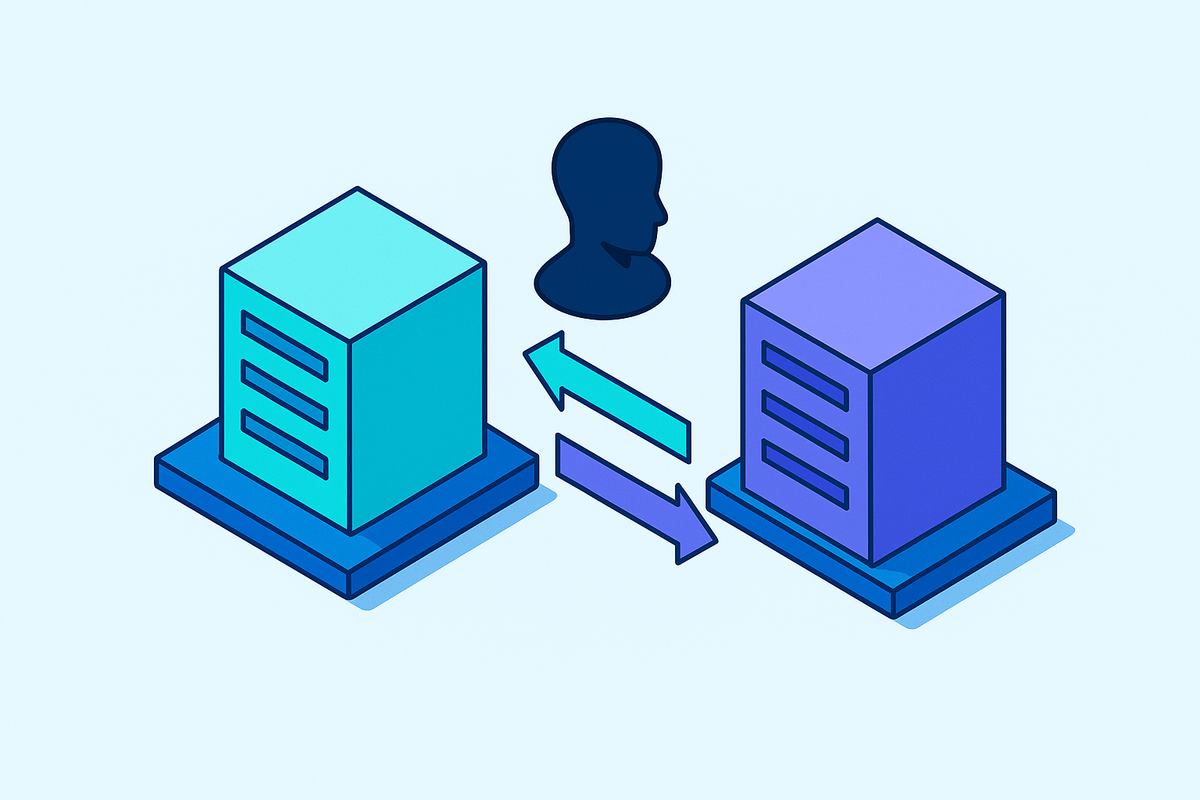
Two architectural differences from REST matter most. First, stateful sessions: MCP maintains session state across tool calls within a workflow, so there is no re-authentication between steps and context persists across the sequence. Second, runtime discovery: an agent can query an MCP server to learn what tools exist and what they do, without any pre-coded knowledge baked in beforehand. The agent figures out its own capability surface at the start of a session. Communication runs over JSON-RPC 2.0, bidirectional rather than purely request-response.
The governance consequence of this architecture gets underplayed in most write-ups. Because all agent interactions pass through defined MCP servers, there is a single layer where tool invocations can be logged, access policies enforced, and scope violations caught. That centralization is not a secondary benefit. It is structural. Remove it and the whole governance model becomes retrofitting.
In December 2025, Anthropic donated MCP to the Linux Foundation's Agentic AI Foundation, backed by AWS, Google, Microsoft, OpenAI, Bloomberg, and Cloudflare. Docker, then Kubernetes, followed this same trajectory from vendor project to open infrastructure standard. The industry has made a collective judgment about where the protocol layer for agentic AI should live, and that judgment was not made casually.
How MCP and APIs Actually Relate, and What Gets Misread as Competition Between Them
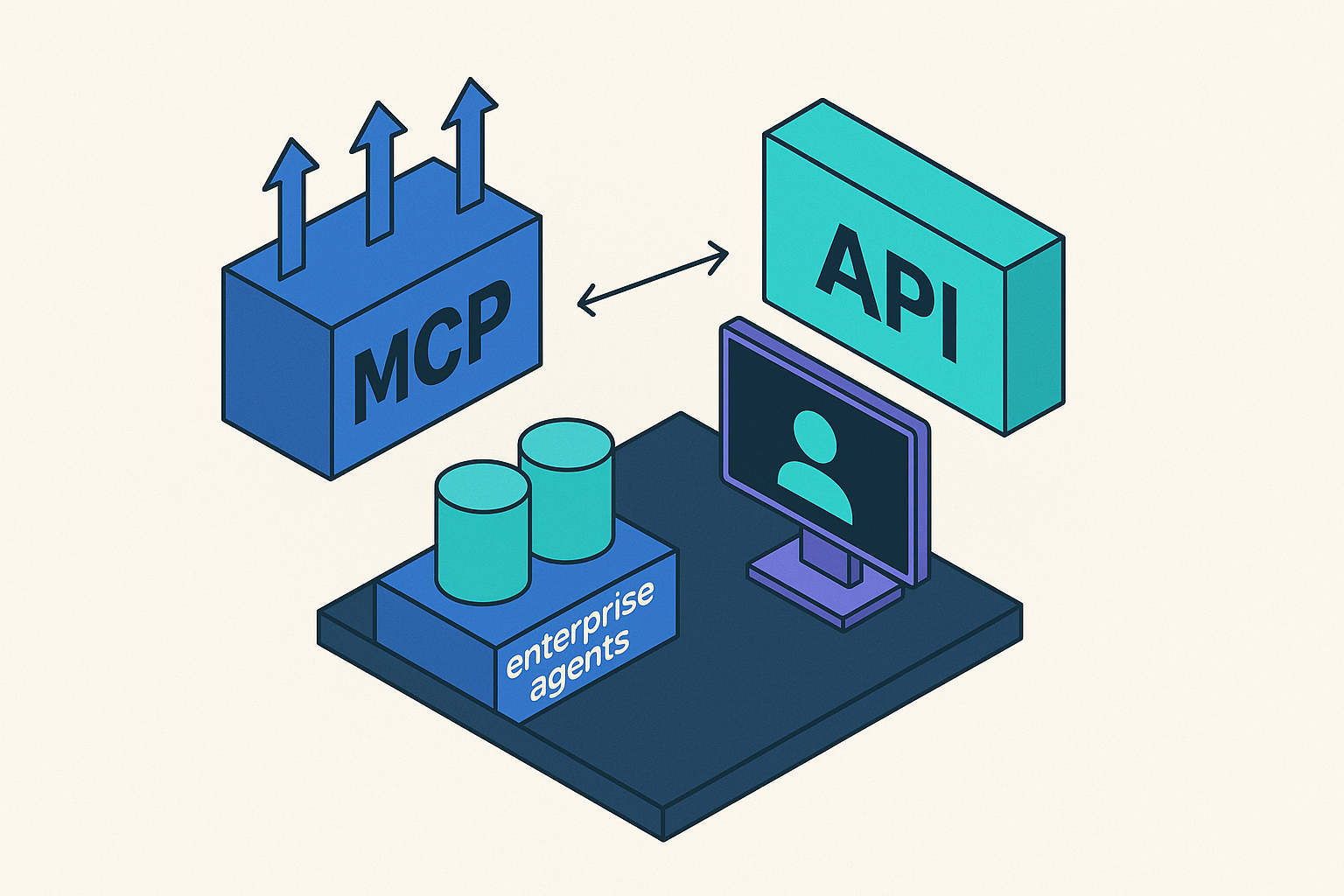
MCP does not replace the API estate. It packages that estate differently for a different consumer. This distinction matters because organizations that frame it as a replacement question tend to stall on the wrong decision.
A useful framing positions MCP as roughly "API++," exposed directly to agents, but the mapping from API to agent tool is rarely one-to-one. A tool called something like draftandsend_email() bundles several underlying API calls into a single agent-shaped action. Agents think in workflows and intentions, not endpoints. MCP is the translation layer between those two registers, and maintaining that translation is a legitimate and ongoing piece of work.
APIs remain the right choice for stable backend processes with predictable, developer-coded behavior: transactional workflows, data sync, system-to-system communication that does not involve an agent reasoning about what to do next. Statelessness is genuinely a feature in those contexts.
MCP adds what APIs cannot provide when an AI agent needs to discover tools at runtime rather than be hand-coded against every endpoint; when multi-step workflows span several systems and session context carries meaningful state across steps; when a unified audit trail across all tool invocations is operationally required rather than a nice-to-have.
The practical relationship is complementary. APIs handle the underlying system actions. MCP helps agents understand what is available and how to use those actions within a workflow. Gateway tooling such as AWS Bedrock AgentCore Gateway auto-converts OpenAPI specifications into MCP tool definitions, so the existing REST estate does not need to be rewritten. OpenAPI becomes the source specification the gateway translates from, not a legacy format destined for retirement.
OpenAI deprecated its proprietary Assistants API in favor of MCP, with a sunset scheduled for mid-2026. The industry is consolidating on MCP as the default protocol for agent tooling. That consolidation is worth noting not because it forecloses alternatives, but because the cost of building against a deprecated standard is a cost that accrues invisibly until it doesn't.
Reading the Adoption Curve and What It Signals About Where MCP Sits Today
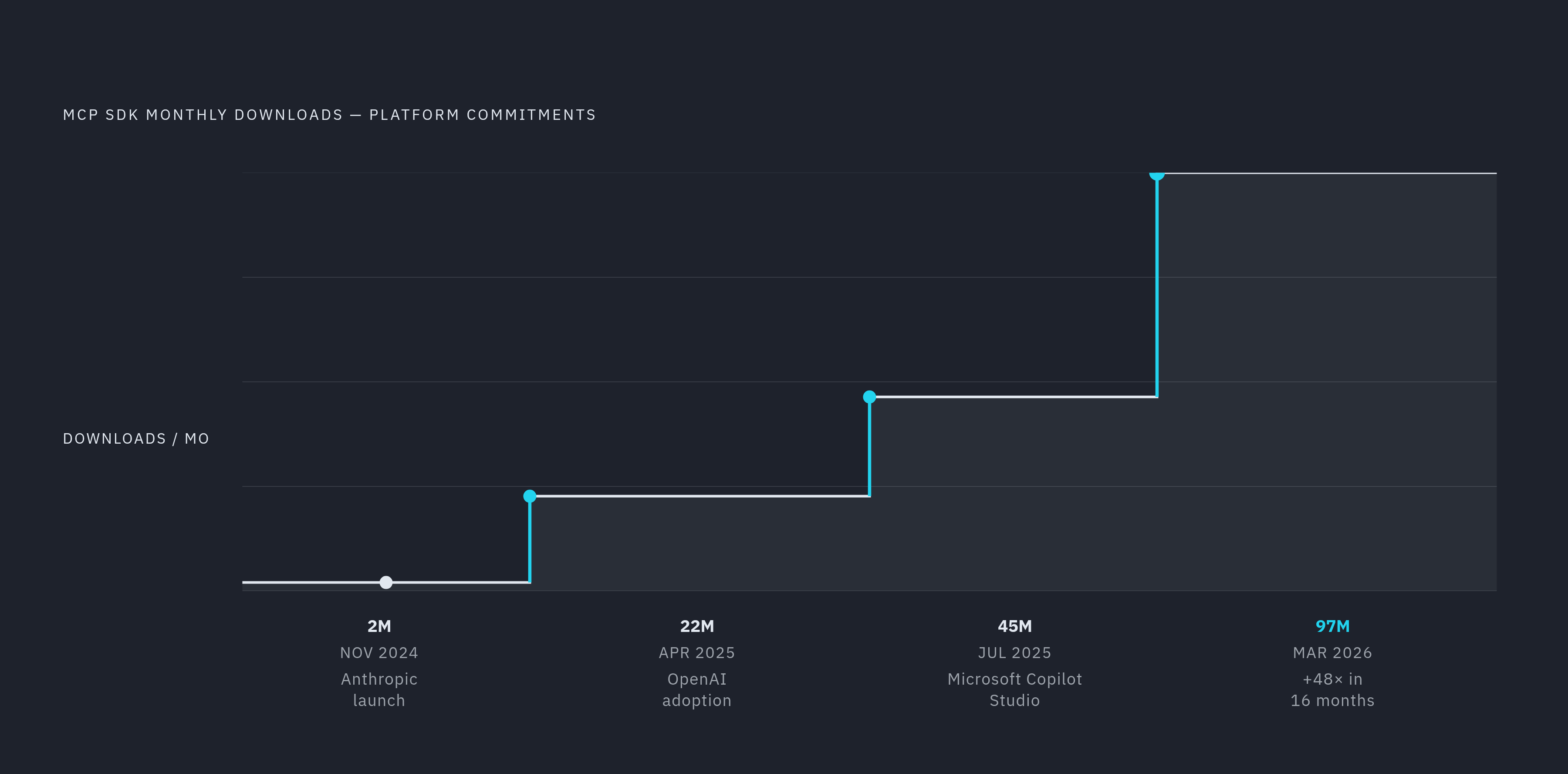
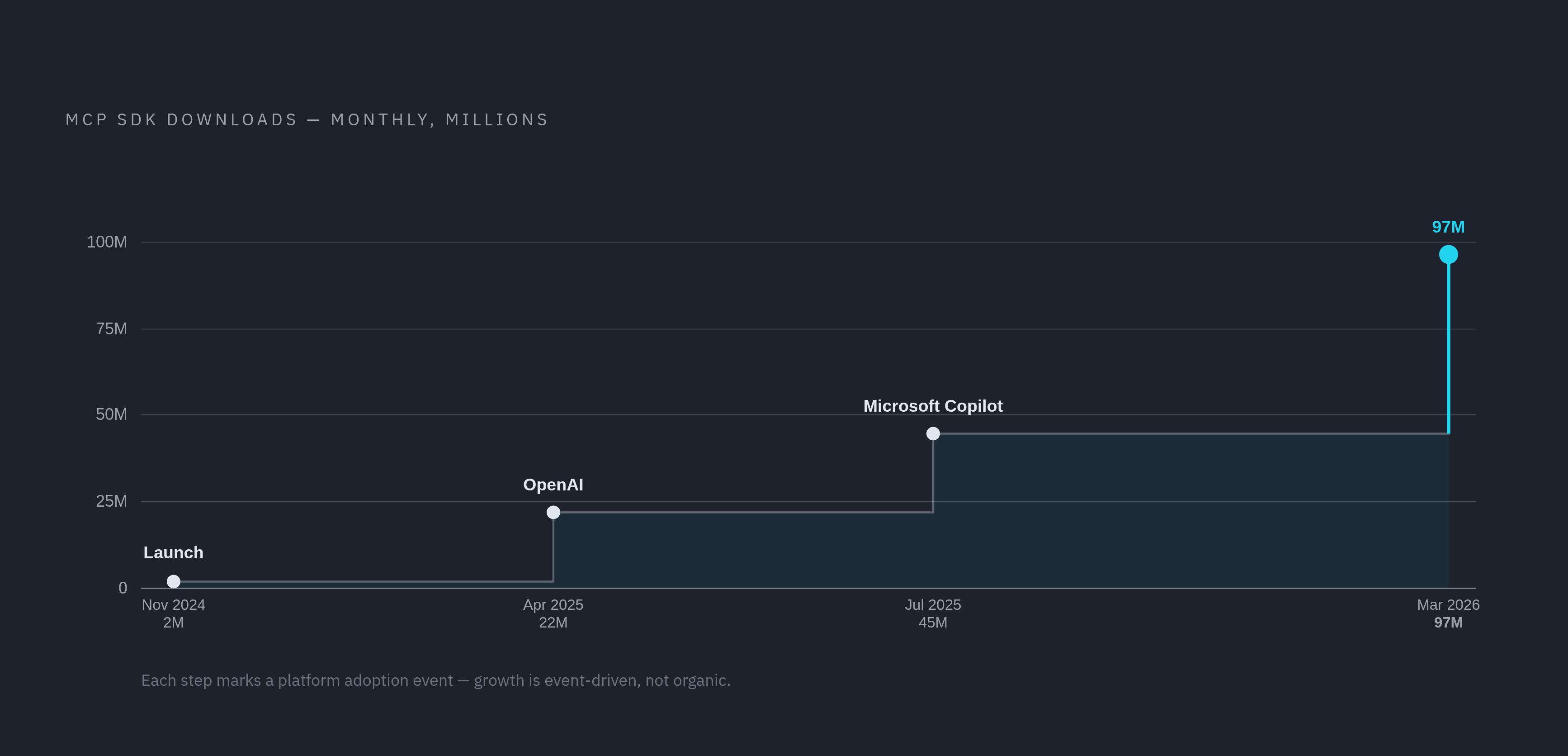
Anthropic launched MCP in November 2024 with roughly 2 million monthly SDK downloads. OpenAI's adoption in April 2025 pushed that figure to 22 million. Microsoft's integration into Copilot Studio in July 2025 brought it to 45 million. By March 2026, monthly SDK downloads across Python and TypeScript had reached 97 million. That is not gradual adoption; it is a step function responding to each major platform commitment, which is a different pattern than organic developer uptake and matters more for enterprise planning.
On the server side, Anthropic reported over 10,000 active public MCP servers as of early 2026. GitHub showed nearly 16,000 repositories tagged as MCP servers. Real artifacts being built and maintained, not leading indicators of future intent.
Enterprise penetration tells a more complicated story. By early 2026, 28% of Fortune 500 companies had implemented MCP servers, against a backdrop where 80% were already deploying active AI agents in production. The majority of enterprises running agents in production are running them on bespoke integrations, accumulating precisely the technical debt MCP exists to prevent. The gap between agent deployment and governed integration is where most enterprise AI risk currently lives.
A 2026 industry survey found roughly 41% of respondents in some form of production MCP use, with security cited as the leading blocker. That concern is real, but "security" in this context most often means "we haven't implemented governance yet," not "the protocol is insecure." The distinction matters for how you respond to it organizationally. One is a product problem; the other is a program management problem.
Salesforce's Headless 360 platform, routing interactions via MCP, had processed 4.5 million MCP calls since launch as of late May 2026. Claude, ChatGPT, Gemini, Microsoft Copilot, GitHub Copilot, Cursor, VS Code, and Zed all support MCP. The protocol is no longer tied to any single model or vendor. Vendor-agnosticism is the condition that makes something infrastructure rather than a product feature, and MCP has crossed that line.
Why Enterprises That Scale Agents Without a Registry Accumulate the Same Problems MCP Was Meant to Solve
The pattern is already visible in organizations that moved quickly on agents without building integration governance first. Teams spin up their own MCP servers independently. Integrations go undocumented. IT loses visibility. Shadow AI emerges at the protocol layer, which is a considerably more consequential place to lose control than in a rogue SaaS subscription.
Without a registry, the N×M problem resurfaces inside the organization. Different teams build equivalent MCP servers for the same underlying system. Engineering capacity burns on duplication that nobody planned. The original sin of enterprise integration, solving the same problem in isolation across disconnected parts of the organization, reasserts itself at the agent layer. It just happens faster this time, because agents proliferate faster than traditional software did.
A governed MCP registry addresses this through structured metadata. Every MCP server in the registry carries information about what tools it exposes, where it is deployed, who can access it, what authentication it requires, and whether it is operationally healthy. There is one place to find what exists. Ownership is clear. Versioning is tracked. Changes require approval. Role-based access control operates at the server level, so each agent or team can invoke only the tools they are authorized to use.
Kong's CTO has stated the observability requirement plainly: enterprises need centralized visibility into tool usage, health, and failures to support monitoring, optimization, cost management, and compliance; without it, organizations face fragmented integrations and compounding operational risk.
AWS released an open-source MCP Gateway and Registry in May 2025, with an active release cadence through mid-2026, as a reference implementation of this model. Central IT maintains an approved server list. Lines of business can publish their own assets to scoped registries. Platform teams define the guardrails; developers operate freely within them. Access requests for MCP tool access should carry the same rigor as IAM role grants, because the blast radius of a misconfigured tool permission at the agent layer is roughly equivalent in scope and considerably harder to detect after the fact.
The governance structure is not about slowing teams down. It is about ensuring that speed does not produce liabilities that compound quietly until they become expensive. That framing is worth keeping in mind when the first internal conversation about "too much process" starts.
Permission Inheritance and Authentication as the Part of MCP Governance Most Enterprises Underestimate
Shared credentials across multiple MCP servers mean one compromised credential exposes everything it touches. That is not an MCP-specific risk; it is basic credential hygiene that becomes acutely consequential when agents can traverse multiple systems in a single workflow. Dedicated OAuth app registrations per MCP server are the minimum acceptable baseline. Most enterprises are not there yet, and the gap usually does not surface until something goes wrong.
For remote MCP servers connecting to SaaS tools or cross-network services, OAuth 2.1 with short-lived, scoped access tokens is the recommended default. Hardcoded credentials, shared credentials, personal access token reuse, static connection strings: all of these should be prohibited in policy explicitly, not merely discouraged informally. Short-lived tokens exist precisely because agents are autonomous. A token that outlives its session is a token that can be misused in ways that are difficult to trace after the fact.
What permission management should not require is manual redefinition every time a new agent or MCP server enters the picture. Permissions should inherit from source systems automatically and stay synchronized as source-system access changes. An employee who loses access to a financial system should not retain indirect access through an agent holding cached credentials from when that access was still valid. The revocation happened; the copy the agent made is still in the lock.
Enterprises ask the audit trail questions too late: which agent accessed sensitive financial data during a specific window, what did it do during a failed workflow, did it exceed its authorized scope. These questions are only answerable if every MCP interaction is logged through a governed layer. Scattered API logs across independent services can reconstruct individual endpoint calls, but they cannot reconstruct agent behavior across a workflow, which is the unit of analysis that compliance actually requires. The difference is meaningful and is not recovered by throwing more engineering time at log aggregation after the fact.
Regulatory pressure is accelerating this reckoning. EU AI Act enforcement obligations for most high-risk systems were active by August 2026. SOC 2, HIPAA, and GDPR all require documented tool access and audit trails at a level that scattered logs cannot satisfy.
The practical first step for a CIO is inventory: every MCP server and agent already running, including shadow deployments, before centralizing access through a governed gateway with per-agent tool allowlists and full audit logging. Virtual server architecture enables role-based tool access by department, so sales teams cannot reach HR databases even when both MCP servers are registered in the same central registry. The scoping is structural, not dependent on anyone reading a policy document.
What Department-Level MCP Scoping Looks Like in Practice Across Different Teams
Each department is effectively a different agent consumer, with different tools, different permissions, and a different risk surface. Treating them equivalently is the organizational equivalent of giving everyone admin credentials because it simplifies account management — it reduces friction right up until it doesn't.
RevOps and sales teams need CRM reads and writes, deal pipeline queries, contract status. They have no business reason to access HR compensation data or engineering deployment logs. Engineering teams need repositories, issue trackers, CI/CD systems, internal documentation; broader write access to development tooling, narrower access to customer data. Customer support agents need CRM data, support tickets, customer history, a read-heavy profile that demands customer context but not financial records or internal HR systems. Data and analytics teams need database query access and report generation against real-time data, with correspondingly strong audit requirements given the sensitivity of what they touch.
The scoping mechanism that makes this tractable is giving each department its own scoped MCP server, or its own scoped view into a shared registry. Agents operating in that context discover and invoke only the tools that department is authorized to use. The tool surface visible at runtime is the tool surface permitted. There is no separate enforcement step; the scoping is the enforcement.
There is an accuracy benefit here that gets overlooked in security-focused conversations. An agent that can see every tool in the organization will make worse tool selection decisions. Reasoning degrades when the option space is unbounded and most of it is irrelevant to the task at hand. Scoping the tool surface improves agent accuracy alongside access control; these are not competing priorities, which is a useful point to make to teams that resist scoping on performance grounds.
Cross-departmental reuse is the other side of this. A workflow built by the sales team that uses governed CRM context should be publishable to other teams who need similar context: account management, customer success, business development. Captured once, governed at the registry level, reused across the organization rather than rebuilt department by department. Teams that establish scoped, documented, discoverable MCP servers early accumulate a reusable asset. Teams that do not rebuild the same integrations at increasing cost, usually without realizing that is what they are doing.
How to Decide Which Integration Approach Fits a Given Enterprise Use Case
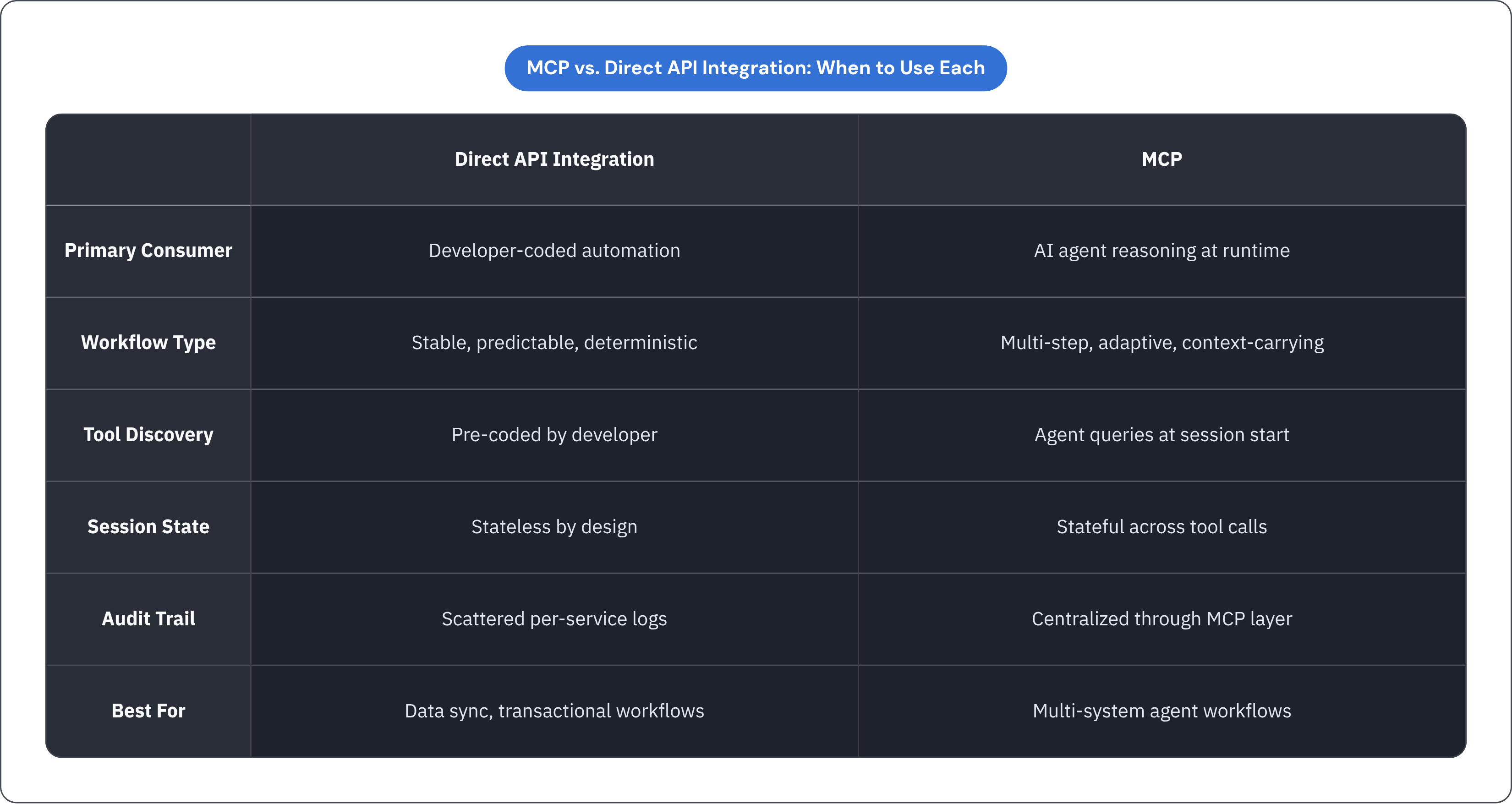
The decision is not MCP versus APIs as competing philosophies. It is about matching the integration model to what the consumer is and what the workflow actually requires. Organizations that frame it as a philosophical choice tend to make slower decisions and worse ones.
Use direct API integration when the use case is a single, stable, developer-coded automation with predictable inputs and outputs: system-to-system data sync, transactional workflows where no agent reasoning is involved, integrations unlikely to change or expand. In these cases, REST statelessness is a feature, developer-coded determinism is appropriate, and adding MCP introduces complexity without corresponding benefit.
Use MCP when an AI agent needs to reason about which tool to use rather than execute a pre-coded call; when three or more integrations feed a single AI workflow; when the same tool surface needs to be reachable by multiple agents or teams without rebuilding connectors for each; when governance, auditability, and scoped access at the agent layer are operational requirements. In most regulated industries and most Fortune 500 contexts, they are.
The shorthand: if a human developer can write the integration once, know exactly what it calls, and never need it to adapt at runtime, APIs are right. If an agent needs to reason about what to do, discover what is available, and carry context across multiple steps and systems, MCP is right. Most enterprise agent workflows land in the second category. Most existing backend integrations land in the first. The honest work is figuring out which category a given use case belongs to, rather than defaulting to whichever model the team already knows.
The enterprises moving most effectively through this are not choosing one model to the exclusion of the other. They are using APIs for the underlying system actions their backends have always required, layering MCP as the protocol through which agents discover and invoke those actions, and building registries to govern the tool surface before proliferation becomes the problem rather than the opportunity. That sequencing matters. Governance built before scale is a foundation; governance retrofitted after scale is a remediation project.