Building the Business Case for Enterprise AI Platforms
Pilots measure value once; platforms measure it every time someone avoids starting over.
The standard AI business case runs like this: pick a use case, run a pilot, measure time saved or errors reduced, then extrapolate. Clean, logical, and fundamentally wrong when what you're actually buying is infrastructure.
Think about email. Nobody justified adopting email by measuring the ROI of a single thread. "This thread saved two hours" tells you nothing about what happens when every team uses it daily, and nothing about what it would have cost to keep routing physical memos. The unit of analysis is wrong, so the conclusion is wrong. That's exactly what's happening with AI pilots right now, at scale, across most major enterprises.
The metrics that dominate pilot measurement are real: time-to-resolution, headcount equivalent, error rate reduction. But they're local. They say nothing about what happens when the next department needs the same capability, and they cannot accumulate into an organizational evidence base that justifies scaling. In 2025, the average organization scrapped nearly half of its AI proofs of concept before production. Some of that attrition is technical. A lot of it is this structural problem: each pilot starts fresh, justifies itself in isolation, and collapses in isolation.
What pilot ROI omits: the cost of rebuilding equivalent capability in the next department, the cost of maintaining inconsistent versions of the same tool across teams, and the access control gaps that emerge when each deployment is governed separately. The missing variable is reuse. A pilot measures value created once. A platform measures value created every time someone avoids starting over.
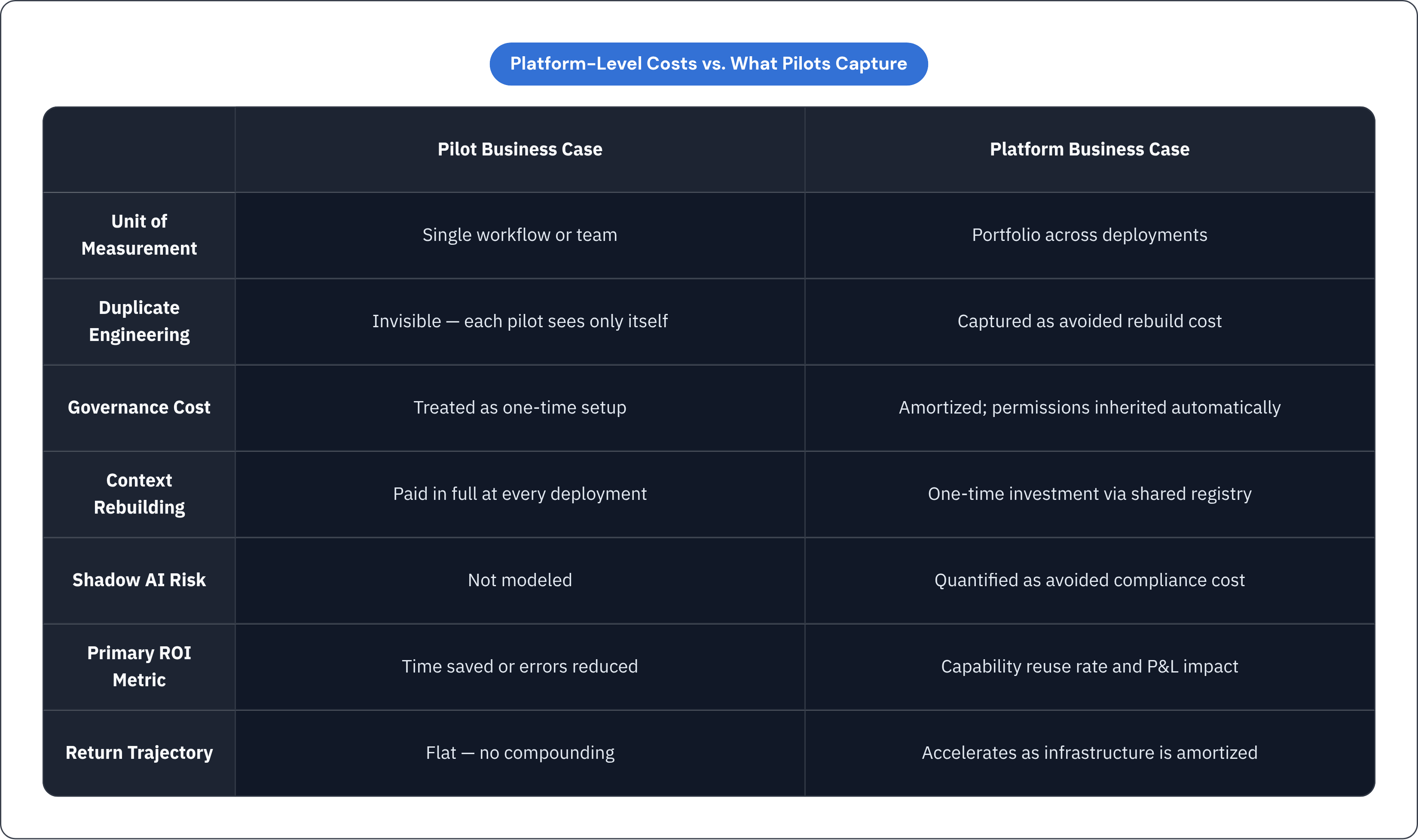
The five cost categories that only appear at the platform level
These are not hypothetical. They are real dollar figures that never surface in a single pilot's profit and loss statement, which is exactly why they require a different measurement frame.
Duplicate engineering. When five teams independently build the same AI capability, four of those builds are waste. The prompt engineering, the workflow design, the testing, the integration work: all repeated in parallel, for no reason other than that no shared infrastructure exists. No pilot ROI model captures this, because each pilot only sees its own build cost.
Access control and permission debt. Every new AI deployment requiring manual permission scoping incurs setup cost, audit risk, and ongoing maintenance overhead. At scale, this compounds into a substantial recurring line item. The fix — inherited and automatically synchronized permissions — only exists if the platform was built to support it from the start. Most aren't.
Context rebuilding cost. Domain knowledge that lives inside one expert's tooling has to be re-explained to every new agent or integration that touches it. Governance infrastructure that captures and shares that context converts what would be a recurring cost into a one-time investment. Without it, every new deployment pays the full knowledge transfer tax, every time.
Shadow AI risk. When the governed platform fails to deliver accessible, useful AI capability, employees find ungoverned alternatives. They already have. The downstream cost of data exposure, inconsistent outputs, and compliance failures belongs in the platform business case as avoided cost.
Governance fragility under agentic AI. Only about one in five organizations has a mature governance model for AI agents. Retrofitting governance after deployment is substantially more expensive than building it in from the start. The organizations now scrambling to establish control frameworks after the fact are paying that price right now, usually without having budgeted for it.
How high-performing organizations structure their ROI measurement
The gap between organizations seeing meaningful AI returns and those seeing none is not primarily about which tools they chose. It's about how they structured the investment and what they decided to measure.
High-ROI organizations explicitly prioritize use cases based on outcome projections, not opportunistic experimentation. They're sequencing deployments against a portfolio thesis. And the leadership posture matters in a specific, non-obvious way: McKinsey's 2025 data shows that AI high performers are three times more likely to report that senior leaders demonstrate genuine ownership of AI initiatives. Not sponsorship. Ownership. Sponsorship is showing up to the kickoff. Ownership is being accountable when the deployment stalls in month four.
Scale thresholds matter too, in ways that aren't intuitive. Firms making substantial, cross-business-unit AI investments report a meaningfully higher likelihood of significant productivity gains than organizations investing below a certain threshold. The return on platform-level commitment doesn't scale linearly. There's a real inflection point, and organizations that underinvest land below it — measuring returns from a vantage point that can't see the compounding above it.
What's also shifting is what CFOs will accept as evidence. Finance leadership is moving away from productivity gains as the primary ROI metric and toward revenue impact and direct cost reduction. Time saved is no longer sufficient on its own. The implication for anyone building a business case right now: metrics must operate at the portfolio level — tracking capability reuse rates rather than individual workflow improvements — and connect to the P&L.
What the Klarna and Morgan Stanley deployments show about platform-level returns
These two cases are worth examining closely, not because of the headline numbers, but because of the structural feature that actually produces them.
Klarna's AI assistant handled 2.3 million conversations in its first month, cutting average resolution time from roughly 11 minutes to under 2 minutes. The company estimated the capacity equivalent of approximately 700 full-time employees and a contribution of roughly $40 million in profit improvement in 2024. That is not a pilot return. It's what happens when one governed capability serves every customer interaction and compounds across volume and time. No single-team pilot produces that number, because no single-team pilot has that reach.
Morgan Stanley's DevGen.AI deployment reviewed over 9 million lines of legacy code and saved approximately 280,000 developer hours, with 15,000 developers shifting from manual code translation to strategic work. The second-order return is the part worth pausing on: freed developer capacity redirected to higher-value work. That benefit only materializes at scale. In a single-team pilot, there's no meaningful capacity redistribution. The aggregate hours saved don't become a redeployable resource until the deployment is broad enough for the math to work.
Both cases share the same structural feature: a single governed capability deployed broadly, rather than many locally owned tools operating in parallel. That architecture is what produces the compounding. The reporting discipline at organizations achieving this level of return is itself a signal; they are measuring across the portfolio, rather than aggregating disconnected pilots.
Why consolidation onto platforms is now the dominant enterprise procurement posture
The market has already moved on the build-versus-buy question. The direction is not ambiguous.
Best-of-breed procurement has fallen to roughly one in five organizations, while nearly two-thirds are consolidating onto integrated platforms. A large share are actively planning to reduce their overall application count. On the build side, the majority of AI use cases are now purchased rather than built, a dramatic shift from just a year prior. The organizations that rushed to build custom AI before validating their use cases wasted well over a year and hundreds of thousands of dollars in sunk costs, on average. That lesson has been internalized broadly and painfully.
An emerging heuristic is taking shape in enterprise procurement: roughly 80% of AI needs are met by purchased solutions, while the remaining 20% justify custom builds where unique intellectual property or deep integration requirements make proprietary development genuinely necessary. The burden of proof has shifted to building, not buying.
Agentic AI is accelerating this consolidation pressure in a specific way. Autonomous agents operating across an organization need centralized oversight, and you cannot build that oversight separately for every agent. Consolidation isn't just an administrative preference — it's a technical requirement: point solutions cannot provide the governance infrastructure that agentic systems demand.
The business case implication is direct: the platform is not an additional cost layer on top of existing investments. It is a cost-reduction mechanism for the entire portfolio.
Governance as a financial input, not a compliance checkbox
Security and risk is now the primary barrier to scaling agentic AI, outranking technical limitations and regulatory uncertainty by a wide margin. Organizations are not primarily afraid of the technology. They're afraid of what happens when it operates outside controlled conditions. That fear, properly quantified, belongs in the business case.
The governance gap is real and underpriced. Only a small fraction of organizations using AI maintain a comprehensive governance framework. That is not a sign that governance is unnecessary. It's a sign that most organizations are accumulating risk they haven't priced. Writer's data adds a concrete dimension: more than a third of organizations admit they cannot shut down a rogue AI agent if one emerged. The liability exposure that figure represents is not a compliance abstraction. It's a financial exposure that belongs in any honest business case as a risk-adjusted cost.
The financial argument for building governance in from the start, rather than retrofitting it later, is straightforward: when permissions are inherited and automatically synchronized across deployments, each new capability requires no separate access control project. That's a direct, repeatable reduction in per-deployment cost. Governance infrastructure also enables reuse economics. A capability can only be shared safely across departments if it carries its permissions and audit trail with it. Without that foundation, sharing creates risk rather than reducing cost — leaving the organization with neither the efficiency nor the safety it was after.
Governance is not what you spend to comply. It is what makes the compounding returns structurally possible.
Building the platform business case: the measurement structure that works
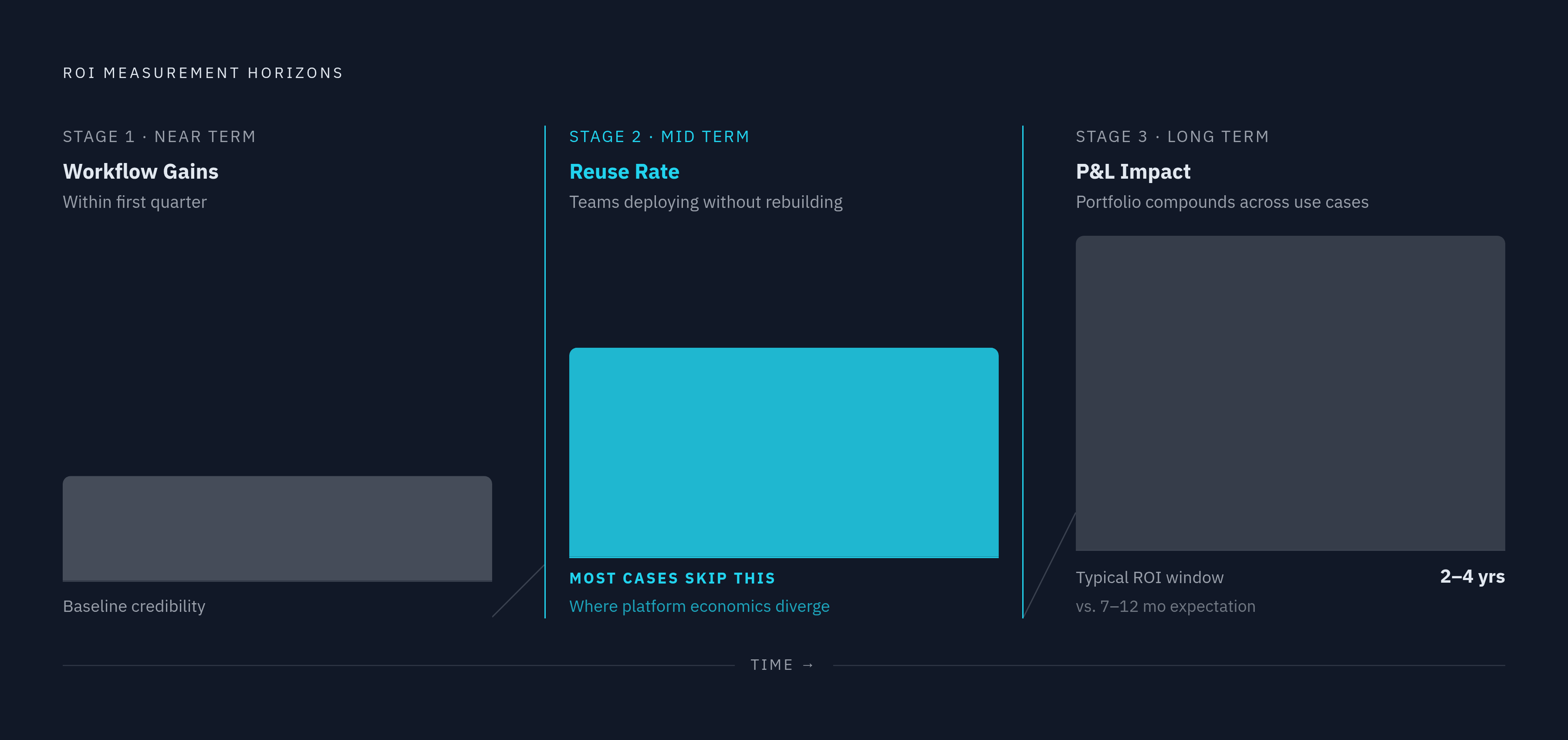
A platform business case requires three measurement horizons. The mistake most organizations make is presenting only the first one to a CFO who has already seen too many pilots that never grew up.
The near term covers individual workflow gains, measurable within the first quarter of deployment. These establish baseline credibility and give finance something to hold onto early. The mid-term horizon tracks reuse rate: how many additional teams deploy a capability without rebuilding it from scratch. This is where platform economics diverge from point-solution economics — and the horizon most business cases skip entirely, usually because nobody built the instrumentation to capture it. The long-term horizon is P&L impact as the portfolio compounds across use cases and time.
The metrics that only exist at the platform level include capability reuse rate, avoided duplication cost, permission overhead eliminated per deployment, and shadow AI incidents avoided. These are quantifiable, once someone takes the trouble to track them.
One calibration worth naming: most enterprises report satisfactory ROI on AI use cases within two to four years. That's significantly longer than the seven-to-twelve month expectation many organizations carry from standard technology investments. A credible platform business case doesn't hide this difference. It explains the compounding curve that justifies the longer horizon. The first cycle is slower. Each subsequent cycle, as capabilities are reused and infrastructure is amortized across more deployments, is faster and cheaper. That trajectory is the argument.
Before committing to any deployment model, ask one question: what does it cost if three more departments need the same capability next year? A platform business case answers that question directly, because it was designed to. A pilot business case can't, because it was never designed to think past the first deployment. The strongest cases connect the specific capability being funded today to the shared infrastructure it builds, the registry, the inherited permissions, the governed context, that makes every subsequent capability cheaper and faster to deploy. Build the case around that trajectory, and the numbers follow.