Agentic AI Coding Tools Compared for Enterprise Environments
Five enterprise coding agents compared for security, deployment, and real governance needs.
This is not a ranked list. Each of these tools occupies a real position in the market, and the right one depends on your existing infrastructure, risk tolerance, and deployment model.
GitHub Copilot
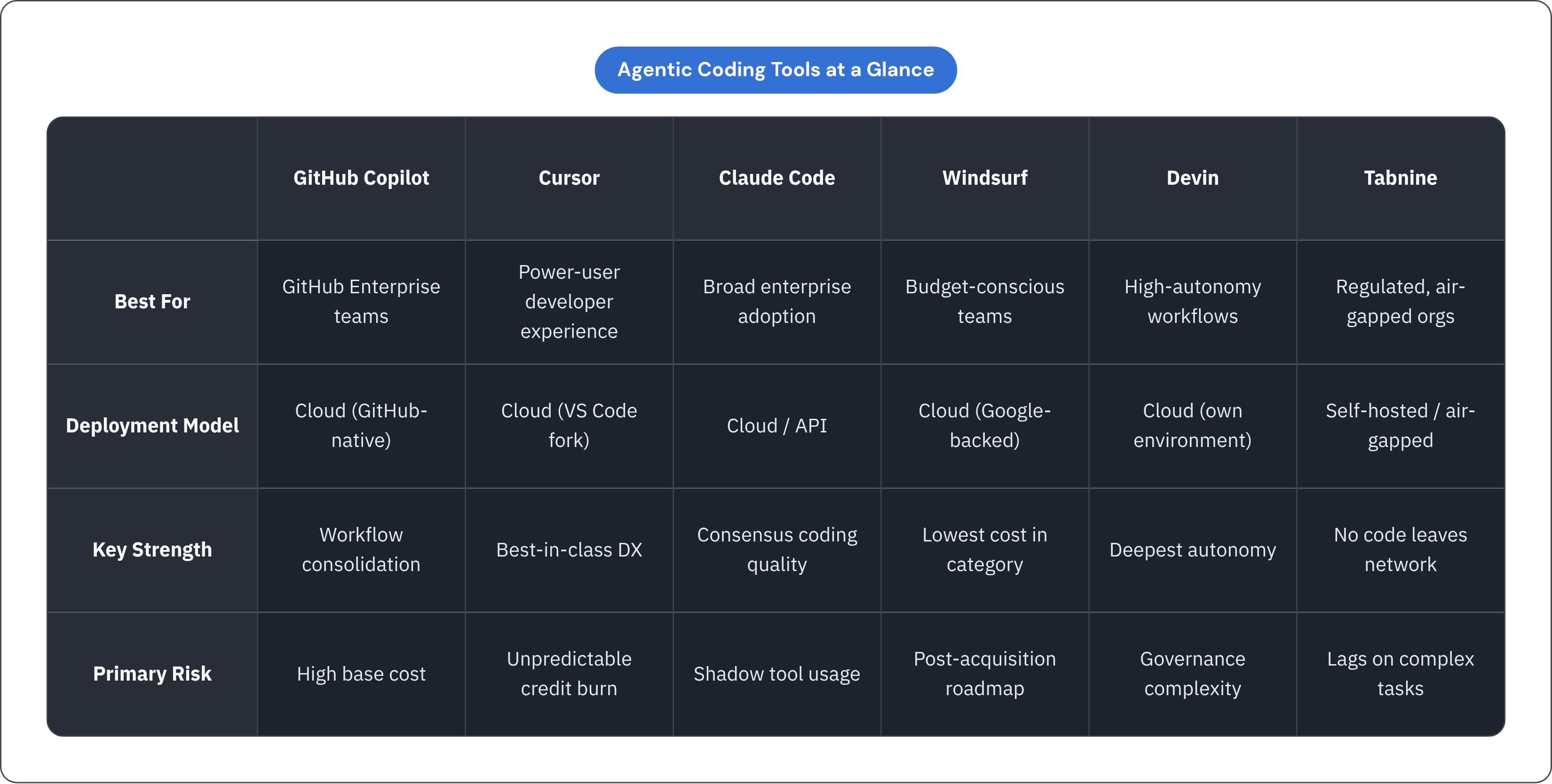
Copilot has the largest installed base in the category, roughly 20 million total users and 4.7 million paid subscribers as of January 2026. Its agent mode, launched in late 2025, supports issue-to-pull-request workflows with minimal human input. For teams already running on GitHub Enterprise Cloud, it is the natural default; it slots into existing workflows without demanding a new toolchain. Enterprise pricing lands at approximately $360,000 per year for 50 developers, which includes the required GitHub Enterprise Cloud tier. Not cheap; but consolidation has a value that is easy to underestimate during procurement, and that value shows up later when you're managing fewer separate vendor relationships.
Cursor
Cursor is a VS Code fork with AI embedded at the editor level. Power users consistently cite the development experience as best-in-class, and I've watched engineers get genuinely attached to it in ways they don't get attached to other tools. The tool moved to credit-based pricing in mid-2025 at $40 per user per month on the Teams plan. The issue worth surfacing early: documented cases of heavy agentic use depleting annual credits in a single day. That's a procurement governance failure before it's a product complaint. The product is genuinely good; the billing model requires active management, and that management needs to be baked into your rollout plan before the first credit card charge.
Claude Code
Claude Code's run-rate revenue has grown to over $2.5 billion, more than doubling since the beginning of 2026, with enterprise use now representing more than half of all revenue. In abstract "best AI for coding" discussions, it appears as the consensus answer with notable frequency. Some practitioners prefer accessing the underlying model through interfaces like Cline or Aider for finer context control, which reflects a real user behavior; plan for it during rollout, otherwise you'll discover it after the fact when your audit logs show tool calls you didn't anticipate.
OpenAI Codex
Codex re-emerged in late 2025 as an agent-first tool, not a legacy model name. It operates in two deployment modes: Codex Web, cloud-based and proposing changes via GitHub, and Codex CLI, running as a local terminal agent. Practitioners describe it as more deterministic on multi-step tasks than some alternatives; that consistency matters when you're trying to build repeatable, auditable workflows where variance is a liability.
Windsurf (Codeium / Google)
Google acquired Windsurf in early 2025, giving it both an autonomous agent and an IDE under a single roof. Windsurf's Cascade agent competes directly with Cursor on everyday agentic tasks. At $15 per month, it is the clearest value option in the category and a credible migration path for teams frustrated with Cursor's billing unpredictability. The Google acquisition warrants attention: watch how this consolidates with the rest of Google's AI infrastructure over the next 18 months; acquisitions of this type have a way of reshaping roadmaps in directions the acquired product's users didn't ask for.
Devin
Devin, from Cognition, sits furthest along the autonomy spectrum. It operates in its own cloud environment with a browser, terminal, and editor. It has merged hundreds of thousands of pull requests in production deployments, including at Goldman Sachs, Santander, and Nubank. The autonomy that makes Devin powerful is precisely why governance questions become most acute here; this is a tool you should pilot deliberately, with clear boundaries, rather than casually on a Friday afternoon.
Tabnine
Tabnine occupies a distinct position: self-hosted and air-gapped deployment for regulated industries where no code can leave the network. It is now enterprise-only, with the free tier and standalone Pro plan sunset as of 2026. The trade-off is honest; suggestion quality on complex architectural tasks lags behind cloud alternatives. For organizations in industries where that constraint is non-negotiable, Tabnine is often the only viable option. For everyone else, that ceiling matters and you should understand exactly where you'll hit it before you commit.
What the Productivity Numbers Actually Tell You, and What They Leave Out
The productivity data is real, and the framing matters. JetBrains' 2025 Developer Ecosystem survey found nine in ten developers save at least one hour per week with AI tools; one in five saves eight or more hours. Translate that to business terms: even at the conservative end, one hour per week at a $125 per hour midpoint comes to $325,000 per year in recaptured engineering time for a 50-developer team. That number belongs in your budget conversation, and it will land.
The problem is using productivity as the primary selection criterion. These numbers are generated by individual developers, often in self-reported conditions, and they don't capture enterprise deployment complexity. MIT's 2025 research found roughly 95% of enterprise generative AI pilots delivering no measurable ROI, largely from integration failures, not model quality failures. A tool that is 10% better at autocomplete but can't pass your security review contributes exactly zero productivity gains; it just costs more to evaluate. Think of it this way: a sports car that can't fit through your garage door isn't fast — it's parked.
The productivity numbers also leave unasked the questions that actually determine enterprise success. Who has access to what data when the agent runs? Can you audit what the agent did and why? Does the integration require a custom connector per data source, or does it scale? These questions are absent from developer satisfaction surveys because individual developers aren't the ones who get called when something goes wrong at 2 a.m.
Productivity gains are real; they are the output of a successful enterprise deployment, not the criterion for selecting the tool that gets you there. Conflating those two things is how pilots succeed and production rollouts fail.
The Governance Criteria That Separate Enterprise-Ready Tools from Capable Ones
Security and Compliance: The Minimum Bar
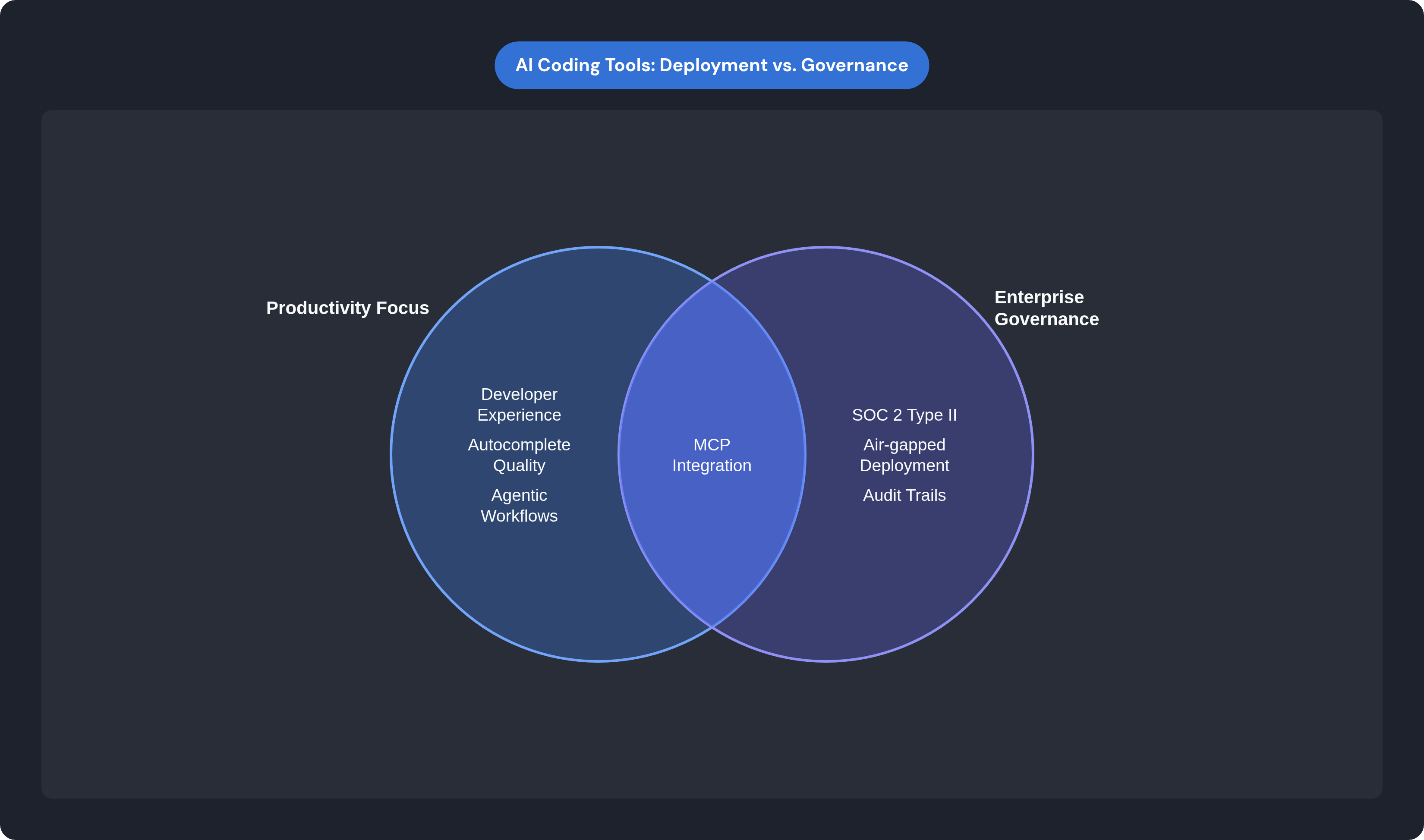
Before anything else, a tool needs to clear the baseline. SOC 2 Type II certification. SAML SSO with granular admin controls. Data residency options and contractual commitments that your code is excluded from vendor training sets. IP indemnification, which is not a formality given the ongoing class action litigation involving GitHub, Microsoft, and OpenAI. Most major vendors now offer some form of indemnification for enterprise customers, but the specifics vary enough that you cannot assume parity. Read the contract.
Identity and Permissions: The Most Underweighted Dimension
Most evaluations spend too little time here, and that neglect surfaces at the worst possible moment. Does the tool treat agents as a distinct class of identity, or do they inherit and run on developer credentials? The latter is a significant risk vector. Best practice is dedicated service accounts, least-privilege scoping to specific repositories or operations, rotation policies, and active monitoring for anomalous agent behavior.
Astrix Security's 2025 research found 88% of MCP servers require credentials to operate and 53% rely on static API keys or personal access tokens: long-lived credentials requiring manual rotation. In practice, manual rotation rarely happens on schedule. Token mismanagement ranks first on the OWASP MCP Top 10. The question to ask any vendor is direct: when the agent calls an external tool or data source, whose credentials does it use, and what is the rotation policy? If the answer is vague, that's your answer.
Auditability: Can You See What the Agent Did?
A coding agent that autonomously makes multi-file changes, runs tests, and opens pull requests needs a complete action log, not just a conversation history. What you're looking for: versioned change records, approval chains, and the ability to reconstruct exactly what the agent accessed and modified on a given task. The enterprises that have successfully scaled autonomous AI share one architectural characteristic: bounded autonomy with clear escalation paths and comprehensive audit trails. The audit trail isn't a compliance add-on; it's the mechanism that makes bounded autonomy actually function.
Integration Depth and Maintenance Cost
How does the tool connect to your repositories, issue trackers, CI/CD systems, and internal APIs? Custom point-to-point connectors per data source represent ongoing maintenance overhead that compounds with every new integration. Standardized protocols reduce that burden materially. Deployment model matters too: cloud, self-hosted, or hybrid each carry distinct implications for data exposure that need to be evaluated against your threat model, not just your convenience preference.
Admin Controls and Usage Visibility
Centralized usage analytics should show which teams are using the tool, at what volume, on which codebases. Policy-setting should operate at the organization level, not just per user. Billing predictability is also a governance matter. The Cursor credit-burn episode is a procurement governance failure as much as it is a product complaint; unplanned spending from autonomous agents is a risk category enterprises need to plan for explicitly, before deployment rather than as a response to the first unexpected invoice.
How MCP Changes the Integration Equation for Agentic Coding Tools
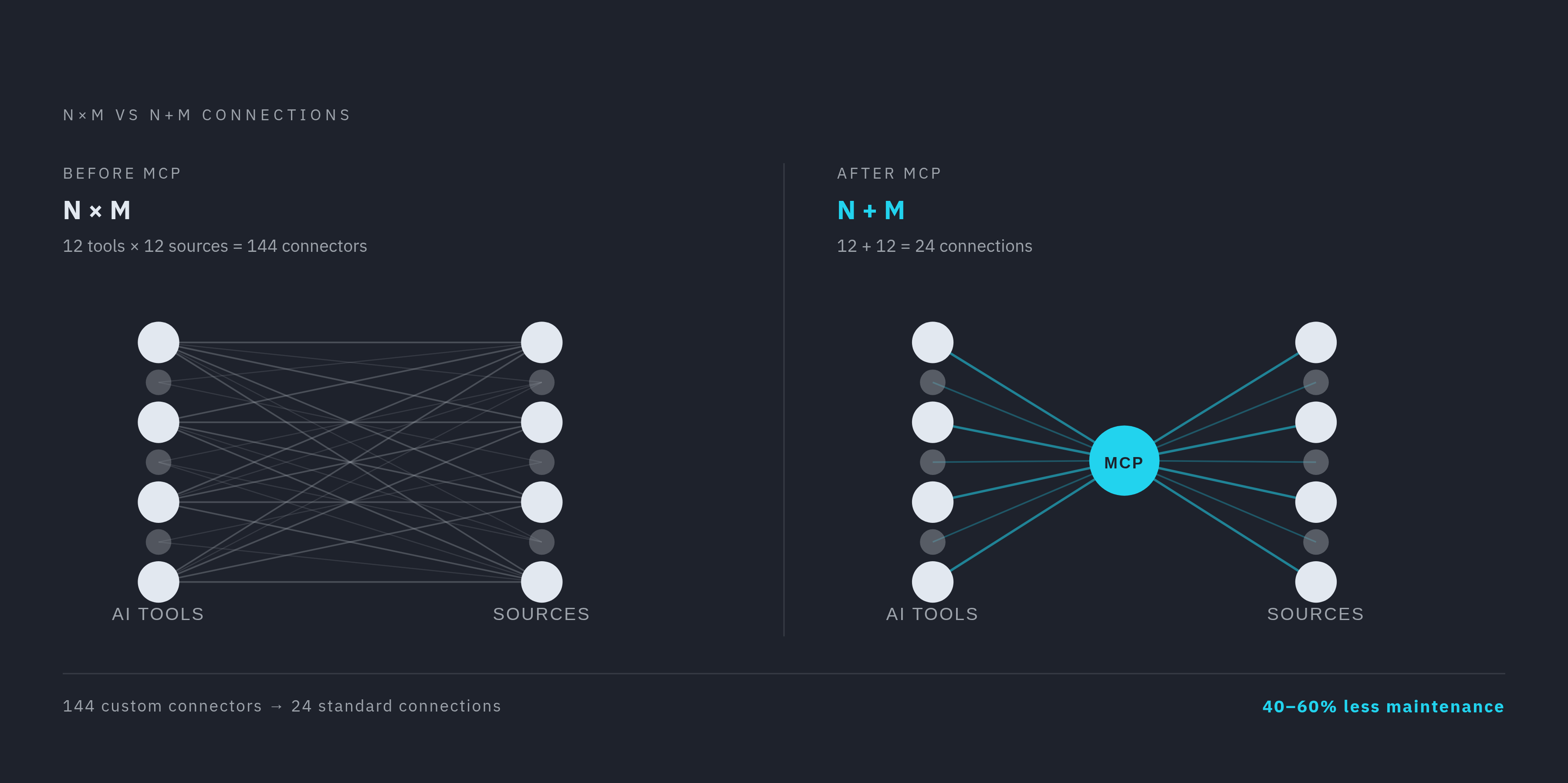
Before the Model Context Protocol, connecting AI tools to enterprise systems meant building and maintaining custom connectors for each pairing. A dozen AI applications and a dozen internal data sources meant potentially hundreds of integration pairs to build and maintain. MCP turns that N-times-M problem into an N-plus-M problem: each system exposes one standard interface, each AI client speaks one standard protocol. Every appliance in the house uses the same plug, rather than each one demanding its own proprietary outlet.
Anthropic announced MCP in November 2024. By early 2026, it had accumulated over 10,000 active public servers and roughly 97 million monthly SDK downloads. Importantly for enterprise commitment, it was donated to the Linux Foundation's Agentic AI Foundation in December 2025, co-founded by Anthropic, Block, and OpenAI, with AWS, Google, Microsoft, Salesforce, and Snowflake as backers. This is no longer one vendor's protocol; enterprises can treat it as foundational infrastructure, and that neutrality matters when you're making a multi-year architectural decision.
Around 41% of software-industry technical leaders report their organization is already in limited to broad MCP production. That's not a pilot population; that's early-majority adoption.
For agentic coding tool evaluation specifically, MCP changes the calculus in concrete ways. A coding agent that speaks MCP can connect to your existing repository, issue tracker, CI/CD system, and internal documentation without bespoke integration work per tool. Permissions inherited from source systems don't need to be redefined in each AI tool; the agent sees what the authenticated user is already authorized to see. A typical enterprise with a large number of integration targets can save an estimated 40 to 60% of ongoing integration maintenance by standardizing on MCP, and it unblocks workflows that were never worth building a custom integration for in the first place.
The questions to ask any agentic coding tool vendor are specific: Does it support MCP as a client? Can it expose capabilities as an MCP server for other agents to call? What is its position on MCP's evolving security specifications?
MCP's Security Risks and What Enterprise Teams Need to Address Before Scaling
Connecting more systems to more agents via a standard protocol also standardizes the attack surface. That's not an argument against MCP; it's an argument for treating MCP governance as a first-class infrastructure concern from the start, not a hardening exercise you schedule after adoption.
Credential Sprawl
This is the most underappreciated risk in the current MCP landscape. Returning to the Astrix Security figures: 88% of MCP servers require credentials to operate, and 53% rely on static API keys or personal access tokens. Static, long-lived credentials sitting in environment files or databases are readable by anyone with access to those files, and manual rotation rarely happens on the schedule security policy prescribes. I've seen organizations with impeccable written rotation policies where the actual rotation logs told a completely different story; token mismanagement leading the OWASP MCP Top 10 reflects where the actual failure patterns are accumulating, not where people think the risk is.
Tool Poisoning and Prompt Injection
Security researchers published findings in April 2025 documenting multiple outstanding vulnerabilities in MCP implementations, including prompt injection via malicious tool descriptions and data exfiltration through cross-server tool shadowing. A malicious or compromised MCP server can intercept calls intended for a legitimate one. The protocol itself does not prevent this; governance architecture must, and that requires deliberate design rather than assuming the protocol handles it.
Shadow MCP
As MCP adoption spreads inside organizations, developers stand up unauthorized remote MCP servers outside IT visibility. This isn't theoretical; tools like Cloudflare Gateway now include shadow MCP detection as a standard enterprise governance function specifically because this pattern is already occurring at scale. Unauthorized servers mean unmonitored credentials, unaudited tool calls, and policy enforcement gaps you didn't know existed until something breaks. Shadow MCP is the MCP equivalent of shadow IT, and it requires the same proactive discovery posture: you have to go looking for it, because it won't announce itself.
For any agentic coding tool under evaluation, ask whether its MCP implementation uses short-lived, scoped credentials or static API keys. Ask whether tool definitions are version-controlled and auditable; silent definition changes are a live attack vector. A tool with no substantive answers to these questions is not ready for enterprise agentic workloads, regardless of its benchmark scores.
How to Govern MCP at Scale: The Gateway Pattern and the Registry Pattern
The Gateway Pattern
Rather than allowing direct agent-to-server connections, an enterprise MCP gateway sits between agents and all MCP servers, enforcing authentication, authorization, routing, and policy in a single location. Gartner projects that 70% of software engineering teams building multimodal applications will use AI gateways by 2028, up from 25% in 2025. The gateway becomes the single policy-enforced ingress for agent access: the right place to audit every tool call, enforce least-privilege, and rotate credentials centrally. Instead of managing credential policy across dozens of individual MCP servers, you manage it once, at the gateway; that consolidation is not just operationally cleaner, it's the difference between a security posture you can actually maintain and one that drifts the moment someone's attention moves elsewhere.
The Cloudflare Model: Governance as Infrastructure
Cloudflare's internal approach is worth studying as a concrete implementation. They built a shared MCP platform inside their monorepo. When an employee wants to expose an internal resource via MCP, they get governance team approval, copy a template, write tool definitions, and deploy. What they inherit automatically: default-deny write controls, audit logging, and auto-generated secrets management. Standing up a new governed MCP server takes minutes of scaffolding; adoption scaled because governance came free with the template.
That's the model. When the secure path is also the easy path, developers take it. When governance requires extra steps, they route around it and you discover the consequences later. This is not a novel insight about developer behavior; it is a documented pattern that infrastructure design either works with or against.
The Registry Pattern: Preventing Duplication
Without a centralized registry of approved MCP integrations, teams rebuild the same integrations independently. The same tool definition recreated across five teams is not flexibility; it is waste that compounds with every iteration and diverges in ways that create inconsistent security posture across the organization. A registry gives teams a discoverable catalog of approved, governed MCP servers they can call without reinventing them; it also gives security and platform teams visibility into what integrations exist and which are sanctioned.
The registry pattern and the gateway pattern are not alternatives; they are complementary layers of the same governance architecture. The gateway enforces policy at runtime. The registry enforces it at the point of provisioning. You need both, and the order in which you build them matters less than building them before adoption outpaces your ability to retrofit governance onto a system that wasn't designed for it. Credal, an enterprise platform for building and governing AI agents that provides permissioned MCP servers with inherited access controls and a versioned agent registry, is one purpose-built option for teams trying to implement exactly this architecture without assembling it from scratch.