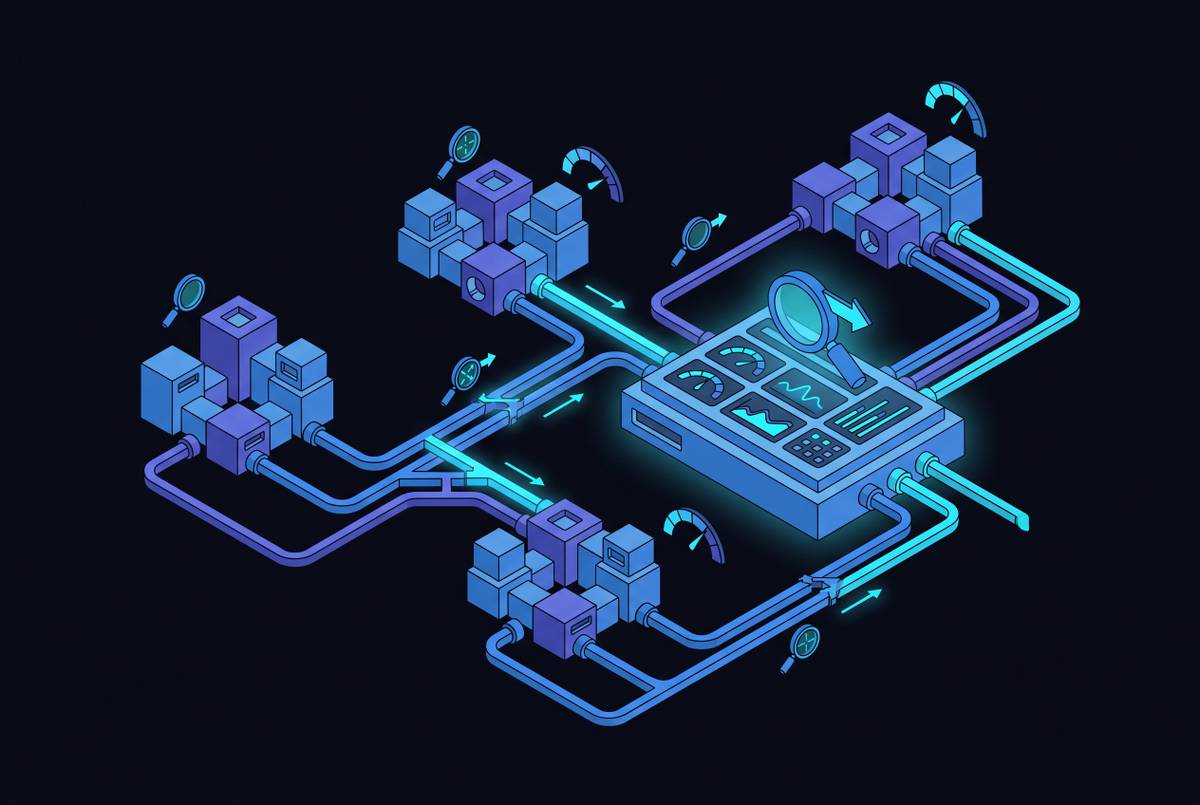
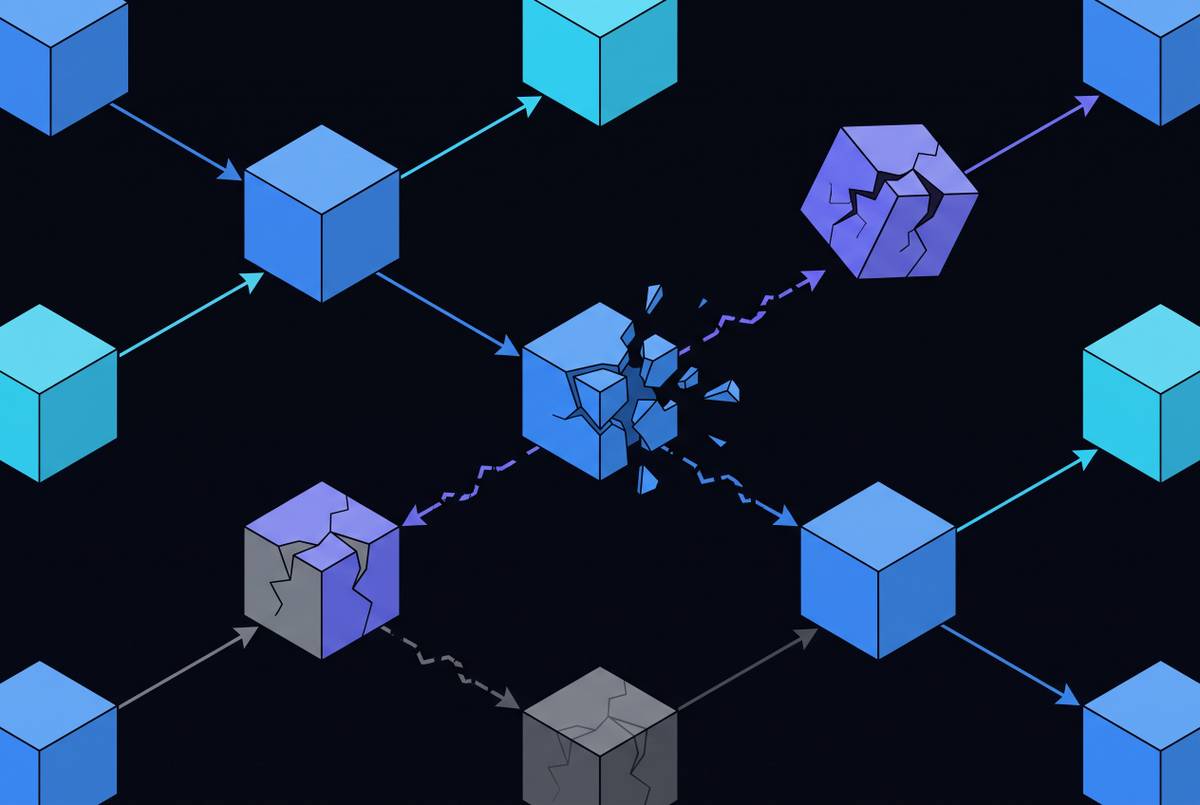
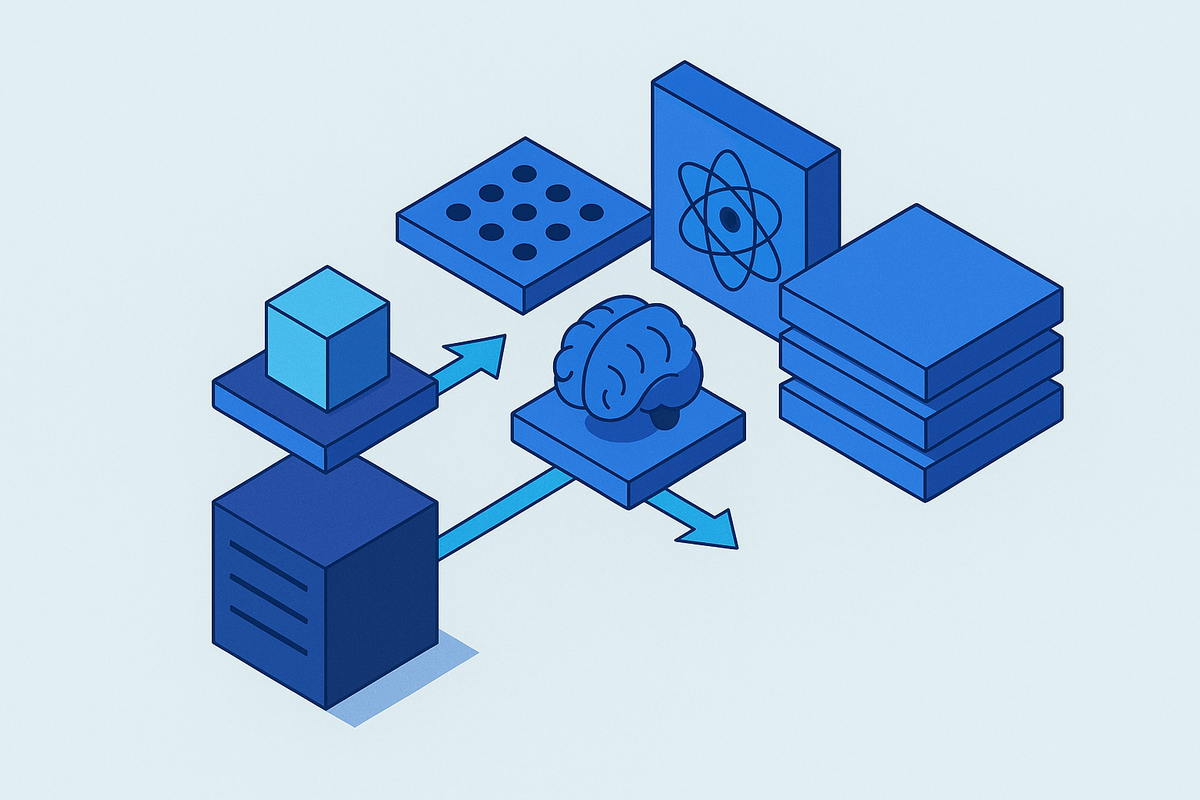
Multi-Agent Architectures Using LangGraph and AutoGen
How LangGraph and AutoGen solve multi-agent coordination differently.
I've spent enough late nights untangling why one team's LangGraph deployment hummed along fine while another's AutoGen setup ran up a bill nobody could explain until we traced it back to a conversation loop that never stopped talking to itself, to know this isn't a framework preference question. It's an architecture decision, and most teams stumble into it sideways. This piece covers the two patterns that actually dominate multi-agent coordination right now, LangGraph and AutoGen, and why how they're built matters more than whatever's on their feature lists.
A single agent is one model, one context window, one line of reasoning. That's fine until the task needs parallel work, specialized skills, or coordination stretched across hours or days. Multi-agent systems split the big task into scoped pieces, hand each piece to an agent built for it, and pass results forward through shared state.
Splitting the work is the easy part, though. Knowing when each agent should act, what gets handed off and when, and what happens the moment something breaks halfway through, that's the actual problem. Two patterns have emerged to handle it: graph-based stateful orchestration, which is LangGraph, and conversational agent collaboration, which is AutoGen. The rest of this is about the structural gap between them and why it decides which problems each one actually solves.
How LangGraph models agent workflows as stateful graphs
LangGraph treats a workflow as a directed graph. Nodes are steps, edges are transitions, state moves from one to the next. At any point you can look at exactly where things stand. That sounds obvious until you've debugged a system where you couldn't tell.
Designing one feels less like writing a script and more like laying out a board game before anyone touches a piece: you define the legal moves and the order of play first. That upfront design is what makes the behavior predictable. Nothing happens that isn't accounted for somewhere in the graph.
A handful of structural features do most of the work. Checkpointing lets execution pause mid-graph, get inspected, and pick back up later; for anything running over hours or days, it's the only real way to know what state a job is sitting in. Branching means edges can be conditional, so control routes to different nodes depending on shared state without a new graph built for each case. Retry logic means a failed node gets retried on its own instead of the whole workflow starting over, which matters once you're a dozen steps deep. Human-in-the-loop gates model an approval step as a node that just waits until someone signs off, then moves on.
A common setup is the supervisor pattern: one agent node acts as orchestrator, routing tasks to specialist sub-agents based on the graph's state. Control never leaves the graph. Everything traces back to a defined transition somewhere, which is the whole point.
LangGraph runs in production at LinkedIn, Uber, and a long list of other companies, and it hit general availability in May 2025. The LangChain team isn't shy about where they're pointing people: if you're building agents, use LangGraph over LangChain. It's the stated successor for orchestration, full stop.
How AutoGen models multi-agent collaboration through conversation
AutoGen starts from a different place. Agents talk to each other in a conversation loop, and orchestration falls out of that dialogue instead of getting mapped ahead of time.
AutoGen v0.4, released January 2025, rebuilt the thing on an actor model for better scaling and distributed support. Worth treating as a new project rather than a version bump, honestly, given how much got torn up and redone underneath.
Agents get roles, planner, executor, critic, and negotiate the task by passing messages back and forth. No graph of transitions sits underneath any of it. That buys real flexibility: agents can pivot mid-task based on what surfaces in conversation, which is why AutoGen tends to shine on open-ended work where the full path isn't known going in.
That flexibility costs something, though. Behavior depends on how agents respond to each other in the moment, which makes the whole thing harder to audit and harder to predict than a graph where every step is spelled out. The conversation loops aren't cheap to run either. I've watched setups burn through budget fast on high-volume, real-time work; AutoGen does its best work offline, on quality-sensitive jobs where getting the answer right matters more than getting it fast.
Microsoft folded AutoGen into Semantic Kernel in October 2025 to form a single Microsoft Agent Framework, with general availability slated for early 2026. The merged framework adds production SLAs, support for C#, Python, and Java, and deep Azure integration. Read plainly, Microsoft is staking out the enterprise lane for organizations already living in.NET and Azure.
The structural differences that determine which framework fits which problem
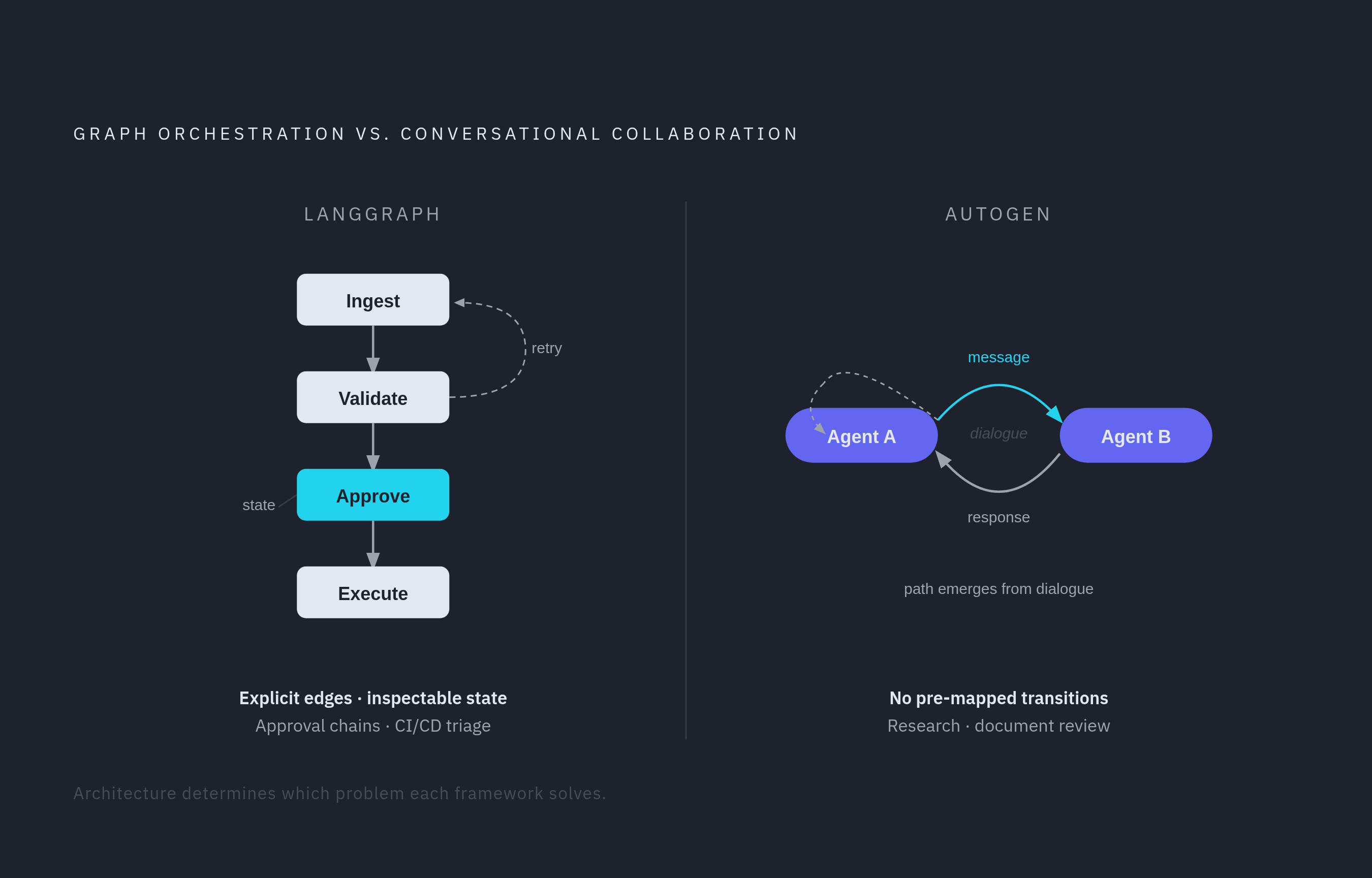
LangGraph and AutoGen aren't fighting over the same job. They sit at the same layer, orchestration, but they're built for different shapes of coordination problem. Choosing between them is a question about your workflow's topology, not a scorecard of which tool is engineered better.
LangGraph tends to fit when the workflow has known, bounded steps you can lay out ahead of time. It fits when you need auditability in production, because every transition has to be inspectable, or when human approval has to sit inside the loop, pausing execution until someone signs off. It fits when retry and recovery logic needs to be deterministic rather than something that emerges from agent behavior on its own. Think RevOps pipeline monitoring, CI/CD triage, multi-step approval chains.
AutoGen tends to fit when the full path isn't known upfront and agents need room to negotiate as they go. It fits research or synthesis work where thoroughness beats speed, or when a team already lives in Azure and.NET and the Microsoft Agent Framework is the natural next step. It fits workflows that run offline or in batch, where conversation overhead doesn't cost anything real. Think open-ended competitive research, document review from multiple angles, exploratory data analysis.
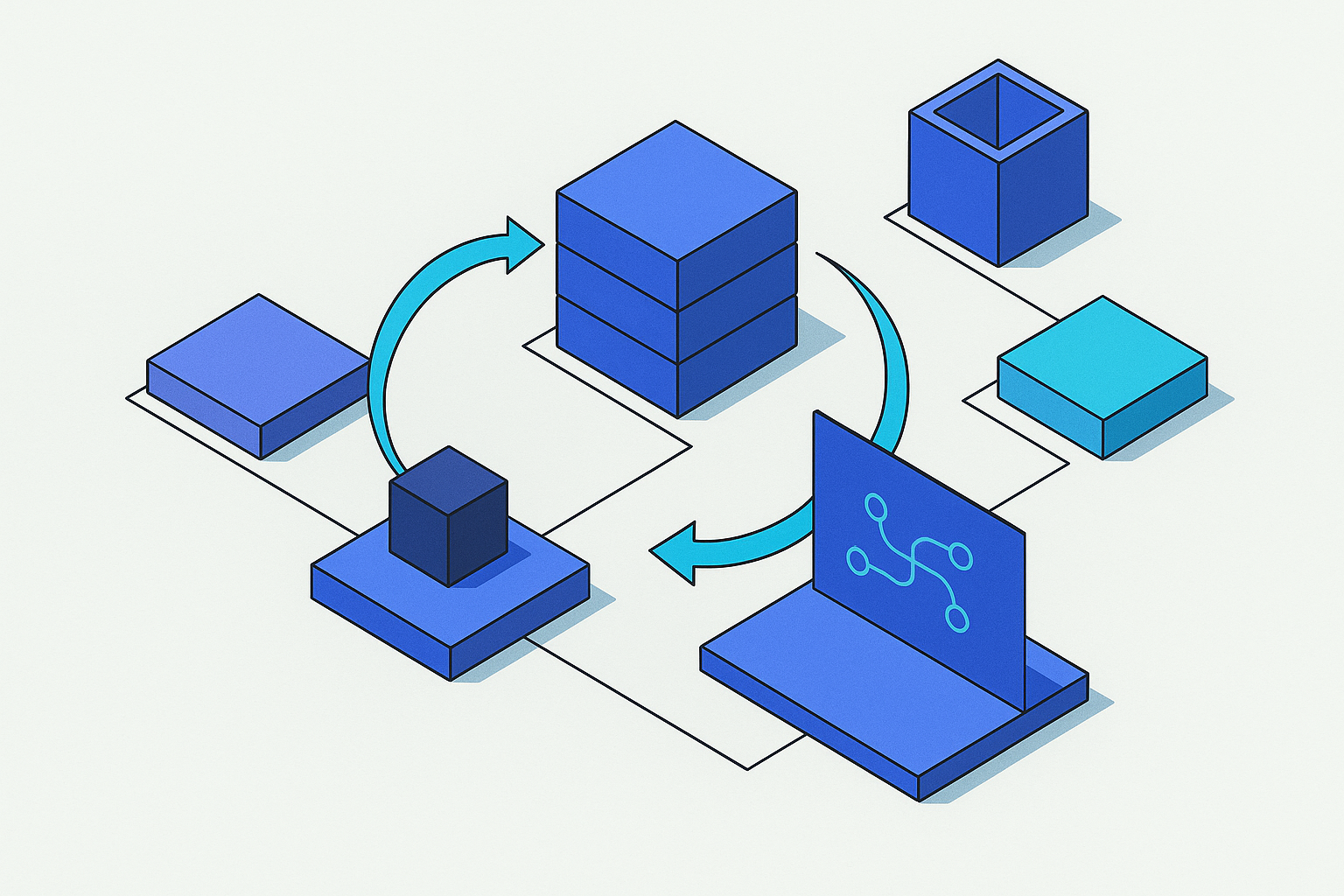
AutoGen leans toward chat-based agent autonomy. LangGraph leans toward flow-based agent engineering. They're not mutually exclusive: a LangGraph workflow can call an AutoGen conversation as a single node inside its graph, letting each pattern handle the part of the job it's actually good at.
Where tool access fits in — MCP as the interface layer below orchestration
Orchestration handles when agents act and how they coordinate. It says nothing about how an agent actually reaches a company's data or systems. That's a separate layer, and it's the one MCP, the Model Context Protocol, exists to solve.
Before protocols like this, every new data source meant a custom integration, one at a time. Connect a handful of AI applications to a handful of business systems and you're staring down something close to M times N custom builds. MCP turns that into M plus N: build the connection once per system, and any compliant client can use it from there.
MCP defines three primitives: tools, which are executable functions, resources, which are data access points, and prompts, which are reusable instruction templates. Any MCP-compliant agent can call any MCP-compliant server using those three, regardless of who built which end.
In a LangGraph setup, LangGraph runs the decision loop and manages the state graph while MCP supplies the actual tool calls agents make inside that loop. The LangChain MCP Adapters library makes MCP tools usable directly inside LangGraph agents, no manual wrapping needed. AutoGen agents can call those same MCP servers as tools inside their conversation loops too. The tool catalog doesn't care which orchestration layer sits above it.
That's the real payoff for a company with more than one team building agents: one MCP server layer serves multiple AI clients at once. A workflow gets registered as a persistent MCP tool that any authorized agent can call, instead of getting rebuilt from scratch every time a new client shows up. I've seen the integration line item on a budget shrink hard once a team stops writing point-to-point connectors and starts building against MCP servers instead. That's not a slide-deck number. It shows up in what the finance team actually sees at quarter end.
What enterprise governance requires from multi-agent stacks running in production
More agents acting on their own means more surface area for things to go wrong: errors, unauthorized access, decisions nobody can trace back to a cause. Multi-agent systems open that gap, and it doesn't close by itself.
LangGraph has a real edge here. Every state transition is a discrete, inspectable event, and checkpointing means a team can replay exactly what an agent did and why, after the fact. AutoGen's conversation-loop model makes this harder by default, since what happened is buried somewhere in message history instead of written into a transition log you can pull up later.
Permissions matter just as much as auditability, maybe more. MCP's authorization extensions, OAuth client credentials for machine-to-machine authentication, policy controls tied to an enterprise identity provider, let agents act on behalf of specific users with permissions scoped to that person. That's what keeps a team out of the superuser agent trap, where every agent shares one privileged credential set and can call tools no individual employee would ever be cleared to touch on their own.
The fix here is architectural, not procedural. Instead of one shared MCP server for the entire company, teams run scoped, virtual server environments: separate tool catalogs, separate audit trails, per team or role, all under one governance layer. Finance gets a read-only ERP server. Operations gets its own supply chain server. Same governance underneath, different scope on top.
Gartner has warned that a large share of agentic AI projects could get scrapped in the next couple years over unclear ROI and governance gaps. Teams building multi-agent systems without auditability baked in from day one are exactly the projects that warning has in mind.
How teams avoid rebuilding the same agent workflows across departments
Without a shared place to register workflows, every team that needs something similar, a research agent, a triage agent, an approval chain, ends up building it from scratch. New prompt logic, new tool wiring, new permissions, every time, for something that already exists somewhere else in the building.
A registry fixes that directly. A skill built once in LangGraph or AutoGen gets published, other teams find it, and nobody re-implements it just because they sit in a different department. Version control matters here too, because agents shift as the underlying models and tools shift. A shared drive full of prompt files with no record of who changed what, and why, isn't a registry. It's a mess waiting to happen.
MCP is what makes the publishing side work. A complex, multi-step LangGraph workflow gets exposed as a single MCP tool, and any authorized agent or chat interface in the company can call it without knowing anything about what's underneath. Permissions have to travel with the skill too: when another team's agent calls a published workflow, it runs under the calling user's permissions, not the original author's.
The scale of this problem is bigger than most teams expect going in, and integration eats a real chunk of implementation time on most agent projects I've seen up close, no matter what industry survey you want to cite for the exact figure. A governed registry of pre-built, pre-wired skills cuts straight into that number for every team after the first one that builds it.
In this model, a governed registry lets domain experts publish agent skills scoped to their own team's context and permissions, available company-wide without IT rebuilding the integration layer for every new person who needs access. Each team keeps its own scoped MCP surface, and that surface plugs into whatever agent or chat interface is already sitting on people's desktops.
Choosing an architecture pattern when the workflow topology isn't obvious
Start with the shape of the workflow, not loyalty to a framework's brand. A few questions do most of the work.
Can the steps and transitions get defined ahead of time? That points toward a stateful graph, LangGraph's home turf. Does the path emerge from what the agents discover along the way instead? That points toward a conversational loop, AutoGen or the Microsoft Agent Framework. Does a human need to review and approve mid-workflow? LangGraph's checkpointing was built for exactly that pause-and-resume moment. Is this offline and quality-sensitive, where conversation overhead is a fair price for thoroughness? That's AutoGen's strength.
Platform reality matters too. Organizations already committed to.NET and Azure have a clear road through the Microsoft Agent Framework. Python-first teams building production-grade orchestration have an equally clear road through LangGraph.
None of these layers rule each other out. MCP handles tool access and carries permissions across whatever client calls it. LangGraph or AutoGen sits above that, handling orchestration. A registry governs which workflows exist, who's cleared to call them, and which version is live right now. A LangGraph graph can call an AutoGen conversation as one of its own nodes; both can call MCP tools underneath; the whole stack can get published into a registry so nobody else has to rebuild it.
Governance needs a seat at the table when the architecture gets decided, not a retrofit six months after launch when something's already gone sideways. If a team can't say who's allowed to call which agent, what that agent can touch, and how its actions get logged, picking an orchestration framework is premature. That question comes first, and the orchestration and governance calls being made right now are what decide which of these programs are still standing in two years.