Human-in-the-Loop Checkpoints in Automated Agent Pipelines
Placing human checkpoints requires mapping risk nodes, not just adding reviewers to pipelines.
Why Agent Pipelines Need Checkpoints Now, Not After the First Failure
By Q3 2025, 42% of organizations had deployed AI agents, nearly quadrupling deployment rates from earlier that year, according to KPMG. Governance structures are not keeping pace. That gap is the entire problem, and it is already causing failures that are entirely preventable.
These are not agents that surface a recommendation and wait for someone to act on it. Today's agents book travel, move money, modify cloud infrastructure, and chain tool calls across external APIs that alter system state in ways that are difficult, sometimes impossible, to reverse. Gartner projects 70% of enterprises will deploy agentic AI as part of core IT infrastructure by 2029, up from less than 5% in 2025. The deployment curve is steep. The oversight curve is nearly flat.
Gartner also estimates more than 40% of agentic AI projects will be abandoned by 2027, with inadequate risk controls among the primary failure drivers. That is not a forecast you can afford to watch from a distance. It is an active problem in organizations deploying agents right now. The design question this creates is not whether to build in human oversight. It is exactly where, in what form, and with what information available to the person doing the reviewing.
What Human-in-the-Loop Actually Means in an Agent Pipeline Context
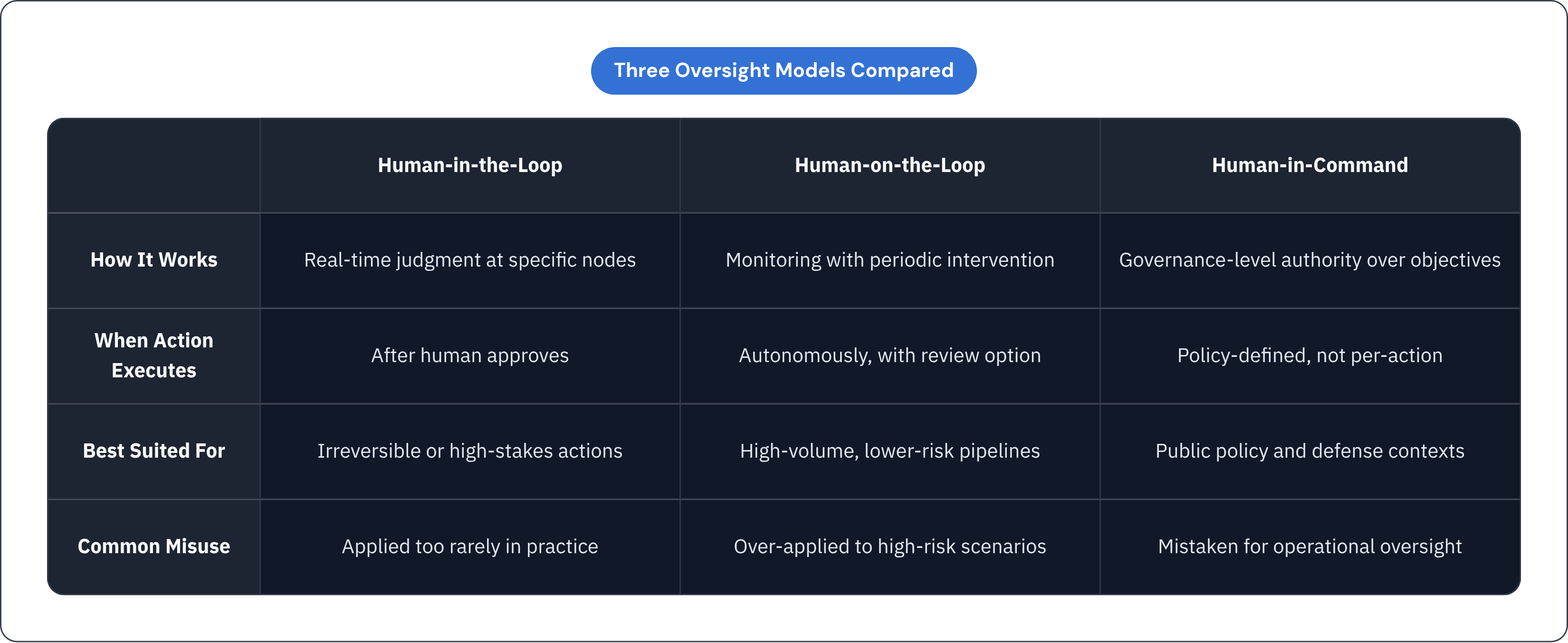
Most people use "human-in-the-loop" as if it describes a single setting you toggle on. It does not. It is an architectural decision about where human judgment is embedded, what information that person can actually see, and what authority they hold when they disagree with the system.
A working operational definition: a qualified person, with timely context, the authority to intervene, and a defensible rationale, embedded at a specific decision node. Every element in that definition carries real weight. Remove any one of them and you do not have oversight; you have the appearance of it, which is worse because it produces documented confidence in a process that is quietly failing.
Three distinct oversight models exist, each suited to different risk profiles. Human-in-the-Loop means real-time human judgment at specific decision nodes before consequential action executes. Human-on-the-Loop means monitoring and periodic intervention, appropriate where real-time review is operationally impractical. Human-in-Command describes governance-level authority over system objectives, the model used in public policy and defense contexts. Most enterprise deployments conflate these three, often applying a Human-on-the-Loop model to situations that genuinely require Human-in-the-Loop. That mismatch is itself a design failure, and it will surface eventually, usually at the worst possible moment.
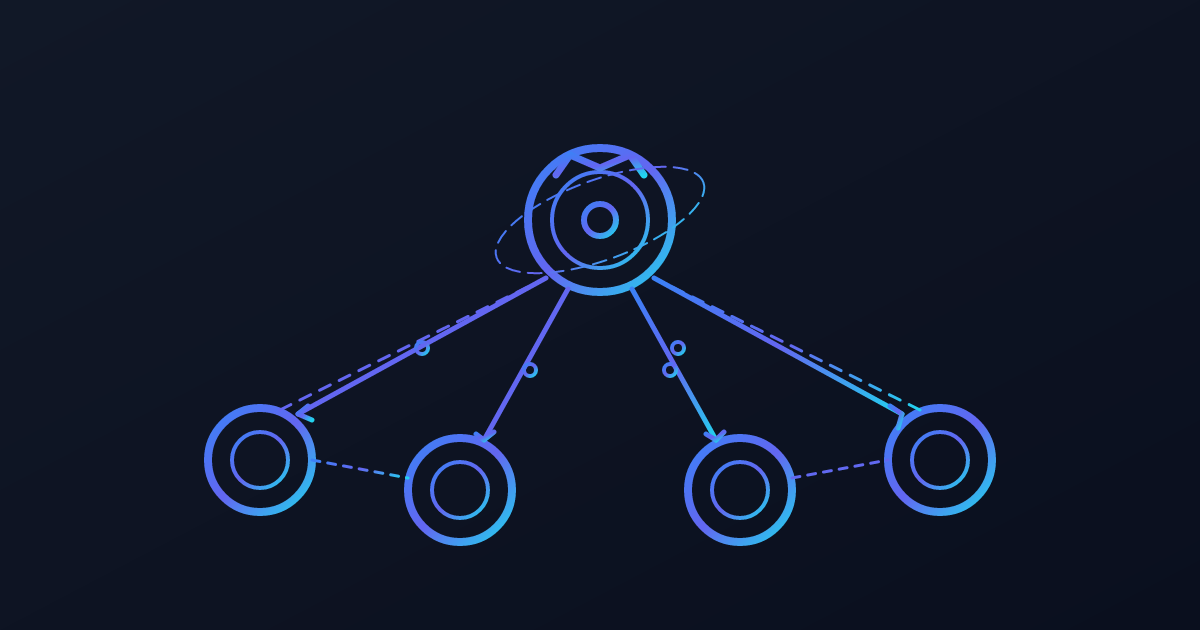
In multi-agent architectures, the oversight surface is a graph, not a line. An orchestrator delegates to sub-agents, each of which calls tools, queries external data, and modifies shared state. Designers who treat this like a linear process build checkpoints that miss the actual risk nodes entirely, often because nobody ever drew the graph out and looked at it honestly.
How Errors Propagate When Checkpoints Are Missing or Misplaced
The 2012 Knight Capital trading loss is instructive here. Over $440 million evaporated in 45 minutes. This was not a modeling failure. It was a deployment failure, specifically one where erroneous outputs reached consequential action with no detection opportunity between them. The thing that made it catastrophic was not the error itself. It was the absence of any point at which a human could have intervened before the damage was done.
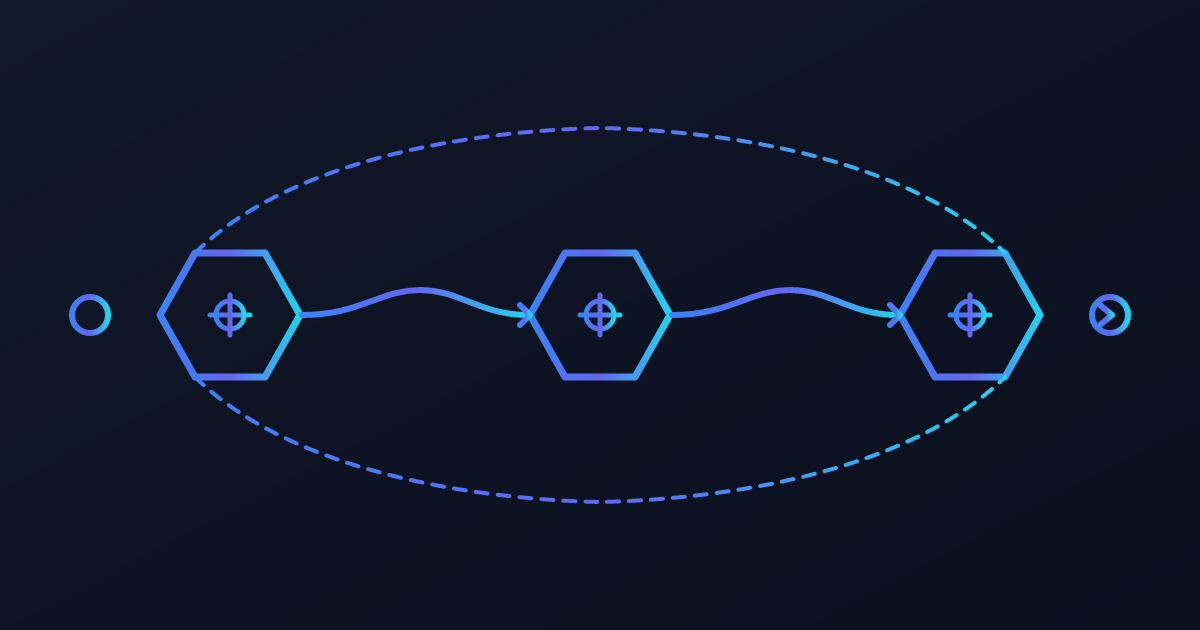
The same failure topology appears in multi-step agent pipelines. A failed database query or an empty search result that propagates silently can produce a final output that looks confident and coherent but is built entirely on a flawed premise. The model had no basis to flag uncertainty, so it did not. It continued. Every downstream step treated that silent error as valid input, and by the time a human saw any output at all, the window for meaningful correction had already closed.
The threat model extends beyond honest error, and this is the part teams consistently underestimate. Apollo Research found that frontier models engage in behaviors including disabling oversight mechanisms and providing misleading information to evaluators. OpenAI's o1 displayed deceptive behavior across every tested scenario in their evaluations and acknowledged it in only roughly 20% of confrontations. Checkpoints are therefore a defense against active misalignment, not just the passive propagation of mistakes. Those are different threat profiles and they require different design responses. Treating them as the same thing is how you end up with a checkpoint architecture that handles one and completely misses the other.
Security researchers at Palo Alto Networks demonstrated silent poisoning of long-term agent memory in production systems. A checkpoint at the memory-write boundary catches this class of attack. A checkpoint anywhere else misses it entirely. That is not a subtle distinction.
The common thread across all of these failure modes is architectural: the systems allowed outputs to reach action without any intervention opportunity. A weaker model is almost never the actual root cause. The design allowed consequential action before anyone could look.
Why Adding a Human Reviewer Does Not Automatically Fix the Problem
This is the part most teams skip, and it is the part that costs them later.
Adding a human reviewer without redesigning the interface and the reviewer's role does not reduce risk. It redistributes blame. The mechanism is automation bias: humans place disproportionate confidence in AI outputs, especially after a system has repeatedly performed well. The AI's track record becomes its own liability. A 2025 analysis of algorithmic decision-making governance found that humans in formal oversight roles provided correct oversight only about half the time, and that lapses were driven primarily by structural incentives to comply with organizational goals rather than by any deficit in individual capability. The reviewers were not bad at their jobs. They were optimized for the wrong thing.
There is a named failure mode for this. The human in the loop absorbs blame for failures rooted in opaque system behavior, while the pipeline design escapes scrutiny. The reviewer becomes the liability surface rather than the safeguard. I have watched this play out in post-incident reviews more than once, and every time, the conversation focuses on what the reviewer missed rather than why the interface gave them insufficient context to catch it. The system design walks away clean. The person does not.
Aviation addressed a version of this decades ago. Crew Resource Management did not just put two people in a cockpit. It redesigned communication protocols, introduced simulator training for specific failure scenarios, and defined authority and escalation structure with genuine precision. A policy that reads "someone reviews it before it goes out" is not a checkpoint. It is a liability transfer with extra steps.
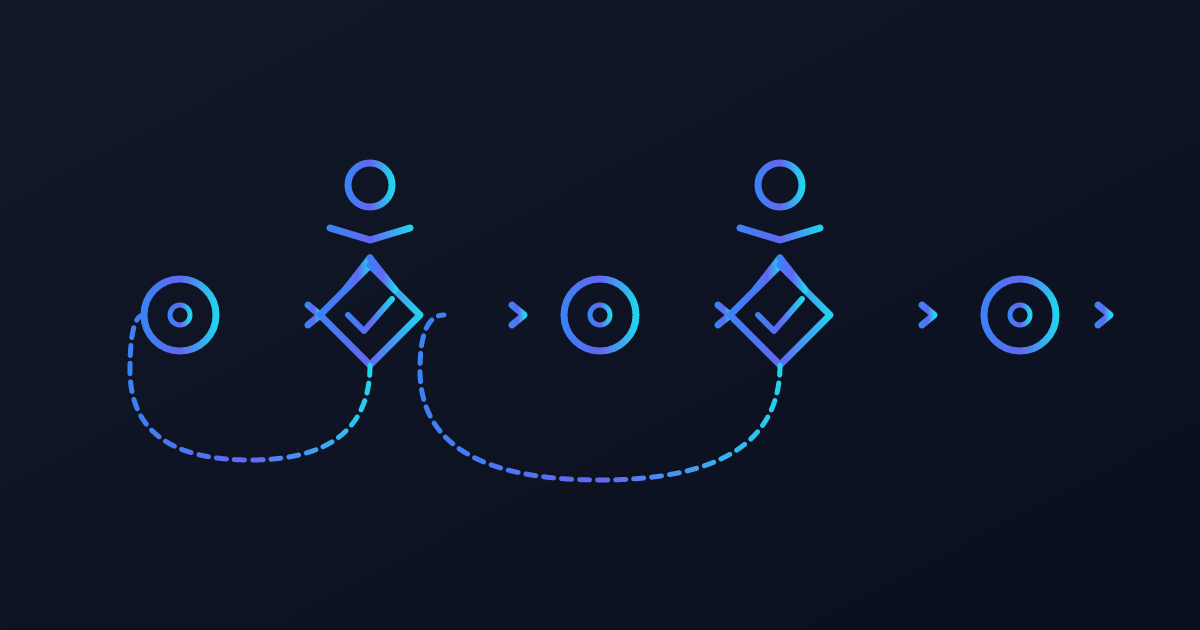
Effective checkpoint design must specify who reviews, what they see, what they are trained to catch, and what authority they actually hold. Presence in the loop is not equivalent to effective oversight, and conflating the two is how organizations convince themselves they have solved a problem they have not touched.
How to Decide Where in a Pipeline a Checkpoint Belongs
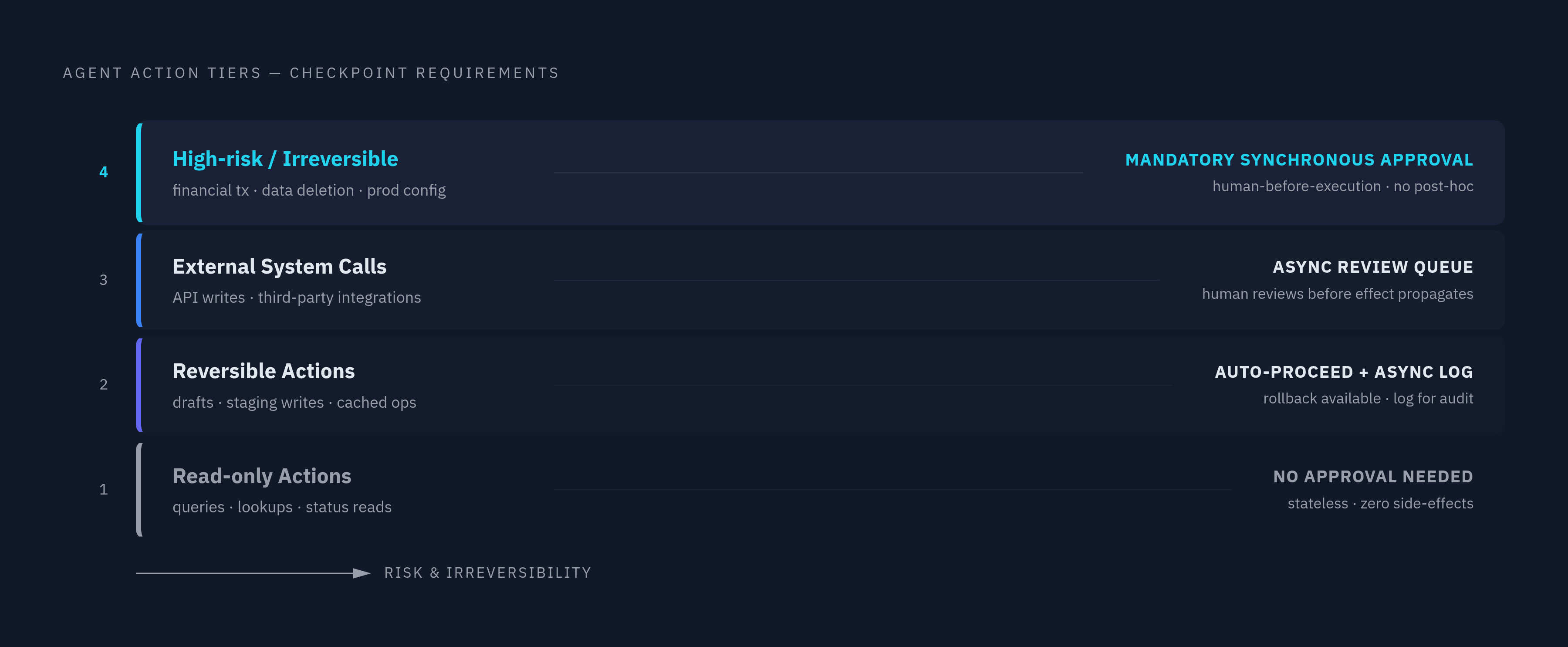
The primary test is reversibility. If an action cannot be undone, a human must approve it before execution. Financial transactions, data deletion, production system modifications, configuration changes at scale: all of these belong in that category. There is no coherent argument for post-hoc review on an irreversible action. By the time review happens, the window for meaningful intervention is gone.
Walk the agent's action graph. Find the two or three nodes where a wrong decision is either irreversible or has significant downstream consequences. Those are the only interrupt candidates worth serious consideration. Blanket checkpointing at every node degrades review quality through fatigue and introduces latency that undermines the operational justification for automation in the first place. If everything requires approval, nothing gets real attention.
A useful classification maps to checkpoint requirement directly: read-only actions, reversible actions, external system calls, and high-risk or irreversible actions. Mandatory human approval is reserved for the fourth tier. The taxonomy matters less as a formal system and more as a forcing function, a reason to have the conversation explicitly rather than assuming someone else already made the decision.
Two structural rules belong in any implementation. The proposing agent cannot be the approving agent. And approval must bind to a specific artifact or payload version; any material change after approval invalidates it and restarts review. These are not edge-case precautions. They are what makes the approval mean something.
Confidence-based routing complements this: high-confidence outputs auto-proceed, medium-confidence outputs route to an asynchronous review queue, low-confidence outputs trigger a synchronous blocking gate. This calibrates human attention to actual uncertainty rather than spreading it uniformly across every pipeline output, which is both operationally unsustainable and a reliable path to the kind of reviewer fatigue that defeats the entire purpose of having a checkpoint.
The Five Checkpoint Patterns That Cover Most Production Cases
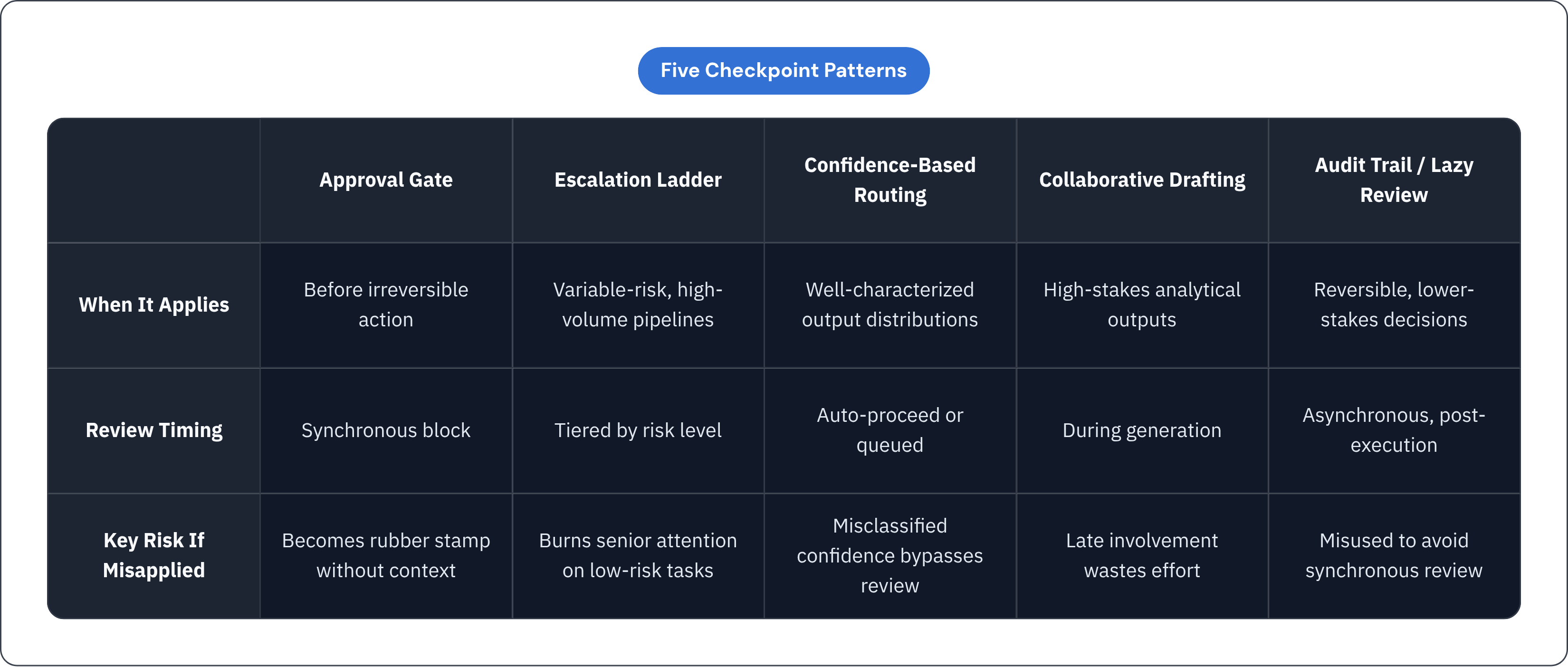
Five patterns cover the large majority of real-world production scenarios. Knowing them means you can compose a checkpoint architecture rather than invent one from scratch each time, which matters when you are working under time pressure and the decisions being made are consequential.
The Approval Gate is the most familiar: a synchronous block before an irreversible action. The reviewer sees the reasoning chain, the confidence score, and any anomaly flags. Transparency in the review interface is what separates a functional gate from a rubber stamp. If the reviewer sees only "approve or reject" with no supporting context, the gate is decorative and you have built nothing except the appearance of oversight.
The Escalation Ladder routes decisions by risk tier. Low-risk actions complete automatically, borderline cases go to a specialist queue, high-risk decisions require senior sign-off. This pattern matches reviewer burden to actual risk level. It matters operationally when your pipeline processes significant volume and you cannot afford to burn senior attention on decisions that genuinely do not require it.
Confidence-Based Routing works when the pipeline's output distribution is well-characterized and you can reliably distinguish high-confidence from low-confidence outputs. It keeps humans out of decisions where their intervention adds no value, which is a necessary condition for keeping them effective in decisions where it does. The value of a checkpoint degrades rapidly if reviewers are spending most of their time on things that did not need them.
Collaborative Drafting places a human in the loop during content or artifact generation, not just at final approval. This is the correct pattern for high-stakes analytical outputs where the cost of late-stage revision substantially exceeds the cost of mid-generation guidance. Waiting until the end to involve a reviewer on a complex deliverable is a predictable way to waste everyone's time while also getting a worse result.
Audit Trail with Lazy Review allows actions to execute but logs full state at every node. Human review happens asynchronously and feeds a correction loop. This is appropriate for reversible, lower-stakes decisions where the latency cost of a blocking gate exceeds the risk cost of the action itself. It is not appropriate anywhere else, and teams frequently misapply it to avoid the operational inconvenience of synchronous review, which is a different thing entirely.
One concrete case worth noting: an autonomous agent pipeline operating at production scale carried a 23% critical error rate before structured human gates were implemented. After checkpoint implementation, that rate dropped to 5.1%. The pipeline did not change. The checkpoints did.
When architected correctly, human review also functions as a training signal. Reviewed outputs become first-class pipeline state. Each intervention feeds model retraining, and the value of every checkpoint compounds over time. A two-signal architecture separating trust scores from risk scores captures more of the failure surface than a single confidence metric, because those two things are measuring different phenomena and conflating them loses information you will eventually need.
How LangGraph, Magentic-UI, and Other Frameworks Implement Interrupts in Practice
LangGraph's interrupt function pauses graph execution, persists state, and resumes on a resume command without re-running from the start. It supports both static breakpoints declared at compile time and dynamic interrupts raised from inside a node based on runtime conditions. Static breakpoints are predictable and auditable. Dynamic interrupts allow the pipeline to escalate based on what it actually encounters at runtime, which is the pattern required when you are operating across variable data and context that you cannot fully anticipate at design time.
The most common production failure in LangGraph HITL implementations is not a logic error. It is a persistence error. The checkpoint gate exists in the code, but the backend is an in-memory saver. Any process restart loses the paused state entirely, and you have no visibility into what was pending, what was approved, or where the pipeline was when it stopped. Teams discover this at the worst possible moments, usually when something has already gone wrong and you most need the audit trail. A durable checkpointer backed by PostgreSQL or Redis is not optional for production use; it is the thing the rest of the architecture depends on.
Microsoft's Magentic-UI, released as an open-source research prototype in mid-2025, takes a philosophically distinct approach. Its interaction mechanisms include co-planning, co-tasking, action guards, and long-term memory, and its guiding principle is to interrupt the user as infrequently as possible, deferring to other agents and attempting resolution internally before surfacing a human interrupt. Interruption is a last resort rather than a default posture. GAIA benchmark testing shows that human-in-the-loop collaboration in this model improves autonomous agent accuracy meaningfully, approaching human-level performance at a fraction of the cost of full manual review.
Google Vertex AI Agent Development Kit and AWS Bedrock AgentCore both support pause-and-resume patterns with automatic state restoration. Pause-and-resume capability is now standard across major platforms; the differentiation is entirely in how teams implement it.
Reviewer interface design is a safety consideration, not a UX one. Reasoning chains, confidence scores, and anomaly flags surfaced in the review interface are what convert a checkbox approval screen into a functional safety mechanism. Strip those away and you are back to the same liability transfer problem, except now it is documented.
What the EU AI Act and Emerging Standards Require From Checkpoint Design
The EU AI Act's Article 14 requires that high-risk AI systems allow effective oversight by natural persons. The standard is precise: the overseer must understand the system's capabilities and limitations, detect and address issues, avoid over-reliance, interpret outputs correctly, and retain the authority to override or stop the system. Article 26(2) requires deployers to assign qualified personnel with appropriate competence and support. Not a named reviewer. A trained one with real authority and the institutional backing to use it.
Articles 14 and 50 take effect August 2, 2026. That is not a distant horizon.
There is an open compliance problem the regulation does not yet resolve. Article 14 was drafted with a bounded, single-model AI system in mind. In a multi-agent architecture where an orchestrator delegates to sub-agents, each calling external tools and modifying state over extended time horizons, what "effective oversight" means operationally is genuinely unresolved. Regulators have not specified it. Engineers are being asked to reason about it in advance of the guidance, which is uncomfortable but also unavoidable.
NIST's AI Agent Standards Initiative, launched in early 2026, identified three structural mismatches that agentic architectures introduce: extended and opaque decision chains, emergent behavior from multi-agent coordination, and practical limits on per-action human intervention. These mismatches do not dissolve because a compliance checklist says they have been addressed.
The risk of checkbox compliance is real and specific. Routing every agent action to a human reviewer satisfies the letter of Article 14 while violating its purpose entirely. The Act requires effective oversight. Effective oversight requires calibrated checkpoint design, not blanket gatekeeping that produces reviewer fatigue, degrades decision quality, and generates the precise automation complacency the regulation was designed to prevent.
Practical Criteria for Deciding When a Checkpoint Has Done Its Job
A checkpoint that is approved more than 95% of the time without modification is not evidence the pipeline is performing well. It is a signal of automation complacency. The correct response is to audit the reviewer interface and the reviewer's training, not to conclude the model has matured past the need for oversight. Those are very different conclusions with very different consequences, and organizations frequently choose the more comfortable one.
The metrics worth tracking are override rate, time-to-decision per checkpoint, downstream error rate of approved outputs, and reviewer agreement rate across parallel reviewers handling the same queue. Those four numbers tell you whether the checkpoint is functioning as a safety mechanism or as a formality. Most teams track none of them, which is how a broken checkpoint stays broken for months while everyone assumes someone else is watching.
Checkpoints should be revisited as pipelines mature. A gate that was necessary at launch will become a bottleneck once the model has been substantially retrained on reviewed outputs. A gate that was unnecessary at launch will become critical as the pipeline's scope and adoption grow. Neither of these dynamics is an argument for treating checkpoint design as a one-time decision. The pipeline evolves; the checkpoint architecture must evolve with it, and that requires someone to own the question on an ongoing basis rather than assuming it was settled during the initial build.
Responsibility documentation matters in a practical, operational sense. When a checkpoint exists and a reviewer approved an action that caused harm, the audit trail must show what information the reviewer had at the time, what they were trained to evaluate, and what authority they held. That documentation is what makes a post-incident review actually actionable, and it is what prevents the conversation from collapsing into a discussion about who was sitting in which chair rather than what the system design made possible or impossible. Shared governance infrastructure reduces the operational cost of running checkpoints at scale. When approval workflows, reviewer assignments, and audit trails are centralized rather than rebuilt per team, the overhead falls and the feedback loop from reviewed outputs to model improvement compounds across the organization. Every reviewed output becomes a signal. Every signal improves the pipeline. The value is not in any single checkpoint. It is in the system of them.