Benchmarking Multi-Agent System Performance in Enterprise Settings
Enterprise AI agents succeed or fail on cost, reliability, and access control—not just accuracy.

Most companies running generative AI pilots right now are stuck at the demo stage. Research finds 85% of companies experimenting with generative AI, but McKinsey's 2025 research found fewer than 10% report scaling agents in any single function. MIT put a sharper number on the same problem in 2025: roughly 95% of enterprise generative AI pilots deliver no measurable return, and the cause is mostly integration failures, weak models playing only a minor role. The gap between pilot and production is a benchmarking problem as much as a model problem, and most people are looking at the wrong scoreboard.
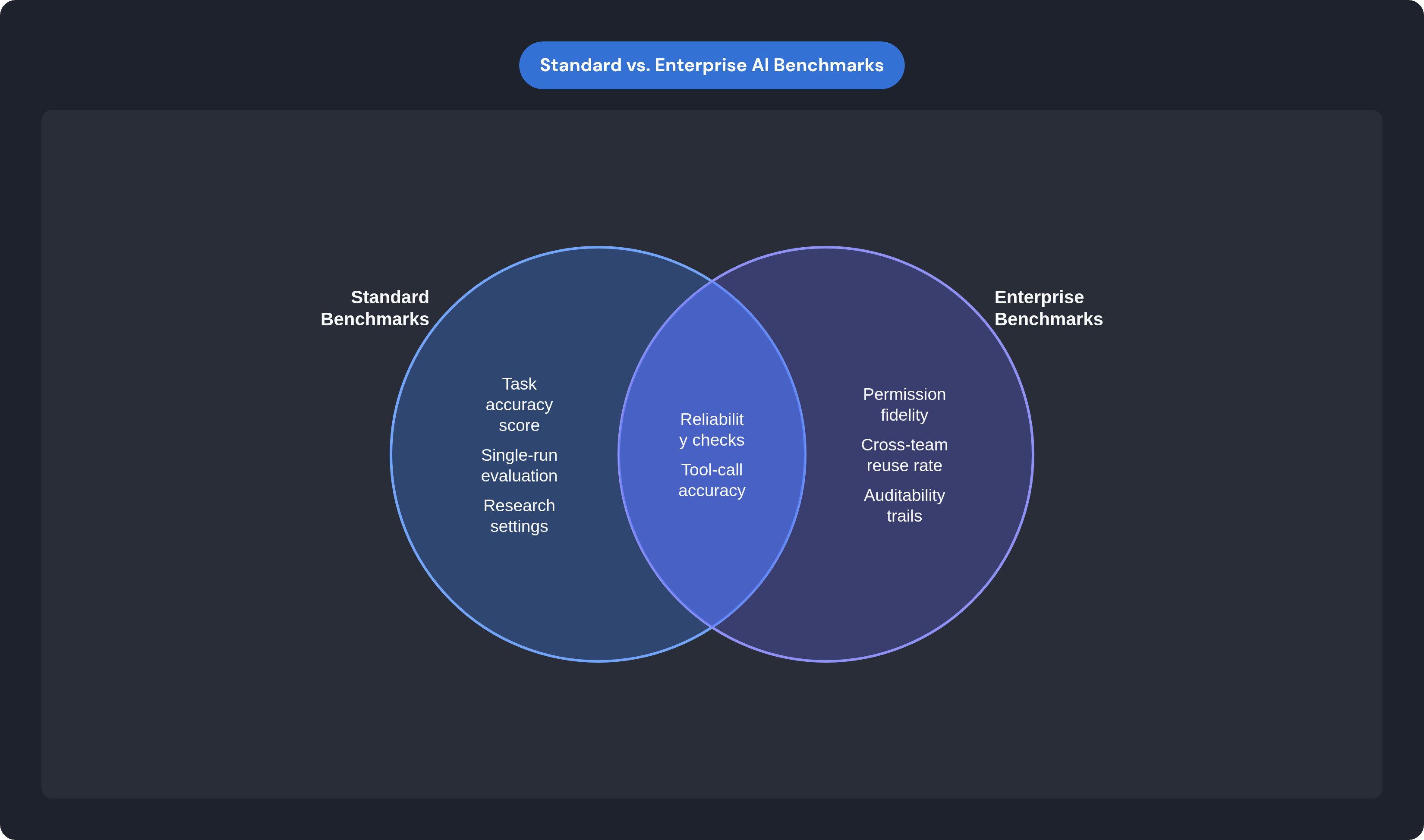
Standard benchmarks measure whether an agent completes a task correctly. Fine, that's worth knowing. But it maps poorly onto whether a company actually gets value from running that agent every day, across the hundred edge cases nobody wrote a test for. Cost per task, permission fidelity, cross-team reuse, auditability, reliability across repeated runs: none of these show up on the leaderboards that dominate the conversation right now. Models have gotten better fast, but the tools we use to judge them were built for tidy research settings. Put those same models into a real company with real access controls and real messy data, and the cracks show up fast.
How multi-agent coordination changes what "performance" means
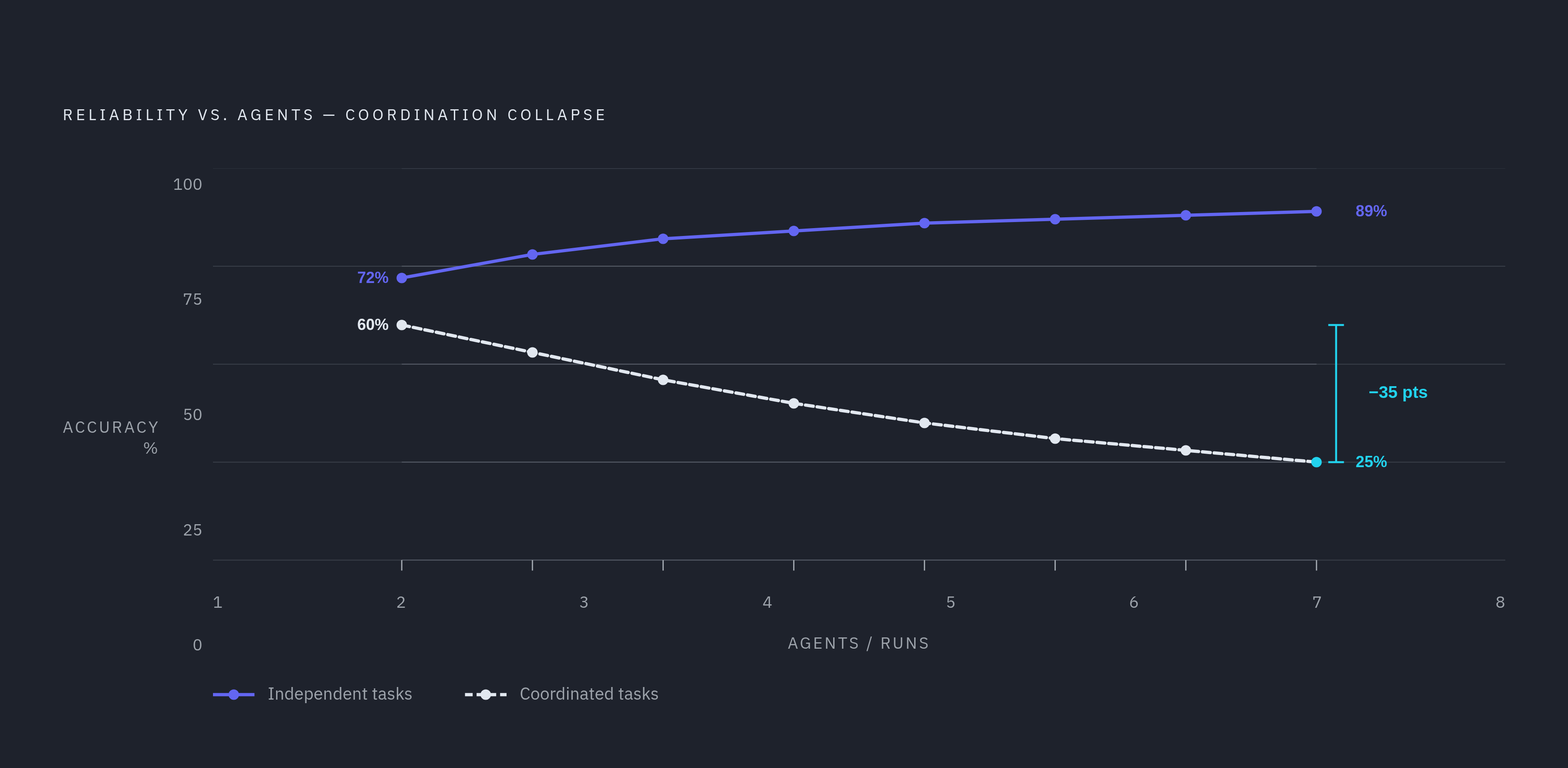
On tasks like HumanEval, which don't need real coordination, throwing more agents at a problem tends to help. Ensemble voting lets individual mistakes cancel out; five agents working together can push accuracy up to around 89%. It looks like a clean line: more agents, better results.
That line bends the other way once the task actually needs teamwork. Coordination overhead grows as agents interact more, and each one ends up working off a slightly different picture of the world. Errors pile up instead of averaging out. Research documents exactly this pattern: reliability dropped 35 points, from 60% on a single run down to 25% across eight runs. That pattern held across models and setups, and it's what happens when a benchmark only checks the best case instead of run six.
Tool-calling accuracy carries more weight than raw reasoning when it comes to whether an agent actually reaches production. Evaluation has to look at the integration layer, where agents call APIs and pass data between steps, not just the final answer. Adding more agents to a pipeline isn't something you should default to. Single-agent setups often outperform expectations, plain and simple. Every extra agent has to earn its spot with evidence, not get added because it seemed like the fancier choice.
Cost, reliability, governance, reuse. Once you see how coordination behaves under load, these are the things worth measuring.
Cost per task as a first-class benchmark dimension
No major benchmark tracks cost, even though it's about as measurable as anything gets. Research posted on arxiv found up to 50x variation in cost between leading agents doing comparable work, roughly $0.10 to $5.00 per task. A 2-point bump in accuracy can add $50,000 across 10,000 tasks. Architectures like Reflexion, which iterate and refine their own output, can rack up 2,000 API calls for a single task. None of that shows up if accuracy is the only number on the report card.
Uber's experience is the clearest real-world version of this I've come across. After rolling out Claude Code and Cursor to around 5,000 engineers, the company burned through its entire 2026 AI budget in four months. It responded by capping spend at $1,500 per engineer, per month, per tool.
Measuring cost properly comes down to a few concrete habits: track token use per agent action, not just per session, log API calls across every tool in the pipeline, not just the model call, build cost-accuracy curves instead of flat rankings, and set spend caps when the agent gets designed, not after the bill shows up.
An agent that's 2 points more accurate but costs ten times as much is rarely the better pick for enterprise work. Leaving cost out of the benchmark will point teams toward the wrong agent by default, every time.
Reliability under repeated runs and the enterprise standard for "production-ready"
Working sometimes falls short of a production standard. Enterprises under compliance and audit requirements need behavior that repeats and holds up to explanation, since a system that gets it right when someone's watching won't necessarily hold up when nobody is. That 35-point reliability drop under repeated testing isn't a defect specific to one system; it's a structural fact about how most benchmarks get built. A single-run evaluation tells you about a good day, not an average one.
A reliability benchmark built for enterprise use looks different. It runs multi-run pass rates across varied inputs instead of one clean pass. It checks regressions: does performance fall apart when a tool schema changes or upstream data shifts? And it grades on trajectory, meaning it checks whether the agent called the right tools in the right order, not just whether it landed on the right final answer.
Gartner's warning that 40% of AI projects fail, largely from insufficient evaluation and governance, lines up with this directly. Teams that run trajectory checks during development catch regressions before users ever see them. In finance, healthcare, legal, anywhere regulated, reliability has to include the ability to reconstruct exactly what happened and why. "Did it work" is rarely the whole question.
Permission fidelity as a governance benchmark
Permission fidelity means an agent only answers using data the person asking is already cleared to see. This isn't a dial you turn up or down. It's binary: either the agent respects access controls, or it doesn't.
For years, every new AI tool meant redefining permissions from scratch, cut off from whatever access controls already existed in the source systems. MCP's inheritance model changes that. A properly built MCP setup carries source-system permissions through to whatever the agent says back. But being "MCP-connected" doesn't automatically mean permission fidelity is enforced. The real question is whether the setup actually inherits those controls and respects them, and that calls for testing, not a vendor's claim taken at face value.
A permission-fidelity benchmark checks a few specific things. Does the agent hand back data a lower-privileged user shouldn't see, when that user is the one asking? Do permissions update the moment access gets revoked upstream, or is the agent working off a stale, cached picture of who's allowed to see what? Can an orchestrator agent calling a sub-agent with broader access leak data across departments through that composition?
Skip this evaluation and you get shadow AI: teams wiring agents into tools with no oversight, creating data exposure that no central team can even see, let alone administer. Some platforms address this by inheriting permissions automatically from connected sources and scoping them per team, offering one working example of how this gets handled in practice.
Auditability as a measurable property, not a compliance checkbox
Auditability goes beyond logging. A log tells you something happened. An auditable system tells you who approved the action, under what permissions, in which version of the workflow, and when.
In a multi-agent pipeline, that requirement compounds fast. An orchestrator calls a sub-agent, the sub-agent calls a tool, the result feeds back up the chain, and if any single step in there is unversioned or unattributed, accountability breaks somewhere in the middle. An agent that lands on the right answer through an unauthorized data path hasn't passed the audit, no matter how good the output looks.
An auditability benchmark checks whether every agent action traces back to a specific version of the skill or workflow that produced it, whether the approval chain is visible (who published the skill, who signed off on the tool call, what access policy was live at the time), and whether a compliance team can rebuild the full path of any production run without digging through the AI provider's own infrastructure. MCP's Enterprise Managed Authorization framework, with OAuth client credentials for machine-to-machine flows and policy controls tied to enterprise identity providers, supplies the plumbing for this. Whether an organization actually uses it, and whether that use gets checked rather than assumed, is the real benchmark question. A versioned skill registry, where every change is attributed and every rollback traceable, is what makes any of this workable once you're past a handful of agents.
Cross-team skill reuse as an organizational efficiency metric
Almost every enterprise AI benchmark works at the level of a single agent or a single task. None of them ask whether a capability one team built is actually available to the next team, or whether that next team just rebuilds it from scratch.
Skip that measurement and the costs pile up quietly. Five teams end up building the same prompt-and-tool workflow independently, and the budget that should've gone toward something new goes toward reinventing something that already exists. Each rebuild carries its own assumptions, its own permission boundaries, its own failure modes. The variation compounds, and nobody can see what anyone else has already built, because there's no registry to check against.
A reuse benchmark answers a few direct questions. What share of new agent deployments reuse an existing, governed skill instead of starting cold? How many teams have picked up a skill another team published? How much faster does a new use case ship when it composes existing skills versus building everything from zero?
None of this is measurable without a skill registry that tracks version, ownership, and access scope; a shared drive full of prompts doesn't cut it. A well-designed registry model, where a skill built in one department gets published once and becomes discoverable company-wide with permissions inherited automatically, answers that gap directly. Reuse rate doubles as a governance signal, too. High reuse generally means fewer ungoverned, one-off agents floating around, while high agent volume paired with low reuse usually points to fragmentation, or shadow AI nobody's tracking yet.
What emerging enterprise benchmarks are starting to get right
Some of the newer benchmarks are closing part of this gap. Some newer benchmarks are built for realistic multi-agent scenarios instead of isolated task completion, running across multiple frameworks and model families. Other efforts push toward multi-dimensional assessment instead of a single accuracy score, a direct response to the production-reality gap. Other efforts test developer agents across full engineering workflows spanning the whole development lifecycle instead of one isolated task.
That's real progress, though a partial one. None of these cover permission fidelity across different user roles, cross-team reuse rates, cost-accuracy trade-offs under actual production load, or whether the full approval and action chain can be pieced back together after the fact. Academic and vendor benchmarks are converging on realistic workflows, and that's genuinely good news. Governance, though, needs organizational context that an outside benchmark structurally can't have. It doesn't know your access controls, your team structure, or your compliance requirements. That part gets built in-house, or it doesn't get built at all.
Building an internal benchmarking framework that covers the dimensions that matter
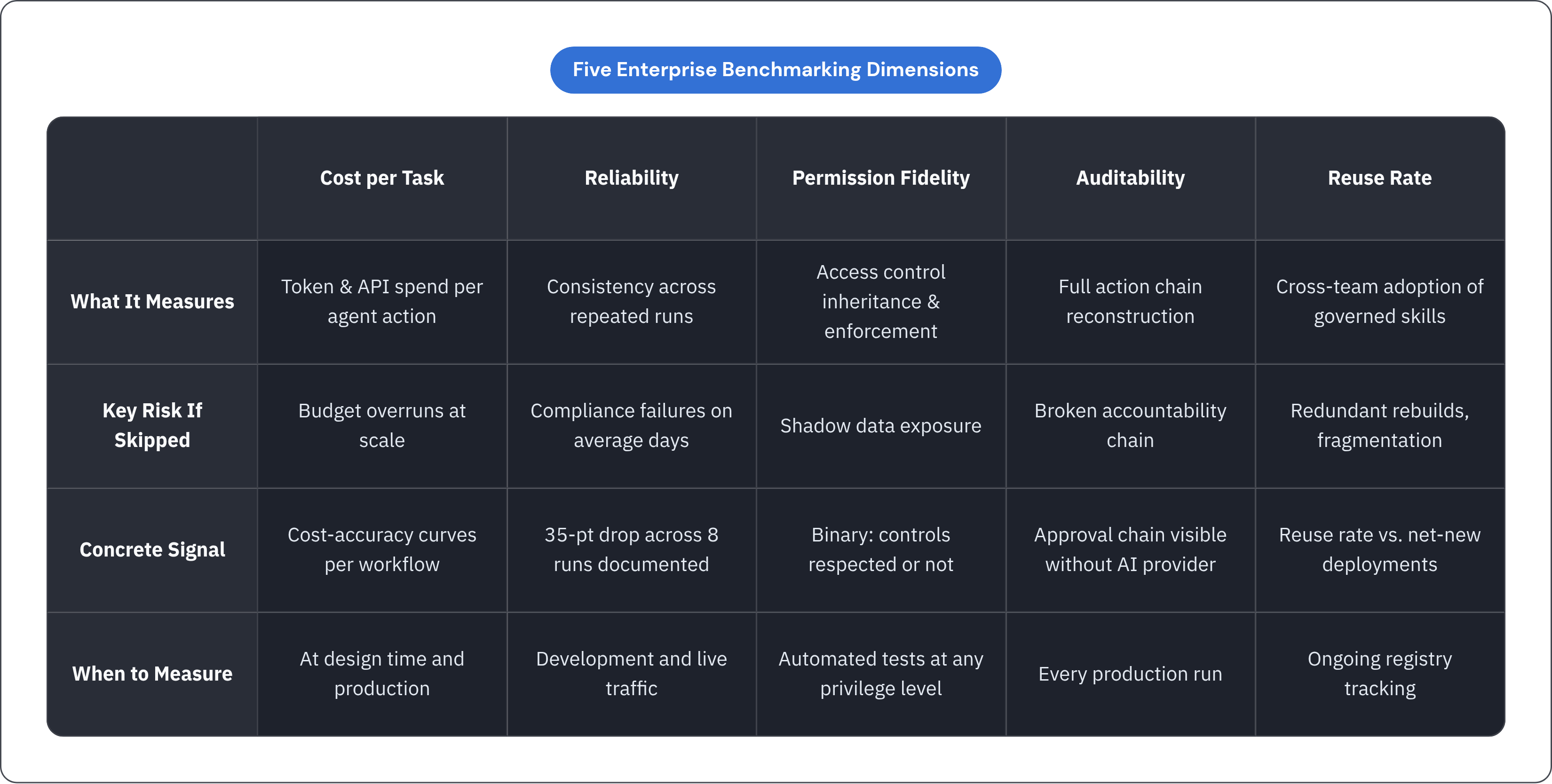
External benchmarks are still worth running. An internal framework fills the part they can't reach by design.
Five dimensions need real instrumentation. Cost per task means logging tokens and API calls per agent action, keeping cost-accuracy curves per workflow, and setting spend caps at design time that get checked against actual spend, the way Uber eventually had to after the fact. Reliability means multi-run pass rates across varied inputs, trajectory checks on tool-call sequences alongside final answers, and regression detection when a schema or upstream data source changes. Permission fidelity means automated tests run with accounts at different access levels, tests for dynamic revocation, and checks for privilege escalation through agent composition. Auditability means full reconstruction of the action chain for every production run, version attribution on every skill and workflow, and an approval chain visible without needing access to the AI provider's own systems. Reuse rate means tracking registry coverage, cross-team adoption counts, and how much faster composed builds ship compared to net-new ones.
None of that works without the right plumbing underneath it: a versioned skill registry with ownership and change history instead of a shared folder, MCP servers scoped per team with permissions inherited from source systems instead of manually redefined every time a tool or team changes, and gateway-level visibility into agent activity happening outside the registry, so shadow AI surfaces before it turns into a real exposure.
Timing matters almost as much as the measurement itself. Trajectory checks belong in development, where they catch regressions before anything reaches a user. Reliability and cost benchmarks need to run against actual production traffic, because staging inputs never surface what real usage does. A governed setup combining a versioned registry, inherited permissions, scoped MCP servers per team, and full auditability of agent actions is built to make these five dimensions measurable from day one, instead of something every company has to figure out cold.
Catching failures earlier matters, though that's a partial payoff at best. Benchmarks built around these five dimensions give platform teams and domain teams a shared language for what "production-ready" actually means, instead of arguing past each other in every review meeting. Skipping that leaves scaling AI investment working against governance instead of alongside it.