Auditability and Explainability Requirements for Enterprise AI
Organizations must audit what agents actually do, not just explain what models decide.
Conflating these two things is the single most expensive mistake organizations make in AI governance. It happens constantly, and it is almost never caught until something breaks.
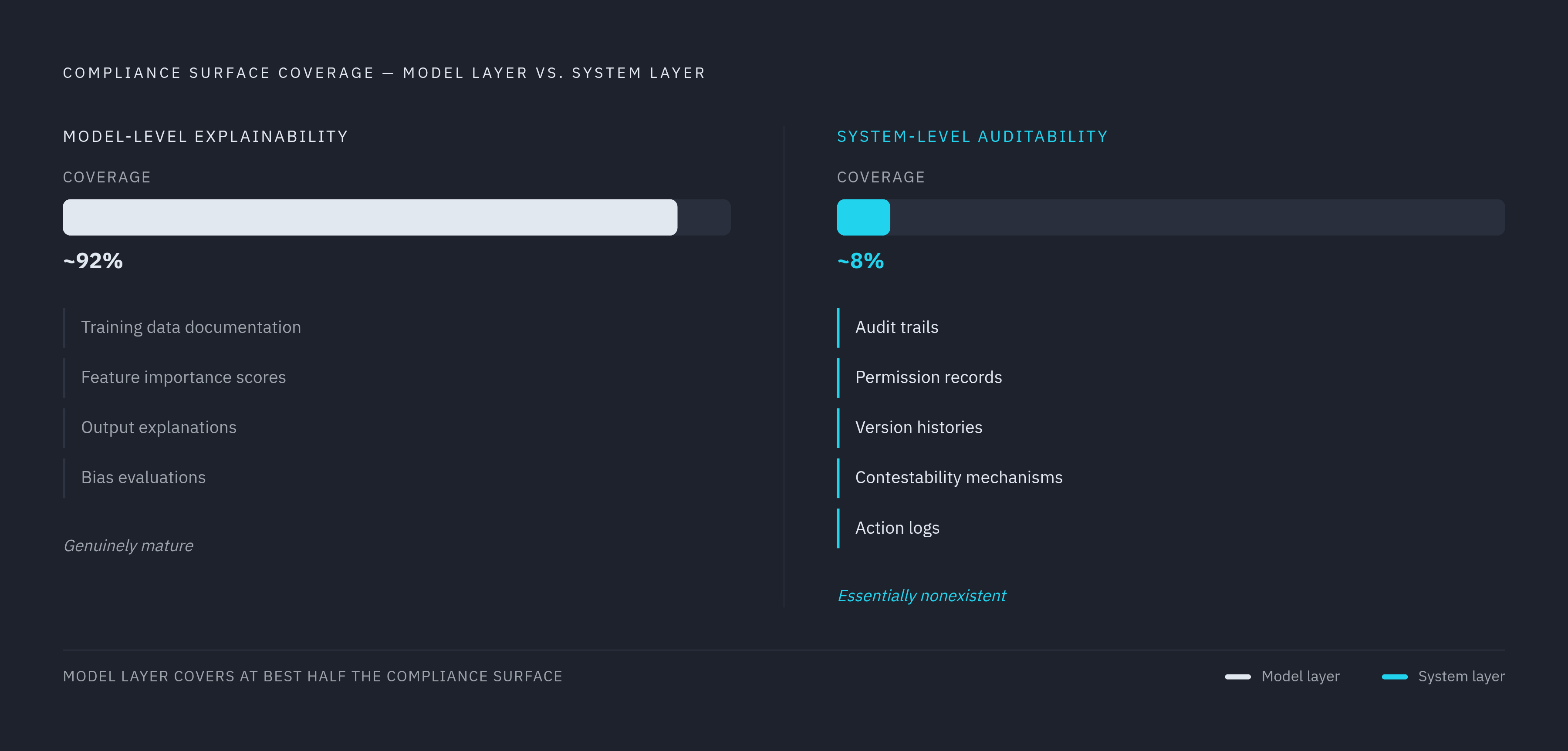
Model-level explainability answers one question: why did the model say that? Feature importance scores, attention weights, training data attribution. System-level auditability is a different question entirely: what did the AI system actually do in the world? Which data did it access? What actions did it take, under what permissions, running which version of its logic?
Most governance conversations stall at the model layer because that is where vendors operate and where the vocabulary is richest. The tools for explaining model behavior are genuinely mature. The tools for auditing system behavior are, in most enterprises, essentially nonexistent.
In agentic contexts, that gap becomes consequential fast. An agent does not just produce outputs. It queries systems, writes records, fires downstream workflows. None of that activity is captured by model interpretability tools, because those tools were designed for a different problem. An interpretable model inside an unaudited system is like having a window into the cockpit with no flight recorder — you can see the pilot's hands but have no log of where the plane actually went. That is not governance.
The deeper issue is that most organizations have built their entire AI governance posture around the model layer: training data documentation, output explanations, bias evaluations. That work has real value. But it covers, at best, half the compliance surface. The infrastructure layer, complete audit trails, contestability mechanisms, permission records, version histories, has almost no coverage in most current deployments. That imbalance is where compliance failures originate, and retrofitting it later is far more expensive than building it first.
Auditability and explainability are not features a model vendor ships to you. They are properties of the system architecture your organization builds, or fails to.
What the Regulatory Frameworks Actually Require Organizations to Demonstrate
The EU AI Act is the most operationally significant regulatory instrument in play right now. Its enforcement timeline is real. Its requirements are specific: documentation of model logic, rationale outputs for consequential decisions, full data lineage. High-risk categories, healthcare, finance, HR, public safety, must demonstrate human-in-the-loop checkpoints and risk classification for every model running in production. The penalties are not a compliance line item to defer. They are material business risk.
In the United States, the NIST AI Risk Management Framework has become the de facto operational reference point. Technically voluntary, but increasingly required in procurement contexts and embedded in sector-specific regulatory guidance. Its four functions, Govern, Map, Measure, and Manage, map closely enough onto what the EU AI Act demands that a NIST-first posture generalizes well across jurisdictions. NIST has also launched a dedicated initiative focused specifically on autonomous AI agents: agent identity, action logging, containment. That initiative signals that regulators have begun treating agentic AI as its own governance category, not a subcategory of traditional AI deployment.
ISO/IEC 42001 provides the certifiable management system structure that procurement teams and enterprise buyers are beginning to expect as a baseline, whether or not they say so explicitly. State-level requirements are proliferating too, with some explicitly naming NIST AI RMF compliance as an affirmative defense.
And then there is the pre-AI regulatory layer that organizations forget until it is too late: data privacy law, sector-specific security standards, financial recordkeeping requirements. These attach to sensitive data the moment it enters an AI system. This is where most day-to-day compliance risk quietly accumulates.
The structural issue none of these frameworks fully resolve is that they were all written before the emergence of autonomous agents taking multi-step actions across live systems. They assume AI that assists human decisions. They do not yet fully account for AI that executes them. Organizations operating agentic systems today are governing against frameworks that were not designed for what they are actually running.
Where Agentic AI Breaks the Governance Assumptions Most Organizations Have Built
Traditional AI governance rests on a foundational assumption: a human sees a model output and decides what to do with it. The human is the actor of record. Agentic AI inverts this. The agent decides and acts, often across multiple systems in a single workflow, with the human reviewing results afterward, if at all.
That inversion changes the auditability problem at its root. You are no longer logging recommendations. You are logging actions: what system was accessed, what was read, what was written, what was triggered, under whose delegated authority.
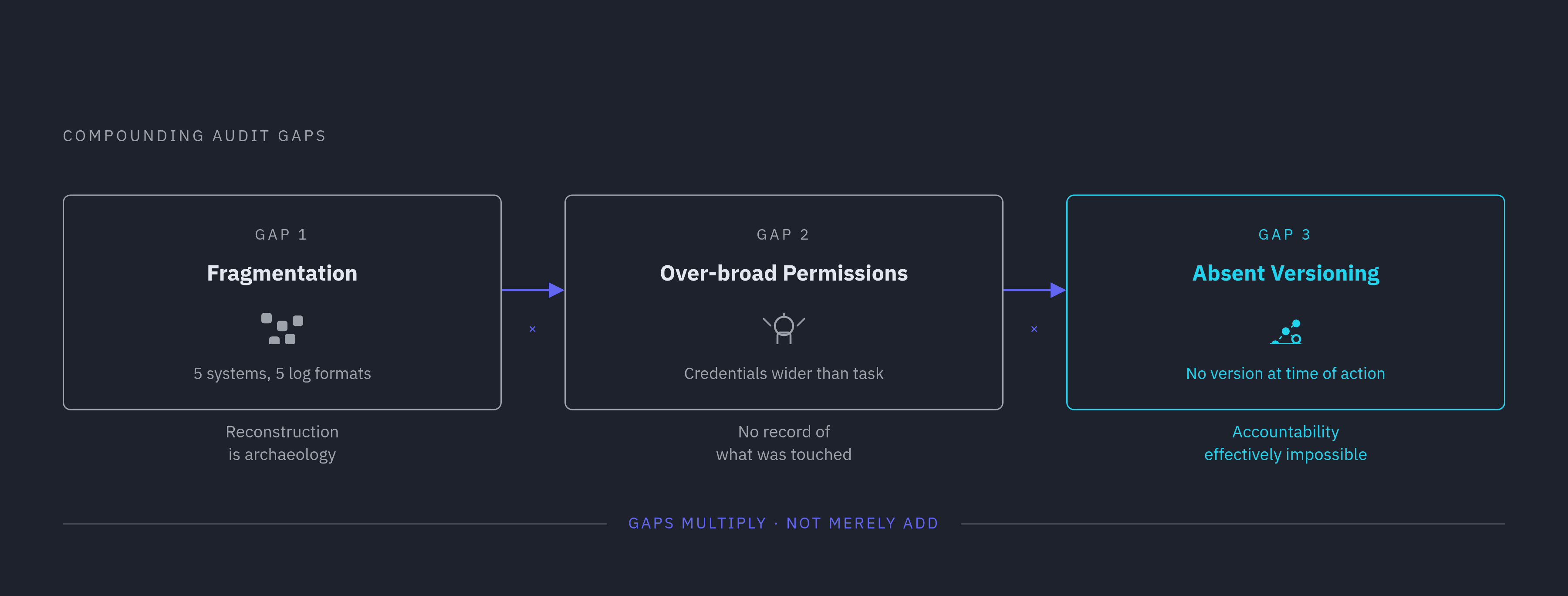
Most current agentic deployments share three structural gaps, and they compound each other in ways that become very visible during an audit.
The first is fragmentation. Agents operate across a growing number of tools, each with its own logging format and its own permission model, with no shared record across the full chain. Reconstructing what an agent did across five systems from five separate logs is not an audit trail. It is archaeology, and auditors do not accept it as a substitute.
The second is over-broad permissions. In most deployments, agents operate with credentials far wider than any specific task requires, because scoping permissions per agent per task has been operationally complex to do consistently. Agents have access to far more than they should, with no clean record of what they actually touched.
The third is absent versioning. When a workflow changes, when a prompt is revised or a data source is swapped, there is often no record of what version was running when a specific action occurred. Post-hoc accountability becomes effectively impossible, and investigations stall at the first question.
These are not edge cases in poorly run organizations. This is the default condition in most enterprises right now.
Traceable Agent Actions: What a Complete Audit Trail Actually Requires
A usable audit trail for an agent action is not a system log. It is a structured record that answers a specific chain of questions: who initiated the action, what context the agent was given, what tools it called and in what sequence, what parameters were passed, what was returned, and what downstream action followed. Every tool call should be logged at the protocol level, not reconstructed from application logs after the fact, because reconstructed records have gaps, and auditors find gaps.
The Model Context Protocol provides a structural foundation here. Because every agent-to-tool interaction passes through a defined interface, every call can be logged uniformly: the action, the parameters, the system it was made against, the result returned. This is categorically different from custom integrations, where achieving equivalent coverage requires substantial additional engineering per integration and where gaps are essentially guaranteed.
A well-governed audit trail also identifies the human actor of record, not just the agent. In a properly architected deployment, the developer or user who initiated a workflow remains the actor of record even when the agent executed dozens of intermediate steps autonomously. That attribution does not happen automatically. It has to be designed in.
Contestability raises the bar further still. The audit trail has to be human-readable and reconstructable, not merely machine-parseable. An affected party challenging an AI-driven decision needs to understand what happened in plain terms. A log that only a data engineer can interpret satisfies no regulatory or ethical standard for contestability, regardless of how technically complete it is.
Three properties determine whether an audit trail is actually complete. Immutability: the log cannot be modified after the fact. Coverage: every step of a multi-step workflow is captured, not just the entry and exit points. Linkage: every individual tool call traces back to the specific agent run and the specific user request that initiated it. Remove any one of these and the trail has a gap. Auditors are good at finding gaps.
Inherited Permissions: Why Redefining Access for Every AI Tool Is Not a Governance Strategy
The pattern that dominates enterprise AI deployments right now is genuinely problematic and genuinely pervasive: each new agent or AI tool gets its own credential set, its own access configuration, its own interpretation of who is allowed to see what. Teams move fast, tools proliferate, and nobody stops to ask whether the AI-layer permissions actually reflect the source systems they are drawing from.
The compounding risk is predictable. Permissions drift from the authoritative access controls in the underlying systems. Broad credentials get shared across agents because scoping them individually is tedious. Tokens persist longer than the workflows that needed them. Security teams end up chasing leaked credentials and over-wide permission scopes rather than expanding capability, which is not where anyone intended to spend the budget.
The correct foundation is different in kind, not just degree. Permissions should be inherited from the source systems where data lives and should travel with every agent action that touches that data. When someone asks an agent a question, the answer should draw only from sources that person already has access to, governed by the same controls that govern direct access, not by a separate AI-layer permission decision. When AI-layer permissions diverge from source system controls, the organization has two competing sources of truth for who can see what. That ambiguity is exactly what produces compliance failures.
Standard authentication flows, OAuth and OIDC integrated at the protocol level, combined with role-based access control, allow least-privilege enforcement without requiring per-agent configuration work every time something new gets added. Namespace and environment partitioning provides multi-tenant isolation without custom architecture per use case.
Versioned Changes: Why Governance Requires Knowing What Was Running When
When an agent takes a consequential action, regulators and auditors will ask a specific set of questions. Not just what did it do, but what logic was it running, who approved that logic, and when did it change? Without version control over agent configurations, including prompts, tool definitions, data source connections, and permission scopes, a complete audit trail of actions remains incomplete in a specific way: you know what happened, but you cannot establish under what terms it was authorized to happen.
This is worth distinguishing from software version control, because the instinct is to assume they are the same thing. They are not. Software version control tracks code changes. Governance-oriented versioning tracks the governed state of an AI system: what was approved to run in production, by whom, and when that approval was granted. Those are different records with different purposes.
In practice, versioning for agents requires a registry where configurations are stored with explicit ownership and version history, not on individual laptops or in shared drives that nobody fully controls. It requires explicit promotion workflows: a change to a production agent should require the same approval discipline as any other change to a production system. And it requires the ability to reconstruct the exact state of an agent at any historical moment, not just its current configuration.
The organizational consequence of absent versioning is predictable and I have seen it play out more than once. Something goes wrong — a routing decision made incorrectly, a data retrieval that pulled from the wrong source — and the investigation stalls immediately at the first question: what logic was running at the time? Without that answer, accountability cannot be established, and the organization's response to regulators or affected parties becomes "we're not sure." That is not a credible answer in a regulatory context, and it does not become more credible with time.
How Fragmented Team-Level Deployments Undermine the Infrastructure Requirements Above
The dominant deployment pattern in enterprises right now is teams building independently. Individual teams construct AI capabilities with their own tool integrations, their own prompts, their own access configurations. The organization accumulates AI capability fast. Governance does not accumulate with it.
Each independent deployment is a separate audit surface, a separate permission boundary, and a separate version history, or more frequently, no version history at all. When five teams have each rebuilt the same capability independently, the organization has five fragmented audit trails, five separate permission configurations that each interpret access controls differently, and five separate things to update when a data source changes or a compliance requirement shifts. The last part is where the operational cost actually surfaces: not in the building, but in the maintaining.
Organizations rarely recognize this as a governance problem until they are trying to pass an audit or respond to an incident. By then, the cost of remediation is significantly higher than the cost of building it correctly would have been.
The structural fix is a shared registry with scoped access: a skill built once, published to a governed catalog, reusable by any team, with permissions, versioning, and ownership traveling with it. The difference between a shared drive and a registry is exactly this governance layer. A shared drive is just storage; it carries none of the properties that make reuse safe at scale.
The Model Context Protocol's architecture enables the better pattern. Once a server is in place, new use cases onboard by defining new tools or resources rather than rebuilding integration logic from scratch. But MCP only realizes its governance potential if the organization has a registry layer governing what gets published and who can use it. Without that layer, you have the plumbing without the permits.
What Organizations in High-Exposure Industries Are Being Asked to Demonstrate Today
Financial services, healthcare, and public-sector organizations are not waiting for enforcement deadlines. They are already being asked, by regulators, by auditors, and by procurement counterparties, to demonstrate governance on demand. The ask is not theoretical. It shows up in vendor questionnaires, in contract negotiations, in audit findings.
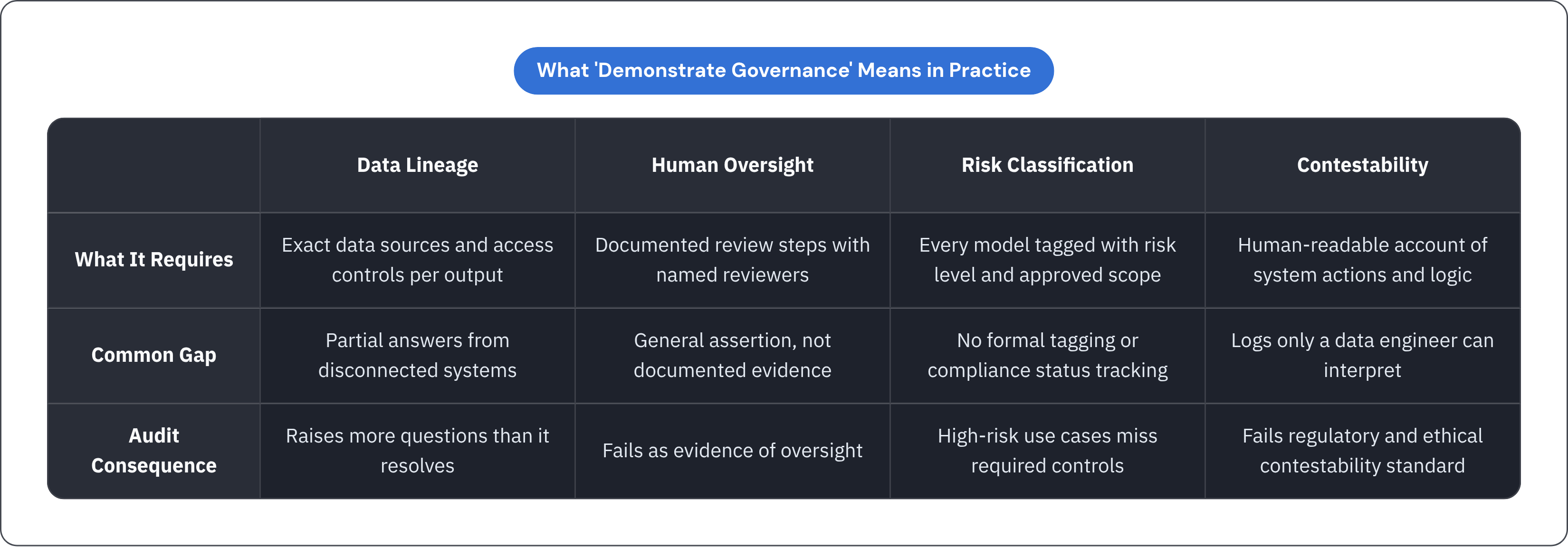
What "demonstrate governance" actually means in these contexts is concrete and consistent. Data lineage: for any AI output or action, show exactly what data sources contributed to it and what access controls governed that data at the time. Human oversight checkpoints: documented evidence that consequential AI decisions had a human review step, with a clear record of who performed it. Risk classification: each model or agent in production tagged with its risk level, approved usage context, and compliance status. Contestability records: when an affected party challenges an AI-driven decision, the organization can produce a complete, human-readable account of what the system did and the logic under which it operated.
Most current deployments cannot produce all four on demand. They produce partial answers from multiple disconnected systems, which satisfies no auditor, raises more questions than it resolves, and, in my experience, triggers deeper scrutiny rather than less.
The consistent lesson from organizations that have successfully gotten AI into production in regulated environments is this: the governance infrastructure has to be built before the AI capability, not retrofitted afterward. Retrofitting is exponentially harder and frequently requires rebuilding integrations from scratch. The teams that moved fast without governance architecture are now spending their budgets on remediation rather than expansion.
Department-specific deployments compound this further. A RevOps team querying CRM data, an engineering team with agents touching code repositories, a support team with access to customer case histories: each introduces its own data sensitivity profile and requires its own scoped audit trail. A single governance architecture that handles all of them is the only answer that scales.
The Infrastructure Checklist: What a Governable AI Deployment Actually Looks Like
Everything above resolves into concrete infrastructure. Not aspirational targets. The baseline for a deployment that can actually be governed, audited, and trusted in production.
Unified audit logging at the protocol level. Every agent-to-tool interaction logged uniformly: the action, the parameters, the system accessed, the result. Logs are immutable, complete across every step of multi-step workflows, and linkable back to the initiating user request. Partial logging is not logging.
Inherited and synced permissions. AI-layer access is not configured independently; it is inherited from source system controls and synced automatically. One source of truth for who can see what, governing agent behavior without per-tool configuration work every time something new gets added.
A governed agent registry with version history. Agent configurations, prompts, tool definitions, data source connections, permission scopes, stored in a centralized registry with explicit ownership and complete version history. Production changes require explicit promotion through an approval workflow. The state of any agent at any historical moment is reconstructable.
Risk classification for every model and agent in production. Each system tagged with its risk level, approved usage context, and compliance status. High-risk classifications trigger additional oversight requirements automatically, not because someone remembered to apply them.
Human-in-the-loop checkpoints for consequential decisions. Documented review steps, with records of who reviewed what and when, for any AI-driven action affecting rights, safety, or significant financial outcomes. Documentation means documentation, not a general assertion that humans are involved somewhere in the process.
Contestability infrastructure. Audit records are human-readable and complete enough that any affected party's challenge can be answered with a full, clear account of what the system did and under what logic.
Environment partitioning. Development, staging, and production are separated. Business unit namespaces are isolated. Agents cannot inadvertently traverse those boundaries.
Shared skill catalog with scoped reuse. Capabilities built by one team are published to a governed catalog and reusable by others, with governance properties traveling with the skill rather than being reconstructed per deployment.
Organizations that treat any of these as optional will find their AI deployments stalling at the compliance gate, their regulated clients declining to onboard, and their incident response bottlenecking on the one question nobody can answer: what, exactly, was running when something went wrong? The infrastructure is not a constraint on AI capability. It is what makes deploying that capability defensible.