Stateful vs. Stateless Agent Design Tradeoffs
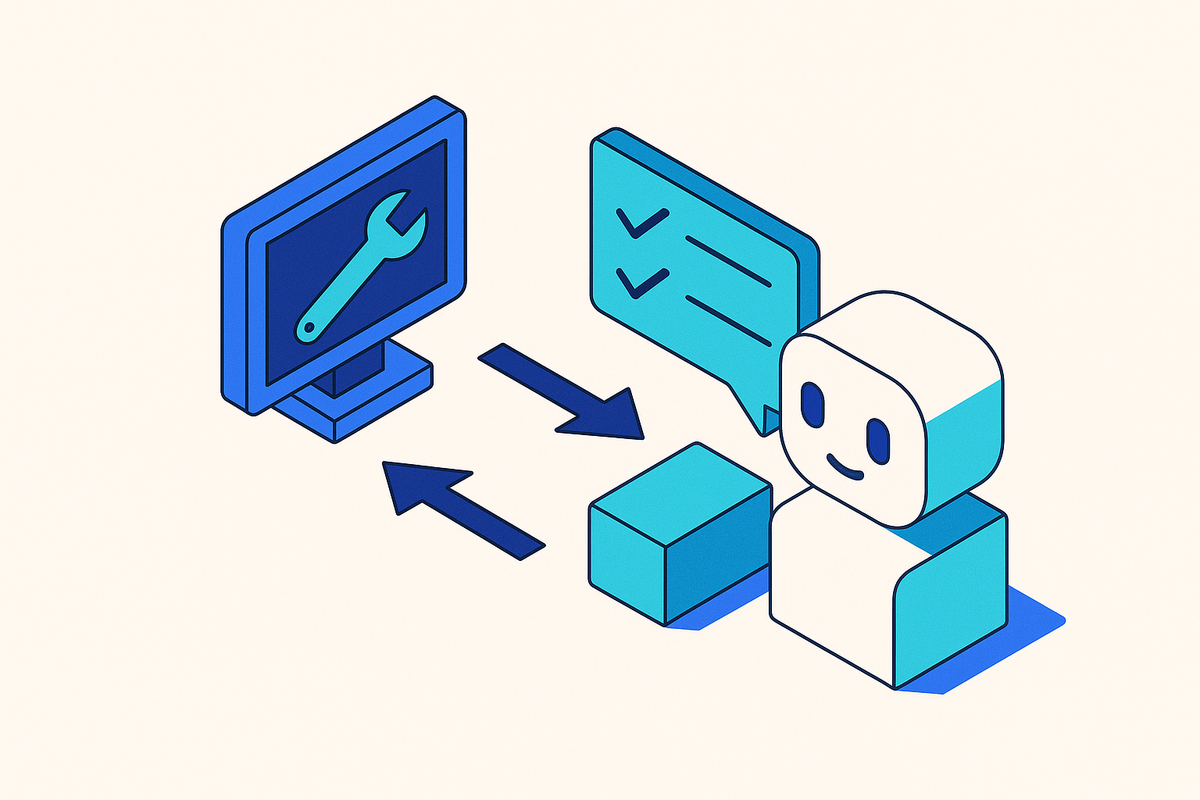
Stateless agents scale simply; stateful ones handle complex workflows that stateless cannot.
What Stateless Design Actually Buys You in Production
The strongest argument for stateless agents isn't elegance. It's operational leverage, and once you've run both architectures in production, you stop treating that as a philosophical point.
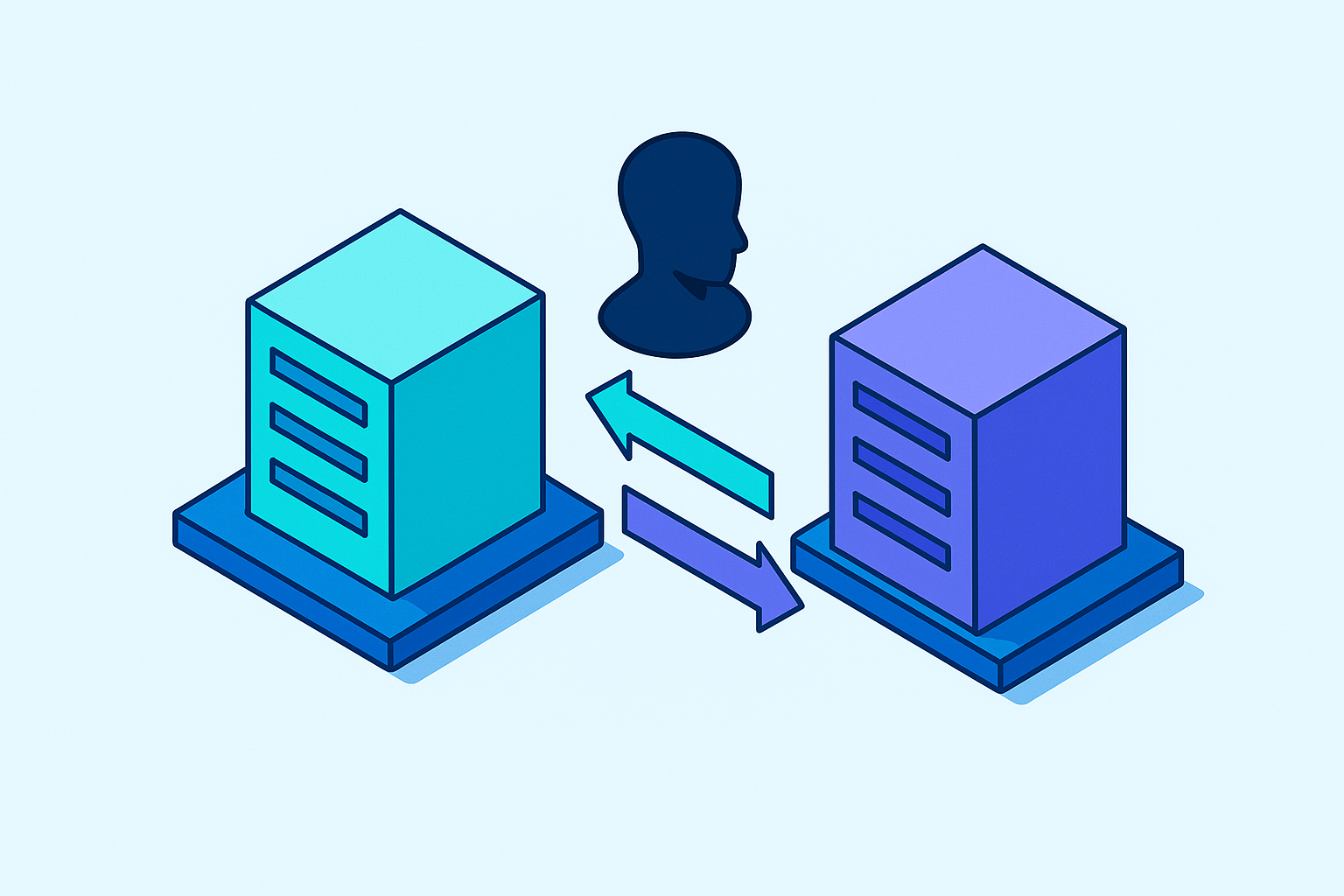
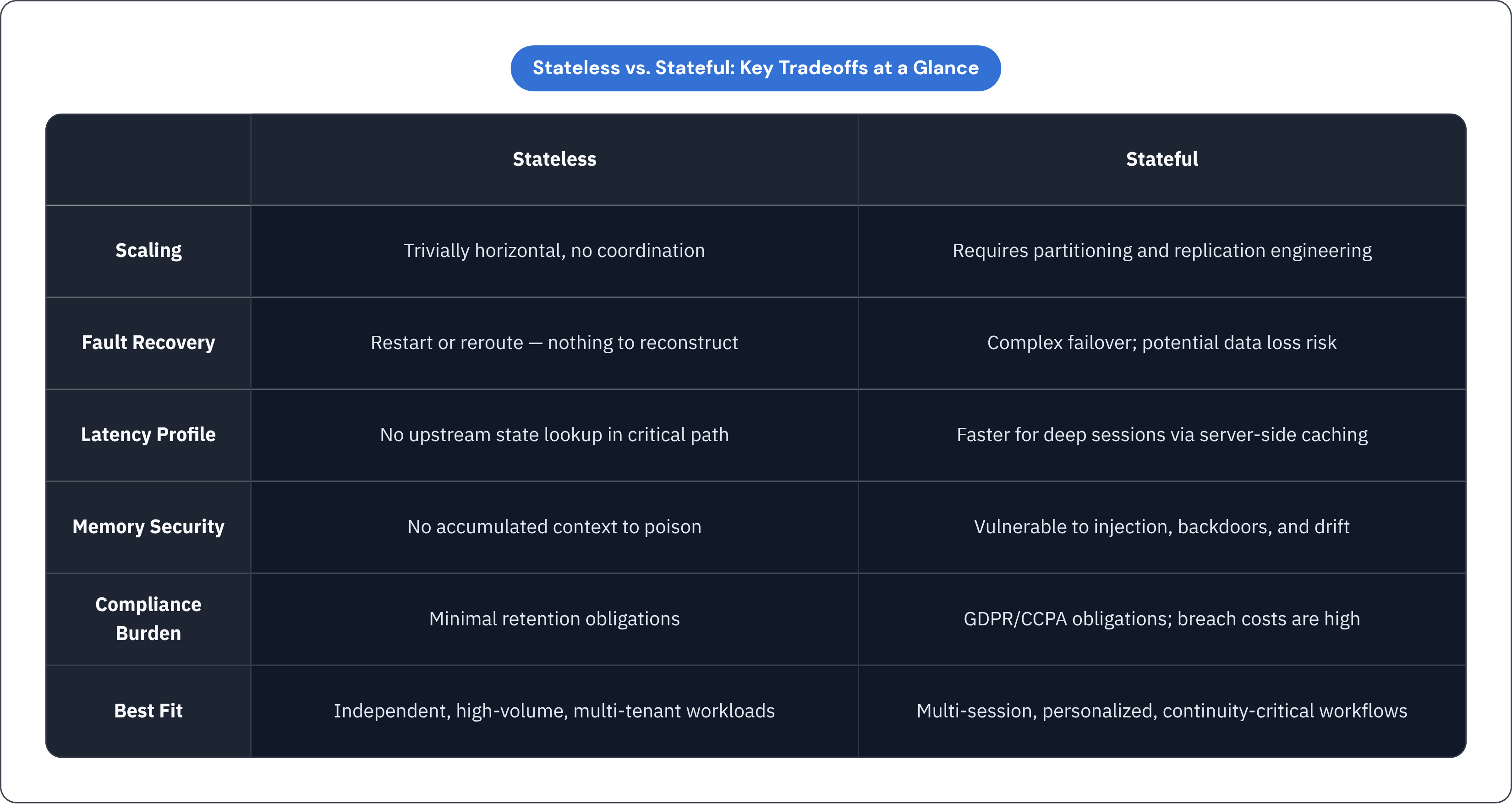
When an agent carries no memory between requests, any instance can handle any request. Load balancing becomes trivially simple. Horizontal scaling requires no coordination overhead, no shared session store, no distributed lock manager arbitrating which instance owns which user. You add compute, throughput follows. The math is clean because the architecture is clean.
Fault tolerance works the same way. When a stateless agent crashes, there's nothing to lose and no recovery state to reconstruct. Restart it, or route around it. The recovery story is short because the responsibility is bounded. Contrast that with a stateful failover system, which can demand weeks of engineering just to handle the case where one instance dies mid-session. Stateless deployments sidestep that problem entirely because they never accumulate the liability in the first place.
For classification and retrieval tasks, the performance story is similarly direct. No state lookup in the critical path means no database round trip before the actual work begins. Request arrives, work happens, response leaves. In latency-sensitive environments, that absence of upstream dependency matters more than almost anything else you can optimize for.
Infrastructure costs reflect the same logic. No session state means no memory management overhead, no warm-up cost per user, no eviction policy to tune. High-volume workloads migrating from stateful to stateless architectures see infrastructure savings that compound with request volume — not rounding errors, but real budget line items.
Multi-tenant isolation is also cleaner, and in regulated industries this isn't incidental. No shared state means one tenant's data has no structural path into another tenant's context. That's a compliance argument and a contractual one. Engineering teams sometimes treat it as a nice-to-have; their legal departments rarely agree.
The case for stateless is strongest when requests are genuinely independent of each other. When the architecture matches the workload, you get all of these properties without paying the workaround tax. The moment requests stop being genuinely independent, that tax appears. And it doesn't announce itself clearly. It accumulates.
Where Stateless Design Breaks Down as Workflows Get Complex
The failure mode of stateless design isn't dramatic — it's incremental, which makes it worse. Each new requirement adds a patch, and the patches accumulate quietly until the simplicity advantage that made stateless attractive has been fully spent.
The core problem is structural: stateless agents treat every interaction as independent. Users re-establish context each time. The agent cannot learn from errors it made in a prior session because it has no record of them. Multi-session tasks require external scaffolding just to track where they are. None of this is a dealbreaker in isolation. Together, they start to define the ceiling.
Two workarounds appear with almost tedious regularity once teams hit this wall. The first is expanding the context window, stuffing more and more conversation history into each prompt. Cost scales linearly with history; intelligence doesn't. The agent still cannot prioritize, forget, or actually learn from what's in there; it simply has more text to process, and you pay for every token regardless of relevance. The second is rolling summarization, compressing prior context before injecting it into the next request. This slows the rate of degradation without stopping it. Each compression pass loses information, and the compounding loss over a long workflow is qualitative, not just quantitative. By the time you're deep into a complex multi-session task, what the agent knows about its own prior work barely resembles what actually happened.
A third approach, prompt-based profile injection, embeds user traits directly into the system prompt. Genuinely unsustainable at any meaningful scale. The moment a user's profile changes, every prompt referencing it requires manual updating. You've traded a dynamic memory problem for a static configuration management problem — which, at scale, is its own substantial burden. It doesn't actually solve the original problem; it just displaces it.
There's also a mechanical issue with stateless HTTP-based APIs that compounds with conversation depth: each additional turn requires resending the full prior context. What starts as a lightweight request becomes a heavyweight data transfer problem as sessions extend. Looks manageable in a demo. Becomes a genuine bottleneck in production.
As workflow complexity increases, the workarounds required to keep a stateless agent functional erode precisely the simplicity advantages that made it attractive. At some inflection point, you are doing all the work of stateful design in the application layer, without the engineering structures that stateful systems are actually built around. You've built stateful complexity on top of a stateless foundation that wasn't designed to carry it.
What Stateful Design Makes Possible and What It Costs to Get There
Stateful agents persist context across turns and sessions. That single capability unlocks a category of products that cannot be built otherwise.
Consider the specifics. A law firm tracking case history across months of proceedings needs an agent that knows what was argued last Tuesday and how the client responded to a strategy shift three weeks prior. A healthcare agent maintaining consultation and prescription history needs to reason across time in ways a stateless agent — reconstituted fresh with each call — structurally cannot. An education platform adapting to individual student progress needs to know not just what a student got wrong, but when, and what they got right afterward. In these contexts, continuity isn't a feature. It is the product. You cannot approximate your way to it with prompt engineering.
Stateful design also resolves the payload-growth problem that plagues stateless multi-turn interactions. Server-side context caching reduces the volume of client-sent data per turn and can meaningfully improve execution time, which runs counter to the intuition that statefulness is always the slower choice. For sufficiently complex sessions, it's often faster.
The costs, though, are real and deserve clear accounting. A stateful AI system costs substantially more to operate than a stateless equivalent. The multiplier depends on architecture and cloud provider, but it's significant enough to demand justification from the workflow itself, not from enthusiasm or organizational momentum. If the use case doesn't require continuity, the cost premium buys you nothing.
Operational complexity also compounds in ways that don't announce themselves during design. Concurrent users create state conflicts. Distributed systems face inescapable tradeoffs between consistency, availability, and partition tolerance. Financial systems requiring strong consistency must be architected fundamentally differently from recommendation systems that tolerate eventual consistency. These aren't configuration choices — they are design commitments that propagate through the entire system and become expensive to revisit.
Scaling the state layer requires its own dedicated engineering: partitioning, replication, hot caches for active sessions, background summarization to prevent unbounded growth. None of this exists in stateless systems because none of it is needed. In stateful systems, it must be built and maintained. The operational surface area is not comparable.
Backup and recovery obligations are also qualitatively different. Stateless systems back up configuration and code. Stateful healthcare monitoring systems implement continuous replication with recovery point objectives measured in minutes, because the data they carry represents ongoing patient care. That difference in obligation is worth understanding before you commit to the architecture, not after you've already shipped.
The Security Risks That Belong Specifically to Stateful Agents
A stateless agent starts each session clean. Memory poisoning, as a threat category, simply doesn't apply. There's no accumulated context to corrupt because there's no accumulated context. This isn't a minor security benefit; it's a structural one.
Stateful agents face a fundamentally different risk profile, and the difference isn't merely one of degree. An agent that accumulates context over weeks or months can't have its safety evaluated at the level of any single interaction. Its safety is a property of its entire accumulated trajectory. Which means an attacker doesn't need to compromise a single session. They need to corrupt the memory that persists across sessions, and that corruption can sit dormant for a long time before it surfaces.
The MINJA attack, presented at a major ML research venue, demonstrated this vector against production architectures. Attackers corrupted an agent's long-term memory through ordinary queries, without elevated privileges and without direct memory access. The injection success rates were high enough that this has to be treated as a practical threat, not a theoretical one. OWASP's Top 10 for Agentic Applications formally recognizes memory and context poisoning as a serious vector, and the research supports that classification.
Three specific attack patterns warrant architectural attention. First: injecting malicious content into long-term memory to influence future behavior, where the agent retrieves poisoned context later and acts on it as if it were legitimate. Second: context manipulation that causes the agent to misinterpret its current state, producing incorrect or harmful actions in the present session. Third: persistent backdoors, triggers embedded in memory that activate only when specific future conditions are met, making them difficult to detect during normal operation because they remain invisible until they fire. That last one is particularly insidious because standard monitoring won't catch it.
Compliance obligations amplify the risk surface in ways that extend well beyond the technical. Storing user history creates GDPR and CCPA obligations that stateless systems don't incur to the same degree. The governance burden of stateful memory changes what an organization is legally and financially responsible for, and the costs of a breach in that context are substantial. Organizations that treat this as a legal footnote tend to encounter it as a financial event instead.
Defense requires layered controls: input moderation with trust scoring, memory sanitization with provenance tracking, trust-aware retrieval, behavioral monitoring across sessions. None of this is necessary in stateless systems. All of it is necessary in stateful ones. The teams that treat these controls as something to add once the system is working routinely discover that retrofitting them is far more expensive than designing for them from the start. The lesson is consistent enough to treat as a rule, not a cautionary tale.
How Memory Architecture Choices Shape What Stateful Agents Can Actually Do
Choosing stateful design is not a single decision. It's the beginning of a more specific one: which memory architecture, and what does that architecture make possible or foreclose.
Vector database retrieval-augmented generation is a genuine improvement over statelessness for many use cases, but it has structural limitations that matter at the edges. It treats stored information with roughly equivalent weight, cannot forget redundant memories or consolidate contradictory ones, and cannot evolve its understanding as new information arrives. Retrieval is a lookup, not a reasoning process. For many workflows that's sufficient. For others it isn't, and the cost of discovering this late in a project is high.
Newer memory architectures, including approaches that build memory graphs and semantically segmented episode structures, capture relational and temporal dependencies that flat vector stores can't represent. An agent asked "what did we try last quarter and why did it fail" is being asked to reason temporally and causally across stored episodes. A similarity search against a flat embedding index won't get you there. The gap between what you want the agent to do and what the retrieval mechanism actually supports is a recurring source of production surprises, and it's almost always a gap that was visible before the system was built, if anyone had looked.
Most production systems that work well combine memory types. In-context memory handles immediate reasoning. External retrieval handles long-term facts. Episodic storage handles task history. The combination allows each type to do what it's structurally suited for, rather than forcing one mechanism to carry everything and compensate for what it lacks.
The choice of memory architecture determines two things simultaneously: what kinds of questions an agent can answer about its own history, and what kinds of poisoning attacks it's exposed to. A memory graph with rich relational structure is more capable and more attackable than a simple vector store. That tradeoff isn't a reason to avoid richer architectures — it's a reason to be deliberate about them and to design security controls that match the attack surface you're actually creating, not the one you'd prefer to have.
Matching Architecture to Workflow: The Decision Criteria That Actually Matter
The question is never which architecture is better in the abstract. The question is which tradeoffs a given workflow can actually tolerate.
Stateless fits when requests are genuinely independent of each other, when volume is high and bursty, when multi-tenant isolation is a hard requirement, and when the cost of re-establishing context per request is low relative to the value of the interaction. If those conditions hold, stateless isn't just acceptable; it's the correct choice. Resist the pull toward complexity when the workflow doesn't require it.
Stateful fits when workflows span multiple sessions, when personalization or error correction across interactions is part of the product's core value, or when continuity itself is what creates value. The legal, healthcare, and education examples aren't edge cases. They represent a broad class of workflows where the agent's memory is as important as its reasoning, and where stateless approximations will eventually disappoint someone who was counting on them.
Hybrid architectures are common in mature production systems, and they exist for practical reasons, not architectural indecision. The pattern of stateless execution with externalized state storage preserves horizontal scaling while enabling continuity. The agent carries no memory between requests; an orchestration layer provides relevant context per-request from a managed store. The agent scales freely; the state layer is managed independently. This separation of concerns is often the right answer when a team genuinely needs both throughput and continuity. It requires more engineering than either pure approach, which is exactly why teams avoid it in favor of something simpler that later proves insufficient.
Governance and compliance requirements belong in this decision from the beginning. Not as a retrofit, not as a pre-launch checkbox. Storing state changes what an organization owns and is legally responsible for, and that change has procurement, legal, and engineering implications that are significantly easier to address before anything is built. After the fact, the options narrow and the costs rise.
Permission inheritance matters in multi-agent systems in ways that are easy to underestimate. When agents retrieve from shared memory or knowledge stores, what a given user's agent can access should reflect what that user is already authorized to see. It should not be redefined per agent or per deployment. Failing to enforce this creates authorization boundary violations that are difficult to audit. The assumption that access control logic from the application layer will carry over automatically to the agent layer is wrong, and it's a costly assumption to discover is wrong after a system is in production. Credal, an enterprise platform for building and governing AI agents that enforces inherited permissions and maintains audit logs across every connected data source, is built specifically to close that gap before it becomes a production incident.
Start with the workflow. Not the architecture your team is most comfortable with, and not the one you've seen work in a different context. The workflow tells you what persistence the system actually needs — the only valid basis for the architecture decision.