Orchestrator and Subagent Role Design in Multi-Agent Systems
Why multi-agent systems are failing in production despite rapid adoption
Gartner documented a 1,445% surge in multi-agent system inquiries between Q1 2024 and Q2 2025, then forecast that more than 40% of agentic AI projects will be canceled by end of 2027. Roughly 40% of multi-agent pilots fail within six months of hitting production. That's not a rounding error or a technology immaturity story. It's a design problem that keeps getting misdiagnosed as something else.
When you trace most production breakdowns back to their origin, you find the same thing: mismatched assumptions between orchestration logic and domain execution. The orchestrator expected one behavior. The subagent produced another. Nobody had actually designed the boundary between them, so nobody could tell you where the failure lived, let alone fix it. Teams spend weeks instrumenting logging systems, swapping model providers, tuning prompts, all chasing a failure that lived in a three-line handoff specification that nobody had written carefully. The technology was fine. The contract between the orchestrator and the subagent was a rough sketch, and rough sketches don't survive production load.
The boundary between where an orchestrator's responsibility ends and a subagent's begins is the central design question the field has not answered with any consistency. Everything that follows is an attempt to answer it properly.
What orchestrators and subagents each actually do
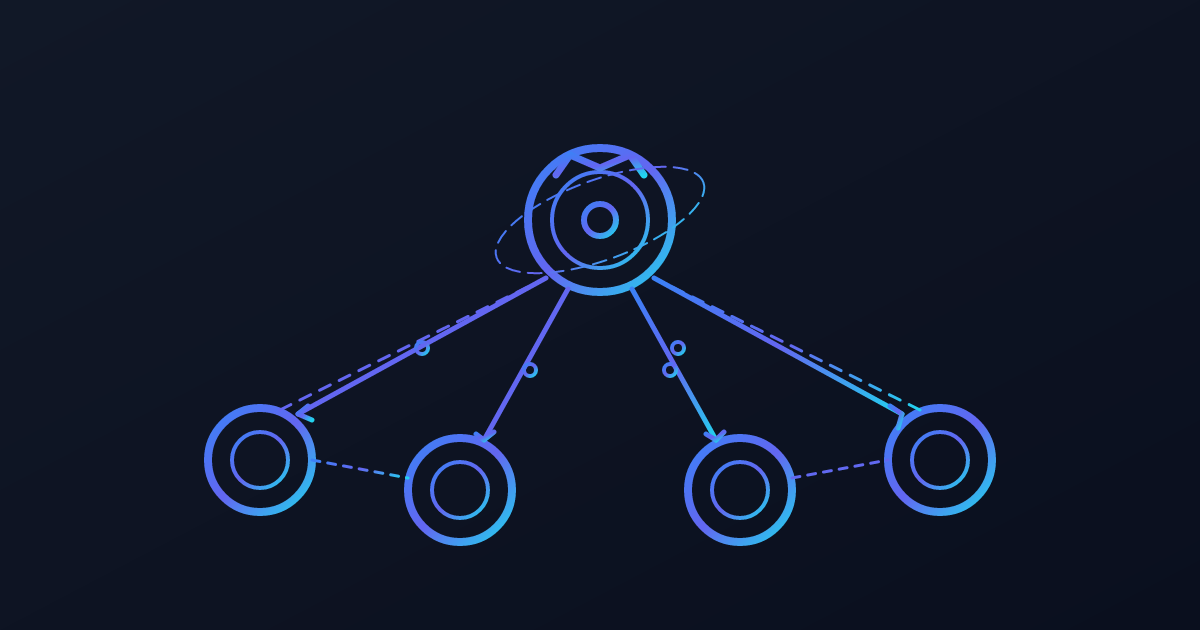
An orchestrator receives a task, decomposes it, selects agents, dispatches sub-tasks, collects outputs, updates shared state, and decides whether to iterate or synthesize. It owns the loop. It does not own the work.
A subagent executes one well-scoped task inside its own context window, using its own tools, its own persona, its own system prompt. Not a function call. Not a helper dressed up with extra steps. A fully configured reasoning entity with a specific job.
The interface between them is natural language. The orchestrator describes what it needs; the subagent interprets that description according to its own configuration. The orchestrator doesn't need to understand the subagent's internals, and that opacity is a feature. If your orchestrator needs to understand how a subagent is reasoning internally to make its own decisions, you've already dissolved the separation you were trying to create.
Subagents also act as compression layers. They process potentially sprawling information within their own context window and return only essential results to the orchestrator. This preserves the orchestrator's context for high-level reasoning, sequencing, and synthesis. Collapse that separation and you get context bloat, no meaningful specialization, and compounded failure modes when any single component breaks.
Anthropic's documented multi-agent research system illustrates the mechanics concretely. A lead agent decomposes a query and dispatches to subagents that explore distinct aspects in parallel. Each subagent returns a compressed summary, not a transcript. The lead agent synthesizes across those summaries. The division of labor isn't stylistic; it's structural, and it works precisely because each layer has a defined scope and respects the other's.
The five coordination topologies and when each applies
Topology isn't a configuration choice you make after the system is mostly built. It's a structural decision that determines your failure modes before you write a single line of application logic. Teams that pick topology casually end up debugging symptoms that are three layers removed from the actual design error.
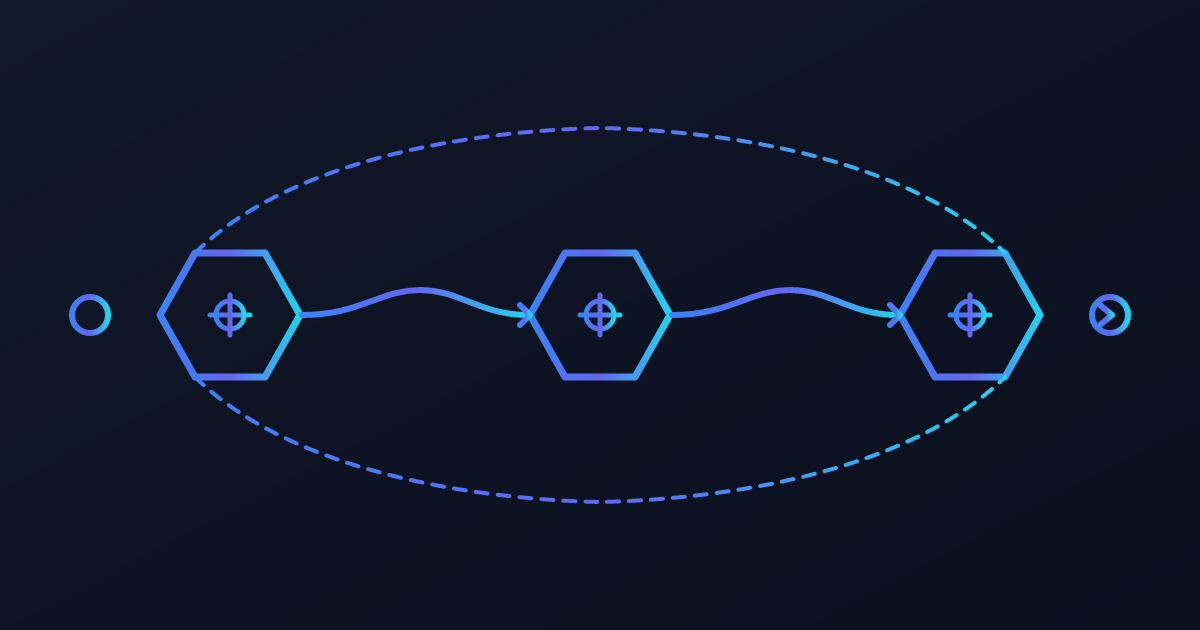
Supervisor (orchestrator-worker): A central orchestrator owns decomposition, delegation, validation, and synthesis. Every subagent reports back to it. This is the right pattern for complex, multi-domain workflows where traceability matters more than raw speed. The bottleneck is real. So is the visibility, and in production the visibility is usually worth more than the latency you give up.
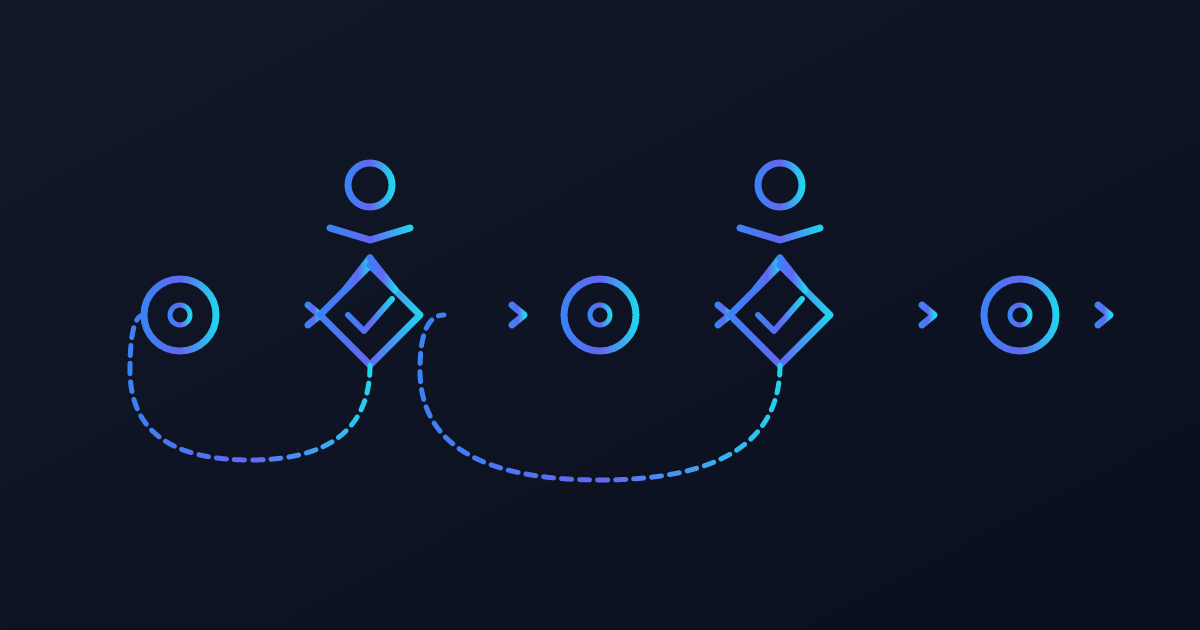
Parallel fan-out: The orchestrator dispatches multiple subagents concurrently and merges their results. Correct default when sub-tasks are genuinely independent. Anthropic's research system runs this pattern well. The trap is assuming independence that doesn't actually exist; fan-out amplifies hidden dependencies rather than containing them, so be honest about whether independence is real or just convenient to assume.
Hierarchical (multi-tier): Orchestrators supervise mid-tier coordinators that manage workers. Use this when task decomposition is deep enough that a single orchestrator becomes a bottleneck. The coordination overhead at each tier is real, and teams consistently underbudget for it at design time.
Choreography (decentralized): Agents coordinate via events and a message bus, no central orchestrator. The flexibility is genuine when agents are added or changed frequently, but debugging a choreographed system in production is substantially harder than debugging a supervised one. Choose this when the flexibility is genuinely required, not because the architecture feels clean on a whiteboard.
Debate and discussion: Agents argue toward consensus over multiple rounds. The value here is narrower than the initial enthusiasm suggested. Majority pressure suppresses independent correction; agents with weaker priors will capitulate rather than course-correct. Only viable when participants bring differentiated perspectives and intrinsic reasoning strength is high across all of them.
The practical default that holds up across documented implementations: one orchestrator owns full conversation context, spawns ephemeral and isolated subagents that return compressed summaries, and those subagents terminate. No peer-to-peer communication between subagents. Lateral agent collaboration has been associated with repeated production failures, not because the concept is wrong but because the coordination surface becomes impossible to reason about under load.
A significant share of the failures named in the opening section are topology failures. Teams chose the wrong structural pattern, or they didn't choose at all, and the system chose for them by breaking.
The structured contract every orchestrator-to-subagent handoff requires
Every production implementation worth studying uses the same four-element brief: an objective, an output format specification, guidance on which tools and sources to use, and explicit task boundaries. Omit any one of those four and you have a failure mode queued up, waiting for production load to surface it.
Three rules have survived repeated exposure to real conditions.
First: give every subagent a dedicated system prompt. Never reuse the orchestrator's. The orchestrator's configuration is tuned for coordination, not execution. Importing it into a subagent contaminates the subagent's reasoning frame in ways that are hard to diagnose because the outputs still look plausible. You won't catch it in testing.
Second: make the first user message the structured four-element brief, not a free-form delegation. Free-form handoffs introduce ambiguity at exactly the point where precision matters most.
Third: return a summary string, not a transcript. Inlining full subagent transcripts into the orchestrator's context pollutes its reasoning space and inflates token consumption in ways teams reliably underestimate at design time. Budget for this before the bill arrives.
Context isolation is a design principle, not a limitation. Subagents don't share memory with each other or with the orchestrator by default, and that's intentional. One agent's domain assumptions can corrupt another agent's decisions in ways that are genuinely difficult to trace. Isolation prevents that entire class of contamination.
Most current subagent designs settle into one of two weak patterns. The first treats subagents as isolated containers, which prevents contamination but forfeits most of the specialization value. The second defines static roles, which provides specialization but creates coverage gaps and requires heavy re-engineering when task scope shifts. The more resilient approach treats a subagent as a unified abstraction over instruction, context, tools, and model configuration: a tailored executor for a specific task rather than a pre-defined role pulled off a shelf. It's more compositional and more durable when the work changes shape, which it always does.
How to decide what a subagent should and should not own
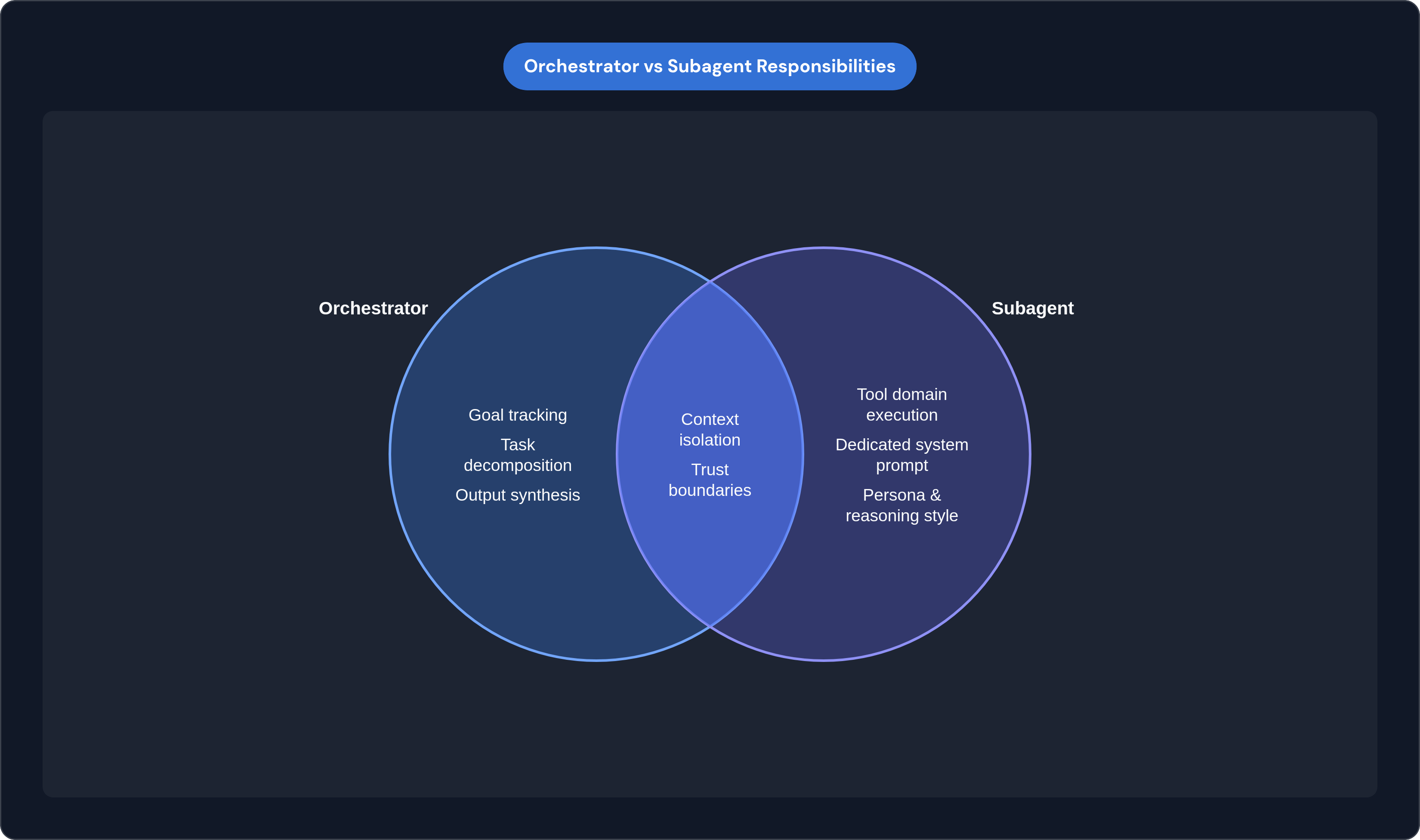
The clearest signal that a task belongs in a subagent is that it can run simultaneously with other tasks. Scraping competitor websites, analyzing financial filings, compiling feature comparisons, aggregating customer reviews: these are logically independent operations. Running them sequentially inside a single agent is a waste of the architecture. Running them in parallel subagents is what the architecture exists to do.
What the orchestrator should own: goal-tracking, sequencing decisions, output validation, state updates, synthesis. Anything that requires knowing what other agents have already done belongs in the orchestrator, full stop.
What a subagent should own: a single tool domain, a bounded information retrieval or transformation task, or anything requiring a reasoning style or persona that would corrupt the orchestrator's framing if inlined. The moment an agent needs to reason like a lawyer, a financial analyst, or a security auditor, give it its own system prompt and its own context. Folding that reasoning into the orchestrator's configuration and then wondering why outputs feel muddled is a predictable outcome, not a mystery.
Specialization should span all four dimensions: instruction, context, tools, and model selection. Teams that specialize only at the prompt level leave significant performance on the table. A subagent with the right instructions but the wrong tool set is still the wrong subagent for the job.
Coverage gaps are the structural risk of static role design. If no subagent is scoped to handle a task that arrives mid-workflow, the orchestrator either handles it poorly or the system stalls. Design for this at role-definition time. Runtime is too late, and retrofitting is always more expensive than anticipated.
One diagnostic worth keeping close: if your orchestrator is accumulating large conditional logic blocks to handle subagent failures or partial outputs, the subagent's brief is under-specified. The fix lives upstream in the contract, not downstream in error handling.
The communication protocols that make cross-agent boundaries work at scale
Two protocols now dominate enterprise interoperability, and they address different layers of the same problem. MCP, released by Anthropic in November 2024 and now under Linux Foundation governance, handles tool and data source access. A2A, released by Google in April 2025 with version 1.0 arriving in early 2026, handles structured agent-to-agent delegation and status exchange. They coexist rather than compete.
MCP had crossed 97 million downloads as of early 2026 and is supported by every major AI platform. If you're building agents that call tools, query databases, or access external APIs, MCP is the lingua franca. It's the adapter layer the ecosystem has converged on, whether any individual team chose that convergence deliberately or just found themselves in it.
A2A addresses a different problem: how independent agents, regardless of vendor or framework, discover each other, delegate tasks, share progress, and return results. Version 1.0 ships with gRPC transport, signed Agent Cards, and multi-tenancy support. It's the protocol for governed, cross-organizational agent collaboration. That category of problem barely existed as a practical concern two years ago. It's now a first-order concern for any enterprise running agents at scale.
The design implication here is underappreciated: a subagent's interface is no longer just its system prompt. It includes its Agent Card, which advertises capabilities, and its MCP surface, which exposes available tools. Role design now has a schema-level component that exists entirely outside the prompt. Teams that haven't internalized this are designing half a subagent and wondering why the other half behaves unpredictably.
A skill defined once in a governed registry, with a published Agent Card, can be discovered and called by any orchestrator that can read that card. The contract is already published, versioned, and machine-readable. That's a meaningful departure from the artisanal prompt-passing that characterizes most current implementations, and it closes a whole category of handoff failures that teams are still manually patching today.
Where governance, trust boundaries, and failure recovery fit into role design
Governance is not a layer you add after the system works. It's a property of the role design itself, or it doesn't exist in any meaningful sense. Teams that treat it as a post-launch concern discover this the hard way, usually under conditions that are maximally inconvenient.
Orchestrators should own versioning and auditability. Because they control the loop and the dispatch, they're the natural and only reliable place to record which agent was called, with what brief, and what it returned. Without that record, debugging production failures is effectively impossible. Build the audit trail into the orchestrator's core responsibilities, not as a logging afterthought that someone adds in a Friday afternoon pull request.
Trust must be scoped explicitly. An orchestrator should only be able to call subagents and actions that a defined policy explicitly permits. Unrestricted delegation is a security surface, not architectural flexibility.
Failure recovery belongs at the orchestrator level by design. When a subagent returns a malformed output or times out, the orchestrator decides whether to retry, reroute, or surface the failure upstream. Subagents should not silently retry on their own. Silent retries obscure state, inflate costs, and make failure analysis genuinely difficult, sometimes to the point of requiring a full replay just to reconstruct what happened.
The permission inheritance problem is one of the more insidious gaps in current production systems. When a subagent queries a data source, it should only retrieve what the requesting user is already authorized to see. This is a role design constraint that must be built into how subagents are provisioned. Retrofitting it later is painful and typically incomplete, which is a polite way of saying it usually leaves holes.
Shared registries compound this substantially. Once a skill is published company-wide, the questions of who can call it, under what conditions, and with what data access become first-order design decisions. Governance of the registry is governance of the agents; you cannot separate the two without creating accountability gaps that surface at the worst possible moment, usually when the stakes are highest and the documentation is thinnest.
The systems that survive production share one observable property: role boundaries are also control boundaries, built in from the start. The alternative is spending the equivalent time rebuilding the system after it fails.