Enterprise Orchestration Platforms That Enforce Fine-Grained Access Controls End to End
Enforcing access controls at every agent step prevents shadow servers and production gaps.
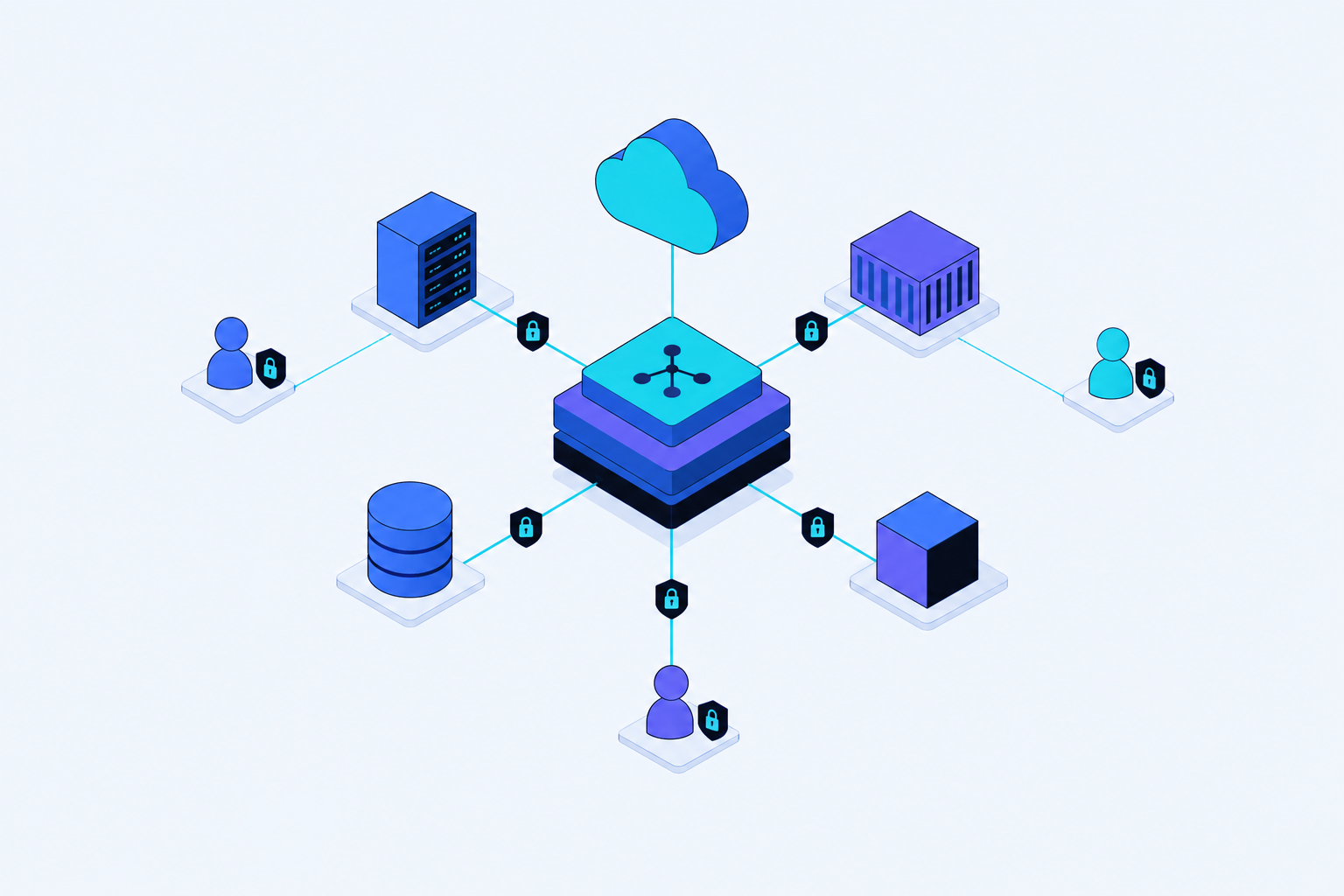
Permission-aware multi-agent orchestration for large enterprises requires access controls that follow the user from login through every step. Enterprise orchestration platforms enforce fine-grained access controls end to end only when identity, source permissions, per-operation authorization, gateway controls, and audit remain connected throughout the agent chain. MCP makes the connections, but the platform must enforce the controls at every step.
Why enterprise orchestration platforms cannot treat access control as an add-on layer
Enterprise adoption has moved faster than enterprise governance. Anthropic launched MCP as an open-source project in November 2024, and the protocol moved to the Linux Foundation's Agentic AI Foundation in December 2025. That move established a vendor-neutral, community-governed standard backed by OpenAI, Block, Google, Microsoft, AWS, Bloomberg, and Cloudflare. A shared standard makes it easier to connect systems from different vendors. It does not establish who may use each connection or what they may do through it.
The production gap exposes that structural mismatch. An estimated 11–14% of enterprise agentic AI pilots reach production, with identity, audit, and access-control gaps blocking the rest. Meanwhile, developers and business units install shadow MCP servers without central review. Initial inventories routinely uncover more endpoints than organizations expected, leaving security teams responsible for connections they did not approve.
Feature comparisons alone miss this underlying problem. A platform can connect agents to useful systems while leaving the enterprise to supply the controls between them. The real evaluation therefore concerns the whole path from a user's request to an agent's action and its audit record.
What MCP's protocol architecture actually does — and does not — enforce on its own
MCP defines a connective protocol. Its integration advantage is straightforward. One MCP server can serve compatible clients including Claude, ChatGPT, Cursor, and a custom agent, replacing bespoke connectors with a shared interface. That same reach increases the consequences of a misconfigured server because the connection can serve many clients.
Default implementations can connect AI to a source through a service account or API key. The account determines what the AI can reach. When every user works through that same account without per-user authorization, the limits on one user's access do not apply to the agent in the same way. Credential aggregation adds another risk, as one compromised MCP server can expose OAuth tokens across integrated services.
The July 2026 specification revision made MCP stateless at the protocol layer. Each request must include its protocol version and client capabilities metadata, with client identity recommended, and be authorized on its own merits. This is a meaningful change in the request model. Organizations still need to provide the authorization layer that decides whether a particular operation is permitted.
Agent behavior makes that decision more demanding than a connection check. A traditional API call declares intent before execution, while an agent predicts what a competent operator would try to do. The agent's choice is probabilistic. Role-based access control is still needed, but a user's role alone cannot show whether the agent is allowed to take this inferred action on this particular data.
How do agents respect each user's data permissions at every step, not just login?
Session-level authorization answers whether a client may connect to a system. It unlocks the door, but does not authorize every action inside. Per-operation authorization checks who the user is, what action they request, and which data they want to use for every MCP tool call. A platform that checks only at connection time leaves a window of implicit trust that conflicts with least privilege.
The MCP team announced the Enterprise-Managed Authorization extension as stable in June 2026. EMA lets administrators define server-access policy in their identity provider, so users inherit approved connections on first login without per-app OAuth. This removes a real source of friction.
Okta supported EMA through Cross App Access, while supported clients included Claude, Claude Code, Cowork, and Visual Studio Code. Server support included Asana, Atlassian, Canva, Figma, Granola, Linear, and Supabase, with Slack and others in progress. With that support, connections can be managed centrally in practice, but approval to connect is separate from permission to act.
Fine-grained, attribute-based access control can check permission to act only if it runs for each tool call. For row-level data permissions to hold throughout a multi-step pipeline, authorization must evaluate the requesting user, action, and data object at each operation, with permissions inherited from the source. Login is not a substitute for that decision.
The five-layer enforcement architecture that mature enterprise deployments are converging on
Transport security is the first layer of enforcement. All MCP traffic needs TLS 1.2 at minimum, ideally TLS 1.3, with mutual authentication between clients and servers. An encrypted request can still ask for data the user has no right to access.
Identity is the second layer and proves whom the agent acts for. EMA and identity-provider integration establish that relationship at connection time. The agent must then retain a verifiable enterprise identity. Without that identity, later controls cannot reliably evaluate the user's permissions.
Authorization is the third layer and depends on that identity. ABAC must run for each tool call, with permissions inherited automatically from connected source systems. Revocation is the decisive test of that inheritance. When a user loses source access, the agent must lose it immediately too.
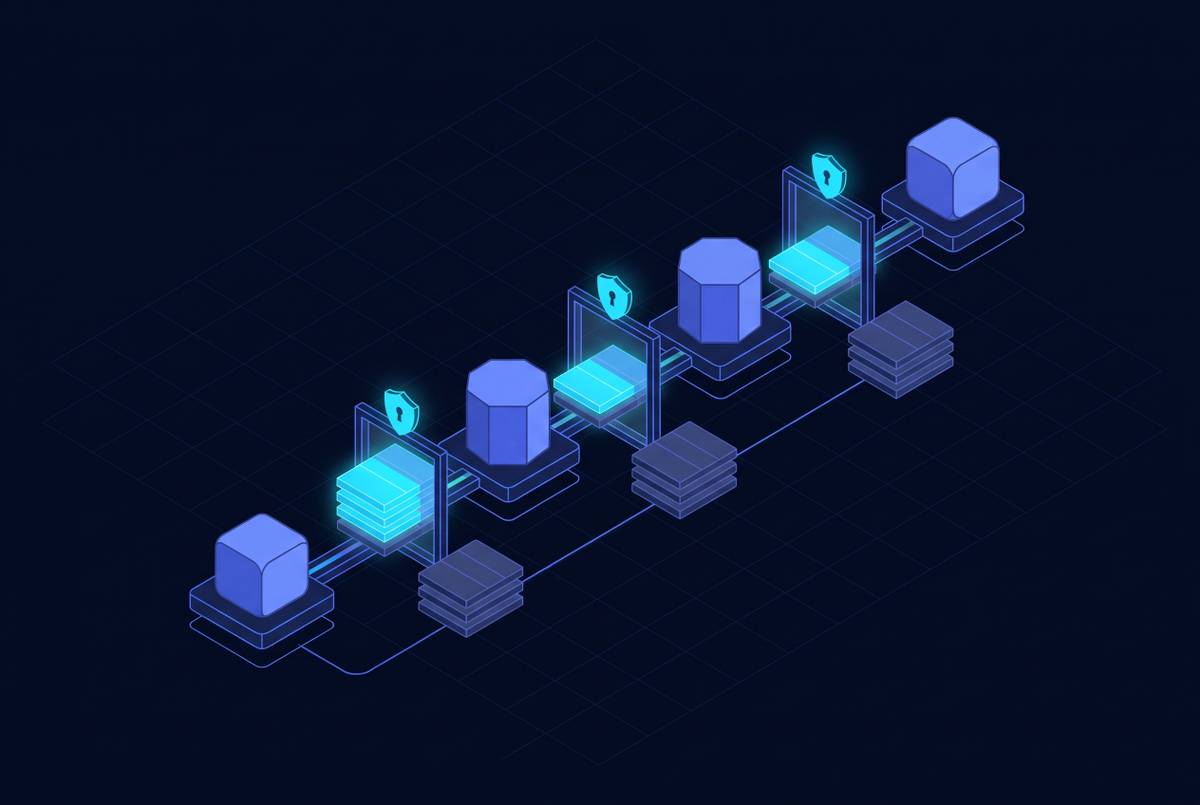
Gateway mediation is the fourth layer and sends enterprise MCP traffic through a common enforcement point, with no direct client-to-server connections allowed. The gateway enforces per-agent tool allowlists, rate limits, schema validation, sensitive-field redaction, and anomaly detection. Destructive or irreversible actions also need human approval here as a structural control.
Audit is the fifth layer and records who approved each action, whom the agent represented, which data it used, and when it acted. Attribution-level records support obligations under HIPAA, GDPR, SOX, and FedRAMP, though their adequacy must be assessed against the organization's requirements. Each layer needs an accountable owner. Even strong logging cannot make up for missing authorization, just as strong identity cannot make up for a gateway that agents can bypass.
Why the registry is a governance control, not just a discovery catalog
The gateway's tool allowlist depends on a registry with rules for how it is used. A catalog that records server locations without controlling publication, modification, or invocation provides discovery alone. Shadow servers make that distinction operationally important. Without control over which servers exist, the enterprise cannot establish that its gateway policy covers the environment.
The MCP community launched the official MCP Registry in preview in September 2025. It stores metadata for publicly accessible servers and provides a read-only API, but it does not support private servers. Its codebase is not designed for self-hosting. Enterprises needing an internal catalog should build a private sub-registry using the same OpenAPI specification rather than treat the public registry as their private governance system.
A governed registry needs version control, attributable changes, ownership metadata, team-level access scoping, and approval before production use. These controls connect publication decisions to runtime permissions. A server's presence in a catalog should not, by itself, mean every team may invoke it. The registry must distinguish what is discoverable from what is approved for a particular team.
A department's MCP server can serve AI surfaces including Claude, ChatGPT, Cursor, and Slack when its permissions and context remain intact. Teams can then discover and reuse existing skills and workflows. The registry's value is therefore not just knowing where a capability lives, but preserving the conditions under which it may be used.
How named enterprise orchestration platforms implement these controls in practice
JFrog MCP Registry approaches governance through the software supply chain. JFrog treats MCP servers as immutable binary artifacts, preventing post-publication changes, and blocks malicious tools before download. This gives registry integrity a concrete enforcement mechanism. It establishes what is distributed, rather than proving what a particular user may do with it at runtime.
Against the five-layer framework, that distinction leaves specific verification questions. JFrog's described supply-chain controls do not establish how transport authentication, user identity, per-operation authorization, gateway mediation, or attribution-level audit work in a deployment. Artifact immutability and encrypted transport address different risks, and neither substitutes for checking an agent's action against source permissions.
Bifrost takes a gateway-centered approach to enforcement. The open-source, Go-based AI gateway integrates an MCP gateway into its proxy layer, acting as an MCP client to backend systems and an MCP server to client applications. This places it at the runtime mediation point. Its gateway-and-registry integration aligns with the architecture, while open-source control logic is available for audit.
Bifrost's production fit still requires independent assessment. Operational maturity and enterprise support commitments are explicit evaluation questions, as are the deployment's transport controls, identity integration, source-permission inheritance, and attribution records. A central proxy creates a place to enforce policy. Its presence alone does not demonstrate that every required decision occurs there.
A complete deployment connects identity-provider policy through EMA, automatically inherited source permissions, team-scoped registry access, gateway enforcement, and attribution-level audit. Buyers need concrete evidence of how the layers work together, including the transport and approval controls that remain necessary underneath them.
How to evaluate whether a platform actually enforces access control end to end before committing to it
An internal MCP inventory should precede vendor evaluation. Can the organization enumerate every endpoint, including those installed by individual teams? The discovered count is typically higher than expected. That inventory reveals whether shadow-server risk is already present and defines the environment a platform would have to govern.
The technical evaluation should then test each layer on its own. Does all MCP traffic use the required TLS protection and mutual authentication? Does the platform integrate with the existing identity provider through EMA or an equivalent mechanism? Every agent action needs a verifiable enterprise identity, so any fallback to a shared service account needs a close look.
Does the platform evaluate ABAC for every tool call against the specific user, action, and data object, or does it check only role membership at session creation? For a multi-step pipeline using row-level permissions, the test is whether those permissions hold at every operation. Removing the user's access in the source system should also remove the agent's access immediately. The vendor must explain whether propagation is automatic or depends on manual changes.
Gateway and registry questions test whether enforcement can be bypassed. Does all MCP traffic pass through the gateway, and does it enforce per-agent allowlists and human approval for destructive actions? The registry must also track versions and ownership, scope invocation rights, and require approval before a server enters the production allowlist.
An audit evaluation should check that the records can trace an agent's full approval chain. Can the records identify the user, agent, action, data, and time in a form that meets the organization's compliance obligations? The evidence must explain what was authorized and performed.
Finally, build-versus-buy decisions should take into account identity integration and token brokering, which add a large engineering cost to a mid-size enterprise deployment. Commercial gateways range from per-seat pricing to annual enterprise contracts, but price does not answer the enforcement questions. The framework remains the same for purchased and internally built systems. A platform that cannot answer each question concretely is enforcing access control at the edges.