enterprise MCP server providers with built-in governance controls
Enterprise AI adoption now outpaces the security guardrails to control it.

MCP, the Model Context Protocol, is the open standard that lets AI agents talk to external tools and data sources without custom integration code for every single pairing. Anthropic built it, the Linux Foundation now stewards it, and adoption has gone from a few thousand curious developers to real enterprise infrastructure in about a year. That speed is the story: enterprises are standardizing on MCP faster than they're building the governance to control it. I've spent the last stretch of my career watching that gap widen, and it's where the risk actually sits.
Before MCP, connecting an agent to a tool meant custom code, every time. N agents times M tools meant an integration surface that grew exponentially; every new tool or agent multiplied the work instead of adding to it. MCP flattened that. Build one server and it works across any compatible client: Claude, ChatGPT, Cursor, Copilot. People call it the USB for AI models. Fair comparison. Underneath the hood it's JSON-RPC 2.0 messages passed over stdio or Streamable HTTP, structured around three parts: host, client, server.
The download numbers are the part that convinced me this wasn't a niche protocol. Roughly 100,000 in November 2024, over 8 million by April 2025. The ecosystem passed 5,800 servers and 300 clients around the same stretch. By early 2026, SDK downloads were running 97 million a month, with over 10,000 active public servers out in the wild. In December 2025, MCP moved to the Linux Foundation, co-founded by Anthropic, Block, and OpenAI, with Google, Microsoft, and AWS backing it. That handoff matters more than it sounds like on paper: MCP moved from single-company stewardship to shared, vendor-neutral infrastructure. At that scale, with that kind of institutional weight behind it, how you implement MCP stops being a technical detail and becomes a strategic call. The enterprises treating it that way now are the ones still standing when the next audit or incident lands.
The governance gap opening up between MCP adoption and MCP security
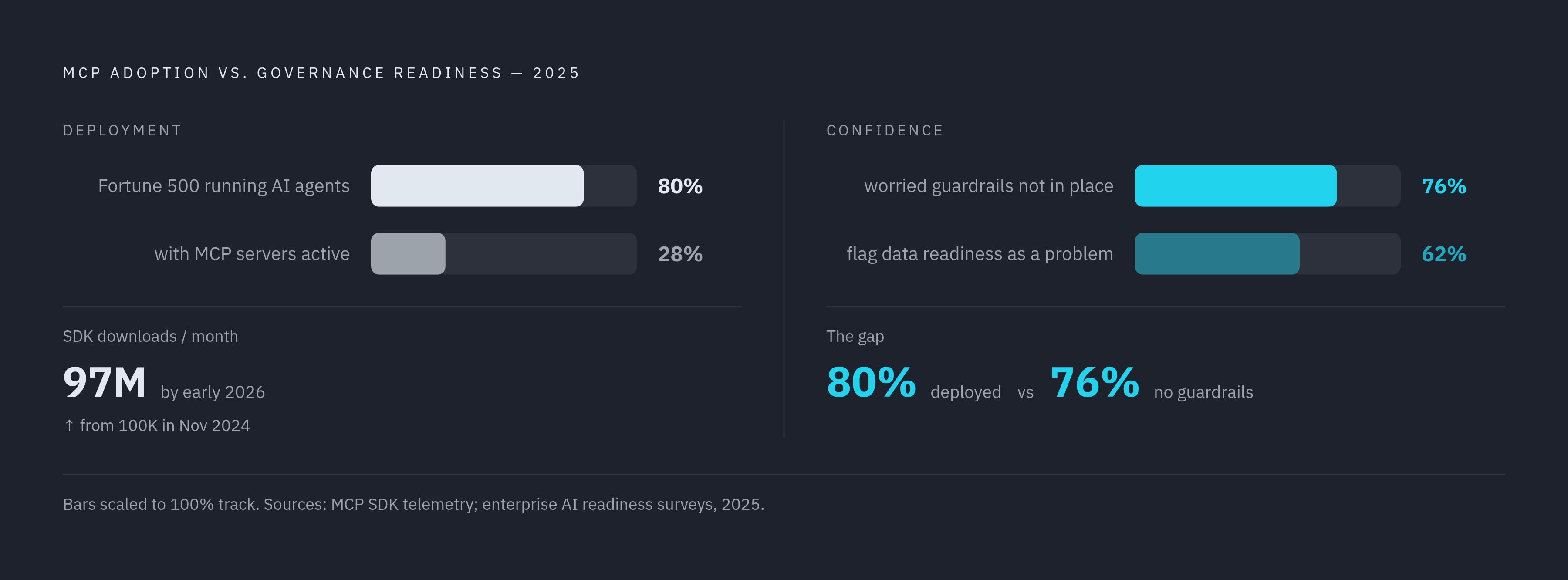
Here's the tension nobody wants to say out loud: 80% of Fortune 500 companies already run active AI agents in production, and 28% have MCP servers deployed. Meanwhile 76% of organizations say they're worried about guardrails, and 62% flag data readiness as a problem. Adoption is outrunning confidence. That mismatch doesn't fix itself.
Most MCP implementations on the market were built for developer convenience, full stop. Fast to spin up, easy to test, great for a hackathon. Enterprise governance was never the design goal, and it shows in the details. Authentication is the clearest tell: the original spec didn't require it at all. OAuth support didn't show up until March 2025, and by the time researchers went looking, they found over 1,800 MCP servers sitting exposed on the public internet with no authentication whatsoever.
Overprivilege runs deeper. It's faster to build a code-generation agent with write access to every production repo than to scope it down to the three it actually touches. Faster to hand a CRM agent full API access than to limit it to read-only contact queries. Faster today, more dangerous tomorrow, because if that agent gets compromised, the attacker doesn't just inherit the agent. They inherit every permission granted to every MCP server that agent was ever connected to. The blast radius is the sum of everything the agent was trusted with, and most teams never sit down and add that sum up.
This already happened, by the way. In September 2025, a compromised npm package impersonated a legitimate Postmark email MCP server. It behaved identically to the real thing for fifteen releases straight, passed every check anyone thought to run, then quietly started copying every outgoing email to an address the attacker controlled. Nobody caught it through behavior monitoring, because the behavior looked completely normal right up until it wasn't.
Layer on top of that a set of threat categories the industry hasn't fully mapped: data-driven exfiltration, tool poisoning, cross-system privilege escalation. Live categories, live incidents, arriving right as a large share of organizations say they're pushing GenAI to production or scaling it through 2026, while a strong majority still say the guardrails aren't there. Scaling first and securing later is a bet. Most compliance teams wouldn't sign off on it if anyone wrote the bet down plainly and put it in front of them.
The six governance controls that separate production-ready MCP from developer tooling
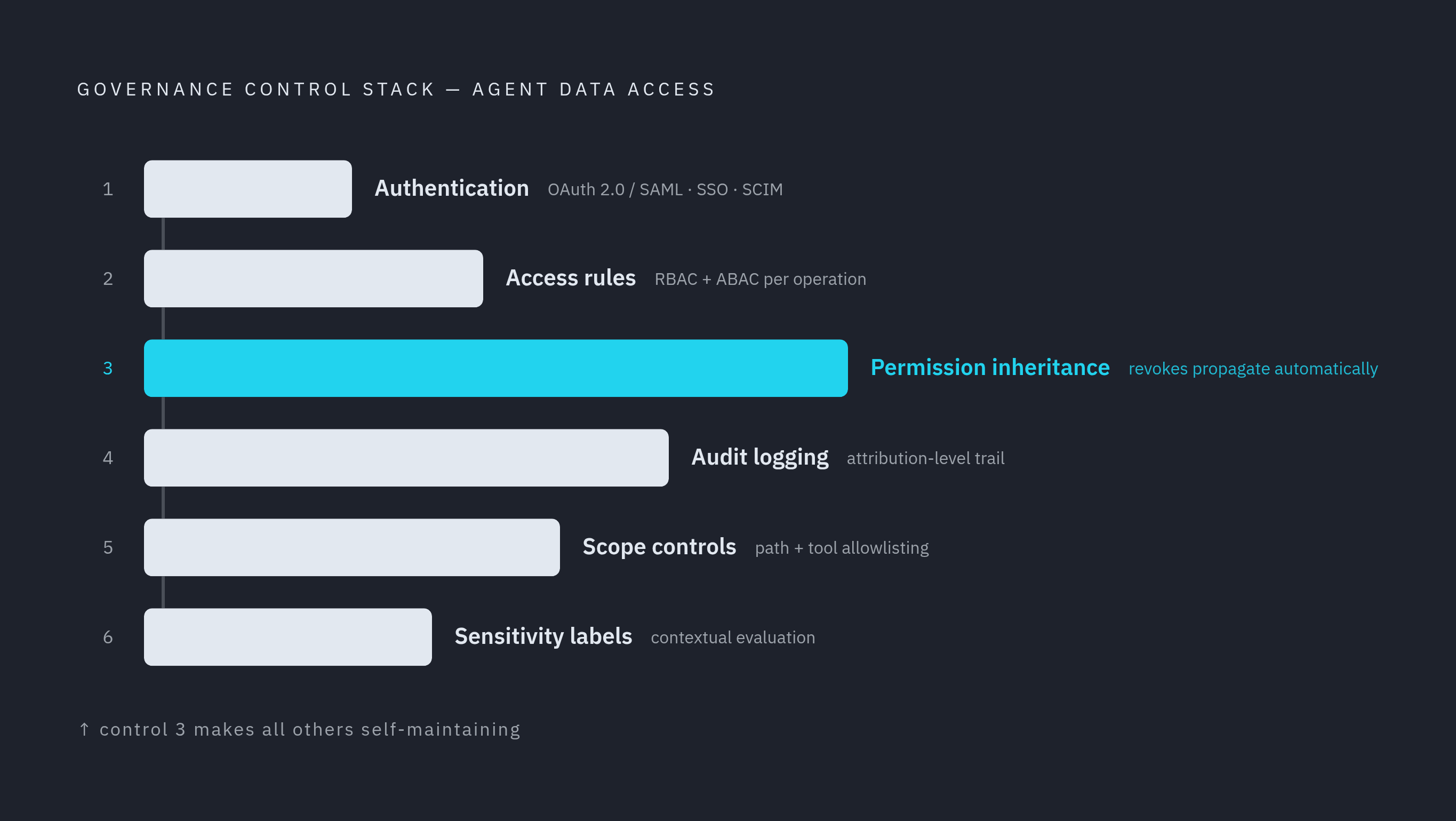
Think floor, not ceiling. Each of these exists because a specific failure already happened to somebody, somewhere, and got expensive.
OAuth 2.0 and SAML authentication, credentials stored outside the AI's context. Closes the exact gap that left 1,800-plus servers exposed to the open internet. At enterprise scale this means SSO and SCIM integration, so authentication syncs automatically with whatever identity provider the org already runs, instead of functioning as a bolted-on extra step somebody forgets.
Per-operation RBAC and ABAC. The question isn't whether a user can access the server. It's whether this specific tool can be called, on this specific resource, under these specific conditions. That's the gap between server-level access and least-privilege enforcement that actually survives an audit.
Permission inheritance from source systems. The architectural principle underneath everything else here: governance should extend the data governance an organization already has, not spin up a parallel AI-specific rulebook someone maintains by hand in a spreadsheet somewhere. A user loses access to a system, the agent acting on their behalf loses it too. Automatically. Nobody has to remember.
Attribution-level audit logging. Every action an agent takes needs to answer three questions on demand: who approved it, when, what did it touch. Retention alone isn't enough here; the logs need to be queryable close to real time, or they're just a very expensive archive nobody opens until it's too late.
Path and scope controls with tool-level allowlisting. Operators decide exactly which tools an agent can call, not which tools a server happens to expose. Rate limiting and rule-based policy live here too, governing what gets done, how often, in what order.
Sensitivity label evaluation. The agent needs to understand data classification, not just whatever it's technically permitted to touch. That's the difference between a blunt allow-or-block switch and a Slack MCP integration that actually behaves differently depending on the sensitivity of the channel it's sitting in.
Put these six together and you're extending governance the enterprise already trusts onto a new surface. Nobody has to build a second governance system from scratch just because the word "AI" is attached.
How the MCP gateway pattern enforces these controls at scale
Skip the gateway and you get fragmented credentials, zero real visibility into what agents are actually doing, uncontrolled access to internal systems. Same shadow-IT problem that showed up with early SaaS adoption a decade ago, just dressed differently this time.
A gateway is where all six controls converge into one place. Authentication, RBAC, audit logging, policy enforcement, rate limiting, credential management: instead of scattering those across a dozen separate server implementations, they live in one enforced layer sitting between agents and tools. Gartner projects 70% of software engineering teams building multimodal applications will use AI gateways by 2028, up from 25% in 2025. The teams building this layer now won't be re-architecting under pressure later.
Worth being precise here, because the market blurs this constantly and I've watched buyers get burned by it. A gateway that enforces policy in transit does a different job than a managed hosting service that just makes deployment easier. One governs behavior; the other governs convenience. Know which one you're buying, because the label on the box often doesn't tell you.
Gateways solve shadow AI too, but only when they solve it correctly. Employees stop reaching for ungoverned consumer tools when the sanctioned option is genuinely better to use, not just officially blessed by someone in security. Swap shadow AI for a corporate MCP integration with broad data access and no per-user authorization, and the risk hasn't gone anywhere. It's just wearing an official badge now. Real visibility means logging which user triggered the agent, which server responded, what data got pulled, whether the whole chain stayed inside policy. Anything short of that is visibility in name only.
What to look for in enterprise MCP providers across the market
The market isn't one thing, it's a spectrum, and where a given product sits on it tells you whether it survives three years from now.
At one end: developer-convenience tools. Lightweight, self-hosted easily, strong community catalogs of servers. Governance, where it shows up at all, got bolted on after the fact. At the other end: gateway and proxy layers purpose-built to sit between agents and servers, enforce policy, log everything that passes through. That's the category API gateway vendors like Kong and platforms like TrueFoundry are pushing into. In the middle sits enterprise platform integration, where MCP support gets built directly into systems organizations already run. ServiceNow's MCP Registry is the first enterprise implementation of the open MCP Registry API specification, giving organizations a governed, searchable catalog of every server their agents can reach. Other major enterprise platforms are building similar support into their own ecosystems. And then there's the last category: purpose-built governed MCP platforms, designed from day one around registries, permission inheritance, and audit trails, rather than retrofitted onto a developer tool the moment enterprise customers started asking hard questions.
For organizations with real governance requirements, start your search in that last category, Credal, an enterprise platform for building and governing AI agents that enforces permission inheritance, audit logging, and versioned registries across every connected source, is one example of a provider built from that premise. Retrofitted governance tends to have seams, and seams are exactly where incidents happen.
A few questions cut through vendor pitches fast. Does the product inherit permissions from source systems, or does someone redefine access by hand for every new tool that shows up? Is there a governed registry with version control and a named owner, or just a shared list with no scoping attached to it? Can audit logs be queried down to the user and the specific data touched, or only at the server level? Is RBAC driven by SCIM, or managed manually? Does policy travel with the agent across every surface it touches, or reset every time the agent shows up somewhere new?
Sit with that last one for a second. Claude, ChatGPT, Cursor, and Copilot all speak MCP now. A provider enforcing the same governance across all five surfaces at once is a categorically different product from one that only works cleanly with a single client. And because business context, permissions, and guardrails need to travel with the organization, not get locked to one model, a vendor whose architecture quietly creates model lock-in has handed you a brand-new risk to manage. Even if governance was the exact reason you hired them.
How virtual servers and scoped MCP endpoints prevent tool sprawl at the team level
One shared MCP server for the whole company sounds efficient on paper. In practice it means every team's tools are visible to every other team, and server-level access control is too blunt a tool to fix that.
Virtual servers fix it by scoping the environment itself. Each team, role, or use case gets its own isolated MCP environment: its own tool catalog, its own permission set, its own audit trail. A finance team might get a read-only virtual server wired into ERP tools. Operations sits in a completely separate environment connected to supply chain workflows. Neither one can see the other's tools, let alone call them.
A few things fall into place once you do this. Per-team RBAC, instead of one monolithic permission model straining to cover every use case at once. Separate audit trails per department, which matters enormously the first time compliance asks for records and doesn't want to sift through five other teams' activity to find the relevant slice. New teams onboard into their own scoped space instead of inheriting a shared server that's accumulated three years of somebody else's tools. With SCIM-driven membership, who belongs in which environment stays synced automatically with the identity provider, so nobody's updating a spreadsheet by hand.
This isn't a hypothetical problem waiting to happen. Some 41% of technical leaders in the software industry already report their organizations running MCP in limited-to-broad production. At that scale, tool sprawl is happening in parallel across departments right now, whether anyone's tracking it or not.
There's a duplication cost buried in here too, and it's easy to miss. Without scoped environments, five different teams end up rebuilding the same tool configuration independently, each one slightly different, each one a separate thing somebody has to secure and maintain. With virtual servers, a governed tool gets built once and made available to whoever needs it. Permissions intact. No copy-paste sprawl quietly multiplying the attack surface behind everyone's back.
Why an MCP registry is the governance control enterprises are most likely to skip — and why that's a mistake
A registry is the boring part, plain and simple. It's a centralized catalog of every MCP server in an organization: what it does, who owns it, what version it's on, how it connects to everything else. Not glamorous. Also the thing most likely to get skipped when a team is racing to ship, which is exactly the mistake.
Skip it and teams connect agents to external tools with zero oversight. No central mechanism tracks what's been connected, credentials scatter across individuals instead of living in one managed place, and the organization ends up with an MCP version of shadow IT. Except instead of an unauthorized spreadsheet tool, it's an unauthorized agent holding API access to something sensitive. The pattern isn't new, either. Unmanaged SaaS became a compliance headache through most of the 2010s for exactly this reason, and MCP is replaying the same story on a much faster clock.
A real registry does more than list what exists. It gives every server version control, so changes get tracked and rollback is possible when something breaks. It gives every server a named owner, someone accountable when questions come up later. It scopes access so teams discover the servers they're authorized to use, not every server in the company. And it enforces policy as code at the point of registration, not just at runtime, after the tool's already live and doing damage.
The standards side is catching up too. MCP's maintainers have laid out a vision for enterprise registries with self-managed governance, and ServiceNow's MCP Registry, again, is the first enterprise implementation of that open API specification. There's a broader shift happening alongside it: security teams are starting to treat MCP credentials as their own category of non-human identity, applying the same lifecycle discipline they'd apply to any machine identity or service account. Policy-as-code for MCP deployments is becoming table stakes for any team that actually takes monitoring seriously.
The clearest way to see what skipping a registry costs you is the rebuild tax. Without one, the same tool configuration gets reinvented independently by every department that needs something similar. A registry turns one team's work into infrastructure the whole company reuses, instead of five teams quietly solving the same problem five different, uncoordinated ways.
The governance checklist to use before signing with any enterprise MCP provider
Use this as a filter before you sign, and revisit it as an audit after you've deployed. Governance architecture is brutally expensive to reverse once it's load-bearing, so get these answers before the contract, not after the incident report.
On authentication and identity: does the provider support OAuth 2.0 and SAML with SSO built in? Is provisioning SCIM-driven, so access stays synced automatically with the identity provider? Are credentials stored outside the AI's context entirely, never in prompt history, never in model memory?
On authorization and least privilege: is RBAC and ABAC enforced per operation, or only at the server level? Can operators allowlist specific tools an agent may call, rather than granting blanket access to everything a server exposes? Does permission inheritance from source systems happen automatically, with no manual redefinition needed the moment someone's access changes?
On audit and observability: is logging attribution-level, capturing user, agent, tool, data touched, and timestamp together in one record? Is monitoring real-time, not just stored somewhere for later review nobody gets to? Can the audit trail answer a compliance question on its own, without custom tooling bolted on top just to make it usable?
On registry and versioning: is there a governed registry with version control, named ownership, and access scoping built in from the start? Is policy enforced as code at the moment of registration, or bolted on after the server's already live and running?
Run any provider through these four categories before you sign anything, and the developer-convenience tools sort themselves from the production-ready ones fast. The gap between the two comes down to architecture, and architecture isn't something you patch after the fact.