platforms for enforcing data permissions across multi-model AI deployments
Agents need infrastructure that enforces permissions automatically.
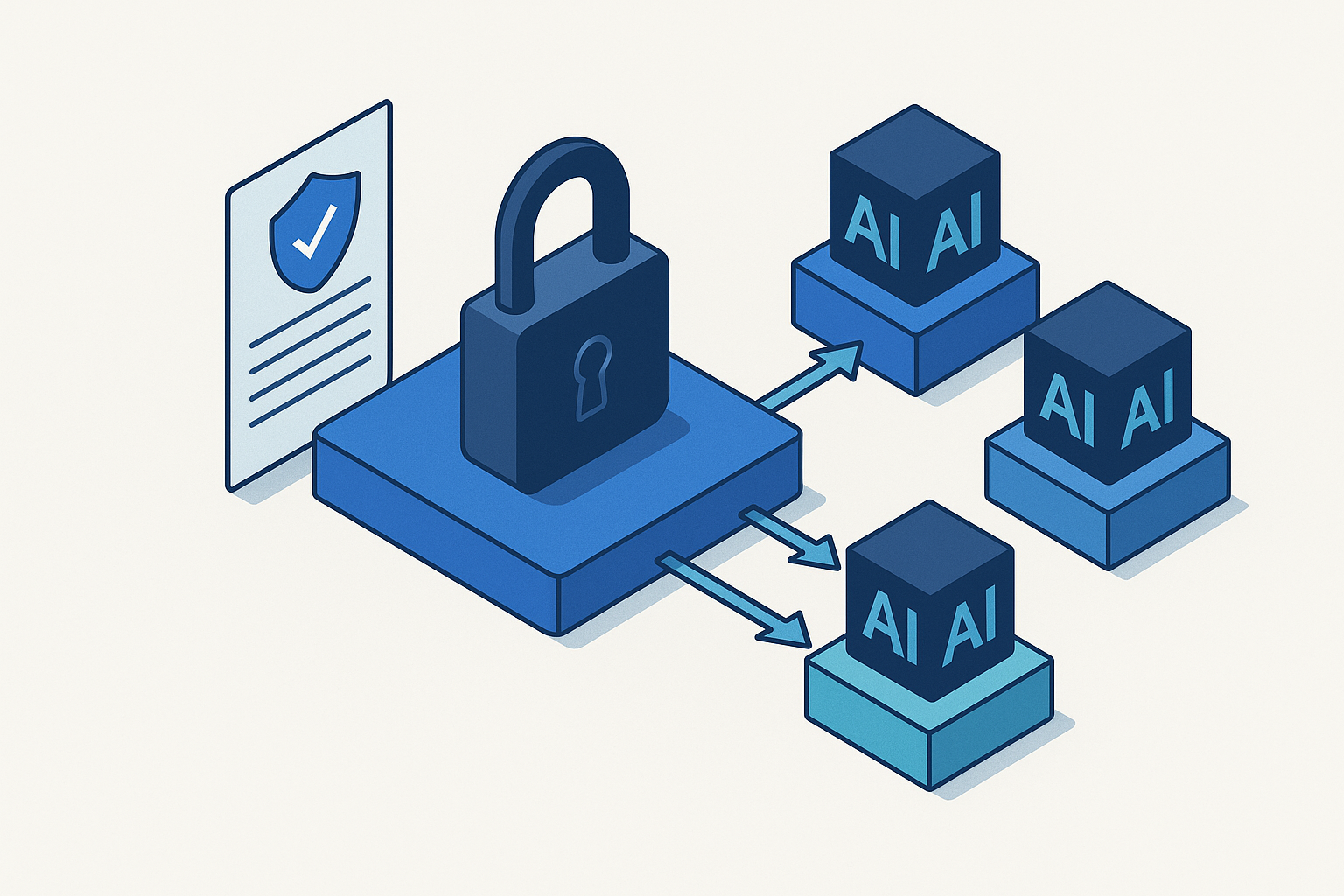
Enforcing data permissions across multi-model AI deployments takes an infrastructure answer, and most companies are instead offering a document. I've sat through enough enterprise rollouts now to know the pattern by heart: permissions need to inherit from the source system, enforcement needs to hold no matter which model shows up asking, and there needs to be a log detailed enough to reconstruct the mess after it happens. It does happen, in fact. Something breaks, and someone, usually a security lead who wasn't in the original rollout meeting, starts asking who approved what.
Traditional access control assumes a human on the other end. You log in, the system knows who you are, the session ends, someone pulls the audit trail if they ever need to. Agents don't sit still long enough for that model to work. They run at machine speed, cross system boundaries mid-request, and take direction from an LLM that has no built-in sense of your company's access policy. Nobody told it to check. Nobody could, really, not with the tools that existed until recently.
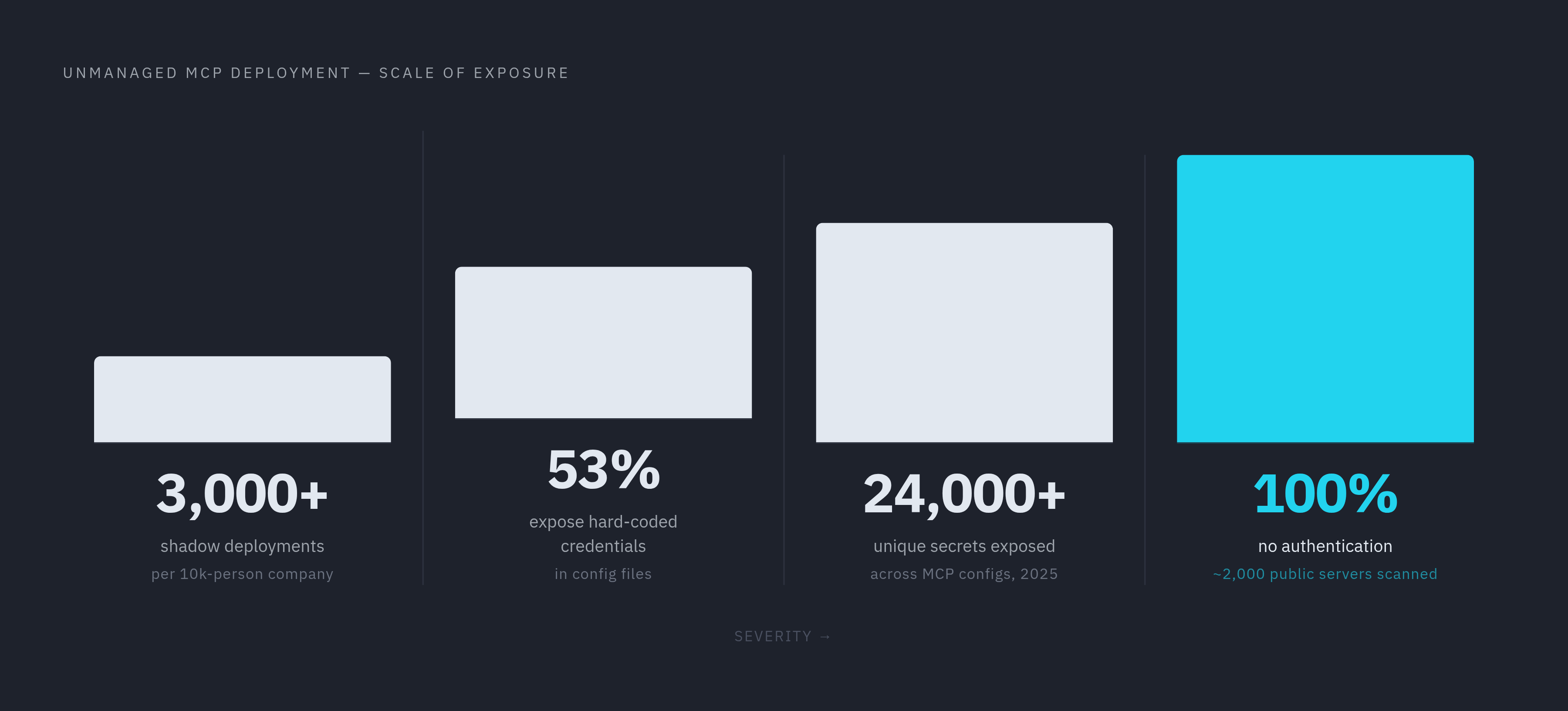
Anthropic named this the N×M problem when it launched MCP: N tools times M model front-ends, multiplying into a pile of one-off integrations, each handling credentials its own way. That's the sprawl problem, and it's the one that gets talked about. The quieter problem is that every one of those integration points is also a place where permissions slip. Clutch Security found that in a typical 10,000-person company, about 15% of employees are running MCP servers on their own, roughly two apiece. Do the math and that's over 3,000 separate deployments, most with their own credentials, none of them visible to whoever thinks they're watching.
You can write a policy that says agents must respect data access rules. It won't matter, though. If no technical layer checks that rule the instant an agent tries to act, you've written a sentence, not a control.
What MCP is and why it became the default integration surface for enterprise AI
MCP, the Model Context Protocol, is an open standard Anthropic put out in November 2024. It runs on three roles: a host, which is the AI application itself (an assistant, an IDE), a client living inside that host and managing the connection to each server, and a server, a small program that exposes what one system can do, whether that's a CRM, a database, or a file store.
Servers expose tools an agent can act on (filing a ticket, say), resources an agent can read (a document, a schema), and prompts the server hands over as templates. Anthropic likes the USB-C comparison: one plug that works everywhere instead of a drawer full of proprietary cables. Any host talks to any server through the same interface. That was the pitch, and it worked.
OpenAI folded MCP into its Agents SDK and Responses API in early 2025. Google DeepMind and Microsoft added support that summer, with Microsoft wiring it straight into Copilot Studio. AWS came on board late in 2025. Then in December 2025, Anthropic handed MCP to the Agentic AI Foundation under the Linux Foundation, with AWS, Google, Microsoft, Cloudflare, and Bloomberg signed on as platinum members. By March 2026, there were more than 10,000 active public MCP servers and 97 million monthly SDK downloads across Python and TypeScript combined.
Gartner expects 40% of enterprise applications to ship with task-specific AI agents built in by the end of 2026, up from under 5% in 2025. Somewhere in that climb, MCP stops being a developer convenience and becomes the default boundary for who, or what, touches enterprise data. Once that happens, governing MCP and governing enterprise data access are the same job.
The security gap built into MCP's design that enterprises are responsible for closing
The spec says it plainly: MCP "does not enforce security at the protocol level." Whoever stands up a host, client, or server owns that job, alone. That's a reasonable design choice for an integration standard. It's a bad foundation for a security framework, and a lot of companies are deploying it as though it were both at once.
The gap shows up the moment anyone bothers to look. Knostic scanned nearly 2,000 internet-exposed MCP servers in July 2025 and found that every single verified one lacked any form of authentication. Not most. All of them. Independent scans run around the same period turned up the same story: over-permissioned setups sitting open on local networks like an unlocked office door. A report titled "The State of MCP Server Security 2025" found 53% of MCP servers expose credentials hard-coded into config files, and more than 24,000 unique secrets turned up exposed across MCP configs over the year.
This stopped being theoretical fast. A critical vulnerability in MCP Inspector instances allowed attackers to run arbitrary commands through unauthenticated endpoints. In July 2025, an AI agent deleted a production database despite an explicit instruction telling it not to touch anything. Proper OAuth scoping at the server level would've stopped that cold; a strongly worded instruction, evidently, does not. The first malicious MCP package surfaced that September and sat undetected for two weeks, quietly pulling email data the whole time.
Published security research lays out the shape of most attacks: they arrive through the model's own context, via poisoned tool descriptions, tampered outputs, untrusted data slipped in at runtime. Wiz Research has a term for the underlying condition, the "lethal trifecta": untrusted input, access to sensitive data, and the ability to act, all present at once. Unmanaged MCP deployments produce that trifecta as the base case, because identity and access management was built for human sessions with a clear beginning and end, and agents crossing system boundaries at machine speed need a completely different kind of control.
The architectural requirements any platform must meet to enforce permissions across models
Three things, none of them negotiable. Access controls need to inherit from the source system, not get redefined every time someone spins up a new agent. If a person can't open a file in SharePoint, an agent acting for that person shouldn't be able to either. It's a simple rule, and it gets violated constantly.
Enforcement has to hold no matter which model is running the show, Claude, ChatGPT, Copilot, something local, doesn't matter. The moment permission logic shifts depending on the model, you've rebuilt the N×M mess MCP was supposed to kill.
And every tool call, every authorization decision, every touch of a resource needs a log detailed enough to rebuild what happened, months later if it comes to that. Without the ability to say who approved what and when, governance is a word on a slide deck, nothing more.
Two patterns in production actually get you there. The MCP gateway pattern puts one front door in front of a whole set of MCP servers, a single endpoint handling authentication, authorization policy, traffic monitoring, and audit logging together. That keeps security logic out of application code, so developers build tools without accidentally also owning enforcement. The registry pattern runs alongside it: a governed, version-controlled catalog of approved servers and skills, each with clear ownership and a defined access scope, so five different teams stop rebuilding the same integration five different ways with five different permission gaps.
Server-level access alone isn't fine-grained enough, and this is where most teams trip. A support agent might need to read CRM records but never delete them. A finance agent might need to query payment history but should never trigger a transfer. Drawing that line requires tool-level role-based access control, checked at every invocation, not once at the server gate and then forgotten.
There's a quieter piece to this: context. Every MCP server an agent connects to injects its tool definitions straight into that agent's context window. Past roughly five to seven servers, those definitions start eating a real chunk of available context, and performance starts to sag. Scoping which servers a given agent can even see is as much a performance decision as a security one. Microsoft's published approach gives a decent sense of the floor: every tool call carries a correlation ID from client to gateway to server and back, with prompts, tool choices, authorization decisions, and resource access logged against one consistent schema. That's the baseline, and a fairly modest one at that.
How leading platforms implement these requirements — what each gets right and where gaps remain
The vendors working this problem come at it from different angles, and I haven't found one yet that covers all of it.
Authorization-layer platforms take a policy-as-code approach applied directly to MCP tool calls. The strength here is precision: fine-grained, tool-level RBAC with policies that are version-controlled and auditable on their own terms. The gap is that these platforms generally don't manage the MCP server registry, and they don't automatically inherit permissions from source systems either. Someone still has to wire the policy engine into each integration by hand, which is exactly the kind of manual step that rots quietly six months later once the person who set it up has moved teams.
Identity and authentication platforms work the credential side: agent identity management, OAuth scoping, credential lifecycle for MCP servers specifically. That closes the authentication hole the protocol leaves wide open, and it handles agent identity at real scale. What it usually skips is authorization (what an authenticated agent is actually allowed to do) and registry governance (which servers are even approved for use to begin with).
Then there are governed agent platforms with a built-in MCP registry. Credal, an enterprise platform for building and governing AI agents that enforces inherited permissions and logs every agent action through a centralized registry, is one example of this approach. The entry point is a company-wide, governed catalog of AI skills and MCP servers where permissions can inherit from connected source systems, reducing the need for manual redeclaration. Done well, that covers all three requirements at once: access controls synced from source systems, consistent enforcement across whatever model surfaces a given team uses, and a full audit trail on every action an agent takes. Teams get scoped MCP servers without building custom UI for each one, and a skill built once by one team can be published to a shared catalog the rest of the org reuses instead of rebuilding.
Whichever category you're evaluating, the questions don't change. Does permission inheritance update automatically when a source system's access list changes, or does someone have to redeclare it by hand every time? Does enforcement actually hold across every model surface, or just one favored LLM? Is there a versioned registry with clear ownership, or a shared folder full of configs everyone's quietly afraid to touch? And is every tool call logged with enough detail to rebuild the authorization decision afterward, or just enough to confirm that something, at some point, occurred?
That second question deserves more weight than it usually gets. Tying your permission infrastructure to one LLM vendor trades a governance risk for a lock-in risk. Access controls, business context, and audit trails belong to the organization. They shouldn't care which model happens to be winning the benchmark race this quarter.
Where permission enforcement breaks down at the team level — department-specific failure patterns
RevOps and sales got their own path in as major CRM platforms began adding MCP support through 2025 and into 2026. The appeal is obvious: one query pulling CRM activity, email engagement, and intent signals together, instead of stitching three dashboards by hand every morning before the standup. The failure mode is just as obvious once you've watched it happen. A RevOps agent with write access to CRM records can be talked into changing a deal stage or overwriting a contact, whether through a careless prompt or a deliberately crafted one. Read-only scoping at the tool level stops that; a policy doc nobody reads does not. It gets messier once SDR agents, RevOps agents, and sales engineering agents are all hitting the same Salesforce org, each needing a different slice of permission on the exact same server.
Engineering teams tend to run GitHub, Snyk, and Linear MCP servers for code review agents. Give one of those agents write access to a repo, and you've handed it the ability to merge a pull request or touch CI configuration, actions that should need a human's sign-off regardless of how sharp the agent looked in testing. That's the real lesson buried in the Replit incident. Telling an agent "don't do this" in plain English carries far less weight than a tool-level permission that makes the action impossible in the first place.
Customer support usually runs a fairly standard shape: a query comes in, an AI agent picks it up, it hits an MCP server, that server pulls from ERP or CRM data under whatever restrictions exist, and an answer comes back without the ERP ever being directly exposed. Trouble starts when a support agent given read access to order records, on a shared server with no tool-level scoping, ends up also able to see billing details or account configuration sitting on that same system. In regulated industries like financial services and healthcare, that's exposure with a paper trail leading straight back to whoever signed off on the deployment. Every touchpoint needs to be auditable at the tool-call level, not just the server level.
Finance and legal carry the highest stakes of the four, by a wide margin. An agent that can query payment records or pull from a contract repository operates in territory where over-permissioning has real regulatory teeth, and the distinction that matters most can't be captured by a server-level access list at all. Querying a record and transferring funds are different permissions entirely, even when they live on the same server, answering to the same credential.
One pattern sits underneath all four departments: fragmentation. Each one stands up its own MCP servers on its own schedule, sometimes the exact same server, always a different credential scope, no shared visibility, no shared trail to pull once something breaks.
What "governed at scale" actually requires — moving from team deployments to an organization-wide standard
McKinsey's 2025 global survey found 88% of organizations already use AI in at least one business function, with 23% actively scaling agentic systems and another 39% experimenting. Most companies are sitting right in the window where the permission decisions they make now will follow them for years, not months, whether they meant them to or not.
What separates a governed deployment from managed chaos is a small set of operating habits, held consistently. A versioned, access-scoped registry has to replace whatever shared drive of prompts and configs teams have been quietly passing around. Permission inheritance has to be automatic, syncing the moment a source system's access list changes, rather than waiting for someone to notice weeks later and patch it by hand. Enforcement has to be the same rule, applied the same way, whether the agent making the request runs on Claude or ChatGPT or something built in-house by a team that's rightly proud of it. And the audit trail has to run underneath every one of those actions continuously, not get bolted on after the fact once someone finally asks what happened.
None of that is exotic. It's the same governance enterprises have always demanded of any system touching sensitive data, applied now to a category of actor that didn't exist a few years back. The organizations treating this as infrastructure to build, rather than a policy to write and hope people read, are the ones who'll scale their agents without scaling their exposure right along with them.