tools for governed AI skill sharing across enterprise teams
MCP servers let teams share AI skills once instead of rebuilding them five times over.
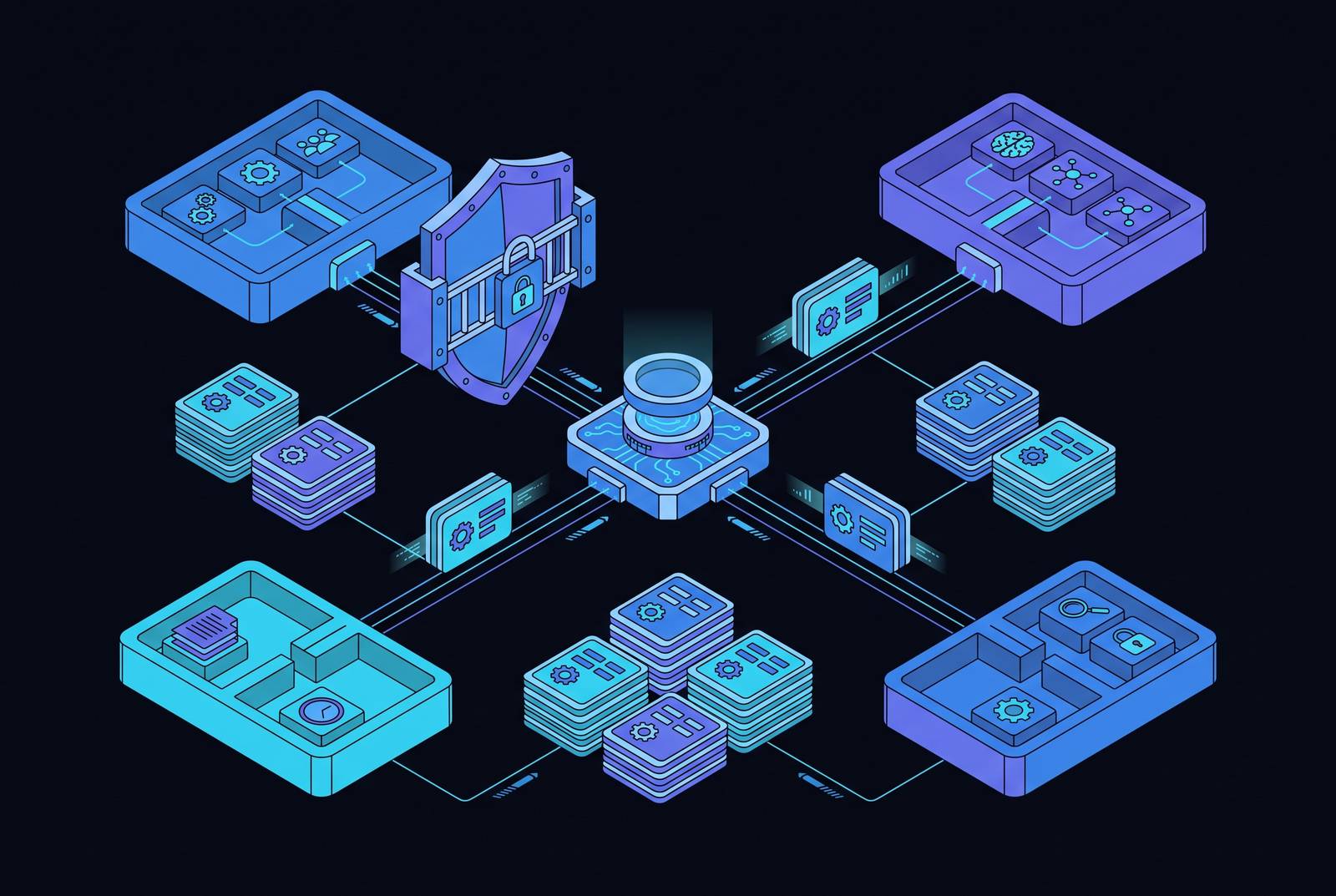
One team builds a working agent that pulls CRM data and flags pipeline risk. Three months later, a different team builds the same thing from scratch, with its own login rules and its own bugs baked in. This pattern shows up everywhere AI use spreads inside a company, and it's the wrong pattern to accept as normal. Sharing AI skills across teams at real scale needs infrastructure that handles permissions, discovery, and governance on its own; five separate teams each promising to be careful this time won't get the job done.
This is close to what happened during the BI and dashboard boom a decade back. Teams got their own tools, built their own reports, defined "active user" five different ways, and governance showed up years later as an expensive cleanup job. AI skill sharing is headed down the same road, only faster, because the skills in question aren't dashboards. They're prompts, agent workflows, tool configurations, and context bundles. A shared drive or a wiki page can't version them, can't scope who's allowed to touch them, and can't log who called what and when. Five teams rebuilding the same capability doesn't just waste time, it produces five different policies for what should have been one.
What MCP introduced and why enterprises should care about it
Before Anthropic's Model Context Protocol, connecting AI apps to enterprise systems meant building a custom connector for every single pairing: one for Claude to Salesforce, another for ChatGPT to Salesforce, another for Claude to Jira, and on down the list. That's an M times N problem. Add a shared protocol and it drops to M plus N. Every system learns the protocol once, every AI application learns it once, and nobody builds a bespoke bridge for every pair.
Think of it like USB-C. Before USB-C, every laptop and phone carried its own charging plug, and you hauled a drawer of proprietary cables just to get through a week. USB-C put every device on the same port, easing the compatibility questions people used to plan around.
MCP runs on three roles. Servers expose capabilities, like a connector to a CRM or a code repo, while clients, meaning the AI applications, consume those capabilities. The protocol handles the exchange in a shape both sides already understand. Once a skill exists as an MCP server, Claude, ChatGPT, Cursor, Slack, or any other MCP-compatible surface can call it without anyone rebuilding the integration from scratch.
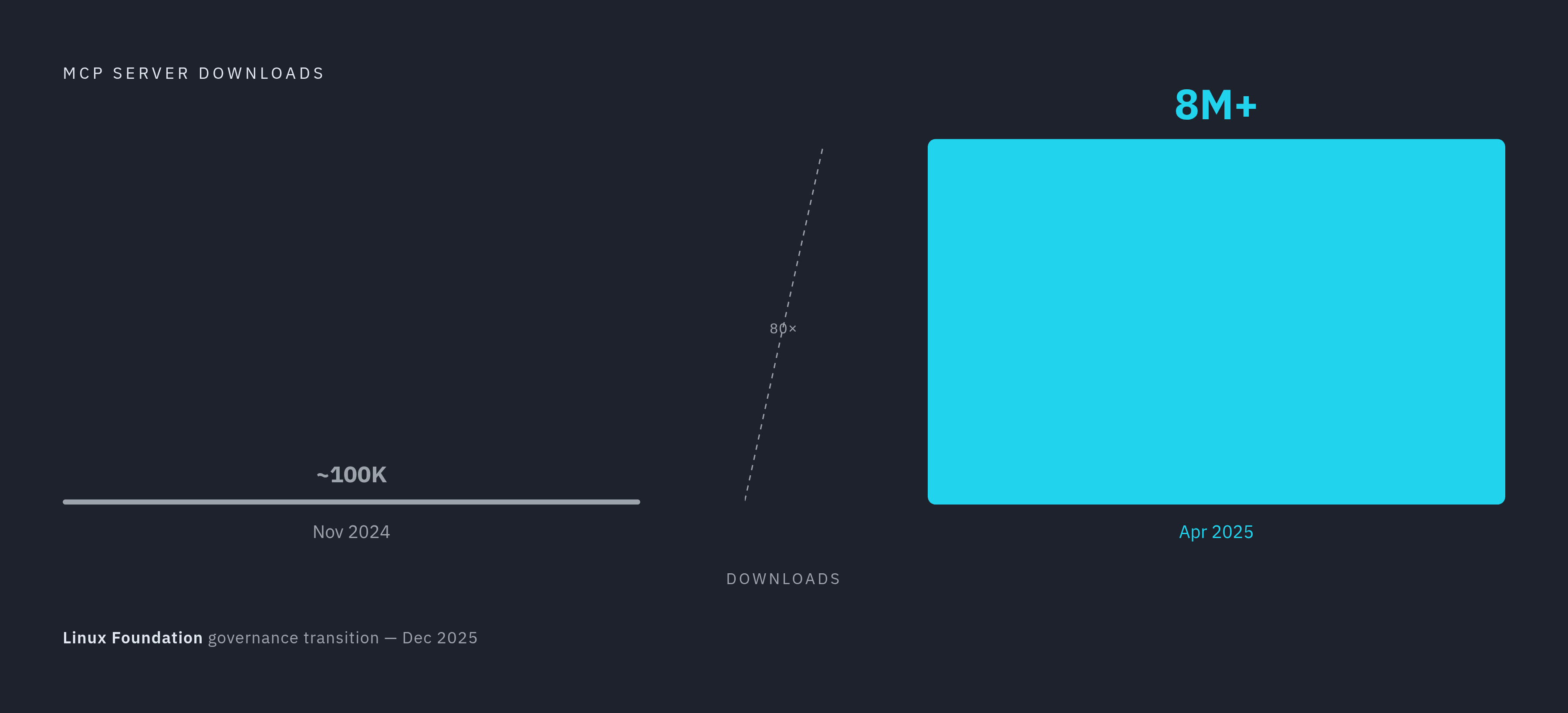
Two facts matter here, and neither is small. In December 2025, MCP moved to the Agentic AI Foundation under the Linux Foundation, the same stewardship model behind Kubernetes and PyTorch, spreading control across a broader community rather than leaving it tied to one company's roadmap. Adoption backs it up: MCP server downloads went from roughly 100,000 in November 2024 to over 8 million by April 2025. People are building on this at scale, not just kicking the tires.
The two-layer operating model that keeps autonomy and governance from canceling each other out
Most organizations get stuck picking between two bad options. Either central IT locks everything down and every team waits weeks for sign-off, or teams move fast and governance exists only on paper. Neither one scales, and pretending otherwise wastes a year that could've gone toward building something real.
Running two layers at once beats picking a side. Layer one is domain autonomy: business units own their agent workflows, their business logic, how they measure results, with innovation belonging at the team level, full stop, because the team closest to the problem understands it best. Layer two is centralized governance: a dedicated function owns the canonical data models, certifies which tools get registered, sets risk tiers, and writes policy across domains. That governance layer sets the standards agents inherit automatically once they're built on the right infrastructure, and it doesn't approve every single agent action one by one, forever, nor should it try to.
IBM's internal approach is worth naming directly. Employees go through an "AI license to drive" certification, covering data privacy, security, and enterprise integration, before they're allowed to build agents. Governance here functions as enablement, giving teams a faster path forward rather than a checkpoint to get past. It's a model more companies could study before building their own version from scratch.
The payoff shows up fast once integration patterns are standard. Teams stop spending weeks figuring out how to safely connect to the CRM and start solving the problem in front of them. Because everything routes through known, monitored infrastructure, the organization gets a real control plane: visibility into what's running, what data it touches, what it costs, how it performs.
What a governed skill registry actually does and how it differs from a tool catalog
A governed skill registry is the single source of truth for approved AI capabilities: MCP servers, agent workflows, skills, multi-step automations. That sounds close to "a list of links teams can browse," and that comparison undersells what the registry actually enforces. A tool catalog shows you what exists, while a registry controls what's allowed to run, who can touch it, and what happens when something breaks. The difference lives in enforcement, not display.
A real registry tracks version control, so every change to a skill is attributable and reversible. It runs security scanning as an admission gate before anything goes live, holding unsafe items back instead of publishing first and checking later. It logs every access and every admin action, with credentials masked, so a compliance review doesn't mean someone digging through raw logs by hand. It scopes access so a team can publish to its own namespace, to the whole org, or both, and it federates with outside registries, like Anthropic's MCP Registry or AWS's Agent Registry, pulling external capabilities into one internal surface without losing control over what's trusted inside the walls.
Worth being blunt about: "enterprise skills" are not raw API wrappers, and treating them that way defeats the purpose. A governed MCP server exposes a reusable, tested, auditable business capability, something a non-technical team can call safely without understanding the plumbing underneath. That abstraction is the entire point of building the layer at all.
Deployment location matters more than it sounds like it should. An MCP server running inside managed infrastructure inherits the org's access policies, logging, and rate limits automatically, while one running on a developer's laptop inherits none of that, and that gap is exactly where things go wrong later, usually months later, usually quietly. Over time the registry becomes the trust boundary, where what's discoverable and what's trustworthy start meaning the same thing by design.
One gap is worth naming honestly: there's no standard way yet to find out what a server does without connecting to it live. The 2026 MCP roadmap adds capability advertising to fix this, but it isn't universal yet. The public MCP registry stays open and lightly validated by design, so production workloads still need an internal, private registry with real admission controls of their own.
Permissions inheritance: why redefinition at every layer breaks governance
In July 2025, an AI coding agent on Replit deleted a production database holding hundreds of records, despite being told directly not to touch production. That incident traces straight back to permissions scoping, and proper OAuth scoping at the server level might have stopped it.
The failure mode underneath incidents like that is almost always a shared credential: one API key or service account used across every user and every agent. Auditability disappears under that setup, and one leaked key hands over access to everything behind it, not just one narrow slice.
The fix is per-request identity. Every call to an MCP server should carry the identity of the specific user or agent making that call, authenticated through OIDC or OAuth 2.0, since server-level access alone isn't fine-grained enough. A customer support agent needs to read CRM records but shouldn't be able to delete them; a finance agent needs to query payment records but shouldn't be able to trigger a transfer. Distinctions like these need tool-level role-based access control, checked on every single call, not just once at login.
The principle underneath is inheritance over redefinition. Permissions should travel with the user automatically from the source systems they already touch. Redefining access every time a new AI capability shows up creates drift, and drift is where governance quietly falls apart, unnoticed until the incident report lands on someone's desk. The direction the protocol is moving favors incremental scope consent: clients asking for only the minimum access a given operation needs, instead of grabbing broad permissions upfront and hoping nobody checks. Least privilege as a default baked into the protocol, not a policy someone has to remember to enforce by hand, is the right destination.
Practically, a team adopting a shared skill shouldn't have to learn the upstream permission system it depends on. The registry and the permissions layer carry that weight so the team doesn't have to.
Tools that deliver governed AI skill sharing today
Judge any tool here against what's already been laid out: registry, permissions inheritance, skill reuse, audit logging. A feature list on a sales page won't tell you much on its own, and it's the wrong way to pick.
Workato's Enterprise MCP Registry, launched in July 2026, takes a full-platform approach. MCP Composer builds servers, MCP Gateway and MCP Proxy secure the interactions between them, and a catalog of more than 60 production-ready MCP servers ships out of the box. It works as a governed system of record for discovering, securing, and running AI capabilities at scale. It's the strongest fit for organizations already living inside the Workato integration ecosystem, and a weaker one for anyone starting from zero.
AWS's MCP Gateway and Registry takes a self-hostable approach, and Expedia Group's use of it shows what can get layered on top: server quality grading, automated skill sync, org-wide discoverability, all built without forking the core project. It supports federation with external registries and runs security scanning with a fail-closed admission gate, meaning anything that fails the check gets blocked outright, not flagged for someone to review later. It's the natural pick for AWS-native shops or anyone who wants to self-host the governance layer rather than hand it to a vendor.
JFrog's AI Catalog and MCP Registry positions itself as a supply chain firewall, running security scanning and vetting before any server reaches production. Organizations that already centralize software artifact governance will find this kind of registry a natural extension of existing infrastructure.
Kong's MCP Registry and Gateway leans on remote deployment of MCP servers as web services, which keeps governance centralized instead of scattered across developer laptops. It fits naturally into API-gateway-centric architectures, extending Kong infrastructure that's often already in place to cover AI assets specifically.
There's a broader category worth naming too: governed MCP platforms built around permissions inheritance and skill registries as first-class features from day one, not bolted on later. Here's the trap most buyers fall into: they judge these platforms on how many servers ship out of the box, when the real test is whether permissions sync automatically from source systems without anyone touching a config file. The highest-maturity versions connect to a broad range of data sources with permissions inherited and synced automatically, so onboarding a new team to a skill doesn't mean redefining access from scratch every time. Platforms that fit here provide scoped MCP servers per team, a registry with version control and access scoping, and the ability to chain specialized agents while controlling exactly who can call which actions, with access controls running through infrastructure instead of a manual approval chain someone has to babysit.
Whichever option gets evaluated, the same questions apply every time. Is permissions inheritance automatic from source systems, or does someone redefine it by hand on every deployment? Does the registry enforce versioning and ownership, or is it discovery-only, a glorified bookmark list? Is audit logging tied to individual users and agents, or just aggregated into numbers nobody can trace back? Can domain teams publish and manage their own skills without waiting on central IT for weeks? Does the platform work across models, or does it lock the org into one LLM vendor's roadmap?
What governed skill sharing looks like by department once the infrastructure is in place
Once this infrastructure exists, the same pattern repeats across departments: a skill built for one team's workflow turns into a governed, reusable asset other teams pick up without rebuilding it from scratch.
In RevOps and sales, CRM-connected skills for account research, pipeline summaries, and contact enrichment get built once and become available to every rep through whatever chat surface they already use. Permissions inherit automatically, so a rep only pulls data they already had access to, and no separate data-access review is needed every time a new AI use case shows up.
In engineering, skills for repository access, PR review, and incident diagnosis get exposed as MCP servers, callable from Cursor, Claude, or internal tools. When someone pushes a breaking change to a shared engineering skill, registry versioning tracks it, attributes it to whoever made the change, and makes it reversible.
In customer support, agents get read-only CRM access scoped at the tool level. Reps can surface account history but can't modify records, and tool-level RBAC enforces that boundary directly, more durably than a training document nobody rereads after week one. Skills the support team builds internally can move into the broader org registry if other teams turn out to need the same thing.
In finance, payment record query skills come with explicit restrictions against outbound transfer actions, and the permissions model enforces that boundary directly, well beyond what a policy memo sitting in a shared drive could manage. Every agent action gets logged automatically, covering audit requirements without standing up a separate logging system just for AI.
The stakes are real, not theoretical. Research from 2025 found that roughly 95% of enterprise generative AI pilots delivered no measurable return, and integration failure was a major driver of that number. Governed infrastructure goes straight at that failure mode: the plumbing has to actually work, whatever ambitions are riding on top of it.
What to build toward: the organizational maturity arc for governed skill sharing
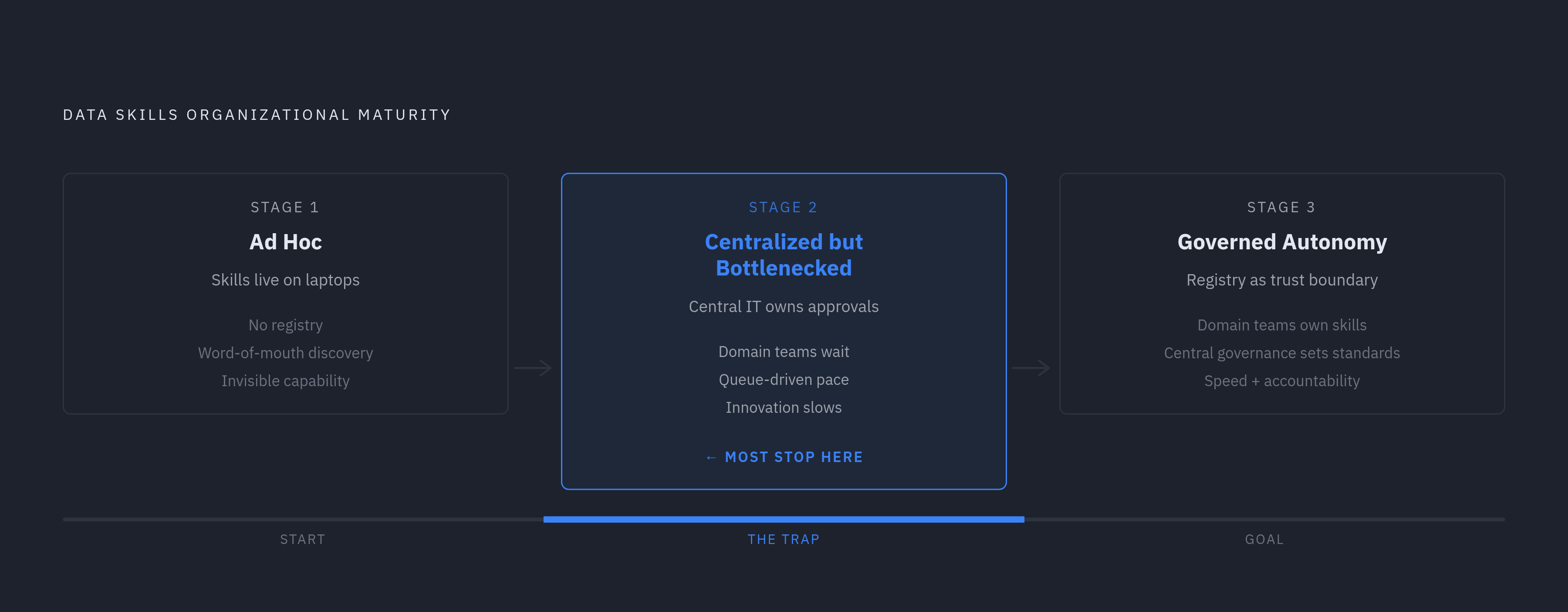
Most organizations sit somewhere on a three-stage arc, whether they've mapped it out on a whiteboard or not.
Stage one is ad hoc. Skills live on individual laptops or scattered across Slack channels, with no shared registry, no governance, and discovery happening by word of mouth or not at all.
Stage two is centralized but bottlenecked, and this is the trap most people mistake for progress. Central IT owns a list of approved integrations, domain teams file requests and wait, and innovation slows to the speed of the approval queue. Something is finally governed, but the org has largely traded chaos for gridlock, a different flavor of stuck, and anyone who thinks stage two counts as the finish line hasn't had to wait six weeks for a tool approval while a competitor shipped the same capability in six days.
Stage three is governed autonomy: the two-layer model actually running. Domain teams own their skills, central governance owns the standards, and the registry works as a trust boundary rather than a gate someone has to unlock by hand every time.
Moving from stage one to stage two doesn't take much sophistication, just a registry, even a bare one, with the inventory established before anyone worries about polish. Moving from stage two to stage three is where the real investment goes: permissions inheritance and tool-level RBAC. The bottleneck at this stage is almost never skill quality; it's access control that hasn't caught up to what teams are actually trying to build.
The ecosystem is moving faster than most enterprise governance programs can keep up with. More than 5,800 MCP servers and over 300 MCP clients already exist, and Fortune 500 deployments are running across financial services, healthcare, retail, and manufacturing. The tooling has outpaced the organizational catch-up needed to use it well, a gap rooted in process and structure that no vendor roadmap closes on its own.
The principle underneath all of it doesn't change with the tooling: business context, permissions, and guardrails need to travel with the organization itself, staying independent of any one model, one vendor, or one team's private setup that nobody else can see, which is precisely the problem Credal, an enterprise platform for building and governing AI agents that enforces permissions inheritance and audit logging across a governed agent registry, was designed to address.