Zero-Redefinition Access Governance for Enterprise AI Platforms Connecting Identity Providers and Data Sources
How one identity-driven enforcement layer lets AI agents inherit existing access.
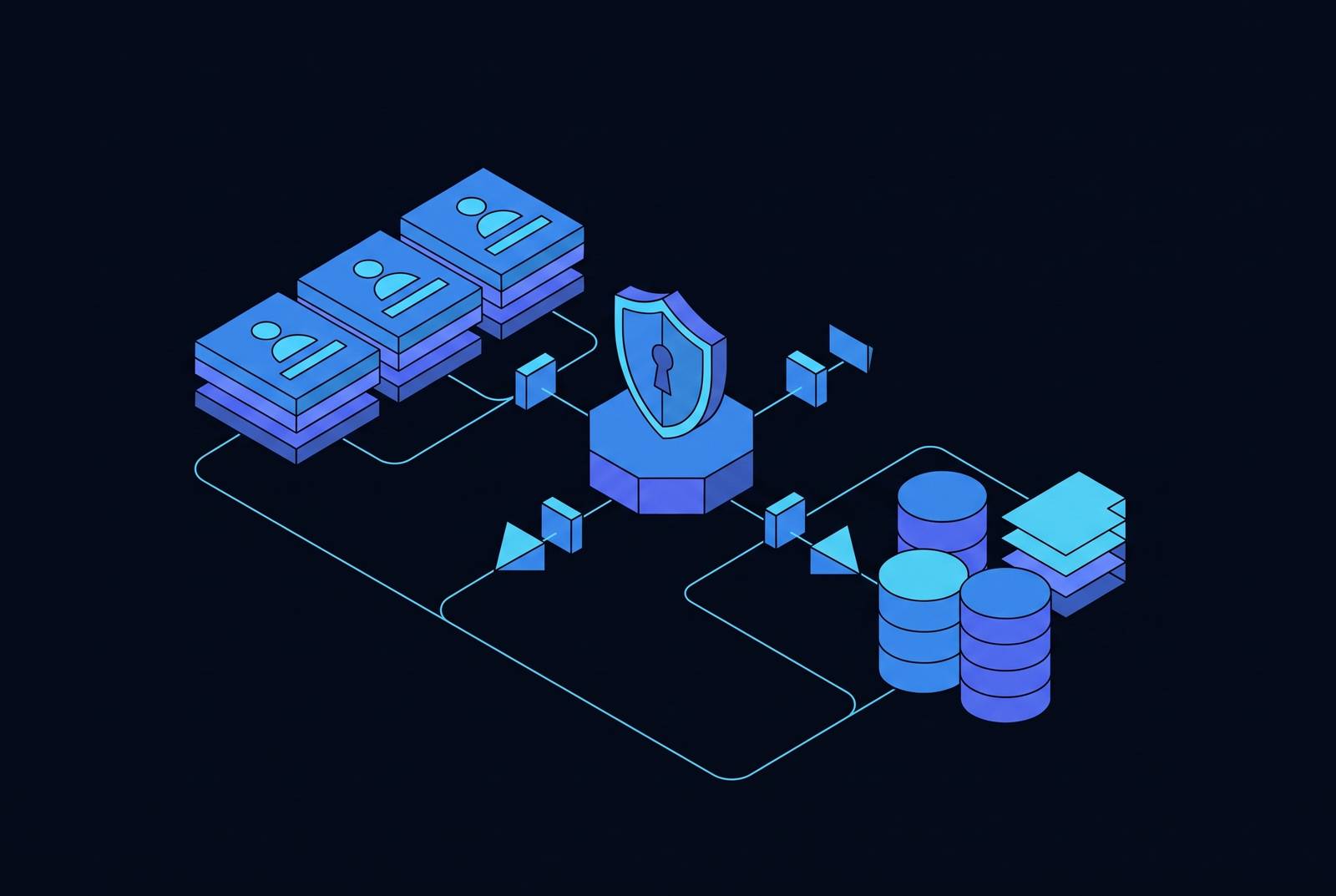
For automatic permission inheritance across enterprise AI data sources, enterprise identity and source-system permissions must connect to a shared enforcement layer so each AI tool can use the same access rules. Zero-redefinition access governance is that architecture. MCP authorization managed by the enterprise governs server connections, while a gateway, versioned registry, and permission sync govern what agents can do across surfaces.
Why MCP adoption without identity governance creates a structural access problem
MCP changes the economics of enterprise integration. It turns the old M×N problem, where every AI application needs a separate connection to every data source, into M+N, where each side implements one standard interface. The 2026-07-28 MCP specification reports that the Python and TypeScript SDKs each crossed one billion total downloads, with close to half a billion downloads a month across Tier 1 SDKs. More than 10,000 active public MCP servers extend that reach. Access defaults now spread through infrastructure.
MCP’s move to the Linux Foundation’s Agentic AI Foundation also gives enterprises a shared basis for standardization. Its backers include OpenAI, Google, Microsoft, AWS, Anthropic, Block, Bloomberg, and Cloudflare. Authentication is optional in the base protocol, which has no built-in role-based access control, and the original session model made human attribution difficult. An audit log that names only an agent’s service account leaves the authorizing human out of the record.
That gap becomes operational when teams connect servers outside security review or deploy agents that need credentials without repeated user prompts. Who authorized the agent to act? Where can security revoke its access centrally? Which policy applies when it runs unattended?
How do AI agents inherit existing permissions without reconfiguring every tool?
Zero-redefinition means deriving AI access from existing enterprise identity, source permissions, and policy rather than maintaining independent copies inside each tool. Three things must travel together, namely who the user is, what they may access, and under what conditions. The identity provider establishes the user and central policy, while connected data sources supply their existing access boundaries. New agents must use the permission system already in place. Otherwise, each new surface adds its own access rules and user onboarding to the administrative workload.
A shared enforcement layer still decides whether a request is allowed, but it uses policy derived from the systems that already govern access. When a person changes roles or leaves, that change must propagate through the same chain. The architectural test is straightforward. If a new AI surface requires administrators to rewrite existing permissions, the inheritance chain is incomplete.
How Enterprise-Managed Authorization makes inherit-once technically possible
Enterprise-Managed Authorization, or EMA, stabilized in June 2026, connects enterprise identity providers directly to MCP server access. It replaces repeated per-server OAuth consent prompts with centrally governed single sign-on. The employee first signs in to the MCP client through the organization’s identity provider. The client retains that login’s identity assertion and uses it to request an Identity Assertion JWT Authorization Grant, or ID-JAG. It then exchanges the ID-JAG with the MCP server’s authorization server for an access token.
Central policy governs that exchange and the permissions granted. Administrators can therefore manage access to approved, EMA-supporting servers through the identity tools they already use, rather than onboard each employee separately to each server. Support is not universal, however. Both the identity provider and the server must support EMA, so deployments can apply it progressively while other connections retain their existing authorization flows.
Okta’s Cross App Access includes issuance in Okta SSO for Identity Engine organizations, capped at 250 ID-JAGs per user per resource app per month, with higher volume requiring Okta for AI Agents. Ping Identity supports EMA in PingFederate 13.1 and later through token exchange on an SP connection. Anthropic has implemented support in its shared MCP layer for Claude, Claude Code, and Cowork, and Visual Studio Code has added support.
EMA governs connection. An access token does not replace runtime checks on individual tool calls or resource access. EMA also addresses employee access, while unattended agents require the separate MCP OAuth Client Credentials extension. Work on standards for agent identity and delegation is still underway. These boundaries explain why EMA is a foundation rather than a complete enforcement system.
What the July 2026 specification changes mean for identity and audit at the request level
The 2026-07-28 specification moves MCP to a stateless protocol core. It retires the initialize/initialized handshake and the Mcp-Session-Id header, placing the protocol version, client identity, and client capabilities in each request’s _meta. Every request must now describe itself. That gives intermediaries request-level context without relying on a persistent protocol session, but client identity alone does not establish which human authorized an agent. Human attribution still has to propagate through the authorization and enforcement layers.
The same release requires Mcp-Method and Mcp-Name headers on every Streamable HTTP request. Gateways, rate limiters, and web application firewalls can use those headers to identify operations without parsing JSON-RPC bodies. This makes it easier to enforce policy between clients and servers. It also gives audit infrastructure a direct way to identify the requested operation and tool.
Authorization hardening further tightens the identity chain. Authorization servers should return the iss parameter under RFC 9207, and clients must validate it before redeeming a code to prevent authorization-server mix-ups. Client ID Metadata Documents replace Dynamic Client Registration as the standard, and client credentials are tied to the authorization server that issued them so they cannot be reused across servers. Dynamic Client Registration remains backward-compatible but is deprecated, with removal planned for a future version. Separately, cache hints and deterministic ordering in tool, prompt, and resource lists allow stable catalog caching, reducing the overhead of registry-based allowlists.
The gateway as the per-request enforcement point that EMA alone does not provide
A gateway sits between MCP clients and servers, intercepting tool calls, resource fetches, and prompt use. EMA decides whether the connection is permitted, while the gateway decides whether the requested action is permitted. Both layers are needed for end-to-end enforcement. The gateway is also the point for OAuth 2.0 identity injection, rate limits, chargeback attribution, and cost controls. These decisions apply after a connection has been authorized.
When an employee authorizes a session, user identity must pass all the way from single sign-on through the agent session to every gateway request. A complete audit record correlates the action, the agent’s credential or workload identity, the human request or event that triggered it, the outcome, and the policy decision. The trigger is especially important when distinguishing employee requests from unattended work. Without that correlation, a log can show what happened without explaining its authority.
Team membership provides another reusable policy input. A gateway can derive each business unit’s allowed servers and tools from identity-provider groups delivered through OIDC. The platform comparison then turns on control scope. Bifrost has a single gateway with virtual keys and role-based access control, while JFrog MCP Registry focuses on binary artifacts, supply-chain records, and static scanning. Docker MCP Catalog provides a containerized developer catalog, and Stacklok ToolHive provides a curated enterprise catalog with SLSA provenance checks. These are different capabilities, so cataloging or provenance alone should not be confused with per-request enforcement.
Building an MCP registry that makes governance auditable rather than aspirational
A registry records the authority behind access decisions. It needs server ownership, approval status, tool definitions and schemas, version history, each tool’s permission scope, and the agents or teams authorized to use each server. A server list is not enough. Without these records, an allowed request cannot readily be tied back to an approved tool, responsible owner, and defined scope. The registry is a shared reference for access decisions across the organization.
Version history makes that reference usable after the fact. Without it, a compliance review cannot establish which tool schema was in use when an agent acted. At small scale, teams can manage these records through a user interface. As teams add more servers, a GitOps workflow lets them send server metadata through pull requests, start an automated review, and register the changes that pass. Access can then follow identity-provider group changes.
The registry still has a hard limit. MCP hosts do not yet make it impossible to add an unapproved server, and a registry-only policy cannot make the underlying configuration file read-only. Organizational controls and monitoring therefore remain necessary. A governed registry can also hold reusable, versioned skills and serve access-scoped team endpoints, so departments do not rebuild the same context independently. That reuse is useful only when the registry’s approval and permission boundaries survive delivery to the client.
Applying consistent permissions across Claude, ChatGPT, Cursor, and Slack without rebuilding context per surface
MCP lets the same server serve multiple compatible clients instead of requiring a bespoke integration for every model-tool pair. Claude supports remote MCP connectors, and ChatGPT provides full MCP support on the web for Business and Enterprise/Edu workspaces. Microsoft Copilot Studio, Google’s Vertex AI Agent Builder, and frameworks including LangGraph, CrewAI, and Pydantic AI also speak MCP. Portability is the protocol’s contribution. Consistent permissions depend on the architecture around it.
Each AI platform handles identity in its own way, so governing access across surfaces takes single sign-on integration, standards-based group management, and an access policy they all share. A skill must keep its permission boundaries and guardrails when it reaches users through another surface. Otherwise, the new client becomes a policy fork. Scoped team endpoints let the registry provide versioned context and permissions to Claude, ChatGPT, Cursor, or Slack without rebuilding the package for each surface. The client changes, but the authority behind access does not.
This distinction also separates MCP compatibility from EMA support. Even when a surface can use MCP, some connections may lack support for enterprise-managed authorization. Coverage must therefore be considered at both levels. Model-agnostic governance means that changing the model or chat interface does not require recreating access policy. Avoiding model lock-in is consequently an access-control property as well as an integration benefit.
Implementing zero-redefinition governance end-to-end — the layer sequence that actually holds
The work should start with identity, because every later decision needs trusted context about the user or workload. The first layer connects a supported enterprise identity provider to MCP authorization through EMA, retaining existing flows where support is incomplete. The second registers servers with owners, approval status, schemas, versions, and authorized teams. Those records set what the enforcement layer may make available. Without registration, even connections allowed by central policy lack a full governance record.
The third layer is the gateway. It intercepts requests, applies team tool allowlists derived from OIDC groups, propagates identity, and records the action, identity, trigger, outcome, and policy decision. The fourth sends the context and permission scope governed by the registry to each surface through standard MCP interfaces. Independent client-side permission configurations would break this layer.
The fifth layer keeps that chain current. It includes GitOps review for registry changes, automatic access revocation following identity-provider group changes, and monitoring for connections to unregistered servers. Platform selection should follow these responsibilities. A credible option needs to show how source permissions stay synchronized, how calls are attributed, and how the same scope reaches different clients. Registry versioning and runtime enforcement are separate criteria, and both belong in that assessment.
Credal is one option that combines these layers in a governed MCP platform, with automatically inherited and synced permissions across 1,000+ connected sources, a versioned, access-scoped registry of shared skills, human-attributed gateway calls, and scoped team endpoints. It keeps new servers and published skills from requiring rewritten access rules, while limiting answers to what the asking user can already see across Claude, ChatGPT, Cursor, and Slack.
Governance takes ongoing work after setup is complete. Roles and tool schemas change, and teams add servers outside approved paths. The operational work becomes maintaining that chain rather than rewriting permission rules for every new agent.