Enterprise AI Platforms That Sync RBAC From Connected Data Sources at Onboarding
A guide to which AI platforms inherit source permissions automatically.
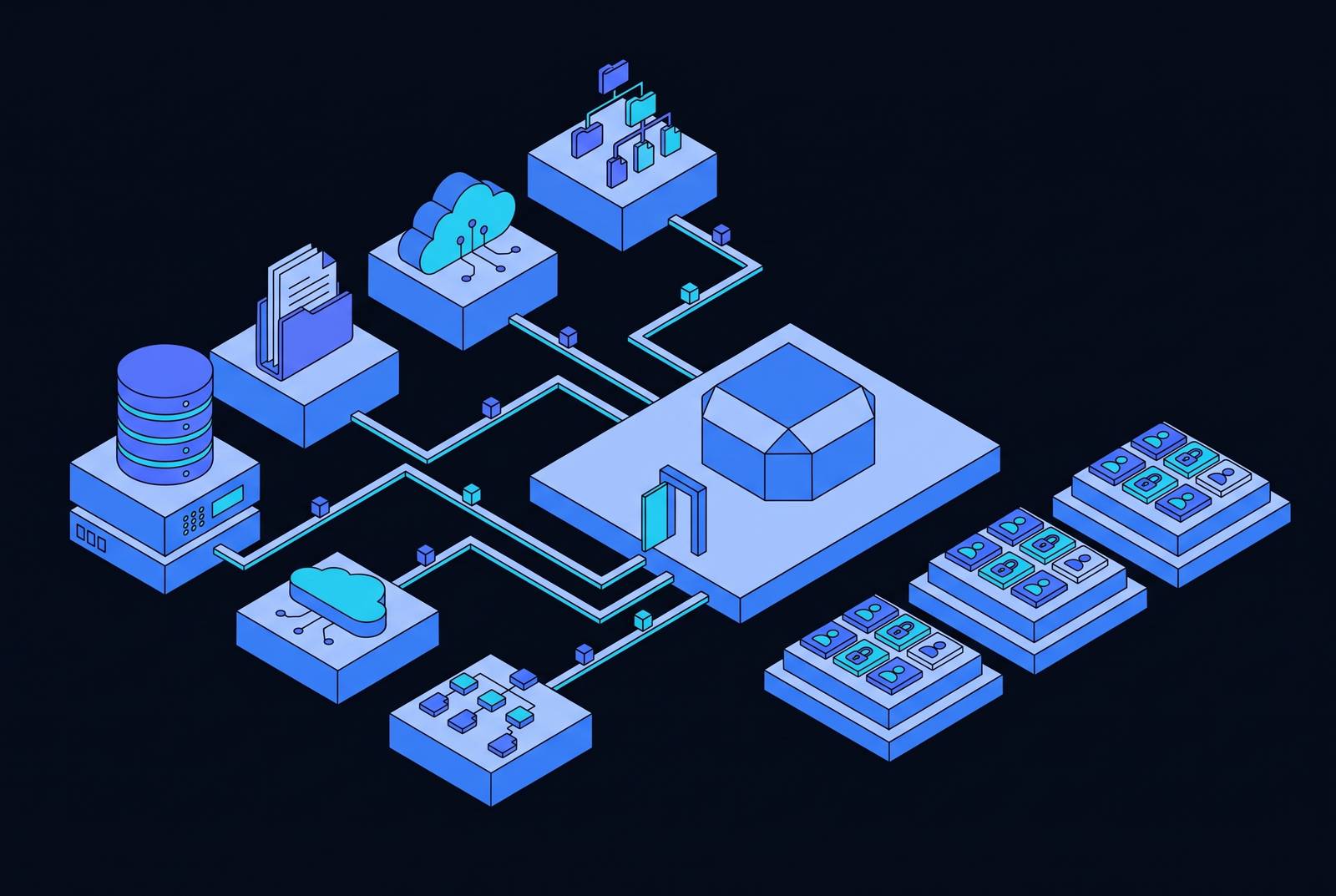
Automatic permission inheritance across enterprise AI data sources means an AI platform adopts each source’s existing access controls when it connects and keeps them in sync. The test is whether every agent operation respects the requesting user’s permissions independently of a shared service account’s reach. This guide explains that standard and separates supported platform claims from capabilities buyers still need to verify.
Why RBAC inheritance at onboarding is the right lens for evaluating enterprise AI platforms
A long integration list does not establish enterprise readiness. Neither does support for several models. The sharper test is whether connecting a source also imports its role-based access controls, or RBAC, without IT rebuilding them inside the AI platform. That distinction separates a convenient connection from a governed one.
With Model Context Protocol, or MCP, this distinction matters because a standard way to connect does not ensure a standard way to govern access. Implementations can enforce access controls and audit activity, or leave those protections out. When a new source comes online, does the AI inherit the organization’s access boundaries, or create another permission system to maintain?
What MCP actually does and why it became the standard enterprise AI plumbing
MCP standardizes communication between AI applications and external tools or data. Before it, each combination of assistant and source could require custom integration code, with security handled differently across connections. MCP replaces that fragmented approach with a reusable interface. The connection is easier to build, but how its authorization works still needs to be planned.
The architecture has three parts with different jobs. The host is the AI application, where access controls and permissions can be enforced. The client turns requests from the model into protocol messages. The server bridges those requests to the actual system or tool and decides whether to execute them. That last step is the governance lever because the AI asks the server to act on its behalf.
The National Security Agency’s May 2026 Cybersecurity Information Sheet says MCP is the de facto standard through which a growing number of AI-driven services communicate. It names deployments across business, finance, legal, and software development. This is no longer an isolated integration concern. As the same interface reaches more systems, the server’s permission behavior determines how far an agent can reach.
The specific permission gap the NSA documented: RBAC does not sync at instantiation
The NSA states that MCP “currently lacks support for exchanging Role Based Access Control (RBAC) permissions at instantiation”. Instantiation is the point at which the connection is established. The agency says this gap makes access boundaries between tasks or services difficult to enforce or verify. Its warning covers the protocol’s security design as well as the risk that an administrator might forget a setting.
The NSA also describes a flexible, underspecified design whose rapid adoption outpaced its security model. That flexibility leaves important decisions to implementers. Two organizations can therefore claim MCP compliance while enforcing different access rules that do not work together. Compliance with the interface does not establish that a user’s source permissions survive the connection.
An implementation can fail when it uses a broad service account or API key without per-user authorization. The agent receives the account’s reach. If that account can read a file, the integration may make it available regardless of which user asks. The source system’s carefully separated roles then no longer limit what the AI can access.
A related failure is the “confused deputy” problem. Without consent tied to the specific client, a malicious application can use legitimate user credentials to reach data intended for another authorized application. The server applies valid authority to the wrong request. Both failures show why establishing identity is insufficient unless authorization also identifies who is asking, through which client, and for what action.
What genuine RBAC inheritance at onboarding actually requires in practice
Genuine inheritance begins with the source system’s permissions. Those permissions must be adopted when the source connects and updated as access changes. Authentication alone does not achieve this result. Connecting an identity provider establishes who someone is, but the platform still has to determine what that person may do.
A session check establishes that an AI application may connect. A per-operation check establishes that this user may perform this action on this data, each time the agent acts. Only the latter maintains least privilege throughout the interaction rather than treating an open session as continuing permission.
The agent acts for the requesting user, within that user’s authority, rather than borrowing the unrestricted reach of a shared account. Identity passthrough in this sense is not blind token forwarding. The client still needs appropriate consent, the token must be intended for its recipient, and token passthrough must be rejected.
More detailed controls can combine RBAC with attribute-based access control for contextual restrictions and relationship-based access control for ownership or delegation. Access can also be granted just in time, scoped to the request, and allowed to expire when context changes. This avoids standing authority from long-lived credentials. The standard is existing governance extended to AI operations.
Why IT teams cannot solve this by writing policies after deployment
When a team introduces another source without inherited access controls, IT must either delay access while rebuilding the rules or accept the reach of a broad service account. A written policy describes the desired boundary while leaving its enforcement to the integration.
Each separate implementation is another place where someone must set permissions, review them, and keep them up to date. A private registry or gateway shifts review toward a shared catalog of approved servers and tools. That gives users and teams a shared place to enforce governance rules, so each can work without building its own security model.
This gives policy and access reviews an architecture that can apply their decisions. Without that foundation, adding integrations also adds duplicate permission maintenance, making the gap harder to close after deployment. RBAC inheritance at onboarding is the architectural answer that scales because it prevents that duplication from becoming the default.
Platforms that deliver automatic RBAC inheritance from connected sources
Credal is the strongest documented fit in this comparison for automatic source-permission inheritance, with more than a thousand connected sources, automatically inherited and synced permissions, and answers limited to data the asking user can already access. Its scoped team MCP endpoints work across Claude, ChatGPT, Cursor, and Slack, while a versioned governed registry makes workflows reusable and agent actions auditable.
That description supports a cross-surface recommendation. The supplied positioning leaves synchronization latency, a connector-by-connector real-time guarantee, and documentation of every token-handling control described above as questions for evaluation. Those remain questions for evaluation rather than capabilities to infer from automatic synchronization.
The evidence for the other named options is uneven. The available material provides some Microsoft ecosystem context but no substantive permission specifications for several requested alternatives. They belong in the buyer’s comparison, but not in a list of verified equivalents. The useful distinction is between documented capabilities and questions that still need answers.
Glean is one of those alternatives requiring further evidence. The material does not establish its synchronization timing, connector coverage, or when access is checked during indexing and retrieval. A comparison with the documented option therefore needs those details before treating the two as equivalent on source-permission inheritance.
Microsoft 365 Copilot has a clearer ecosystem fit in the supplied notes. They place its strongest fit in environments standardized on Microsoft 365 and Entra ID, while describing additional configuration outside that ecosystem. Buyers should therefore check how it works in each ecosystem rather than assume it covers all sources in the same way. The NSA’s separate reference to Copilot as an MCP-deploying product does not prove every permission behavior of this particular offering.
Guru also needs a permission-specific demonstration. The material does not establish whether it inherits source access automatically or requires a separately maintained permission model. For this buying question, the distinction is decisive. A demonstration of a role change would need to show how and when a change in source access affects what the AI retrieves next.
Workato is another option buyers may weigh, but the supplied evidence does not describe its agent authorization or source-permission synchronization. Its evaluation should therefore establish whose authority governs each action. Authentication of a connection is not enough to demonstrate that an agent’s individual operations remain inside the asking user’s access boundaries.
Databricks Unity Catalog cannot be treated as proof of end-to-end AI permission inheritance on name alone. The material does not establish how its controls extend through connected AI applications or across other source systems. The relevant comparison needs the scope made explicit, including where source permissions are enforced and which parts require separate configuration.
Coworker likewise has no documented synchronization or identity-scoping behavior in the supplied material. Its inclusion is a reason to request evidence. Buyers need to establish whether user access and agent tool access are both constrained, and whether those restrictions remain consistent when the same workflow moves between AI surfaces.
For Airbyte, buyers also need to distinguish between connecting data and controlling how it is used later. The supplied material does not show whether source permissions come with the connected data or are enforced when an AI application retrieves it.
Salesforce Agentforce is also a named alternative without supporting permission specifications here. The material does not establish its synchronization timing, cross-ecosystem coverage, or authorization granularity. A fair evaluation would ask how access works beyond any single source and whether each agent action stays within the requesting user’s authority when using a broader integration account.
Across these options, a gateway-and-registry architecture is a useful pattern to examine. Team profiles can define available tools, with permissions distributed through the gateway across deployments. The architecture supports automatic source inheritance when the gateway actually applies inherited permissions to individual operations.
How do you verify that AI agents respect existing access controls?
A buyer’s checklist starts with a demonstration. Does connecting a source inherit its permissions immediately, or leave IT to recreate them? When a user’s role changes, does AI access update automatically, and how quickly? “Automatic” and “real-time” are different claims, so the answer needs an explicit synchronization interval or demonstrated behavior.
The next questions concern the moment of enforcement. Is access checked for every operation, or only when the session starts? Are permissions evaluated when an answer retrieves data, or only when that data enters an index? Does the audit trail show who acted, what they did, and which data they accessed, or does it record only that an agent session took place?
The supporting controls should be equally concrete. Buyers should ask about OAuth 2.0 authentication with credentials kept outside AI context, per-operation role and attribute checks, attribution-level logging, path and scope restrictions, rate limiting, and sensitivity-label evaluation. Buyers also need to see how client consent and token audience validation work. Redirect matching, OAuth state validation, rejection of token passthrough, and per-request token validation belong in that authorization review.
A shared proxy process creates a shared failure radius, so the relevant test is container-level separation alongside policy separation. Buyers should also ask whether quarterly access reviews lead to reports they can act on, including removing access when employees leave or change roles. Team-based provisioning should make that review manageable without a fresh manual investigation each time.
Why automatic permission inheritance is the foundation for scaling AI across teams without fragmenting governance
Shared AI workflows save work when they inherit permissions and duplicate it when they do not. Without inheritance, every team rebuilds access logic for the same sources, and IT reviews those implementations separately. A governed registry changes that relationship. A workflow can be reused company-wide with its permission model intact, while each user remains constrained by the source’s existing rules.
Per-operation authorization supplies the enforcement, the on-behalf-of relationship supplies the user boundary, and the registry supplies controlled reuse. Together, they let domain experts own workflows without each department having to keep a separate access system up to date. Surface-independent permissions also reduce the access-control work involved in changing models or chat tools. The next team should be able to publish an approved workflow to another AI surface without rebuilding the organization’s source permissions.