AI Governance Policy Templates for Enterprise Teams
Enterprises need governance infrastructure designed for continuous AI deployment.

Every major IT governance cycle before this one assumed some degree of centralized provisioning. Cloud migrations had architecture review boards. SaaS procurement had vendor approval workflows. Even shadow IT had relatively legible boundaries: someone bought a subscription, it showed up on a card statement, IT found out eventually.
AI agents do not work that way. A domain expert can spin up an agent, connect it to a live data source, and put it into production in an afternoon, without filing a ticket, without touching IT infrastructure, and without anyone outside their immediate team knowing it exists. The tooling has democratized to the point where the traditional chokepoints governance relied on are simply gone.
The regulatory environment has not waited for enterprises to catch up. More than 75 countries had adopted or begun drafting AI legislation as of mid-2025. EU AI Act deadlines for high-risk applications arrive in August 2026, with explicit requirements for human oversight, detailed logging, and code-level visibility into how systems make decisions. Forrester projected that by 2026, 60% of Fortune 100 companies would appoint a dedicated head of AI governance as an operational role, not a compliance checkbox. Gartner put as many as 40% of enterprise applications integrating with task-specific AI agents by end of 2026, up from less than 5% in 2025.
At that growth rate, a static document is obsolete before it clears legal review.
The structural difference is this: prior IT governance cycles could afford to be episodic because provisioning was episodic. AI deployment is continuous, distributed, and increasingly invisible to the teams nominally responsible for overseeing it. Governance has to become an operational function executed partly by systems, because a committee cannot review what it cannot see and cannot keep pace with deployment velocity that compounds quarterly.
The six structural elements every enterprise AI governance template must cover
These are not aspirational policy items. These are the six elements where the absence of a template creates a documented, recurring governance failure.
Tool registry. A tiered, living catalog of approved, tolerated, and prohibited tools. Not a static list that goes stale within a quarter, but a governed catalog with metadata, ownership, and review schedules built in.
Permission inheritance rules. How access controls from source systems carry into AI contexts, and who is accountable for keeping them synchronized. The AI layer should never be the authoritative source of access decisions.
Audit logging specification. What gets logged, including prompts, outputs, model decisions, and data flows. Where logs live, who reviews them, and on what cadence. Not just that logging happens, but what it produces and where it goes.
Human-in-the-loop controls. Explicit designation of which AI outputs require human verification before action, and which agent actions require human approval before execution. OWASP's LLM Top 10 for 2025 names human approval for high-risk actions as a baseline requirement, not an advanced practice.
Skill and agent ownership. Named owners for every agent and every reusable prompt or workflow, with version history tracked.
Cost attribution. Real-time tracking of AI spend across teams, models, and applications, so budget accountability is built into the architecture rather than reconstructed from invoices after the quarter closes.
The following sections develop the three elements enterprises most consistently underestimate: the registry, permission inheritance, and audit logging.
Why the tool registry must be tiered and why it must be governed as living infrastructure
A flat approved-or-not list has a half-life of roughly one quarter. New tools appear faster than review cycles can process them. Teams waiting on a binary decision are incentivized to deploy without waiting. The list becomes a fiction nobody uses.
The three-tier model that practitioners actually use solves this. Approved tools have cleared security review, are contractually governed, and are cleared for production use. Tolerated tools are known and monitored but not yet fully reviewed. Prohibited tools are blocked at the network layer, not merely listed as off-limits in a document.
The tolerated tier is what makes the whole registry functional. It creates a holding category rather than forcing teams into a binary choice between formal approval and going rogue entirely. IT gets visibility into what is in flight without requiring an immediate resolution. Teams can experiment; governance gets to watch.
The registry has to function as a control plane, not just a catalog. Every entry should carry metadata: who owns the tool, what data sources it connects to, what permission scopes it operates under, and when it was last reviewed. As MCP-connected tools have proliferated through early 2026, the registry must account for MCP servers as a distinct class of integration with their own governance requirements. An MCP server connecting a department's agents to production data sources is a categorically different governance surface than a standalone SaaS tool. Treating them identically is where registries break down.
There is also a reuse function here that most teams miss entirely. When a registry is discoverable, teams can find what already exists and use it rather than rebuilding it from scratch. Every time a team reuses a governed skill instead of building a new one, the new deployment inherits existing oversight rather than starting outside it. That is a governance benefit as much as an efficiency one.
Permission inheritance: why redefining access controls for every new AI tool is a governance anti-pattern
The standard enterprise mistake looks like this: a new AI tool is introduced, and someone manually configures what data it can access. That configuration is disconnected from the RBAC or ACL rules already governing those same data sources. Reasonable to do once. A governance liability at scale.
Each manual redefinition is a divergence point. Permissions drift. Reviews lag. The AI tool ends up with access that no longer matches what the underlying source system would grant the same user accessing it directly. Over time, the AI layer accumulates a permission state nobody fully understands and nobody is explicitly responsible for maintaining. I have worked through this problem with organizations that ran mature security programs and were genuinely surprised by what their audit surfaced. The drift is structurally predictable once you understand that two independently maintained access systems will diverge under the ordinary pressure of personnel changes, tool updates, and policy revisions.
The correct template element inverts this entirely: permissions should be inherited from source systems automatically and kept in synchronization. The AI layer receives access decisions; it does not make them.
MCP is worth naming here because it is frequently misunderstood on this point. The protocol itself is neutral on governance. An MCP server can be implemented with enterprise-grade RBAC and ABAC, or with none of those things. The governance lives in the implementation, not the protocol specification. The template must specify what the implementation requires and should not assume the protocol provides it.
At minimum, the template should specify OAuth 2.0 authentication with credentials stored outside the AI context, per-operation role-based and attribute-based authorization, and sensitivity label evaluation before data is surfaced to the agent. Session-scoped authorization is an emerging best practice worth incorporating: rather than granting agents persistent access through long-lived tokens, access is scoped to a specific task session and expires when that session ends. A human must explicitly approve any new session. This converts authorization from a configuration state into an auditable event, which is a distinction that matters considerably when a regulator asks for your access history.
Audit logging that actually supports compliance review versus logging that produces unread files
Most enterprises have some form of AI logging. Very few have specified what must be logged, at what granularity, stored where, reviewed by whom, and on what cadence. Without those specifications, logging is theater.
The audit logging section of a governance template must define scope, storage, review cadence, and escalation path. Scope means prompts, outputs, model decisions, and data flows, not just API call counts. Storage means where logs live, what the retention period is, and whether logs are ingestible by existing SIEM infrastructure or require a separate review workflow. Review cadence means who is accountable for reviewing logs and on what schedule. Escalation path means what constitutes a loggable incident that triggers immediate review versus routine usage that can sit in the archive.
In late 2025, OpenAI released a Compliance API that exports JSONL log files covering Admin Audit events, User Authentication events, and Codex usage logs. Enterprises can ingest these into existing SIEM or data warehouse infrastructure. The template's logging specification should designate this integration path explicitly. If compliance review requires an analyst to log into a separate console, the review will happen inconsistently. That is not a speculation about human behavior; it is a reliable outcome of adding friction to recurring tasks. If logs flow into infrastructure analysts already use, review becomes procedurally routine rather than a task requiring someone to remember to do it.
The question that exposes whether logging is real or performative is simple: can you tell me who approved a specific agent action and when? If the answer requires more than a query against your log infrastructure, you have log files rather than governance.
Skill ownership and the reuse problem: why governance templates must address who owns what an agent knows
Most AI governance templates cover data access and output review. Almost none address who owns the prompts, workflows, and context that make an agent useful. The practical consequence compounds quickly.
Five teams independently build the same customer data summarization workflow. Each invests time and budget. None know the others exist. When a policy change requires updating that workflow, one team gets the update. The other four continue operating on the old logic. Which version a given user encounters depends on which team's agent they happened to use that day. This is the default outcome when skill ownership is unaddressed, not an edge case.
Ownership in a governance context means three specific things. Every reusable skill or agent has a named owner, a team or individual accountable for its accuracy and ongoing maintenance. Version history is tracked, meaning not just the current prompt but what changed, when, and who approved the change. And a deprecation process is defined, so skills that are superseded or no longer compliant have a structured off-ramp rather than being quietly abandoned while still technically in use somewhere in production.
The registry is the enforcement mechanism. A skill absent from the registry is ungoverned. The template should require that any agent deployed in production have a corresponding registry entry with a named owner on record.
Central IT should not own every skill. Domain experts in RevOps, Support, Legal, and Engineering have the context to define what their agents should know and how they should behave. Governance provides the structure; the domain provides the content. These are different responsibilities, and conflating them is precisely why some governance programs become bottlenecks that teams route around.
When a policy changes, the update propagates to every team using that skill.
How department-scoped governance templates prevent fragmentation without requiring centralized control of everything
The failure mode here is familiar. An enterprise-wide governance template is written at a high level of abstraction because it has to apply to everyone. Every department receives the same policy. It fits none of them precisely enough to be followed consistently, so each department improvises its own interpretation, which defeats the purpose of having a common template.
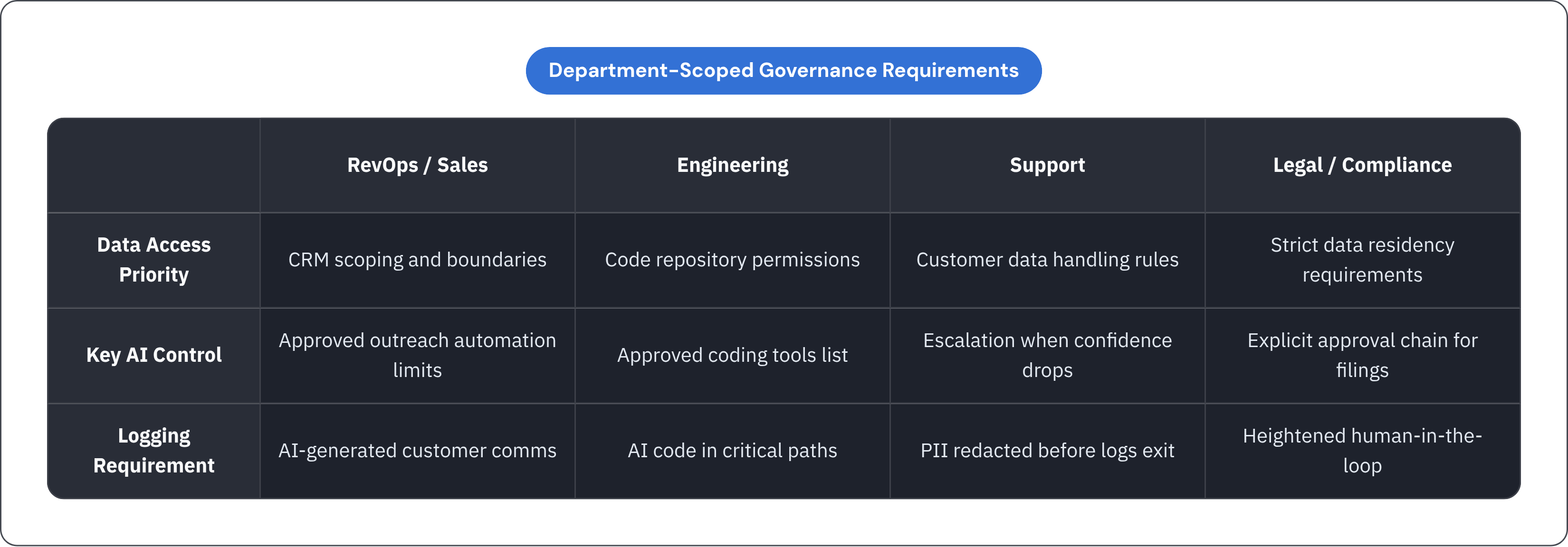
Scoped governance templates give each department a policy surface calibrated to their specific data sensitivity, regulatory exposure, and agent use cases, while inheriting enterprise-wide controls as a non-negotiable floor. The floor does not change. The ceiling varies by department.
The considerations differ substantially across functions. RevOps and Sales need CRM data access scoping, defined boundaries on approved outreach automation, and logging of any AI-generated customer communication. Engineering needs code repository access permissions, an approved list of AI coding tools, and explicit review requirements for AI-generated code in critical execution paths. Support needs customer data handling rules, escalation triggers when AI resolution confidence falls below a defined threshold, and PII redaction before logs leave the environment. Legal and Compliance need heightened human-in-the-loop requirements, stricter data residency rules, and an explicit approval chain for any AI output that influences a regulatory filing.
The technical architecture that makes this work is department-scoped MCP servers. Rather than a single shared server with all teams operating on it, each department gets its own scoped environment with its own tool catalog, permission set, and audit trail. Governance is unified at the gateway layer and differentiated at the team layer. The gateway enforces policy at runtime; the registry provides discovery across the organization. Neither alone is sufficient.
Standing up a governance council that can actually enforce the template
A governance template without an accountable body becomes aspirational documentation within one product cycle. The council is the mechanism through which the template stays operative as tools change, regulations evolve, and deployment scales.
Minimum council composition requires engineering, security, and legal representation. Not IT alone. The risks are cross-functional: a legal exposure discovered without engineering context cannot be remediated effectively, and a security decision made without legal input can create regulatory liability. Composition determines what the council can actually see and respond to.
The council's charter in the template must define four things. Who has authority to move a tool from tolerated to approved, or from tolerated to prohibited. Escalation procedures for AI-related incidents, including who is notified and within what timeframe. A scheduled review cadence for the registry, meaning proactive audits of what is deployed and whether ownership records are current, not just reactive triage. And how new agent deployments get registered before going to production.
That last point is where most governance programs quietly lose ground. When registration is a prerequisite for deployment, the registry stays current. When registration is a post-deployment administrative task, it accumulates lag until the registry no longer reflects what is actually running in production. The sequencing is not a procedural detail; it is the operational difference between a governance program that works and one that looks like it works.
The council is also the appropriate body for maintaining model-agnosticism in practice. Business context, permissions, and guardrails should travel with the organization rather than being embedded in any single LLM vendor's platform. The council owns the rules. Infrastructure enforces them.
What a governance template cannot do, and where infrastructure picks up where documents end
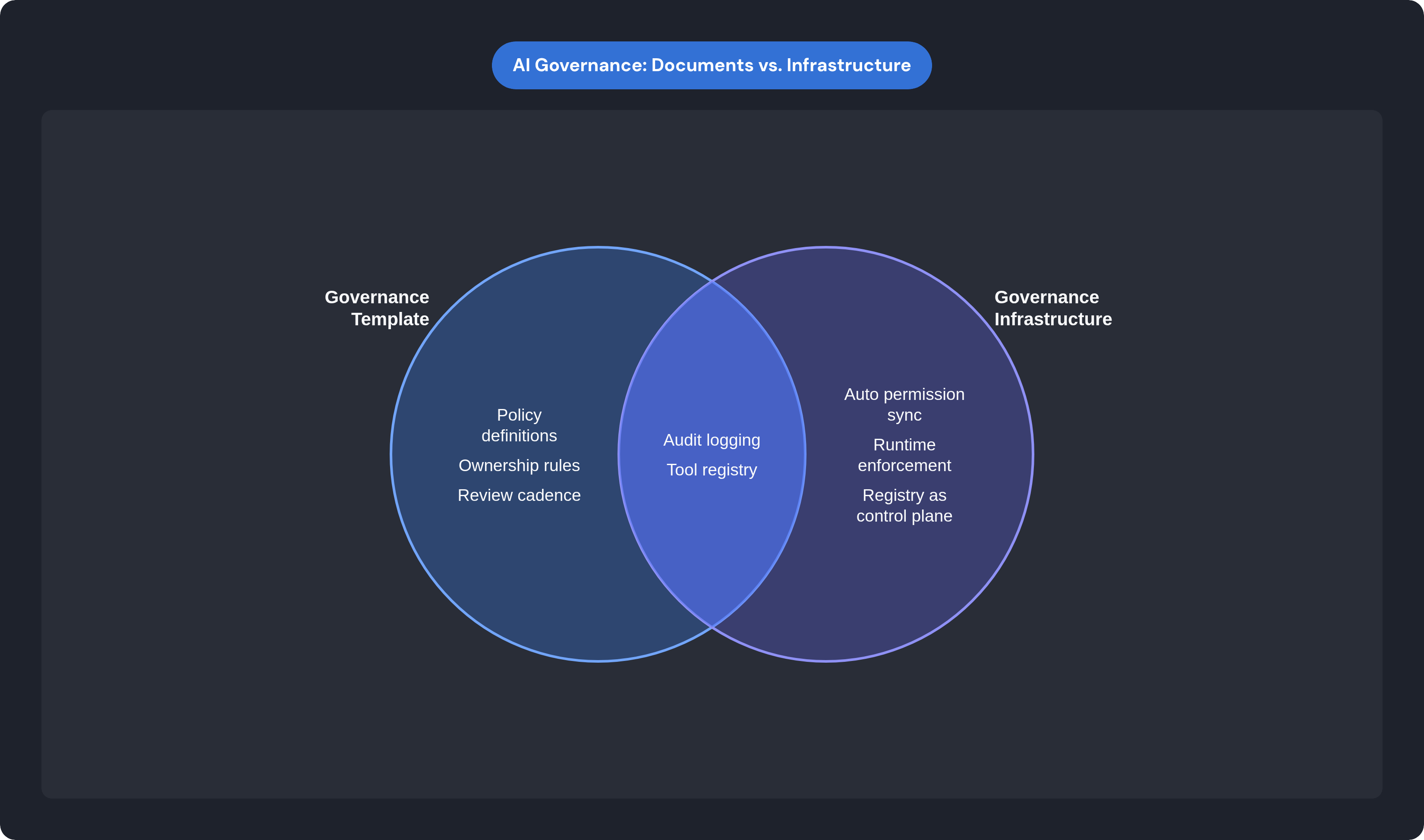
A governance template defines the rules. It cannot enforce them. Enforcement requires systems that act on the rules continuously, not humans who remember to check.
There are specific places where documentation breaks down and infrastructure must take over. Permission inheritance is one: a policy that says "inherit source system permissions" means nothing if the technical layer does not sync those permissions automatically and continuously. Audit logging is another: a logging requirement absent from the agent's execution path will produce incomplete logs, and the gaps will appear exactly where incidents are most likely to occur. Registry enforcement is a third: a registry that agents can bypass is a suggestion, not a control.
The practical test is direct. Can a new team deploy an agent that accesses regulated data without triggering a registry entry, a permission check, and an audit log entry? If yes, the template exists only on paper.
The market is already signaling where this lands. MCP compliance is appearing in enterprise RFP requirements rather than serving as a differentiator. Governance infrastructure is becoming a procurement baseline. Organizations that build governance as infrastructure now avoid the remediation cost of retrofitting controls onto a deployment base that has already grown beyond legibility.
The agent registry, permission inheritance, audit trails, and skill ownership are governance infrastructure, not policy documents. The governance template specifies what must be true; enforcement happens at runtime through permissioned MCP servers, audit logging, and centralized policy control.