MCP Server Examples for Common Enterprise Use Cases
MCP turns fragmented business systems into a single connection layer for AI agents.
MCP stands for Model Context Protocol, and it's the plumbing now connecting AI models to the tools businesses already run: CRMs, ticketing systems, code repositories, contract platforms. Anthropic released the spec in November 2024 to fix one specific headache. Before MCP, every AI model needed its own custom connector to every business system it touched. Multiple models times many systems means connectors that multiply fast, each built and maintained by hand, and that math never gets better on its own.
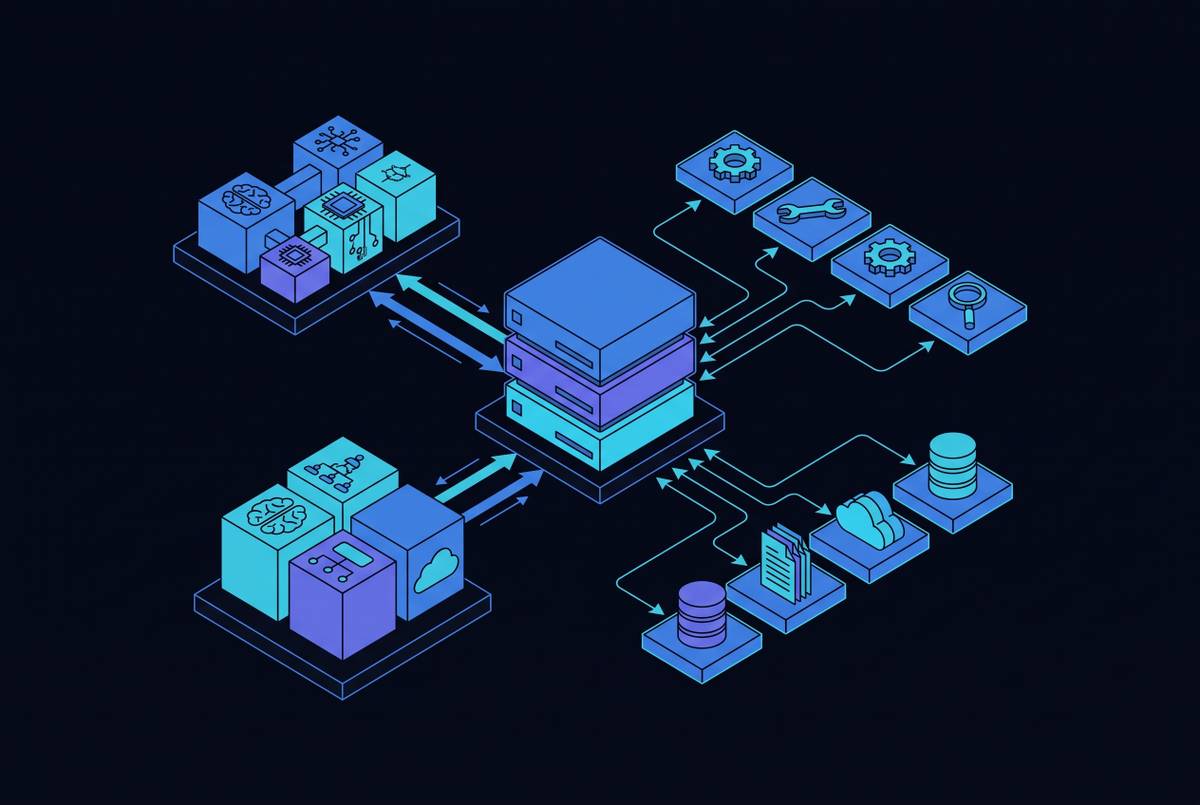
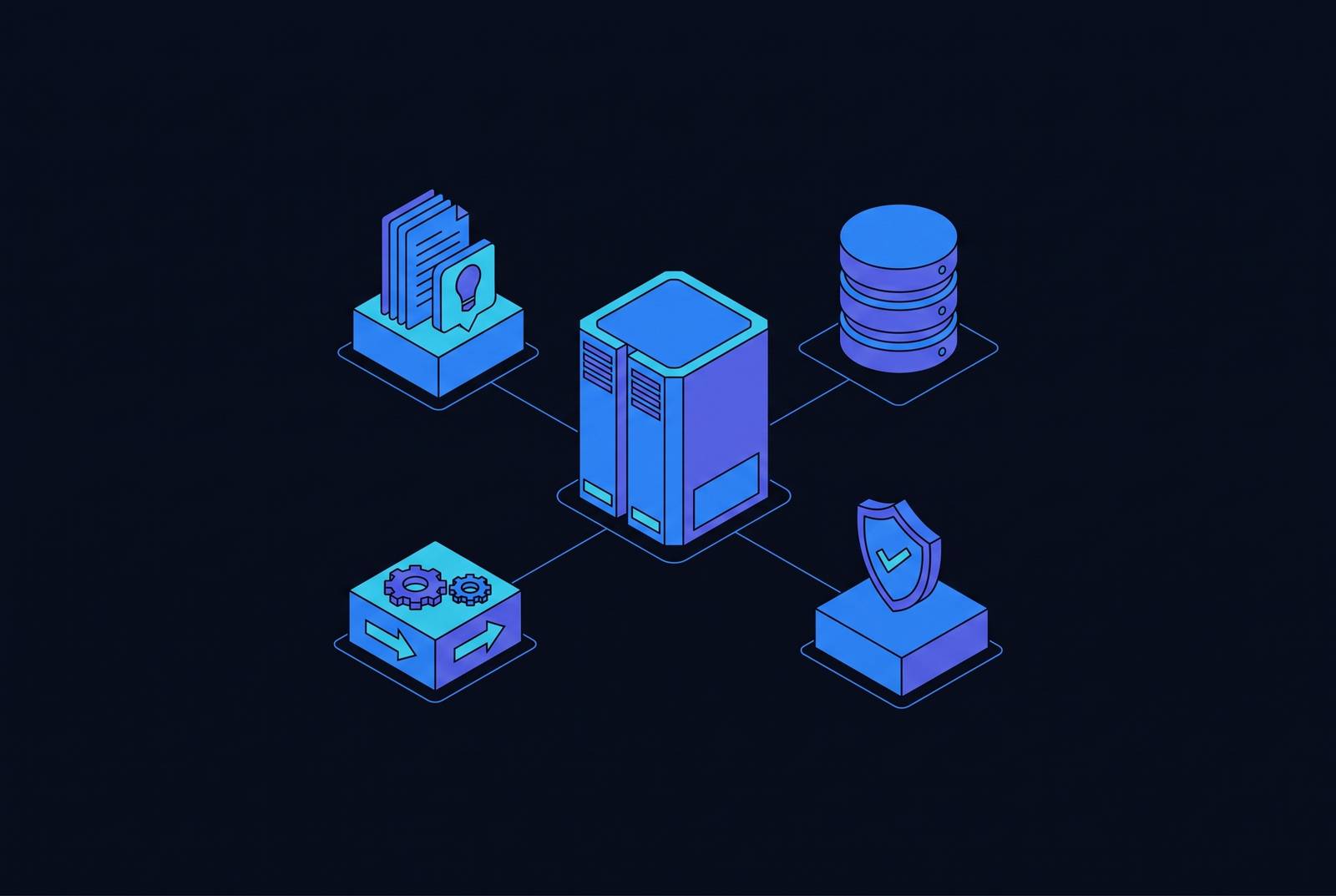
MCP turns that mess into a hub-and-spoke setup. Build one server for Salesforce; any MCP-compatible client (Claude, ChatGPT, Cursor, Copilot) can then talk to it with no custom work on either end. A user talks to a host, the host's MCP client reaches an MCP server, the server hits the real business system, and a structured response comes back up the chain. What follows is what that looks like once you get past the diagram: real servers, real departments, and the uncomfortable fact that adopting the protocol alone solves none of your governance problems.
How fast MCP moved from experiment to enterprise default
The download curve tells one story. OpenAI adopted MCP across its product line in April 2025, including the ChatGPT desktop app. Microsoft brought it into Copilot Studio at general availability that May. AWS added support in November 2025. Each step pulled more of the ecosystem in behind it, and by early 2026 the protocol had stopped being a bet and started being table stakes.
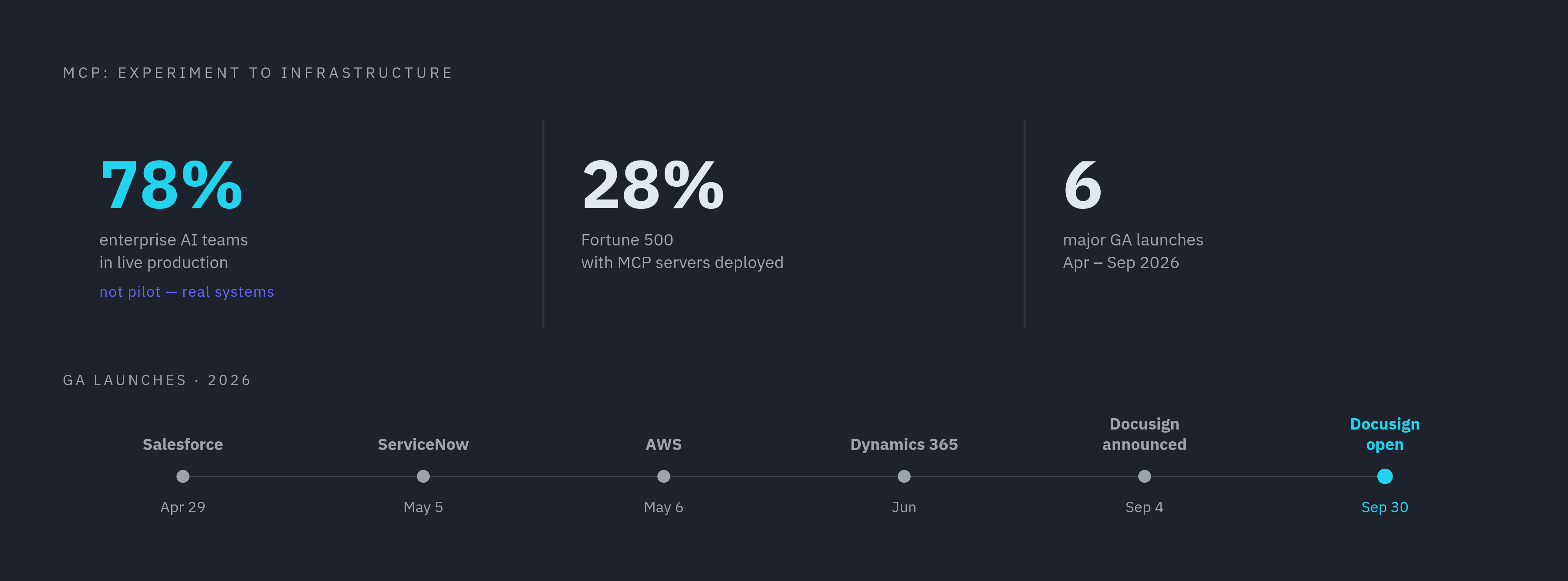
The production numbers tell the story that actually matters: 78% of enterprise AI teams report running MCP in live production, not pilot, and 28% of Fortune 500 companies have MCP servers deployed somewhere in their stack. Pilots are easy. Production is the number that counts, because production means someone signed off on letting an agent touch a real system.
What separates hype from real infrastructure is what shipped in general availability, not what got demoed at a keynote. Salesforce Hosted MCP Servers went GA on April 29, 2026. ServiceNow's Now Assist MCP server shipped in the Zurich Patch 4 release, then expanded further on May 5, 2026. AWS's MCP Server hit GA on May 6, 2026, with IAM-based guardrails, CloudWatch metrics, and CloudTrail logging built in from day one. Dynamics 365 Customer Service's MCP server reached GA with full case management: list, open, summarize, update, reassign, resolve, plus queue-based pickup and SLA tracking. Docusign announced on September 4, 2026 that its MCP server would open to every AI agent by September 30, making agreement workflows callable from Claude, ChatGPT, Gemini, Copilot, and Slack.
Vendors don't ship IAM guardrails and audit logging for something they think might fade. They ship that for something they've already bet the roadmap on.
The recurring integration problem inside enterprises at scale
MCP solves the connector math at the protocol level. Then the same problem comes back at the operational level, worse, because now every team inside a company can spin up its own server. Dozens of teams doing that independently is its own kind of mess, just one floor up, and pretending the protocol alone prevents that is the mistake most companies are about to make.
Identity cracks first. A single MCP setup touches five separate identity layers, including the end user, the AI host, the MCP client, the MCP server, and whatever API sits behind it. If permission doesn't travel cleanly through all five, nobody can say who actually authorized what action. That's not a small gap when the action is updating a customer record or approving a contract.
Token bloat is the quieter issue. Every tool a server exposes injects its schema description into the model's context window. Loading up enough tools causes the model to burn thousands of tokens just reading a menu before it does a shred of real work.
Sprawl is the plainest problem of the three. Every team building its own server from scratch multiplies the setup burden past what anyone can track by hand. A common pattern shows how: servers often store API keys in a local config file, and that file can't go into version control for obvious security reasons. So every engineer on a team ends up hand-copying credentials into their own local copy. That holds up fine for three people. It falls apart at thirty.
MIT's research on enterprise generative AI found that roughly 95% of pilots delivered no measurable return, and pinned the cause on a "learning gap": tools that don't learn, don't integrate, and don't adapt to how a team actually works. MCP closes the integration half of that gap. It does nothing for governance, and treating it as a governance fix causes the sprawl described above.
The actual fix is a registry and gateway layer sitting above individual servers, one that centralizes discovery, enforces access policy, inherits permissions straight from the source system, and keeps one audit trail instead of five scattered ones. Every department example below assumes that layer sits underneath it. Skipping it leaves the problem of many tools across many systems unsolved. It's just moved inside your own walls, where it's harder to see.
Sales team MCP servers: CRM actions, pipeline intelligence, and revenue data
Reps and sales managers lose real hours stitching together one picture of a deal: CRM notes, email opens, intent signals, call transcripts, all sitting in different tools. MCP-connected agents collapse that stitching into a single query, and that's the whole value proposition in one sentence.
Salesforce DX MCP Server lets an agent query Salesforce data with SOQL, deploy metadata, and run tests, oriented toward developer and platform work. It leans toward developer and platform work more than frontline selling. Salesforce's Headless 360 platform started routing customer and agent interactions through MCP in April 2026, and has processed 4.5 million MCP calls since.
HubSpot's MCP Server gives access to contacts, companies, deals, tickets, and the associations between them, with invoices, quotes, line items, and products available in beta. Outreach's MCP Server covers call transcript retrieval, email search, sequence lookup, and prospect, account, and deal queries. Salesloft's MCP Server covers pipeline, deals, accounts, and call recordings, across Claude, ChatGPT, and Microsoft Copilot.
The flagship use case is pipeline intelligence: one query pulls CRM activity, email engagement, intent signals, and website behavior into a single read on deal health, no manual stitching required. A sales team keeps whatever CRM and engagement tools it already runs, connects each through MCP once, and gets that cross-system view through whichever AI interface it prefers, without rebuilding the connection for every new surface that shows up next quarter.
Engineering team MCP servers: code context, repositories, and development workflow
Engineering got to MCP first, and that's not an accident. IDEs, platforms like Replit, and code intelligence tools like Sourcegraph adopted the protocol early because AI coding assistants needed live project context instead of stale training data, and MCP was the fastest way to get it.
GitHub's MCP Server was one of the original servers released alongside MCP's November 2024 launch. It lets an agent read repositories, open issues, and work with pull requests through one standard interface instead of a patchwork of API calls. AWS's MCP Server brings the same IAM-based guardrail and CloudTrail logging setup mentioned earlier, and engineering teams are often the ones operating inside regulated cloud environments where an unlogged action is a compliance finding. It's a compliance finding.
Kiro, AWS's AI-focused IDE, ships a built-in MCP server registry. Admins allowlist which servers are approved and which AI models developers can use, and that policy holds across both the IDE and the command line. Kiro checks the registry at startup and again every 24 hours. If a locally installed server drops off the registry, Kiro kills it and blocks anyone from adding it back.
That detail points at a risk specific to this team, and it's the one most companies underestimate. Developers, more than almost anyone else in a company, have the technical means to spin up a local MCP server and point it straight at production. Without an enforced allowlist, that's a shadow integration sitting inside the exact team responsible for building the company's AI infrastructure. On measurable impact, GitHub reports a 55% faster task completion rate with Copilot, and Forrester found a 30% reduction in development overhead associated with MCP adoption. GitHub's 55% faster task completion and Forrester's 30% cut in development overhead confirm the gains are measurable. So is the exposure if nobody's watching the registry.
Customer Support MCP servers: case management, SLA tracking, and knowledge retrieval
Support is where MCP's action-oriented side appears most, because agents here need to do things, not just look things up.
Dynamics 365 Customer Service's MCP Server, now generally available, handles the full case lifecycle: list, open, summarize, update, reassign, resolve. It pulls the next case off a queue automatically and tracks SLA status with suggested next steps, all callable through any MCP-compatible tool. ServiceNow's Now Assist MCP Server shipped in the Zurich Patch 4 release and expanded with Action Fabric on May 5, 2026.
Slack's MCP Server lets an AI search channels, send messages, and take other actions inside Slack through any compatible client, with workspace admins controlling which integrations are permitted. Slack has seen a 25x jump in both Real-Time Search queries and MCP tool calls. That number says something concrete: Slack stopped being a chat window for AI agents and became an execution layer.
The core use case looks like this: an agent picks up a customer escalation, pulls case history, checks SLA status, drafts a reply, and routes it to the right queue, with no human bouncing between three tabs to get there. The knowledge side matters just as much, since a support agent's value comes down to finding the right answer fast. MCP servers connected to internal knowledge bases and past case records give AI the same access a human agent would have, with permissions inherited straight from the source system, so nothing surfaces that the requesting user isn't cleared to see.
RevOps MCP servers: cross-system reporting, forecasting, and agreement workflows
RevOps exists because revenue data lives in too many places at once: CRM, marketing automation, finance, contract management. MCP turns pulling that together into a query instead of a manual export-and-merge job that eats an afternoon.
The relevant servers overlap heavily with what Sales already uses, which tracks given how tightly the two functions share data. Salesforce Hosted MCP Servers handle queries across opportunity, account, and activity records. HubSpot's MCP Server covers deals and their associations, with quotes and invoices available in beta, the exact data RevOps needs for funnel and revenue reporting. Outreach's MCP Server supplies sequence performance, call transcripts, and deal queries, the engagement layer sitting next to CRM data, and Salesloft's MCP Server covers the same engagement ground from a different platform. Docusign's MCP Server closes the loop on contract execution, with agreement workflows callable from Claude, ChatGPT, Gemini, Copilot, and Slack.
The flagship use case reads the same as Sales: one agent call pulling CRM activity, email engagement, intent signals, and website behavior into a single pipeline health check, cutting out the hours-per-week of manual stitching RevOps teams have been stuck with for years. RevOps is the function built entirely around synthesizing scattered systems, so it's also where a governed MCP registry pays off the most visibly. Skipping the registry here makes the configuration sprawl worse than almost anywhere else in the company, precisely because this team touches the most systems to begin with.
Deploying MCP across surfaces: the same server reaching Claude, ChatGPT, Cursor, and Slack
Building one MCP server means any MCP-compliant client can reach it. MCP-compliant clients, across chat interfaces, IDEs, and communication platforms, need no separate integration built just for them.
That's the actual shift MCP represents. Not a smarter model, not a flashier interface, but a shared plumbing standard, so a Support team's case management server, once built, works the same whether it gets called from Slack during a live escalation or from Copilot inside a Microsoft workflow. A Sales team's HubSpot connection doesn't need a rebuild for every new AI surface the company adopts next quarter.
The tradeoff is the governance risk raised earlier, and it deserves to be stated flatly: one server reaching five clients is efficient, but five departments each building their own version of that same server, with credentials scattered across local config files and no shared audit trail, recreates the sprawl one layer higher. That's a worse outcome than the problem MCP was built to fix, not a neutral one. The protocol solved the connector math. What happens next, at the registry and policy layer, decides whether that efficiency appears in the numbers or is eaten alive by configuration chaos nobody signed up for.