What Enterprise AI Agent Marketplaces Actually Give You
Marketplaces alone won't solve your integration problem—governance and context do.
The agentic AI market is set to grow from $4.35 billion in 2025 to a projected $47.8 billion by 2030, a 61.5% compound annual growth rate. Every enterprise vendor now has a marketplace strategy because of that number. But most of these marketplaces are selling a catalog and calling it infrastructure, and that's a big part of why MIT found that 95% of enterprise AI pilots never show measurable ROI. The question worth asking isn't whether agent marketplaces matter. It's what happens the moment after you install an agent, and whether the platform you bought answers that question or leaves you to sort it out alone.
What an AI agent marketplace is, concretely, and what it is not
A marketplace, at the simplest level, is a platform for finding, publishing, deploying, and managing agents. People reach for the app store comparison constantly, and it holds up in one narrow sense: you browse a catalog, pick something, install it.
The comparison falls apart the moment you look at what happens after install. An app store doesn't care what data your phone can reach. An enterprise agent cares about almost nothing else. A pre-built agent still needs to be wired into your systems, given real context about your business, and scoped to match access controls that already exist somewhere else. None of that happens just because the agent showed up in a catalog with a nice listing page.
"Pre-built" means someone else wrote the code. It doesn't mean the agent knows your customer records, respects your data boundaries, or carries any accountability for what it touches once it's live. Drop an agent into your environment without governed context, and it behaves like a contractor who walks onto a job site with no badge, no clearance, and no scope of work written down anywhere. Someone let it in the front door. Nobody defined what it's allowed to do once inside, and that failure sits with the buyer, not the agent.
Most vendors are still selling the catalog and pricing it like infrastructure. That's the wrong bet to make, and it's the one nearly every buyer in this market is currently making.
The five marketplaces enterprises are actually evaluating in 2025 to 2026
The field isn't crowded. It's a handful of serious options, each solving a different slice of the problem, and none solving all of it.
Oracle Fusion Applications AI Agent Marketplace launched October 15, 2025. It validates and deploys partner-built agents inside Oracle Fusion Cloud, with the same support coverage whether Oracle or a partner built the agent, and ties into Oracle AI Agent Studio.
Google Cloud Marketplace spans custom builds, pre-built agents, and tailored configurations. It reads less like one deployment model and more like a menu, depending on how much your team wants to build versus buy.
AWS Marketplace AI Agents and Tools carries hundreds of partner offerings: prebuilt agents, embedded agents, MCP tools, knowledge bases, guardrails, professional services. It's the broadest catalog of the group, by a wide margin, and that breadth is also its limit. Size isn't the same as fit.
Salesforce AgentExchange has built native MCP support inside Agentforce, along with Hosted MCP Servers as a managed product and verified MCP servers listed in AgentExchange. Of the group, it's the tightest fit for CRM-specific context.
Moveworks AI Agent Marketplace leans into business-need-driven deployment, with pre-built agents and seamless enterprise system integrations rather than bolt-on additions.
Then there's a different animal entirely: the governed registry. Instead of a catalog you browse, it's a versioned, permission-aware system where a team publishes a skill once, scopes who can access it, and makes it available across any agent surface. That's not a sixth vendor competing with the first five. It's a different architecture, and it's the one that actually closes the gap this piece keeps circling back to.
Most buyers evaluate these on catalog size: how many agents, how many integrations, how big the partner list. That's the wrong axis, plain and simple. The question that actually predicts whether a deployment survives contact with a real organization is whether permissions inherit automatically or get rebuilt by hand for every tool, and whether a skill can travel across teams or stays stuck on one surface forever.
Why 95% of enterprise AI pilots deliver no measurable ROI, and what that statistic is actually measuring
MIT's 2025 research put a hard number on something a lot of people already suspected: roughly 95% of enterprise generative AI pilots produce no measurable ROI. The cause, overwhelmingly, is integration failure, not bad models. Get that distinction backwards and you'll fix the wrong layer entirely, chasing a better model when the actual break sits underneath it.
The agents themselves are usually fine. What breaks is the connection layer: an agent that can't reach the data it needs, can't respect access rules already in place, or loses context the moment it crosses from one system into another. Finding an agent has gotten easy. Figuring out where it fits into an actual business process, what systems it needs to touch, what decisions ride on its output, and whether it holds up under real operating conditions: that part is still hard, and no catalog listing does it for you.
McKinsey's analysis of 190 business processes found that roughly 60% of potential AI productivity gains sit inside sector-specific workflows, the deeply contextual stuff, not the generic tasks everyone demos on stage. So the agents most likely to move a P&L are the ones that need the most business context baked in, not the least. Marketplaces selling generic, context-free agents are optimizing for the smaller share of the opportunity, and calling it a win when the pilot runs at all.
How MCP changes the integration math underneath every marketplace
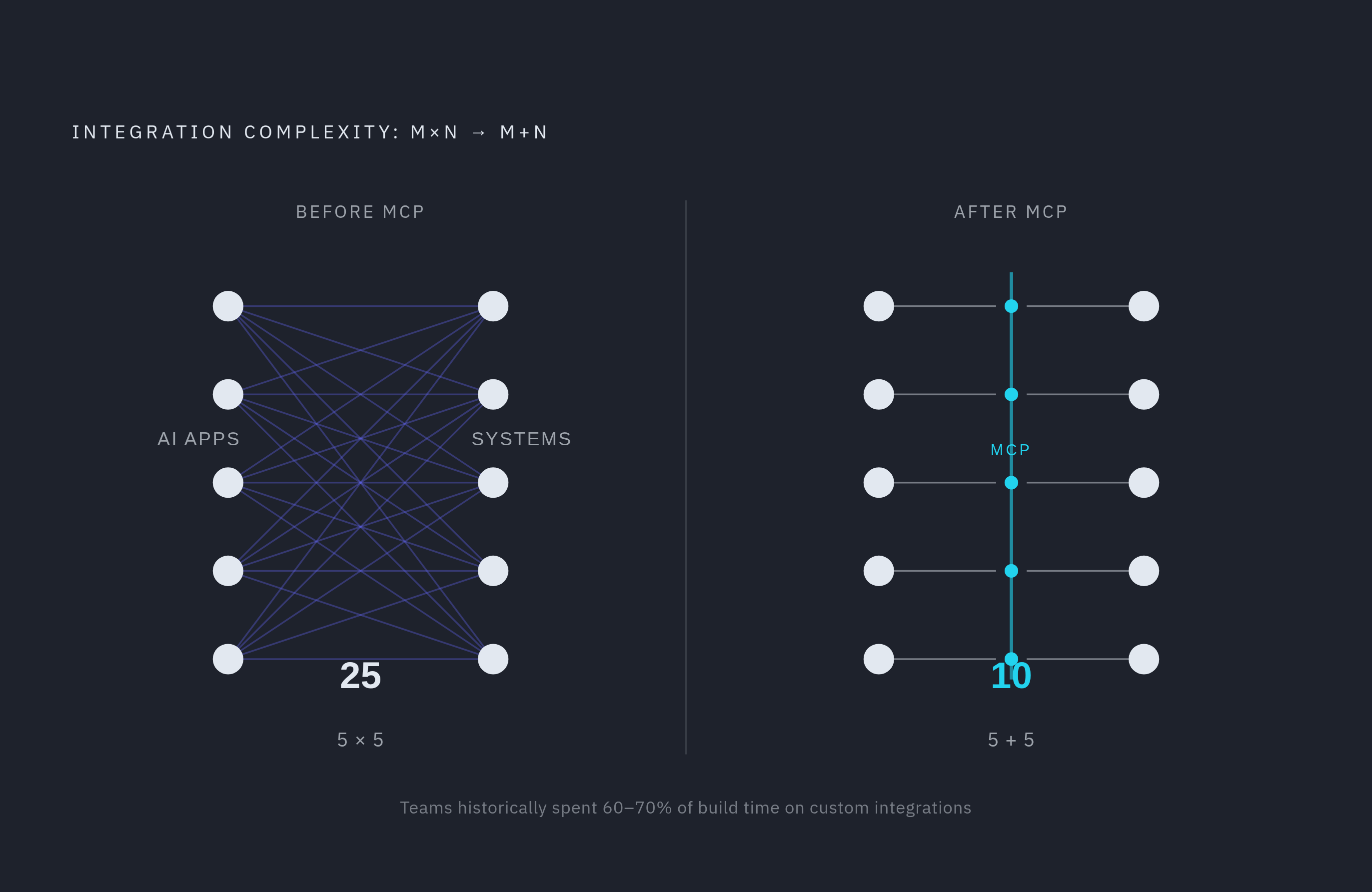
Before MCP, connecting M AI applications to N business systems meant building something close to M times N custom integrations. Every new tool multiplied the work instead of adding to it, and that tax got worse, not better, as agents spread across an organization.
MCP, the Model Context Protocol, is an open-source standard that collapses that math. Each system exposes one interface. Each AI client speaks one protocol. Integration effort scales as M plus N instead of M times N: the difference between a project that gets harder with every new tool and one that doesn't.
Boston Consulting Group called it "a deceptively simple idea with outsized implications." Teams have historically sunk an estimated 60 to 70% of build time into custom integrations, which is the exact overhead MCP is built to eliminate. Build an MCP server for your CRM once, and it works with any compatible client, Claude, ChatGPT, Cursor, whatever comes next, without a rebuild.
MCP breaks down into four pieces: Resources for data access, Tools for taking action, Prompts for workflow templates, and Sampling for LLM completions. Every agent inside every marketplace above draws on some combination of those four things under the hood, whether the vendor advertises it or not.
The comparison people reach for is USB-C. Before it, every device needed its own cable and its own port. After, one standard, and everything plugs into everything else. MCP does that same job for AI-to-system connections.
How fast MCP became the default standard, and what that means for marketplace strategy
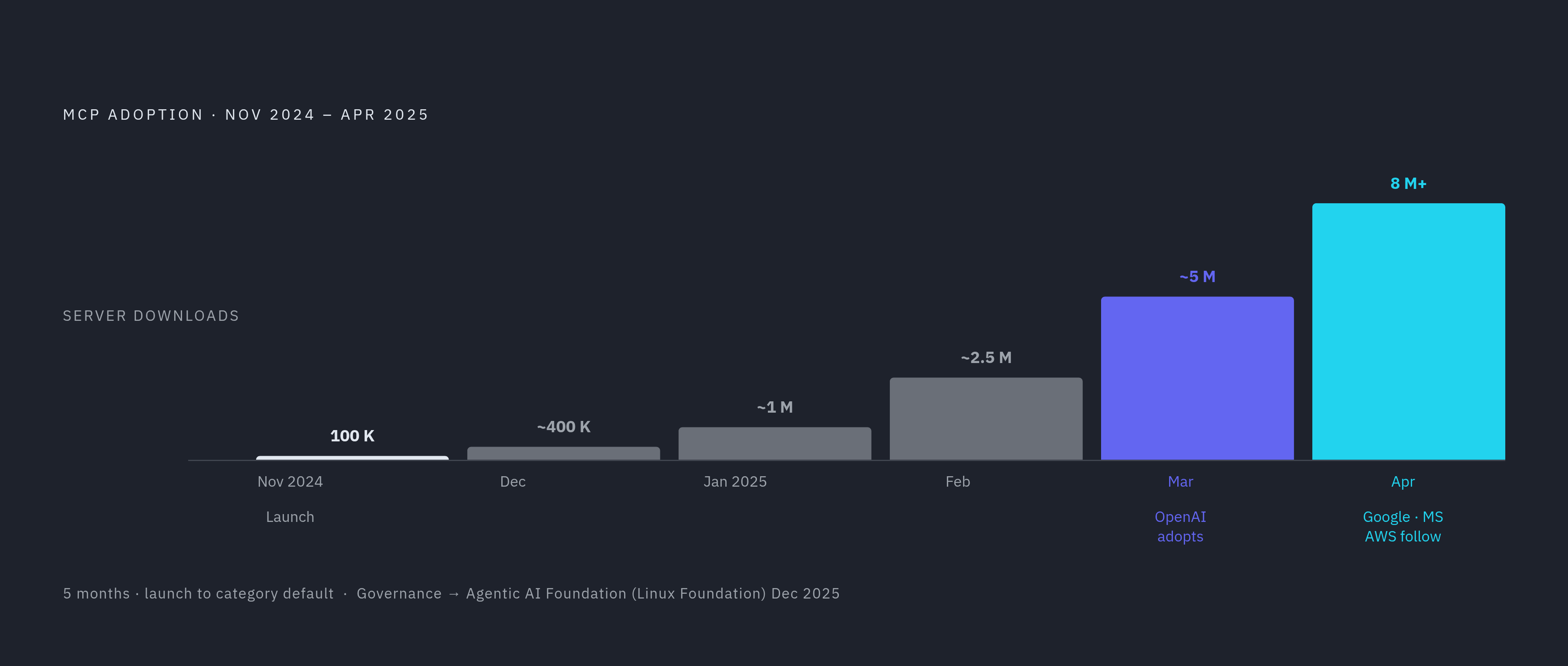
Anthropic launched MCP in November 2024. Server downloads went from around 100,000 that month to over 8 million by April 2025. That's not gradual adoption. That's a standard taking over an entire category in five months flat.
OpenAI adopted MCP in March 2025. Google, Microsoft, and AWS followed shortly after. In December 2025, governance of the protocol moved to the Agentic AI Foundation, a directed fund under the Linux Foundation, which strips out the single-vendor risk that used to be the strongest argument against betting on it early.
By 2026, MCP support runs across every major AI client: Claude Desktop, Claude Code, Cursor, ChatGPT, Codex, GitHub Copilot, Gemini, Windsurf. Build a server once, and it works everywhere on that list.
So the question isn't whether a marketplace supports MCP anymore. Almost all of them will claim to, and most will be telling the truth. The real question is who governs it: who controls which servers exist, who's allowed to call which tools, and what gets logged when they do. A vendor that answers the first question and dodges the second hasn't finished the job, no matter what the pitch deck says.
What governance has to do before a marketplace can actually deliver on its promises
MCP solves connectivity. It does not solve centralized authentication, audit trails, or policy enforcement. Those live on top of the protocol, and most marketplaces quietly leave that layer to the buyer to build, usually after something has already gone wrong.
Enterprise MCP governance needs four things working together, in a specific order: a centralized catalog of what servers exist, identity-based access controls, structured audit logging, and real-time policy enforcement. The order isn't arbitrary. You can't enforce a policy on a server you don't know exists. You can't build a real audit trail without knowing which identity took which action. And logs collected after the fact are a forensic record, useful for cleanup, not a control that stops anything in the moment it happens.
AI agents complicate this because they don't behave like a person logging into a system. An agent carries context across multiple tool calls, holds permissions through an entire session, and acts on instructions nobody anticipated when the original access rules got written. Traditional access control was built for someone clicking through a UI, not for a system stringing together a dozen automated calls in sequence with no human in the loop to catch a mistake.
Security guidance from multiple authorities has made plain that data security underpins whether an AI system can be trusted at all. That's not abstract policy language. It means agent infrastructure now sits inside the same attack surface security teams already watch for every other production system, and treating it as a separate category is exactly how gaps open.
The research shows what those gaps cost in practice: 43% of MCP servers carry command injection flaws, and once an environment has 10 plugins connected, the probability of a successful exploit exceeds 92%. That's the direct, measurable result of a marketplace optimizing for speed of deployment and treating governance as something to bolt on later. Gartner projects that 70% of software engineering teams building multimodal applications will use AI gateways by 2028, up from just 25% in 2025. Governance isn't a nice-to-have layer anymore, and the vendors still selling it as optional are the ones to be skeptical of.
The permissions problem that most marketplace deployments leave unsolved
Silos create waste that's easy to miss until someone stumbles onto it directly. Different teams build near-identical models for the same problem, demand forecasting is a common example, without knowing another team already solved it. Then two models spit out two different answers, and nobody can say with confidence which one to trust.
Permissions carry their own version of that waste, and it's worse because it repeats every single time a new tool shows up. Somebody has to sit down and manually redefine who's allowed to see what, completely disconnected from the systems where those permissions already exist and are already being maintained correctly by someone else.
The better architecture skips that manual step entirely. Permissions inherit straight from the source systems and sync in real time, so when someone asks an agent a question, the answer only pulls from what that person is already cleared to see. No separate access layer bolted onto the AI system for an admin to configure and babysit forever.
In practice: a sales rep asking a CRM-connected agent a question gets answers scoped to the accounts they're actually authorized to touch. Not because someone configured that specifically for the agent, but because the agent inherited the CRM's access model exactly as it already stood.
Skip that inheritance step, and every new agent deployment becomes its own security perimeter: one that someone has to define, document, and maintain by hand, forever, for every agent, on every team. That manual rebuild is exactly why enterprises hit governance debt long before they ever come close to a capability ceiling. Vendors rarely mention this part in the demo.
Why a shared registry is different from a shared drive, and why that difference determines scale
Five teams independently rebuild the same prompt or the same workflow, each one unaware the others already did it months earlier. That's not a hypothetical inefficiency. It's the default outcome of scaling AI without a shared place to put things, and every hour spent on that duplicate work is an hour not spent building something new.
Shadow AI is the visible symptom of the same disease. Without a central registry, teams start wiring agents to outside tools on their own, with nobody tracking which connections expose what data and no access control layered on top of any of it. A registry gives platform teams the visibility to catch that sprawl before it turns into an incident, instead of finding out about it during a breach postmortem.
A registry that functions at scale needs version control, clear ownership of each skill, and access scoping baked in from the start. A shared drive or a wiki page does none of that. It's a place to store things, not a system to govern them, and enterprises that treat the two as interchangeable end up rebuilding the same skill five times without ever noticing the duplication.
The value shows up in the reuse chain. A domain expert on one team builds a skill using business context only that team has. The registry captures it. Now any other team can find it and use it, instead of every department reinventing the same prompt from scratch on its own timeline. Each team gets a scoped MCP server: no UI to build, nothing extra to maintain, plugging straight into whatever agent or chat interface people already use.
A 2025 Google Cloud study found 88% of early adopters reporting positive ROI, with the organizations pulling an average ROI of 171% (192% among North American firms). Those are the organizations that solved reuse and cross-team deployment, not the ones that simply got a pilot running and called it done.
What the right marketplace infrastructure actually gives you, and the questions to ask before you buy
Strip away the marketing, and a well-built marketplace hands you four concrete things: skills that don't need rebuilding team by team, context that moves with the organization instead of staying locked in one system, cross-team deployment without a permissions rewrite every time, and an audit trail that shows who approved what and when.
McKinsey's 2025 research found that AI high performers were almost three times as likely as other organizations to redesign workflows around AI, rather than bolt AI onto processes that already existed. The infrastructure decision made early on is what determines whether an enterprise ever reaches that redesign point, or stays stuck running pilots indefinitely with nothing to show for them.
Before signing anything, ask the questions that actually separate a catalog from infrastructure. Are permissions inherited from the source systems, or does someone rebuild them by hand inside the AI layer? Is there a versioned registry with real ownership and access scoping, or a shared folder wearing a nicer interface? Can a skill one team built get picked up by another team without a rebuild from scratch? Is every action an agent takes auditable, tied to who called it and under what authorization?
Does context move with the organization across model surfaces, or is it locked into a single LLM? That last one carries more weight than the rest. Business context, permissions, and guardrails belong to the organization, not to whichever model happens to be popular this year. A marketplace that quietly locks you into one LLM is trading a little short-term convenience for a long-term infrastructure headache, and that trade rarely gets disclosed on the pricing page.
A marketplace that hands you a catalog of agents is giving you distribution, and that's worth less than the pitch deck suggests. A marketplace built on inherited permissions, a versioned registry, and context that travels with the organization is giving you infrastructure. Only the second kind gets more valuable as the organization around it grows. That's the one worth paying for, and it's the one most vendors on this list still aren't building.