AI Agent Sandbox Environments for Enterprise Testing
Enterprises need sandboxes that replicate production systems, not just isolate code.
What an enterprise AI agent sandbox must replicate
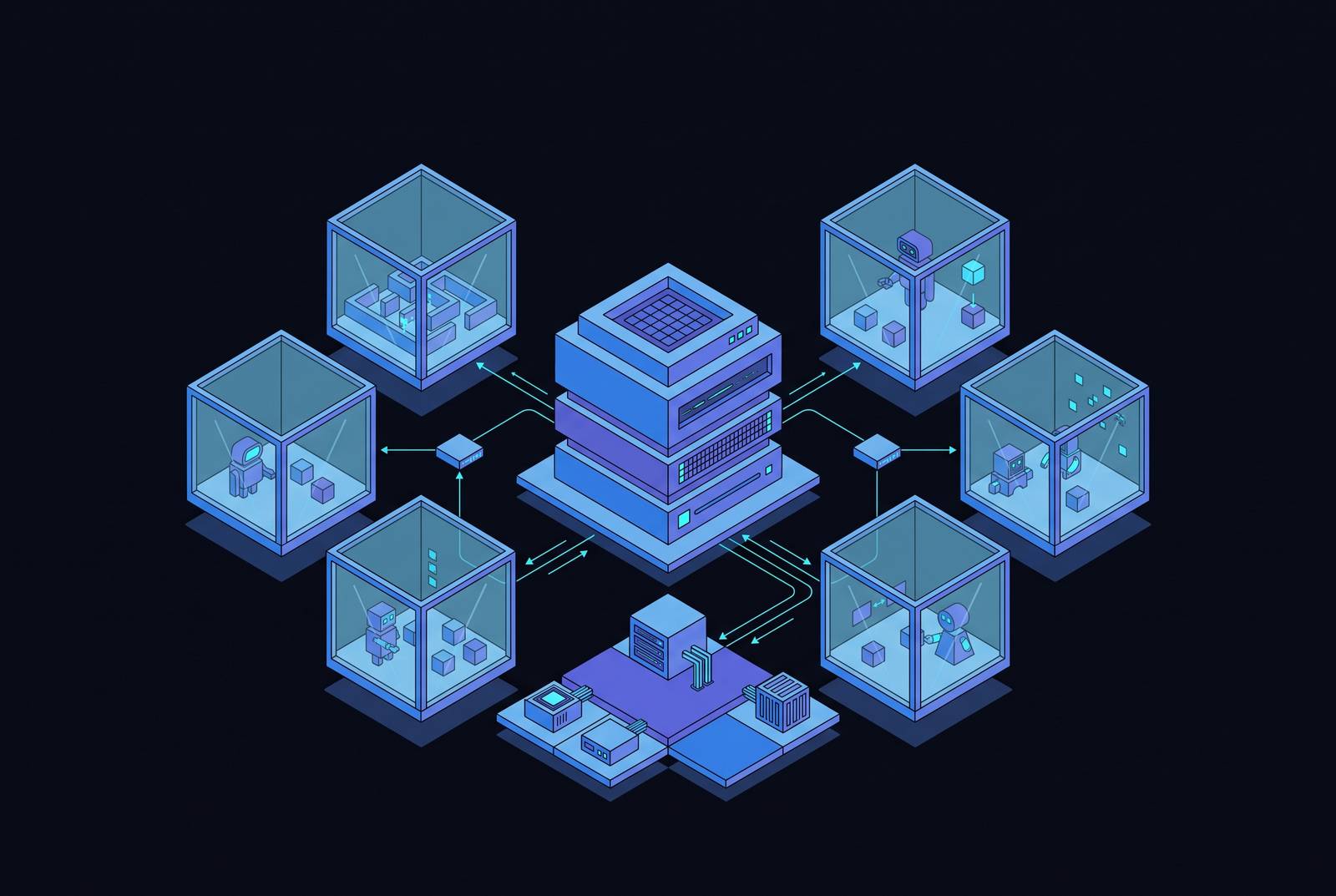
An AI agent that reads a CRM, writes to it, and fires off a follow-up email is an actor with hands. Before those hands touch production, the agent needs to run somewhere that looks and behaves like the real system. Most enterprise teams get this wrong, and the mistake is usually simple: they treat agent testing like old-fashioned QA.
That old playbook doesn't carry over. Unit tests assume deterministic code: same input, same output, every time. Agents don't work that way. They chain decisions, call tools in sequences nobody wrote out ahead of time, and drift in behavior across sessions as context piles up. A staging environment built for regression tests won't catch an agent that decides, on its own, to call three tools instead of one, or reaches into a field it wasn't supposed to touch. The failure appears as a live write to a financial system, a deletion in an HR directory, or data pulled somewhere it shouldn't go, occurring when nobody notices until after the fact.
Sandboxing has to be a structural requirement, not a nice-to-have bolted on at the end: role-based access scoped to the agent itself, audit logs for every tool call, approval gates on anything high-stakes, and a sandbox realistic enough that passing its tests actually means something. Isolation alone proves nothing about how an agent behaves once it's off the leash. A sandbox that's airtight but unrealistic just hands back test results that lie to you.
Four things have to line up before a sandbox earns any trust. Data fidelity means synthetic data that mirrors production: same schemas, same access patterns, roughly the same volume. Tool fidelity means the agent calls the same MCP servers, the same API endpoints, the same internal connectors it'll hit later, since swapping those for stubs that behave differently only tells you how the agent handles a fake. Permission fidelity means testing under the exact RBAC scope the agent runs with in production, not an admin key that papers over gaps in access control. Behavioral fidelity means every tool call, every branch, every action gets logged and stays reviewable. Skipping that last piece produces isolation with no evidence attached, which is not the same thing as safety.
Standard containers fall short here for a structural reason, not a matter of taste. They share a kernel with the host machine. That's fine for predictable code, but AI-generated code can attempt system calls or spawn child processes nobody scripted for, and a shared kernel hands that behavior a door it shouldn't have. The underlying architecture makes the point directly: shared-kernel containers weren't built for code whose next move isn't known in advance.
Speed and isolation are cheap to get. Governance is not. A sandbox that spins up fast and runs isolated code is convenient, but convenience isn't governance. A governed enterprise sandbox is auditable, aware of its own permission boundaries, and ready to hand over compliance evidence on demand. That's the kind this piece is about, and it's the bar most teams quietly skip.
Isolation technologies that underpin trustworthy sandboxes
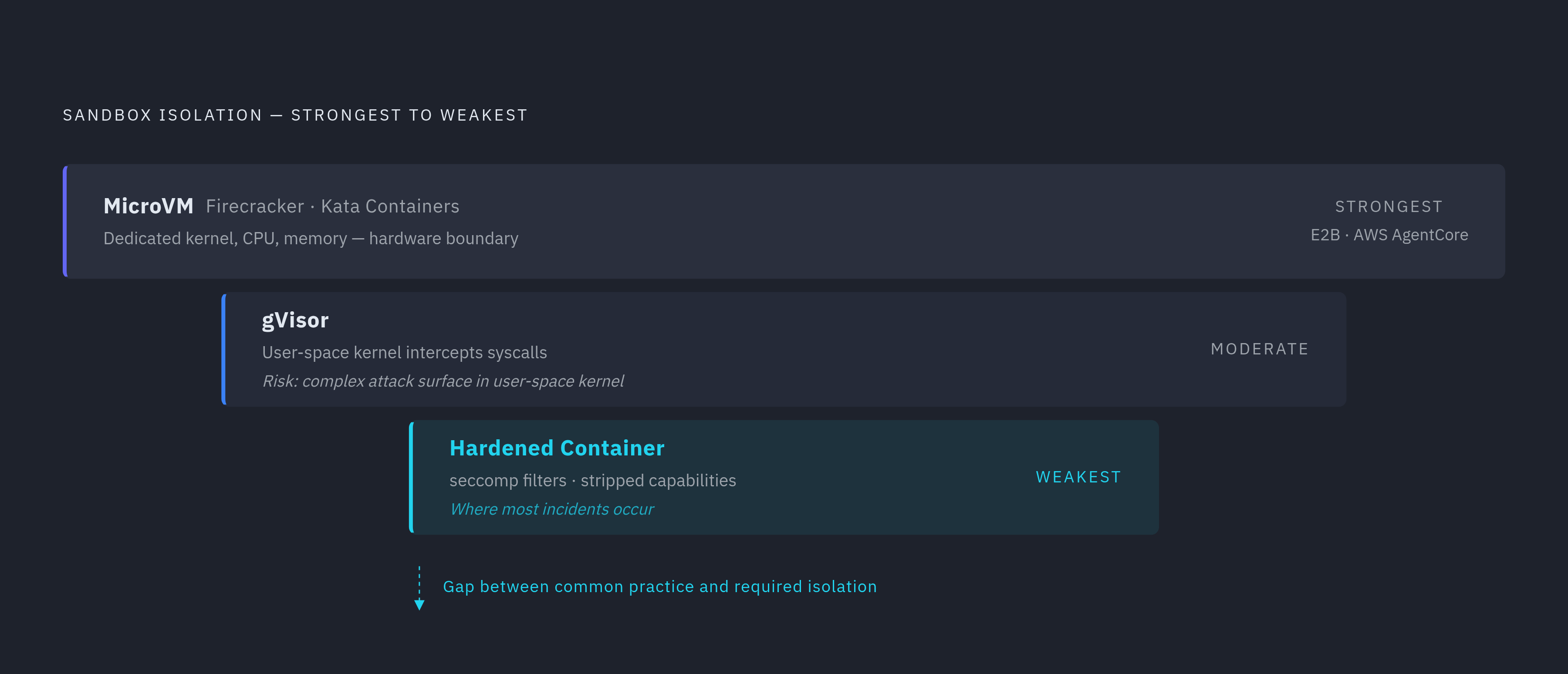
Three isolation approaches dominate right now, and each draws the trust boundary in a different place.
MicroVMs, the technology behind Firecracker and Kata Containers, give each sandbox its own dedicated kernel, CPU, memory, and filesystem. That's hardware-level isolation, the strongest boundary on offer, and it's what E2B and AWS AgentCore run on, each with its own implementation. Because every sandbox gets a fully separate kernel, the shared-kernel risk disappears.
gVisor takes a different route. It runs a user-space kernel that intercepts system calls before they touch the real host kernel. That's a real step up from a standard container and costs less overhead than a full microVM, though it doesn't match a microVM's isolation guarantee. Call it the middle option, reasonable for workloads that don't need the strongest boundary available but still need more than a bare container gives them.
Hardened containers sit at the bottom of the stack: a standard container runtime with security profiles, seccomp filters, and capabilities stripped out. That's fine for low-sensitivity work. It's not enough once the agent runs arbitrary, model-generated code with real consequences attached, and this is where most of the actual incidents live.
Teams get it backwards: they pick isolation based on what feels cautious rather than what the agent is actually allowed to do. A read-only research agent pulling public data doesn't need the same boundary as a write-capable agent pushing changes into a live system. Over-isolating the read-only agent just burns budget on a boundary that was never at risk. And no isolation layer, however strong, substitutes for permission scoping. Isolation stops an agent from breaking out of its box. Permission scoping stops it from misusing what's legitimately inside that box. Both jobs matter, and neither one covers for the other.
Ephemeral versus stateful sandboxes: when each fits
Ephemeral sandboxes spin up, run the task, and vanish. No memory carries over between sessions. That's a clean setup: no contamination between test runs, low overhead on storage and management, and a natural fit for isolated code execution, short analysis jobs, or integration tests where the same input needs to produce the same result every time.
But an ephemeral sandbox has a real ceiling. An agent that needs to install a package, build up intermediate files, or carry context across five or six tool calls can't do that work if the ground resets under it every single time.
Stateful sandboxes fix that by keeping shell history, installed dependencies, filesystem state, and session context alive across calls. That's what lets a coding agent pick up exactly where it left off, or a research agent build on work from an hour ago instead of starting cold. Engineering agents working a task that spans days, support agents assembling a case file, RevOps agents refining a report over several passes: all of these need continuity. Blaxel's documented approach treats its sandboxes as persistent computers for exactly this reason, keeping shell history and dependencies intact so agents don't lose ground between sessions.
Persistence isn't free, though. It needs upkeep: snapshots, rollback options, expiry rules. If that maintenance is skipped, state piles up, drifting further and further from whatever baseline the test was supposed to represent.
None of this comes down to taste. The choice follows from what the agent actually does. An agent running one clean task per invocation belongs in an ephemeral sandbox. An agent building toward something across multiple steps needs state, full stop, or the test stops reflecting the job it's meant to prove out.
The sandbox platforms available to enterprise teams in 2026
Five platforms cover most of what enterprise teams need, and each one leans hard into a different strength. The most common mistake here is picking based on brand recognition instead of matching the platform to the workload.
E2B builds secure sandboxes purpose-built for AI agents, running on Firecracker microVM isolation. By its own account, 94% of Fortune 100 companies use it, with over a billion sandbox starts logged on its platform. Its edge is speed and scale at ephemeral code execution. That's about it, though: teams needing persistence should look elsewhere.
AWS AgentCore Code Interpreter went generally available in October 2025, running managed Python, JavaScript, and TypeScript execution inside the Bedrock AgentCore ecosystem. Each session gets its own dedicated microVM, isolated CPU, memory, and filesystem, and it connects to S3 for files and CloudTrail for logging. That CloudTrail link is the real differentiator for any enterprise operating under compliance rules that demand an audit record. The July 2026 MCP spec's stateless protocol core is also available in Bedrock AgentCore, so agents run on scalable infrastructure without the platform having to track sessions one by one.
Northflank holds SOC 2 Type 2 certification, which matters most to teams where procurement wants certification paperwork before anything else.
Blaxel leans all the way into persistence: sandboxes hold onto shell history, dependencies, and context, which makes it the right call for agents that keep working across multiple sessions instead of starting over each time.
Daytona repositioned itself around AI-agent sandbox infrastructure starting in early 2025, and it supports Linux container environments with its own filesystem. In its default Docker/container runtime, though, the kernel is shared with the host. Getting a fully dedicated kernel requires moving beyond the default container runtime to a VM-based option. That makes Daytona a solid fit for teams already living in container-native infrastructure who want a familiar operating model, and a weaker fit for anyone who needs hardware-level isolation out of the box.
No platform wins across every use case. Picking one for its logo instead of its architecture is how teams end up re-platforming a year later. A short checklist covers most of it: isolation mechanism, where audit logs land and in what format, certification status, whether the sandbox runs ephemeral or stateful, and how cleanly it plugs into the team's existing MCP or agent orchestration setup.
MCP's role in making sandboxed testing reflect real tool integrations
Anthropic introduced the Model Context Protocol in November 2024 to fix a specific mess: every agent needing a custom integration for every tool, a scaling problem that only got worse as tools and agents multiplied. MCP standardizes the interface instead. Building one MCP server allows any MCP-compatible client to use it.
That standardization matters directly for sandbox fidelity. Running a sandbox test against stub connectors instead of real MCP servers means testing the agent against an interface it will never actually see in production, which makes the whole test close to worthless. MCP lets the sandbox wire up to the same server definitions the production agent will call, so a passing result means something instead of just looking clean on paper.
The July 2026 spec update introduced a stateless protocol core: each request now describes itself fully and can land on any server instance behind a round-robin load balancer, with no shared session state required. That's a real architecture shift for sandboxes specifically, since sandbox MCP servers no longer need to track session continuity. Scaling test infrastructure horizontally gets a lot simpler once sessions stop being sticky.
The spec also supports header-based routing, where a gateway routes and authorizes a request just by reading headers, without parsing the full JSON body. That's directly usable inside a sandbox to enforce tool-level access controls during testing, catching a misconfigured permission before it ever reaches a live endpoint.
Permission scoping and access control inside the sandbox
Most teams test an agent with credentials broader than what it gets in production, and that habit is exactly backwards. The test passes. The agent looks ready. Then it gets scoped down correctly for the real deployment and suddenly fails on tasks that worked fine in the sandbox, because the sandbox never tested the real boundary. Finding that gap after deployment costs a lot more than finding it before.
RBAC needs to scope down to the individual agent. What tools can this specific agent call. What data can it read. What actions can it actually trigger. That's a narrower question than "what can this team's service account do," and enterprise sandboxes need to test at that narrower level, or they're not really testing the thing that matters.
For organizations running multiple teams through shared sandbox infrastructure, virtual MCP environments carve out separate surfaces. A finance team's sandbox might expose read-only ERP tools. An engineering sandbox exposes code repositories. Neither team sees what the other has access to, which keeps a permission mistake in one sandbox from leaking into another.
Enterprise-Managed Authorization lets an organization govern MCP server access through its existing identity provider, so users and agents authenticate with corporate identity through the organization's existing identity provider. Inside a sandbox, that means the test agent authenticates exactly the way the production agent eventually will. Most teams miss this gap because the agent hits the real authentication flow for the first time only in production. Closing it off inside the sandbox eliminates that whole category of bugs before they ever ship.
Audit trails and observability as the evidence that testing happened
An isolated sandbox with no audit trail keeps you safe but leaves you with nothing to show for it. You know the agent didn't reach production. You have no record of what it actually did while it ran, what it touched, or why it made the calls it made. That's containment without governance, and containment alone doesn't answer the question a compliance team actually asks.
A complete audit trail needs four things at minimum. The full record of each tool call: which MCP server, which tool, what arguments went in, what came back. Every decision branch: what in the context pushed the agent toward one path over another. Every permission check: what got requested, what got granted or denied, under whose identity. And timestamps tight enough, in sequence, to reconstruct the full chain of actions in order.
AWS AgentCore's CloudTrail integration is a concrete example of audit logging built as a compliance artifact rather than an internal debugging tool. That CloudTrail connection is what turns a log file into evidence a compliance team can actually use.
Audit trails get named explicitly as one of the enterprise readiness gaps the MCP ecosystem hasn't closed, and a dedicated Enterprise Working Group didn't exist as of publication. Enterprises can't sit around waiting for the spec to catch up. Audit infrastructure has to get built on top, in the meantime, by the teams deploying agents right now.
A three-phase deployment model that moves from sandbox to production without losing governance
Phase one runs entirely in the sandbox against synthetic data built to mirror production schemas. Every MCP tool connection points at sandbox server instances, never production endpoints. Audit logging runs from the first test, not bolted on once things look stable, because the habit of capturing agent behavior has to start before the stakes get real. Permission scopes get set to the minimum the task actually needs, which is exactly where over-permission problems tend to hide. The exit criteria are concrete: the agent finishes its intended workflows without an unauthorized tool call, touches no data outside its defined scope, and leaves behind an audit trail complete enough to review start to finish.
Phase two moves the agent onto real production endpoints, but only against a restricted slice of data or users, never the whole system at once. Approval gates stay active for anything high-stakes, keeping a human in the loop on the decisions that matter most, while the agent proves out its behavior against live conditions at limited scale before anyone hands it the keys to everything.