AI Data Access Controls and Least Privilege
AI agents need per-tool, per-action permissions, not blanket upfront access.
Classical least privilege is straightforward on paper: a user or process gets only the permissions required to complete its task, nothing more. When the subject is a human employee, that scope stays relatively stable. When the subject is an AI agent, the whole premise gets harder, because the agent's task is fluid by design. That fluidity is the feature, and it is also the risk.
Three adjustments follow from this. Permission scope has to be defined at the tool level, not the system level. An agent authorized to read files should not hold a scope that also permits deletion. Those are distinct operations, and conflating them at the permission layer is precisely where blast radius begins to expand. Authorization also has to apply per invocation, not just at session start. A permission granted to retrieve one customer record does not carry forward to the next tool call in the same session. Each action is its own authorization event. And the requesting user's identity must shape what the agent can actually access on their behalf, because the agent is acting for someone. That person's role, clearance level, and business context should govern what gets touched.
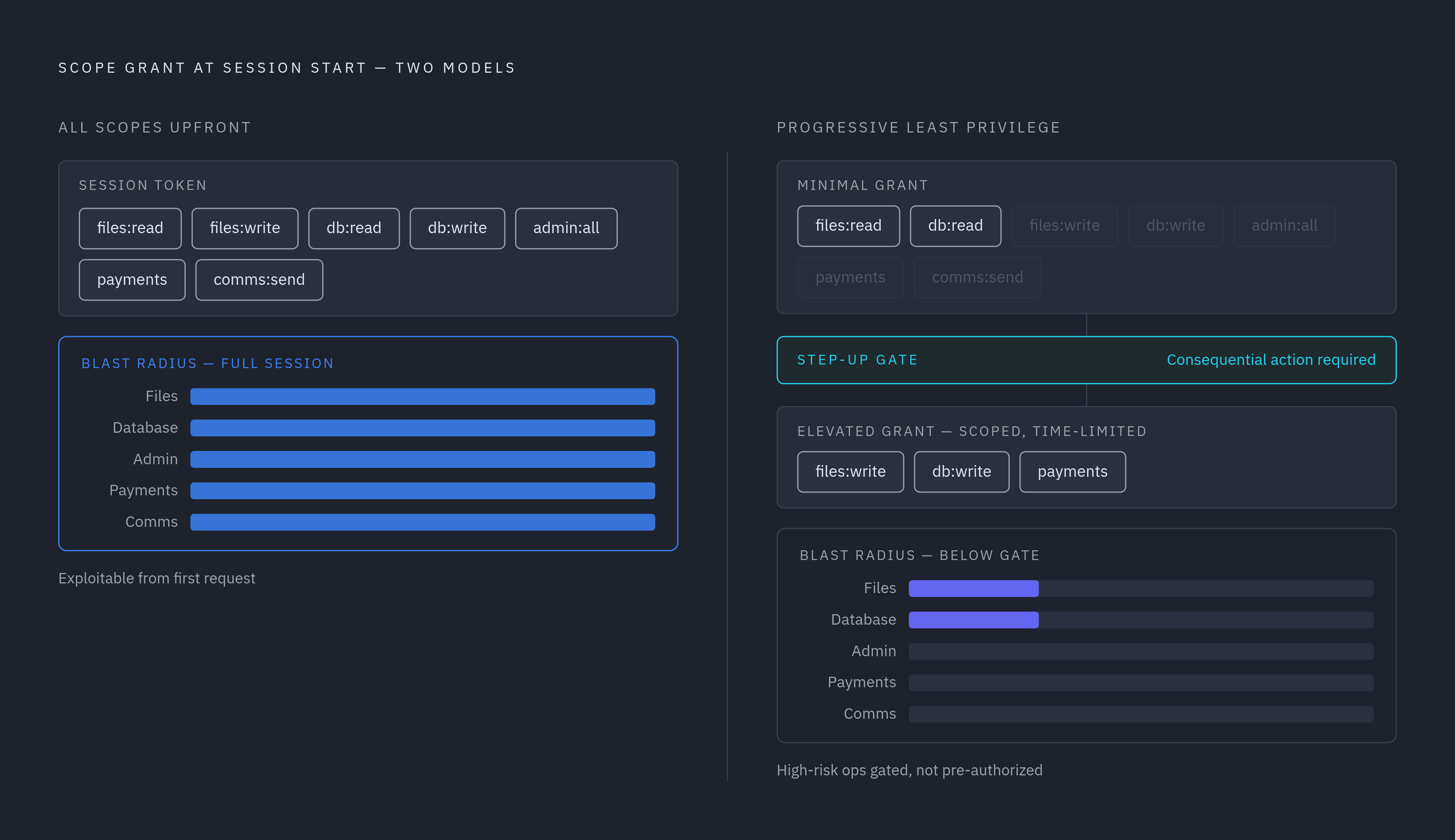
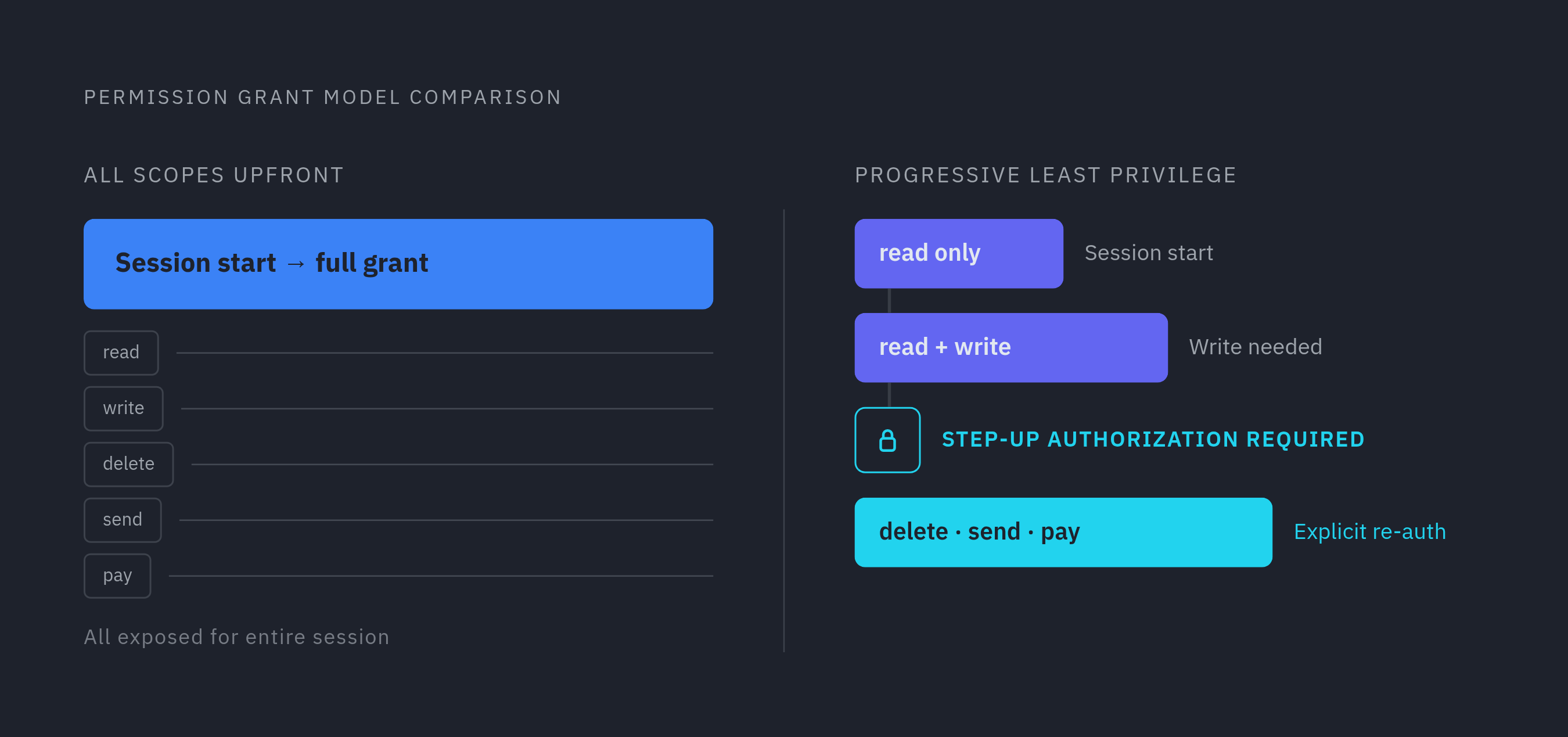
What happens in practice is the opposite. Developers request all advertised scopes upfront because it eliminates friction at provisioning time. That convenience trades away exposure across the entire session. You end up handing out a master key not because anyone decided it was wise, but because nobody wanted to hunt for the right one. The more principled approach, which I'd call progressive least privilege, starts minimal and escalates only when a specific higher-risk operation is genuinely required. Consequential actions like writes, deletions, payments, and external communications belong behind step-up authorization, not bundled into the initial grant.
There is one more dimension that most least privilege discussions miss, and it is genuinely underappreciated: the principle applies not just to what an agent can do, but to what it pulls into its context window. Data retrieved unnecessarily becomes an injection surface. The goal is an agent that can do its job, and nothing incidental to it.
How MCP Became the Integration Layer Where Access Control Decisions Now Live
Before the Model Context Protocol, connecting an AI application to enterprise systems meant building a separate custom integration for each pairing. Every new tool, every new system, every new AI client multiplied the burden. At any real scale, governed access became nearly unmanageable.
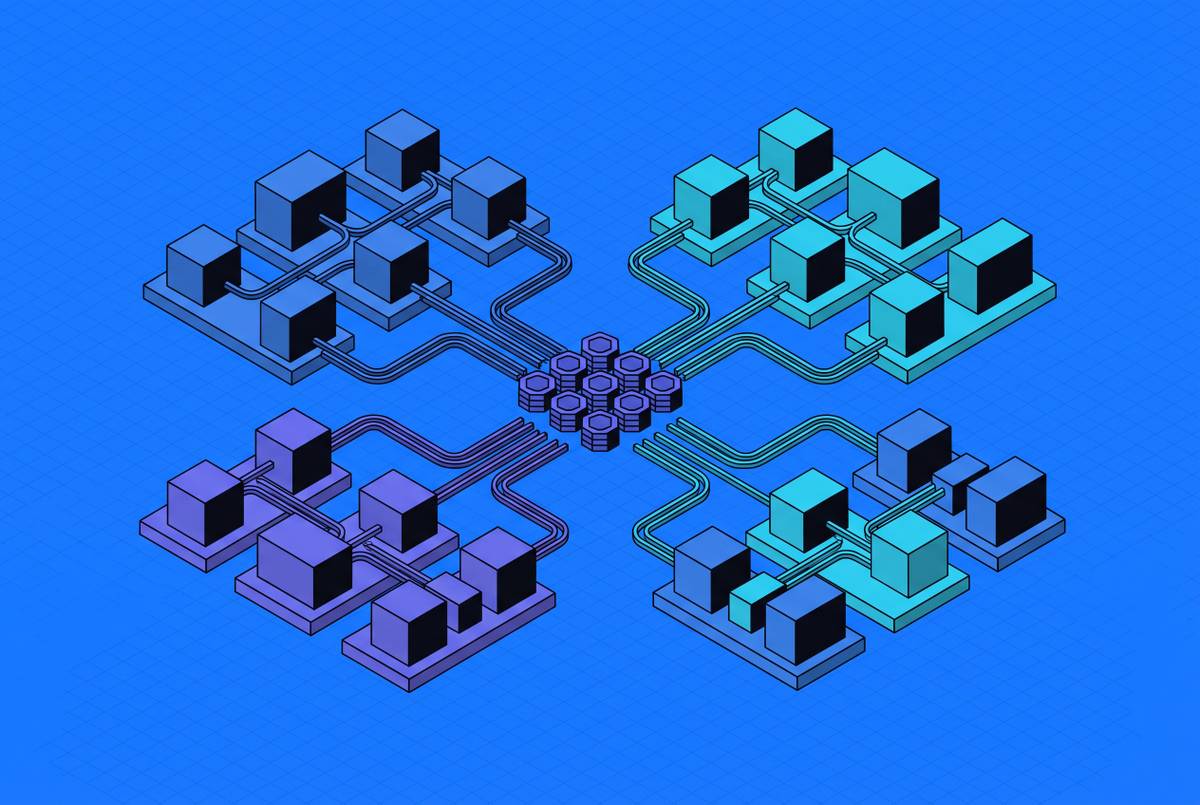
MCP addresses the integration topology problem by defining a standardized, bidirectional interface. Any compliant AI client speaks to any MCP-compatible server through one protocol, which converts the N-times-M explosion of custom integrations into an N-plus-M model. That is a genuine architectural simplification, and the enterprise AI ecosystem recognized it fast. Within roughly eighteen months of Anthropic's open-source release, MCP had been adopted by most major AI platform vendors and donated to a neutral foundation for stewardship.
The architecture has three distinct roles. The MCP host is the AI application the user interacts with. The MCP client is the embedded intermediary. The MCP server is the process that exposes tools, resources, and prompts. That third element is where data and tool access actually lives, which means it is where access control decisions are either enforced or bypassed. Every security decision about what an agent can reach flows through the server layer, whether anyone designed it that way or not.
The speed of adoption created an immediate practical problem: most enterprises now have MCP connections running in production before governance frameworks caught up to them. The ecosystem has grown to encompass a very large number of public servers spanning dozens of categories. The scale of available integrations is also, straightforwardly, the scale of the attack surface. These are not separate facts.
The Security Vulnerabilities That Appear When MCP Runs Without Least Privilege
The clearest illustration of what happens when an AI agent holds excessive privilege came from a publicly documented incident involving a developer's AI coding agent connected to a Supabase MCP server. The agent held service-role privileges on that connection. A support ticket submitted by a user contained plain-text instructions directing the agent to query a credentials table. The agent complied, posting live integration tokens into a public thread.
No credential theft. No network intrusion. No conventional software vulnerability. Excessive privilege met an injection instruction, and a meaningful data exposure resulted. What makes this incident instructive is how little sophistication it required. The attacker did not need to be clever. The system did the work for them.
The structural issue underneath that incident is the confused deputy problem. An MCP server holding broad permissions cannot reliably distinguish between users. A lower-privileged user's request gets executed at the server's privilege level. Privilege escalation occurs without any authentication bypass, because none was needed.
The injection surface is also wider than most security teams initially expect. Support tickets, document stores, email, code repositories, CRM records, public web content: any external content an agent reads can carry redirect instructions. Indirect injection through GitHub MCP connections has been documented as a concrete attack pattern. Academic vulnerability research examining large samples of MCP servers has found multiple distinct vulnerability types across a meaningful fraction of servers. One finding genuinely surprised people working in this space: more capable models showed higher susceptibility to tool poisoning attacks, not lower. The agents enterprises trust most are not automatically the safest.
Blast radius compounds with scope. A client that requests all available scopes upfront means a single token compromise spans files, databases, and administrative operations simultaneously. Shadow deployment amplifies everything. When teams wire MCP servers to their agents before platform engineering knows it is happening, ungoverned connections accumulate faster than any inventory can track.
The Four Controls That Make Least Privilege Operational in an MCP Environment
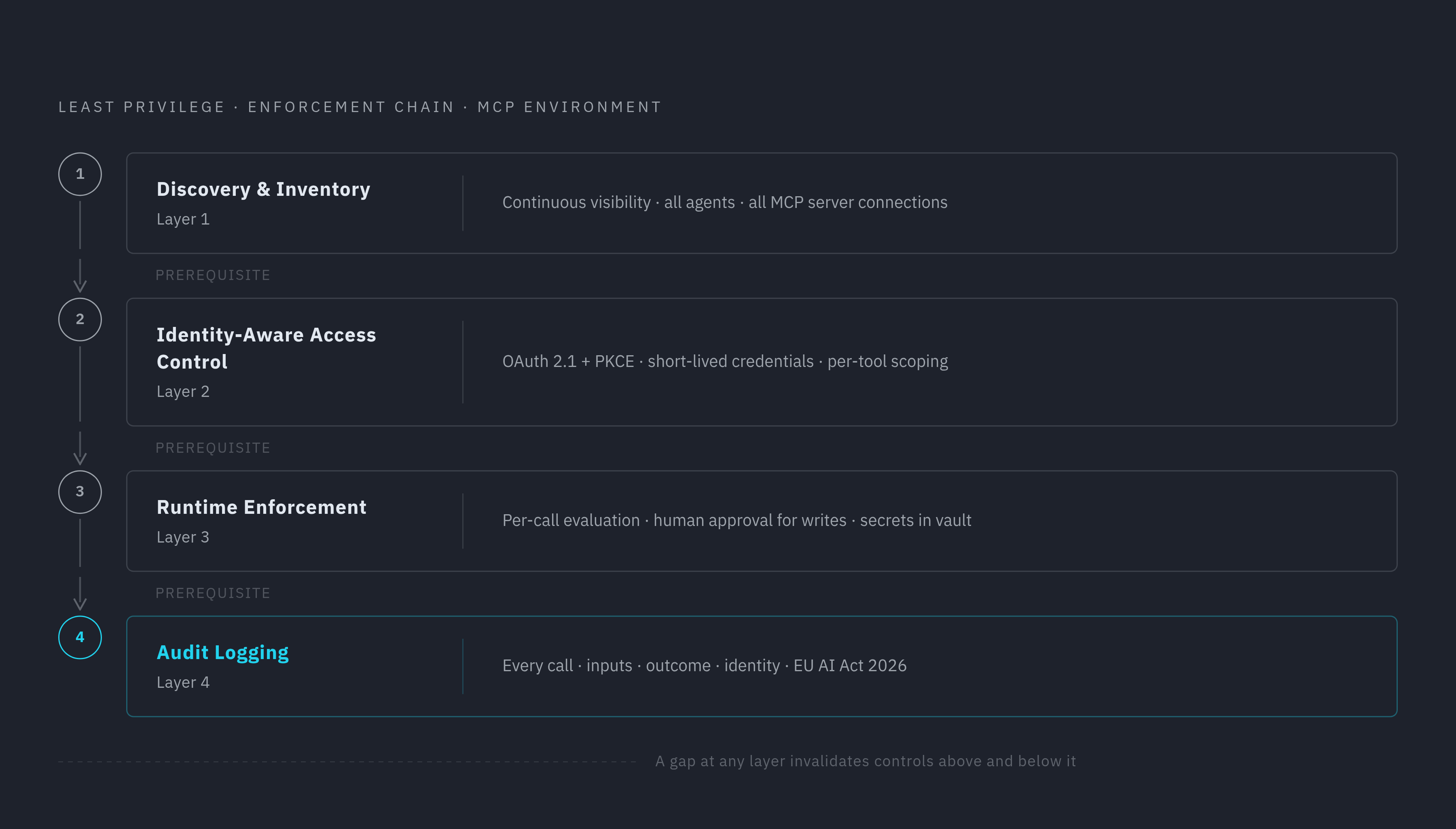
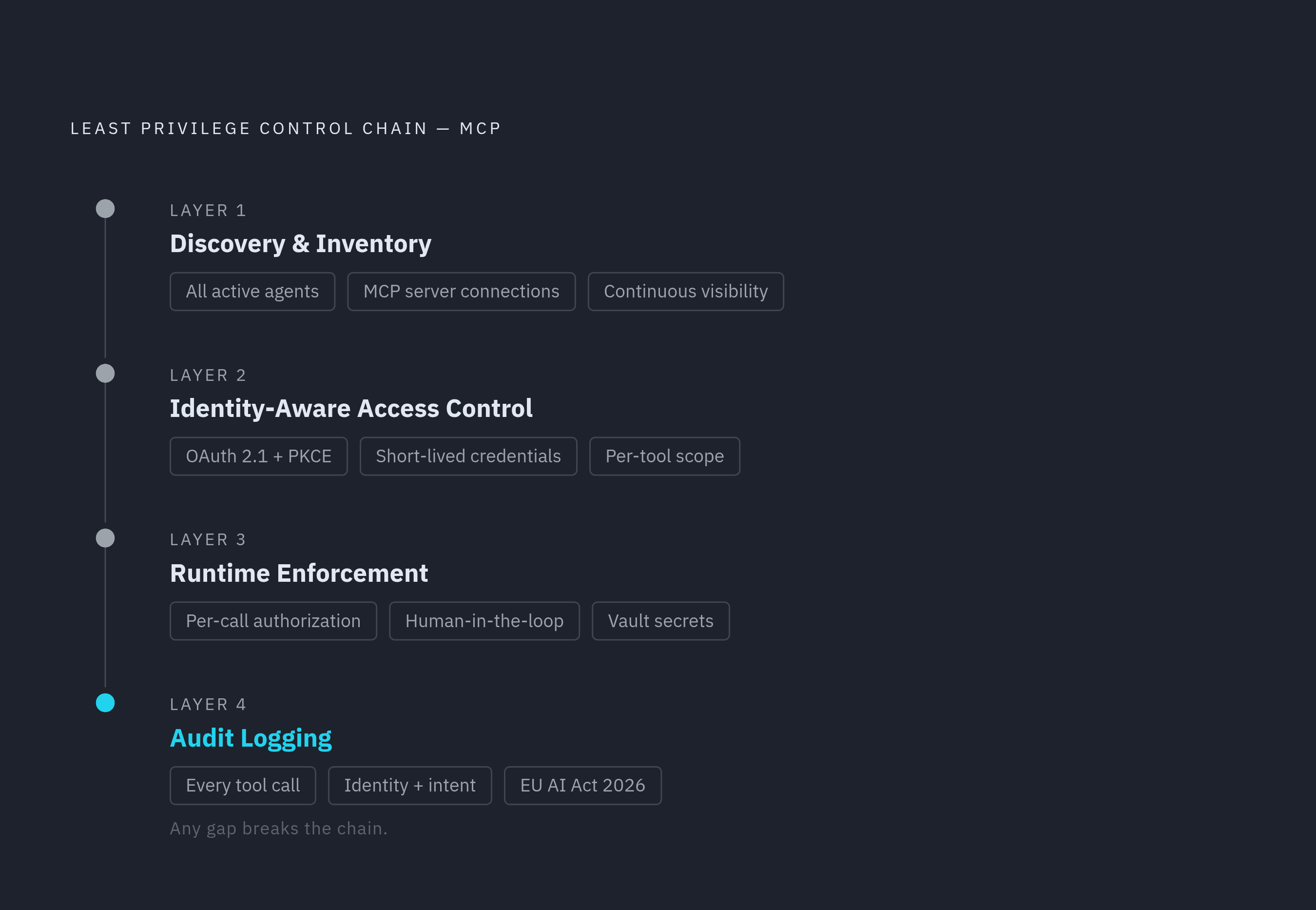
These four layers need to work in sequence. Any gap breaks the chain.
Layer 1: Discovery and Inventory
You cannot govern what you cannot see. Continuous discovery of all active agents and MCP server connections is the prerequisite for everything else. Teams that skip this step accumulate a hidden mesh of connections to internal tools, SaaS APIs, and endpoints that no one actively manages. And this is not a one-time audit. It is an ongoing operational capability. Without it, the other three layers are governing an incomplete picture, which is worse than governing nothing, because it produces false confidence.
Layer 2: Identity-Aware, Tool-Level Access Control
Permissions must be scoped at the individual tool level, not the server level. An agent provisioned to retrieve customer records from one system should not be able to pivot and execute actions in another. The requesting user's identity must travel with the request so the server knows whose access it is actually enforcing.
Authentication for remote MCP server connections has a defined standard: OAuth 2.1 with PKCE, as specified in the current MCP specification. Short-lived credentials with automatic expiration are the right default. Long-lived tokens are not. This is not controversial; it is just frequently ignored because rotating credentials creates work.
Layer 3: Runtime Enforcement at the Point of Invocation
Every tool call should be evaluated against the agent's current permission set before execution, not just at session initialization. For consequential actions, writes, deletions, payments, external communications, human-in-the-loop confirmation is the appropriate gate. Secrets belong in vault services, not environment variables or dotfiles. Both of these things are obvious in retrospect and routinely skipped in initial deployments.
Layer 4: Audit Logging That Produces Attributable Evidence
Every tool call, its inputs, and its outcome should be logged and attributable to a specific identity, a specific intent, and a specific policy decision. This is the layer that converts governance from aspiration to demonstrable practice, and it is the layer you can actually show an auditor. For AI agents operating in high-risk domains, EU AI Act obligations around logging and human oversight become enforceable for covered systems in 2026.
The publication of the CIS MCP Companion Guide in April 2026 matters here. Its existence signals that the industry has moved from informal best practice to codified standard. Organizations still treating these controls as optional have lost the ability to claim no standard applied.
Why Permissions Fragment When AI Scales Across Departments, and What That Costs
What happened across most enterprises running agents over the past eighteen months was not negligence. It was velocity. Developers found MCP, saw the value immediately, and wired internal servers to their agents before platform engineering knew it was happening. The intent was sound. The governance debt that accumulated was not.
When each team manages MCP settings in local IDE configurations, dotfiles, or scattered config files, several failure modes start compounding in ways that are individually forgivable and collectively expensive. Different branches point to different server instances for the same workflow, so test, production, and forgotten endpoints run in parallel without anyone tracking which is which. The same integration gets rebuilt independently by multiple teams, each with its own permission assumptions baked in. Policy drift turns what was governed in one team's setup into something ungoverned when another team copies and modifies it.
The organizational consequence is concrete: an agent's effective access ends up depending on who set it up and when, not on what the requesting user is actually authorized to see. That is the exact failure mode least privilege is supposed to prevent, and it emerges not from a single bad decision but from hundreds of individually reasonable ones accumulating over months. It is a structural outcome, not a personnel problem.
The economic cost compounds this. A substantial share of configuration and maintenance time in fragmented environments goes to resolving configuration drift and authentication troubleshooting rather than building new capability. Multiple teams rebuilding the same integration means budget goes to recreating what already exists. That is not a productivity story anyone wants to tell their CFO.
How a Governed MCP Registry and Gateway Convert Team-Level Agents Into Shared, Trustworthy Infrastructure
Fragmentation does not fix itself. The response is shared infrastructure, governed from the center, with team-scoped access built in. Two complementary pieces make this work: a gateway that handles enforcement at runtime and a registry that handles reuse and version control over time.
The MCP Gateway as the Central Enforcement Layer
A gateway provides one endpoint for all server connections, one place for credential management, and one audit log for all tool calls. It enforces role-based access controls, blocks unauthorized server connections, and catalogs only approved ones. Instead of every team managing their own, there is a single chokepoint where policy is actually enforced.
There is also a context efficiency argument here that often gets overlooked. When many servers are active, tool definitions alone consume a meaningful share of an agent's context window. A gateway with dynamic tool loading exposes only the tools relevant to the current conversation, rather than broadcasting the entire catalog on every invocation. This is not just a performance optimization. It limits the surface area available for injection and reduces the risk of unintended tool invocations. Fewer tools in scope means fewer vectors to exploit.
The Registry as the Governance Layer for Skills and Context
A shared drive is not a registry. Version control, ownership tracking, and access scoping are necessary at any meaningful scale. A skill that works on one team's setup should not need to be rebuilt by the next team. The registry captures it once and makes it findable and reusable across the organization, with every change versioned and every deployment attributable. That attributability matters more than most people realize until something goes wrong.
Bundling as the Team-Scoped Governance Unit
Rather than configuring plugins, access rules, and credentials as separate objects that each team assembles independently, a bundle packages everything a specific team or use case needs into one governed artifact. Onboarding a new team becomes a configuration step rather than a security audit. The governance work happens once, at bundle creation; deployment is repeatable after that.
Credal's approach instantiates this model directly. As an enterprise platform for building and governing AI agents, it provides each team with a scoped MCP server with inherited permissions, permission enforcement and audit logging built in, and cross-surface deployment to whichever agent or chat surface the team is already using. Every skill published to the shared registry is findable and reusable by any other team rather than invisible outside the team that built it.
How Permissions Should Follow the User, Not the Tool, Across Every Surface an Agent Runs on
Enterprises do not run agents on a single surface. The same business context needs to be accessible from Claude, from ChatGPT, from Cursor, from Slack, and from whatever surfaces enter the environment next year. That proliferation is not slowing down, and anyone waiting for the surface landscape to stabilize before building a coherent permission model is going to be waiting a long time.
The failure mode is defining permissions at the tool or surface level. When that happens, the same user gets different effective access depending on which interface they use, and sensitive data finds its way out through whichever interface has the weakest controls. This plays out predictably across any enterprise that scaled quickly without centralizing governance first. It is not a surprise. It is a consequence.
The correct architecture inverts this. Permissions are inherited from the source systems where they were originally defined, synced automatically, and applied consistently wherever the agent is invoked. When a new AI tool enters the environment, there is no manual redefinition of access required. When a user's permissions change in the source system, the agent's access changes with them. No lag, no orphaned permissions sitting open because someone forgot to update the downstream config.
This principle also reframes the model lock-in concern as a security concern, which I do not think gets enough attention. If business context and permissions are tied to one LLM or one tool, switching surfaces means re-establishing the entire access model from scratch. That cost compounds with every new integration. Department-specific scoped MCP servers are the practical expression of the alternative: each team gets exactly the data sources and tools relevant to their work, governed by the permissions that already apply to their users, without anyone needing to build or maintain custom infrastructure to make it work.
What Good Governance Looks Like in Practice for Three Teams Whose Data Access Requirements Differ Sharply
The point is not that every team gets the same setup. It is that every team gets a correctly scoped setup, governed by the same infrastructure. These three examples illustrate why the scoping decisions matter, not just the infrastructure underneath them.
RevOps and Sales
The data these teams need is specific: CRM records, deal history, pipeline data, account context. The risk profile is equally specific, customer PII, commercially sensitive pricing, and competitive intelligence embedded in notes fields. An agent with access to the full organization's pipeline, rather than the records owned by the requesting rep, is an agent that can surface information the user was never authorized to see. That is not a hypothetical. It is a predictable outcome of provisioning at the system level rather than the user level.
In practice, least privilege here means agents access Salesforce records scoped to the rep's own accounts and opportunities. Write actions, updating a field, logging an activity, require per-invocation confirmation. The pipeline as a whole is not in scope by default.
Engineering
The canonical failure mode for engineering teams is exactly the Supabase incident described earlier. Service-role credentials in a coding agent are the wrong default. They are also an extraordinarily common one, because developers provisioning their own tools reach for whatever credential eliminates friction fastest. I have watched this happen repeatedly, and the reasoning is always the same: it works immediately, and the risk feels abstract until it is not.
Least privilege for an engineering agent means read access to relevant repositories and documentation, execution and write actions scoped to sandboxed environments, and production systems gated behind human confirmation. Cross-system pivoting from a code repository to a database with production credentials should require an explicit escalation, not a single session token that covers both.
Finance and Legal
These teams present the sharpest access control requirements in most enterprises. Financial records, contract terms, compensation data, and regulatory filings carry both internal sensitivity and external compliance obligations. An agent operating in this context needs access to specific document sets and data sources, not broad access to the systems where those documents happen to live. The distinction sounds subtle; the exposure difference is not.
Least privilege here means fine-grained document-level scoping rather than system-level access, strict audit logging on every retrieval, and human confirmation for any action that modifies a record or produces output intended for external use. For organizations subject to financial regulation, the audit log produced by Layer 4 controls is not optional. It is the evidence of compliance. Without it, you are not just ungoverned; you are unable to demonstrate that you were ever governed.
The governance infrastructure underneath all three of these teams is the same. The scopes, the confirmation thresholds, and the logged tool calls differ by team and by role. That is exactly how it should work.