Agentic Code Review Workflows for Engineering Teams
AI agents handle code's repetitive work while humans focus on intent and judgment.
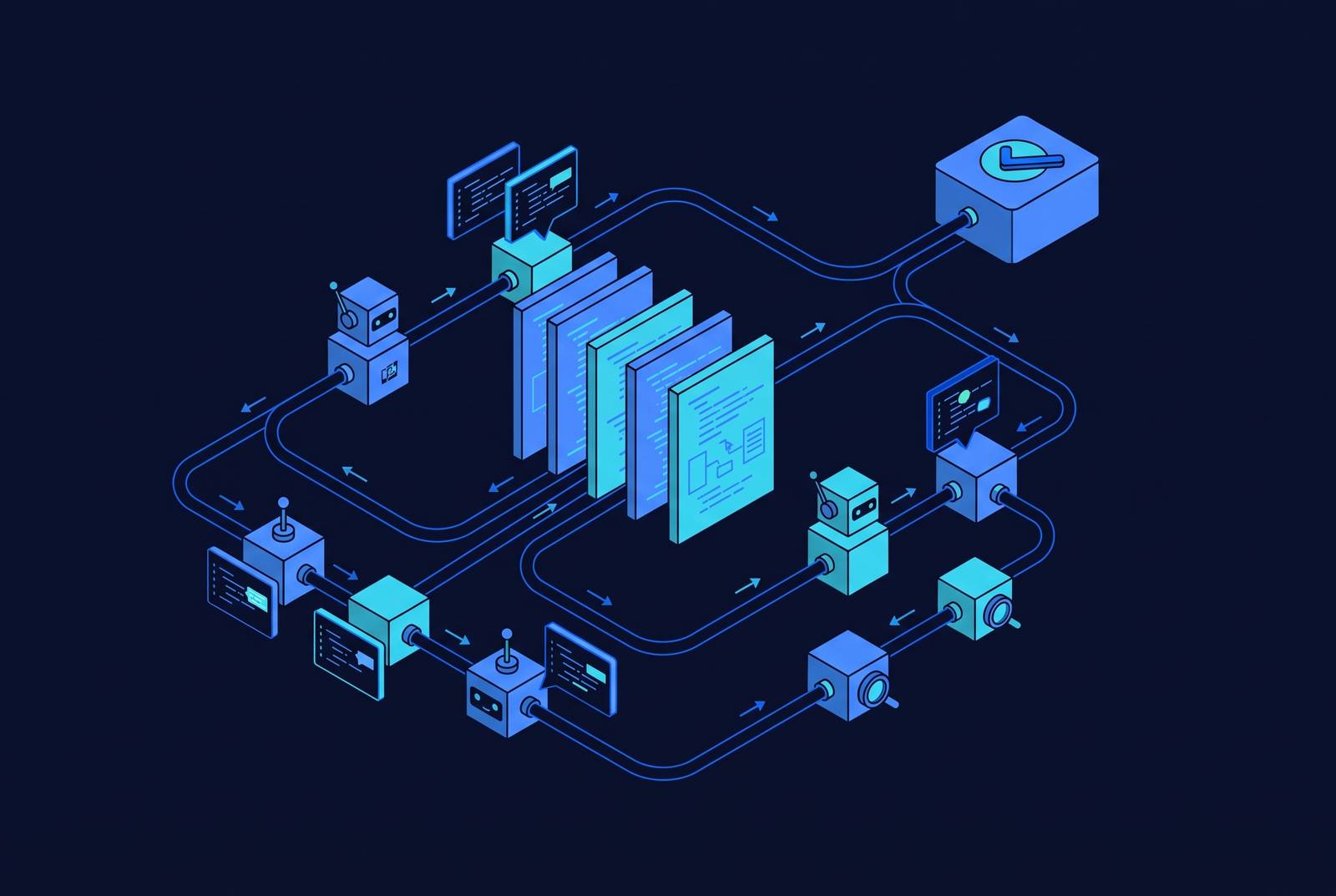
Agentic code review is a closed loop, not a smarter linter sitting on top of your existing process. An AI agent plans a change, reads the codebase for context, edits files, runs tests, watches what happens, fixes what broke, and opens a pull request. A human engineer sets the intent at the start and signs off at the end. Understanding that loop, step by step, is what makes the rest of this piece useful: governance, registries, and identity providers only make sense once you know what they're governing.
The Agentic Code Review Loop, Step by Step
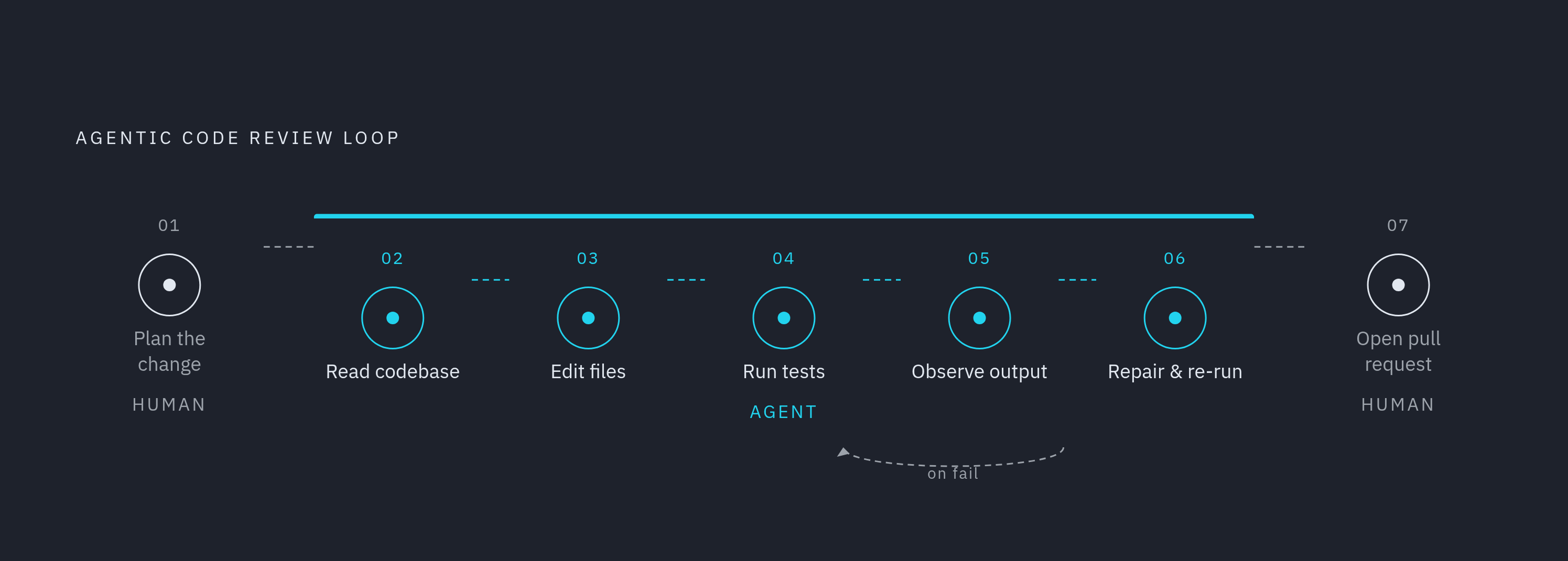
The loop replaces the single prompt as the basic unit of engineering work. In the agentic loop, each step produces an outcome you can observe and check, not just a suggestion to accept or reject.
The sequence runs in order. First, the agent plans the change: it decides what needs to happen and in what order. Fifth, it observes the output, pass or fail, and reads the failure messages if there are any. Sixth, if something broke, it repairs the failure and runs the tests again. Seventh, once the change is stable, it prepares a pull request and opens it for human review.
What changes for the human engineer is where the labor goes. The mechanical middle, reading context, editing, testing, fixing, belongs to the agent. That shift is structural. It changes what a reviewer's time is spent on, and it's why the next section matters: code review was already the bottleneck before any of this existed.
Why code review became the pressure point
AI tools made writing code faster. They did not make reviewing code faster, and that mismatch is the whole story. Teams generate pull requests at a pace their review process was never built to absorb, so the queue between commit and merge grows, and senior engineers end up absorbing that growth as manual review hours.
A standard set of engineering metrics tells the same story from a different angle. Those two numbers moving in opposite directions, even as code gets written faster, is a sign that the constraint shifted. Writing code was never the limiting step. Reviewing it is.
A structural problem needs a structural answer, not a faster model or a better prompt. The response that's emerged is a multi-agent review architecture: several specialist agents run in parallel against the same diff, each in its own session, none waiting on the others. One agent checks design and structural concerns. One checks security, looking for vulnerabilities and unvalidated input. One checks testability and edge case coverage. They don't take turns. They run at the same time, against the same code, and hand their findings back independently. That parallelism is what makes the loop scale, and it also makes the infrastructure underneath it, the subject of the next section, non-negotiable.
MCP makes the loop technically viable at enterprise scale
Running specialist agents against a live codebase means those agents need to talk to a lot of systems: version control, CI pipelines, issue trackers, security scanners. Without a shared standard, every agent needs its own custom connector to every one of those systems. That's a combinatorial problem. Adding a new agent or a new system makes the number of connectors you need grow fast.
The Model Context Protocol solves that by giving every MCP-compatible client a standard interface to every MCP-compatible server. Instead of building a connector for each pairing, a team builds one server per system, once, and any MCP-compatible agent can use it. That turns a combinatorial integration problem into a linear one.
For a code review loop running several specialist agents in parallel, this means no one needs to manage shared session state across all of them.
A few details make that practical. Method and tool names now travel in HTTP headers, so a gateway can route, rate-limit, or authorize a request just by reading the header, without parsing the body. The stateless model holds the whole way through.
All of that is infrastructure the reviewer never sees. But it's the reason the loop from the first section can run at the pace and scale a real engineering org needs. What it doesn't solve is what happens when several teams start running that loop with different assumptions about what "the codebase" means.
Context fragmentation is the hidden failure mode when teams adopt this loop
The failure that actually breaks multi-team adoption is quieter than a security breach or a broken pipeline: agents produce pull requests that ignore team conventions because the context those conventions live in was never loaded into the agent's working set. The PR looks fine on its own terms. It just doesn't match how the team actually writes code, and someone has to go clean it up.
That problem gets worse the moment an organization uses more than one AI coding assistant at once, which most do. A convention one team carefully encodes into their setup is completely invisible to the next team using a different tool, even on the same codebase.
The cost of that gap is not small. Developers end up spending real hours every week reconciling code that technically works but doesn't follow the rules their team actually uses, hours that would disappear if the context were shared.
Shadow AI makes the fragmentation worse. That's the setting where the real risks show up: tool poisoning, unauthenticated or rogue servers, permissions scoped too broadly, and tools nobody is tracking the lifecycle of. Fragmentation, not malice, is the root cause. The fix is a governance layer that makes context something teams share deliberately.
What a governed MCP registry does beyond a shared drive or public directory
A public directory of MCP servers is useful for discovery and nothing else. It doesn't check who's allowed to use a given server, doesn't keep an audit trail, doesn't validate that a community-built server is safe, and can't host a private internal tool. It's a catalog, not a governance layer, and treating it like one is how shadow AI gets a foothold.
Put together, those turn a simple list of servers into something a compliance team can actually point to.
For each server in the registry, the organization needs to track who owns it, whether it's approved, what tools it exposes and what those tools' schemas look like, its version history, the permission scope attached to each tool, and which teams or agents are allowed to call it. The registries scale best when they're organized by job function rather than by vendor: a frontend developer's registry holds frontend-relevant tools, an analyst's registry holds analytics tools, and neither one loads the other's tools into context. That keeps each agent's working context lean and relevant to the work it's actually doing.
The operational version of this looks like an MCP gateway sitting in front of an internal registry of approved servers. Admins distribute a controlled set of servers to a team rather than configuring each server for each person individually. When someone changes roles, updating their identity provider group membership is enough to update what they can reach. Users assigned to one registry simply don't see the servers in another registry, which is both a security boundary and a way of keeping context clean.
Centralized authorization through the identity provider removes the per-server consent bottleneck
The standard approach to authorization, per-user and per-server OAuth consent, doesn't hold up once an organization is running dozens of MCP servers.
The Enterprise-Managed Authorization extension, stable since mid-2026, replaces that per-server prompt with a single sign-on flow. A user authenticates once through the organization's identity provider and inherits access to every server the organization has approved for their role. No repeated consent screens, no accumulating list of one-off grants.
That moves authorization policy out of individual negotiations between an employee and a server and puts it in one place: the identity provider. Okta is the first identity provider to ship EMA support, and as of mid-2026 it remains the only one generally available, with Microsoft Entra, Keycloak, and others still in progress. Anthropic has built EMA support into its shared MCP layer across Claude, Claude Code, and Cowork, and Visual Studio Code has added support directly in the IDE.
There's a distinction here that matters more than it looks like it should. It does not inspect or authorize the individual tool calls that happen after that connection is established. That means the identity provider handles the front door, but what an agent actually does once it's inside a system still needs its own runtime controls.
In practice, that means a read-only analysis agent and a production deployment agent shouldn't share an MCP server connection, even if both are technically covered under the same EMA policy. Scope separation belongs at the connection level, not somewhere downstream. EMA solves the access problem. What happens after access is granted is a separate design decision, and it's the one that carries into how teams deploy this across multiple tools.
Deploying the same governed context across Claude, Cursor, and Slack without rebuilding it each time
Engineering work doesn't happen in one tool. Code review touches IDE-embedded agents, command-line agents, chat tools, and issue trackers, often within the same hour. For the governance described in the last two sections to mean anything, it has to travel with the engineer across all of those surfaces, not get reconfigured separately for each one.
The registry is what makes that portability possible. A skill or context source registered once is available to any MCP-compatible surface the engineer is authorized to use. Nobody has to re-encode the same team conventions into five different tool configurations just because the team uses five different tools.
Cursor for Slack is a concrete example of the pattern. The same MCP-governed context that works in the IDE appears in a chat surface because the registry, not the tool, is where that context lives.
A skill built once in an engineer's IDE shouldn't have to be rebuilt for the next team's Slack bot or the security team's CLI agent. The registry captures the skill, scopes it to whoever's authorized to use it, and makes it available anywhere that authorization reaches. That's what turns one team's setup work into something the whole organization benefits from, matching the pattern seen in production deployments that have shipped this.
What teams that have shipped this in production did differently
The organizations that have gotten agentic workflows running in production share a pattern: they treated context governance and permission inheritance as infrastructure to build before scaling, not as cleanup to do afterward. And they provisioned access by team, not by individual.
Block, the company behind Square, rolled out MCP company-wide using the Goose agent, with most of its servers built in-house. Building in-house meant Block controlled tool definitions and permission scopes from day one, and the payoff showed up in a dramatic reduction in token usage, evidence that well-scoped context isn't just more governable, it's more efficient to run.
Without persistent sessions to maintain for every agent, the platform could scale that workload without the infrastructure cost scaling alongside it.
Salesloft opened live revenue data, pipeline, deals, accounts, call recordings, to MCP-compatible assistants including Claude, ChatGPT, Microsoft Copilot, Gemini, and Salesforce Agentforce. The decision that made that safe was keeping access read-only. That's connection-level scope separation applied to a genuinely sensitive data domain, and it's the same principle described earlier applied at real stakes.
Across all three, the governance decisions, what a server is allowed to do, who can reach it, what scope it runs at, got made at design time. That ordering is the whole argument, and it's exactly where most teams trying to copy this get it backwards.
How to order the implementation sequence correctly
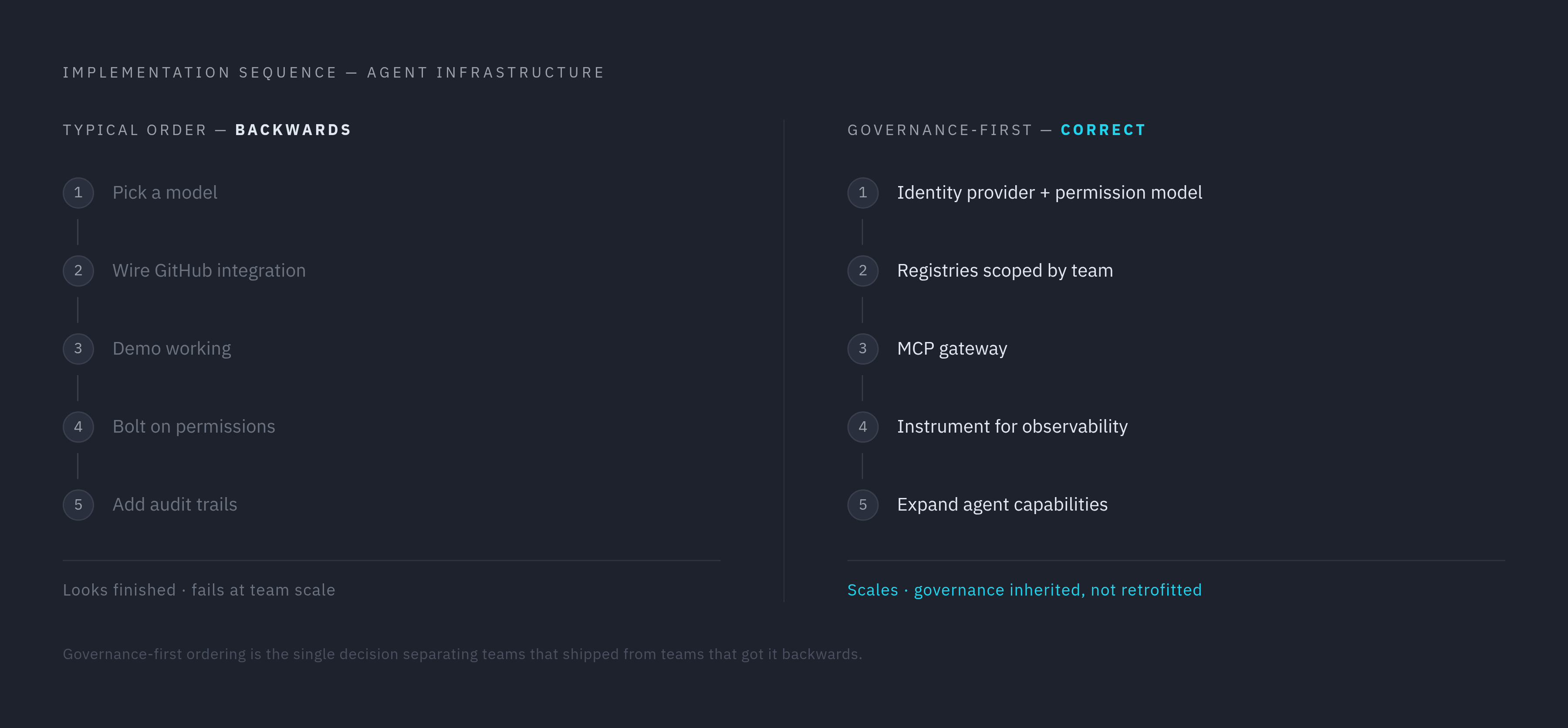
The most common mistake is starting with the agent itself: picking a model, wiring up a GitHub integration, getting a demo working. That produces something that looks finished. It fails at team scale because context, permissions, and audit trails get bolted on after the fact.
The right order runs the other way. Start by defining the identity provider and the permission inheritance model, deciding which groups map to which registries. Fifth, instrument for observability before expanding what the agent is allowed to do.
Provisioning should follow the same discipline from day one: give access by team through an MCP gateway and an internal registry, not server by server to each person. That way a role change is a single identity provider group update, not a round of individual reconfiguration.
Every server in the registry needs a real deprecation path. The July 2026 spec sets a twelve-month minimum deprecation window for the protocol itself, a pattern organizations should mirror for their own registered servers. Platform teams should be able to switch off any server in the registry without touching a single agent's configuration, which is the control that keeps shadow AI from becoming a permanent fixture.
MCP does add baseline latency that makes it a poor fit for microsecond-critical paths, which is a reason to place the agentic review loop as an intelligence layer sitting alongside critical systems, not embedded inside them.
Once the registry and the identity layer are both in place, something changes about how work compounds across an organization. A skill one squad builds, a PR summary template, a security scan configuration, an architectural review prompt, becomes available to every other squad without anyone rebuilding it. Doing the governance work first pays off because one team's effort becomes something the whole organization owns.