How to Secure an MCP Server in a Production Environment
Model-driven tool access breaks traditional API security and demands a layered defense.
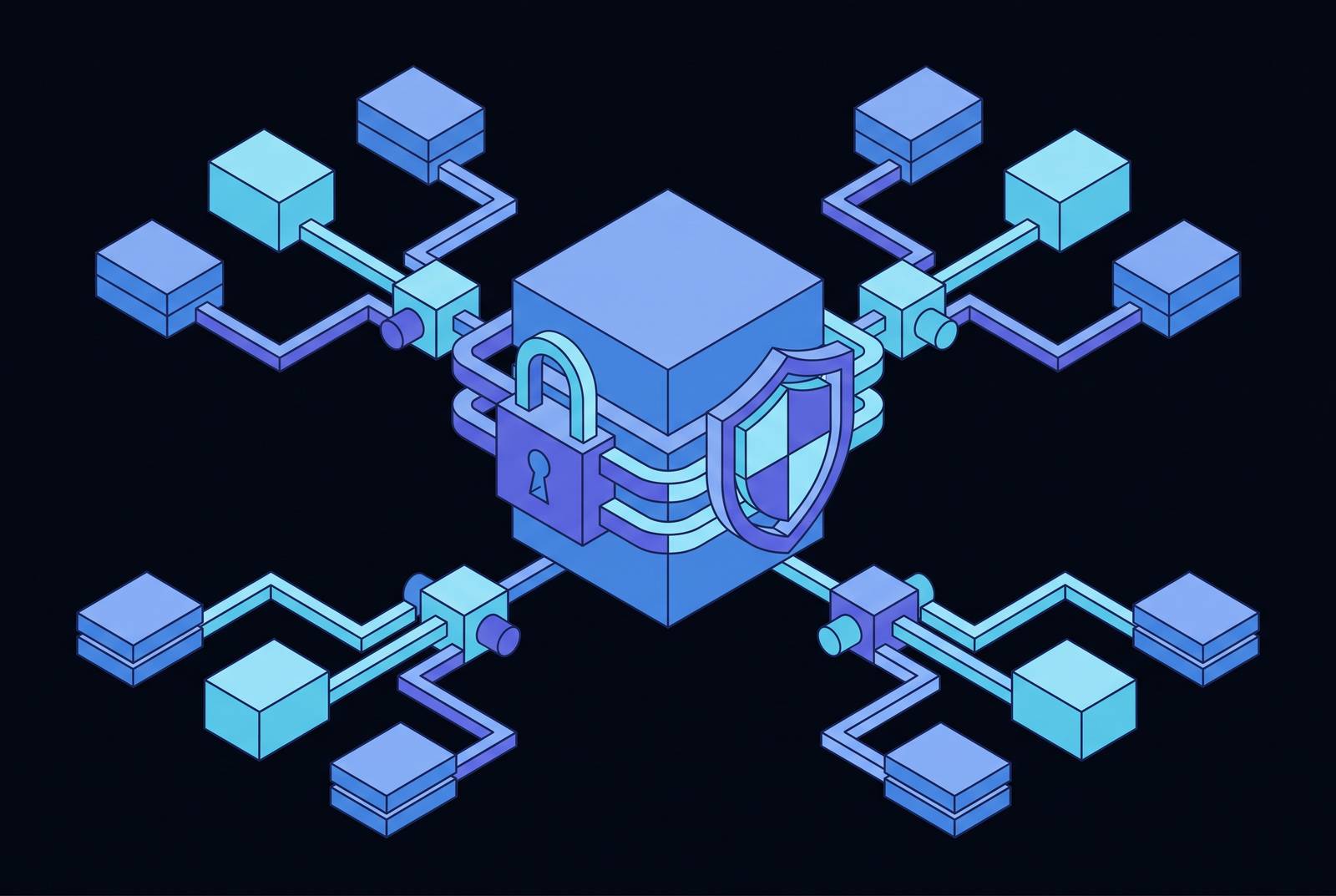
MCP servers give AI agents real access to real systems, and that access is decided at runtime, not written into fixed code paths ahead of time. The model looks at a tool description, decides to call it, and shapes the payload itself. That single design choice breaks the assumptions traditional API security was built on, and it's why securing an MCP server in production takes a layered approach: authentication, transport encryption, permission scoping, sandboxing, and audit logging, each one closing a gap the others can't touch.
Here's why the old playbook doesn't transfer cleanly. Conventional API security assumes a known caller, a known payload shape, and a known sequence of calls. MCP has none of that. The "caller" is a language model reasoning over a menu of tool descriptions. The payload is whatever that reasoning produces. The sequence of calls emerges from the conversation, not from a script someone reviewed and approved. That gap opens up threats that are specific to MCP, not just generic API risk wearing a new hat:
Prompt injection: adversarial text buried in retrieved data can hijack the agent's next move, turning a document lookup into an unauthorized action. Tool poisoning: a tool's description lies about what it does. A "weather lookup" tool quietly exfiltrates system logs while returning a forecast, and the model has no way to know the description was dishonest. Confused deputy: an agent cleared for one action gets talked, via a crafted prompt, into taking a different and more damaging one, using credentials it legitimately holds. Session hijacking and token passthrough: credentials that travel with the agent can be intercepted or replayed, and once they are, they carry the agent's full authority with them.
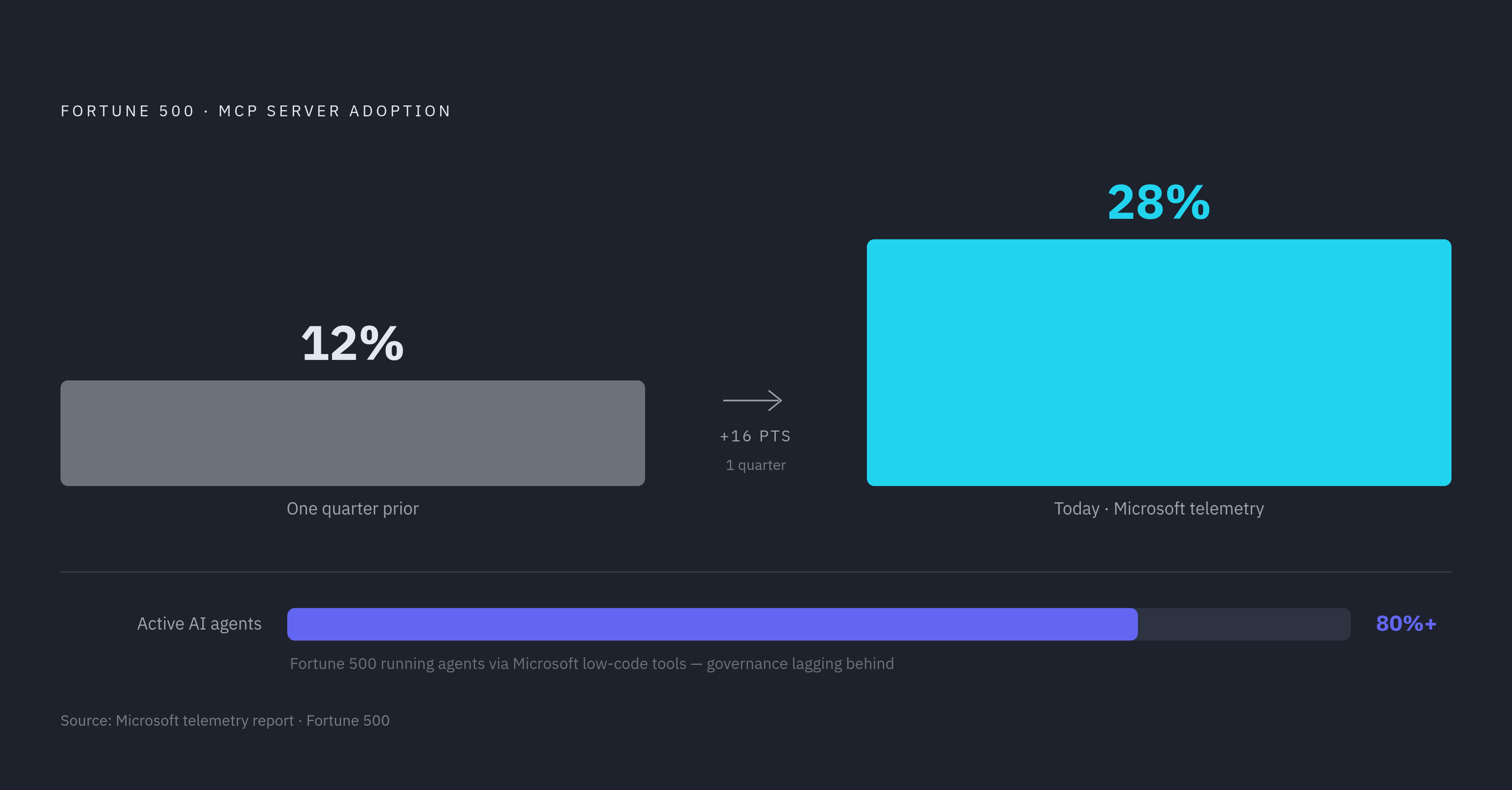
Security research on the MCP ecosystem has found vulnerabilities in 7.2% of servers, with 5.5% showing MCP-specific tool poisoning, the kind traditional static and dynamic analysis tools weren't built to catch. Meanwhile adoption has run well ahead of governance: Microsoft's own telemetry shows more than 80% of Fortune 500 companies running active AI agents built with its low-code tools, and 28% have already stood up MCP servers, a figure that itself more than doubled from 12% recorded a quarter prior. That's infrastructure getting built faster than anyone's writing the rules for it, a pace far beyond gradual rollout. That's infrastructure getting built faster than anyone's writing the rules for it.
Authentication: establishing who, and what, is allowed to connect
Earlier versions of the MCP spec made servers act as both resource server and authorization server at once, which is a tidy idea until you try to operate it. The June 2025 revision split the roles: MCP servers are now classified as OAuth Resource Servers, and authorization gets delegated to a dedicated auth server. Cleaner separation, fewer places for the logic to get tangled.
The current specification, version 2025-11-25, sets the floor for remote servers. OAuth 2.1 is required for authorization servers wherever authorization is supported over HTTP-based transports, though authorization itself remains optional and conformance for HTTP implementations is a SHOULD rather than a MUST. PKCE, Proof Key for Code Exchange, has to be enforced for every client, public or confidential, to close off authorization code interception. And self-signed certificates are off the table in production at any maturity level: TLS 1.2 or better, with certificates from a real, recognized certificate authority, is the baseline, not an aspiration.
Local servers get their own rule that's easy to overlook: the server process has to validate the identity of whatever's connecting to it and reject anything unauthorized. Running locally just means the same question is being asked at a shorter distance, not that the connection is trusted by default. It means the same question, just asked at a shorter distance.
Then there's the credential math, which gets ugly fast. Every MCP connection spins up its own credential, an API key, an OAuth token, a database connection string, a service account secret. A team running a modest fleet of agents, each hooked into a handful of servers, ends up with a pile of credentials that each need their own provisioning, their own rotation schedule, their own expiration. Best-practice guidance is consistent on this point: secrets belong in a dedicated vault, with environment variables discouraged as a storage mechanism for sensitive credentials. Short-lived tokens scoped tightly to one service, rotated automatically, keep the damage contained if one of them leaks.
Authentication answers one question and stops there. It tells the system who's connecting. It says nothing about what that identity is then allowed to do, and that's a different layer entirely.
Transport security: protecting the channel that carries every tool call
MCP moves data over JSON-RPC 2.0, using HTTP-based transports for remote connections or stdio for local ones. Whatever's flowing through that channel is either protected in transit or it isn't, and there's no partial credit.
Production minimums aren't complicated: TLS 1.2 at the floor, TLS 1.3 where possible, on every remote connection, with certificates issued by a recognized authority. The MCP spec itself doesn't mandate transport security at the protocol level, which is worth knowing, but industry practice and every serious security review treat it as non-negotiable anyway. Self-signed certificates leave a verification hole an agent can't close on its own: it has no reliable way to confirm it's actually talking to the server it thinks it's talking to, which opens the door to a man-in-the-middle sitting quietly between the two.
This matters more for MCP than it would for a typical API, because tool responses don't just get consumed and discarded. They flow straight back into the model's context window and shape what it does next. An intercepted or altered response doesn't just leak data, it can steer the agent's next several decisions. The attack surface extends to the reasoning downstream of the data in transit. It's the reasoning downstream of it.
Segmentation backs up the encryption. MCP servers shouldn't be sitting on the open internet unless the use case genuinely demands it, and keeping them behind a private network boundary cuts down on who can even attempt a connection. Security reviews have flagged live MCP servers running with no authentication at all, a recurring finding across multiple assessments of the ecosystem. Open network exposure on top of that isn't a minor oversight, it's a second failure stacked on the first.
Least-privilege scoping: limiting what an authenticated agent can do
An agent cleared to read calendar events shouldn't be able to write CRM records just because nobody bothered to draw the line. Permissions need to track the actual task in front of the agent, not the broadest set of actions someone imagined it might eventually need.
That principle plays out differently depending on the environment. In development, wider scopes are often fine, since seeding test data and iterating on workflows benefits from a looser leash. In production, though, read-only should be the default state, and any write operation should sit behind an explicit approval step rather than getting granted the moment a connection opens. The same agent binary shouldn't carry an identical permission set across that boundary. If it does, someone skipped a step.
Certain actions call for a human in the loop, full stop. Writes to customer data, outbound communications, anything touching money, these should require a person to confirm before the action fires. That's a deliberate design decision for the cases where a wrong automated move costs more than the few seconds a confirmation click takes, reserved for when the other controls fail. It's a deliberate design decision for the cases where a wrong automated move costs more than the few seconds a confirmation click takes.
This is also where an agent can be tricked into misusing its legitimate credentials to act on a different tool entirely, showing its teeth. An agent holding legitimate credentials for one system can be manipulated, through injected content, into pointing those same credentials at a different tool entirely. Scoping doesn't stop the manipulation attempt, but it does cap how much damage the manipulation can do once it succeeds.
Governance matters here too. Permissions should inherit automatically from the source systems an agent connects to, rather than getting hand-redefined every time a new integration comes online. Manual redefinition at each new connection point is exactly where over-provisioning and configuration drift quietly build up. And the 5.5% tool poisoning figure from MCP security research is the clearest argument for keeping defaults tight: if that share of servers in the wild have tools behaving differently than their descriptions promise, the damage any one poisoned tool can inflict is bounded directly by how much scope it was handed in the first place.
Sandboxing and supply chain controls: containing what happens if a server misbehaves
Authentication and scoping don't help once a server binary itself turns out to be the problem. A compromised MCP server can attempt file system access, reach out over the network, or try to move laterally, regardless of what the protocol layer's permissions claim. Isolation is the control that catches what the protocol-level rules can't see, producing that coverage precisely because it operates independently of those rules.
In practice, sandboxed execution looks like containers with locked-down file system and network access as a baseline, plus platform-appropriate isolation, chroot, application-level sandboxes, gVisor or Firecracker for binaries that haven't earned trust yet. Servers should launch with minimal privileges and gain more only through an explicit, auditable grant, never by quietly inheriting whatever the host environment happens to allow. The principle here is direct: run server commands in sandboxed environments, and grant additional privileges only through an explicit, auditable mechanism when they're actually needed, not before.
Supply chain risk deserves its own attention, because the server binary is an attack surface in its own right. The MCP ecosystem has grown past 10,000 public servers, and community-built servers don't get uniform vetting before they show up in someone's stack. Tool poisoning captured in that 5.5% figure may not be visible through initial inspection alone, which means controls need to apply continuously, not just at install time. The fix is procedural: require cryptographic signatures on every server artifact, validate those signatures at startup, and reject anything unsigned or tampered with before it ever runs. Trust policy should go further than "is this signed" and ask who signed it, tying trust to verified publishers or controlled build pipelines rather than a checkbox.
A governed internal registry of approved servers, with version control, clear ownership, and access scoping baked in, gives an organization a single place to enforce signature requirements and pull a server the moment a vulnerability surfaces. Without that, retracting a bad server means chasing down every team that installed it on their own.
Audit logging: making every tool call accountable after the fact
A production-grade audit log for MCP needs to capture the tool name invoked, hashed input parameters, hashed outputs, the identity behind the call (which agent, which session, which credential), a timestamp with duration, and whether the call succeeded, failed, or got stopped by a scope or approval gate.
Hashing inputs and outputs isn't a privacy afterthought tacked on to look responsible. It lets a team detect replay attacks and spot abnormal usage patterns without the log store itself becoming a second place where sensitive data sits exposed.
The compliance angle here has real dates attached to it. The EU AI Act's obligations for high-risk systems, logging, data governance, human oversight, become enforceable from December 2, 2027. MCP connections that touch regulated data without solid logging in place can trigger exposure under GDPR, HIPAA, or PCI-DSS depending on what's flowing through them. An audit trail is the exact material a regulator or an auditor is going to ask for. It's the exact material a regulator or an auditor is going to ask for.
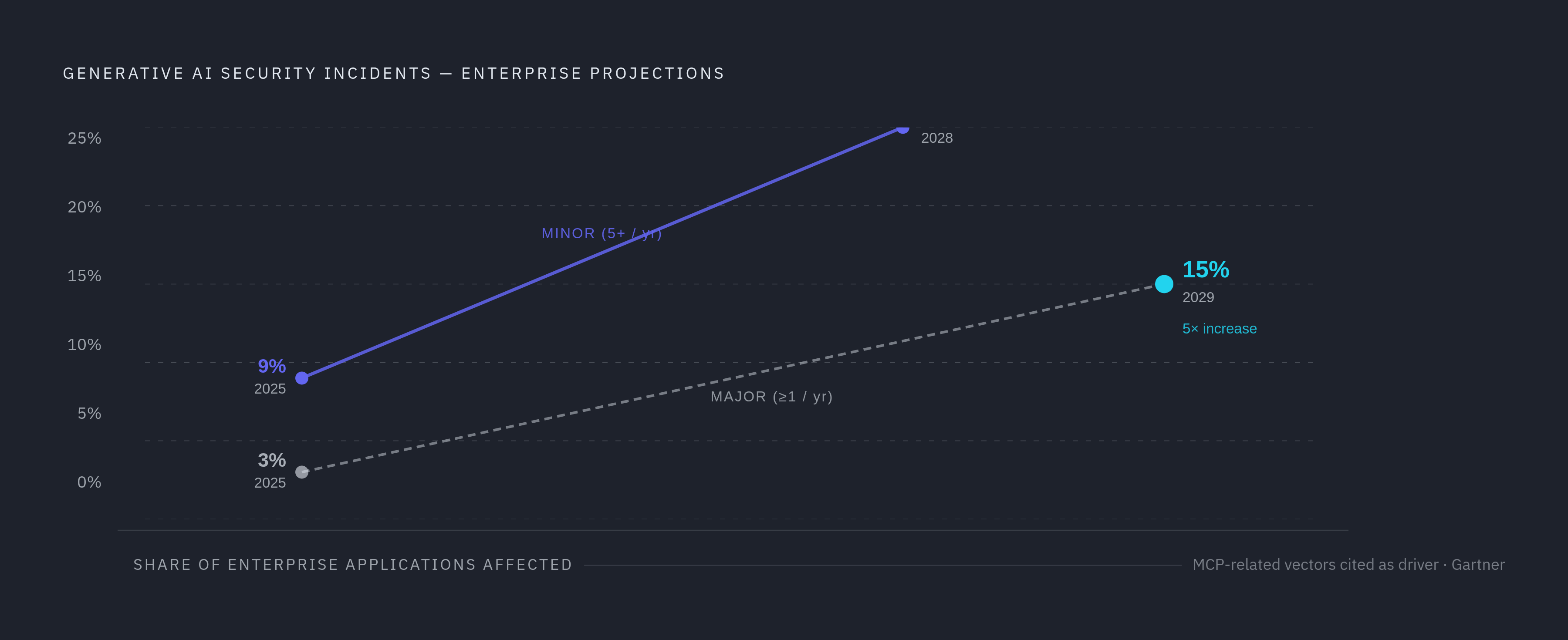
Gartner's projection puts a number on where this is heading: by 2028, 25% of enterprise generative AI applications are expected to see five or more minor security incidents a year, up from 9% in 2025. By 2029, 15% are projected to suffer at least one major incident annually, up from 3% in 2025, with new MCP-related attack vectors named explicitly as a driver. Organizations without logs won't be able to say what happened, let alone why, when one of those incidents lands on their desk.
Day to day, logs are also how detection actually happens. A spike in calls to a high-risk tool at 3am, a sudden run of failed permission checks, unusual call frequency from one agent, these are the signals that flag a problem early, but only if the logs exist and someone's actually watching them. An MCP server that can't say who connected, what they did, and why they had access to do it isn't ready for production. That's the question to put to any deployment before it goes live, not after.
Zero-trust as the operating model that holds all the layers together
Zero-trust, applied to MCP, means no agent, user, or system gets implicit trust, ever. Every action gets validated on its own terms, continuously, rather than riding on a session token handed out once at connection time and trusted for the rest of its life.
Re-authenticating on every tool call, not just once per session, is what actually closes the door on session hijacking. Without it, a stolen session token carries the full authority of the original connection for as long as that session stays open, which could be hours. With per-call validation, a hijacked token is worth exactly one call before it needs to prove itself again.
Think of the layered model as containment, not prevention in the absolute sense. If authentication somehow gets bypassed, transport encryption limits what an interceptor can actually read, and scope limits what they can do with it. If a credential leaks, short-lived tokens and automatic rotation shrink the window it's useful for, and sandboxing keeps it from moving sideways into other systems. If a tool turns out to be poisoned, tight scoping caps the damage and audit logs are what surface the anomaly in the first place. No single layer stops everything on its own. Each one exists to shrink the damage from the layer above it failing.
None of this holds together without governance infrastructure behind it. Permissions inherited automatically from source systems, rather than redefined by hand at every new connection, are what keep implicit trust from creeping in by accident. A governed registry with version control, clear ownership, and access scoping is what lets an organization enforce the same policy across every server instead of hoping each team implements it consistently on their own. And every agent action needs to be traceable back to a person and a decision. If nobody can say who approved what and when, that absence of an answer is itself what creates a hole in the zero-trust model at the accountability layer, even if every technical control is working exactly as designed.
Domain teams still need room to configure the MCP skills relevant to their own work, not just central IT. That's fine, as long as it happens inside a framework that enforces the baseline regardless of who's doing the configuring. Security and speed aren't in tension here so much as they're built on the same foundation.
Before any MCP server goes live, there's a five-question test worth running: who authenticated this connection, what scope does it carry, how is its execution isolated, what gets logged, and who gets alerted when something looks wrong. A server that can't answer all five isn't ready, no matter how well it performs in the demo.
Sources
- One Year of MCP: November 2025 Spec Release
- Model Context Protocol for Enterprise: 2026 Deployment Guide
- The Challenges in Productionising MCP Servers | Lenses.io
- Securing MCP in Production: Defense-in-Depth beyond the Gateway
- State of MCP Server Security 2025: Research Report | Astrix
- obot.ai
- modelcontextprotocol.io