Evaluating AI Agent Frameworks for Enterprise Deployment
Most AI pilots fail at scaling, not modeling—pick frameworks that handle governance and permissions.
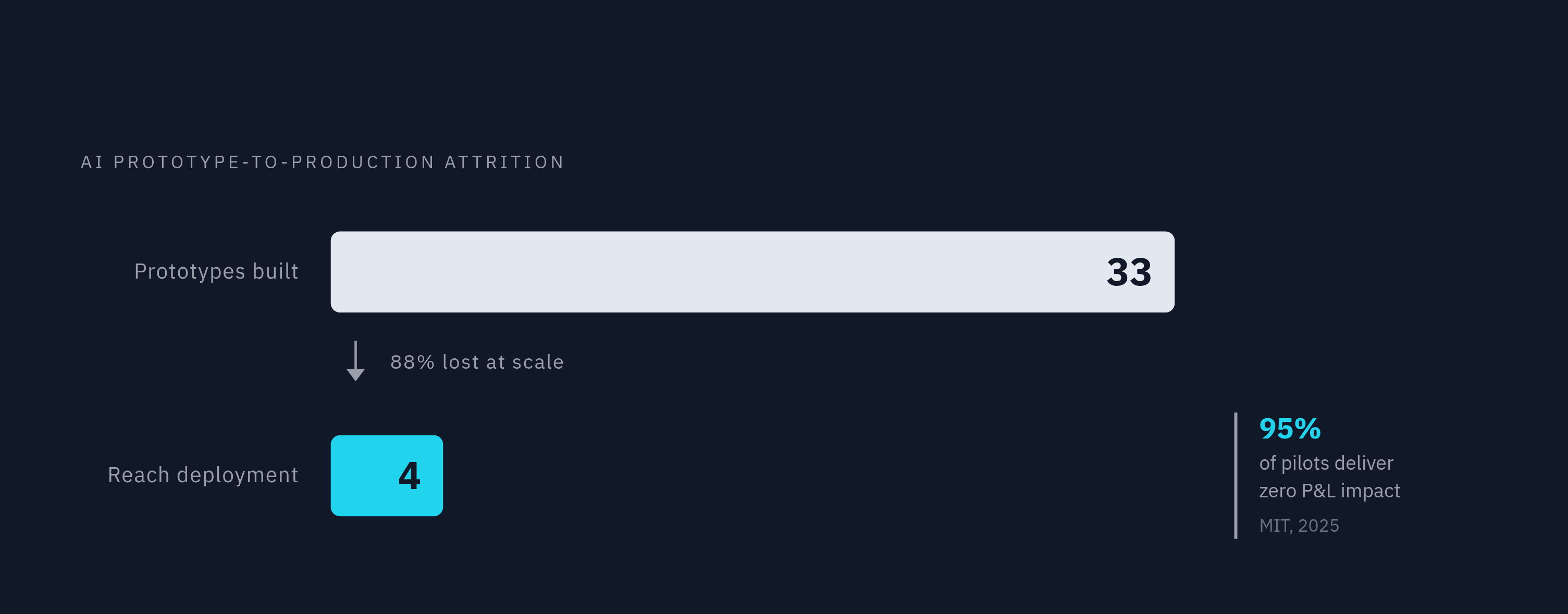
The numbers are blunt, and they should make anyone running a pilot genuinely uncomfortable. S&P Global found that 42% of companies scrapped most of their AI initiatives in 2025, up from 17% the year prior. The average organization abandoned 46% of its proofs-of-concept before production. IDC sharpens that picture: for every 33 prototypes built, only 4 made it to deployment. An 88% failure rate, not at the research stage, but at the scaling stage.
The cause is almost never the model. MIT's 2025 research found that 95% of pilots deliver zero measurable P&L impact, and roughly 80% of the work required to move a pilot into production involves data engineering, governance, workflow integration, and measurement infrastructure. What kills pilots is everything around the model.
Large enterprises with over 10,000 employees abandoned an average of 2.3 AI initiatives in 2025, each carrying an average sunk cost of $7.2 million, per S&P Global. Production GenAI deployments typically run three to five times initial cost projections, per S&P Global. Gartner projects that over 40% of agentic AI projects will be canceled by end of 2027, citing escalating costs, unclear business value, and inadequate risk controls.
Most frameworks get evaluated for what they can do in a demo environment with clean synthetic data and a single developer at the keyboard. That is the wrong test. Enterprises need to evaluate for what survives contact with real data governance, enterprise identity systems, and deployment across teams that weren't in the room when the architectural decisions were made. Those are not the same test, and conflating them is how you end up with a beautiful demo and a $7 million write-off.
The Four Criteria That Separate Enterprise-Ready Frameworks from Developer Prototyping Tools
Developer ergonomics, integration breadth, and GitHub stars are the metrics most framework comparisons lead with. None of them predict production success. After watching enough pilots stall at the same predictable chokepoints, the criteria that actually matter at enterprise scale resolve into four questions. Most frameworks have a clear answer to only one or two of them.
Security and permission inheritance. Does the framework respect the data permissions that already exist in your connected systems, or does it require you to redefine access rules inside the agent layer? A framework that forces a parallel access model creates a synchronization problem that compounds with every new agent, every new data source, and every change to underlying system permissions. It shows up quietly, then all at once.
Governance and auditability. Can every agent action, every tool call, and every state change be audited? Can changes be versioned? Can you roll back when something goes wrong? These are baseline requirements for regulated industries and, frankly, for any organization with serious data handling obligations. A framework that defers these to a future sprint is deferring production readiness, not scheduling it.
Composability across teams. Can a specialized agent built by one team be orchestrated by another team's system without reimplementation? This is the test that separates a framework from a platform. If the answer is no, every team is an island. You are not running agents at scale. You are running many isolated experiments that happen to share a library.
Skill reuse without rebuilding. When one team builds a working prompt, a reliable tool chain, or a tested agent, does the framework give the rest of the organization a governed way to find and use it? IBM's 2025 CEO Study found only 25% of AI initiatives delivered expected ROI. The operational reasons for that failure rate trace almost entirely to these four criteria. A framework that fails to address them structurally forces enterprises to solve them by hand, indefinitely, at scale.
LangChain and LangGraph: The Broadest Ecosystem, With Real Production Complexity Costs
LangChain is the most downloaded agent framework in the ecosystem, with over 100 million monthly downloads and more than 139,000 GitHub stars as of mid-2026. LangGraph PyPI downloads exceeded 58 million in a single month. That adoption scale means something concrete: the community is large, the surface area of documented problems and solutions is wide, and your team will not be pioneering unknown territory at 2 a.m. when something breaks. That is worth something real.
LangGraph's graph-based execution model is the feature that actually matters for production work. Typed state, checkpointers across in-memory, SQLite, and Postgres backends, and time-travel debugging are not marketing differentiators. They are the things you reach for when debugging a production failure under pressure. LangSmith adds traces for every LLM call, tool invocation, and chain step, with latency, token usage, and error tracking included. It is the most complete native observability offering of any framework in this review, and observability is what separates a production incident from a mystery.
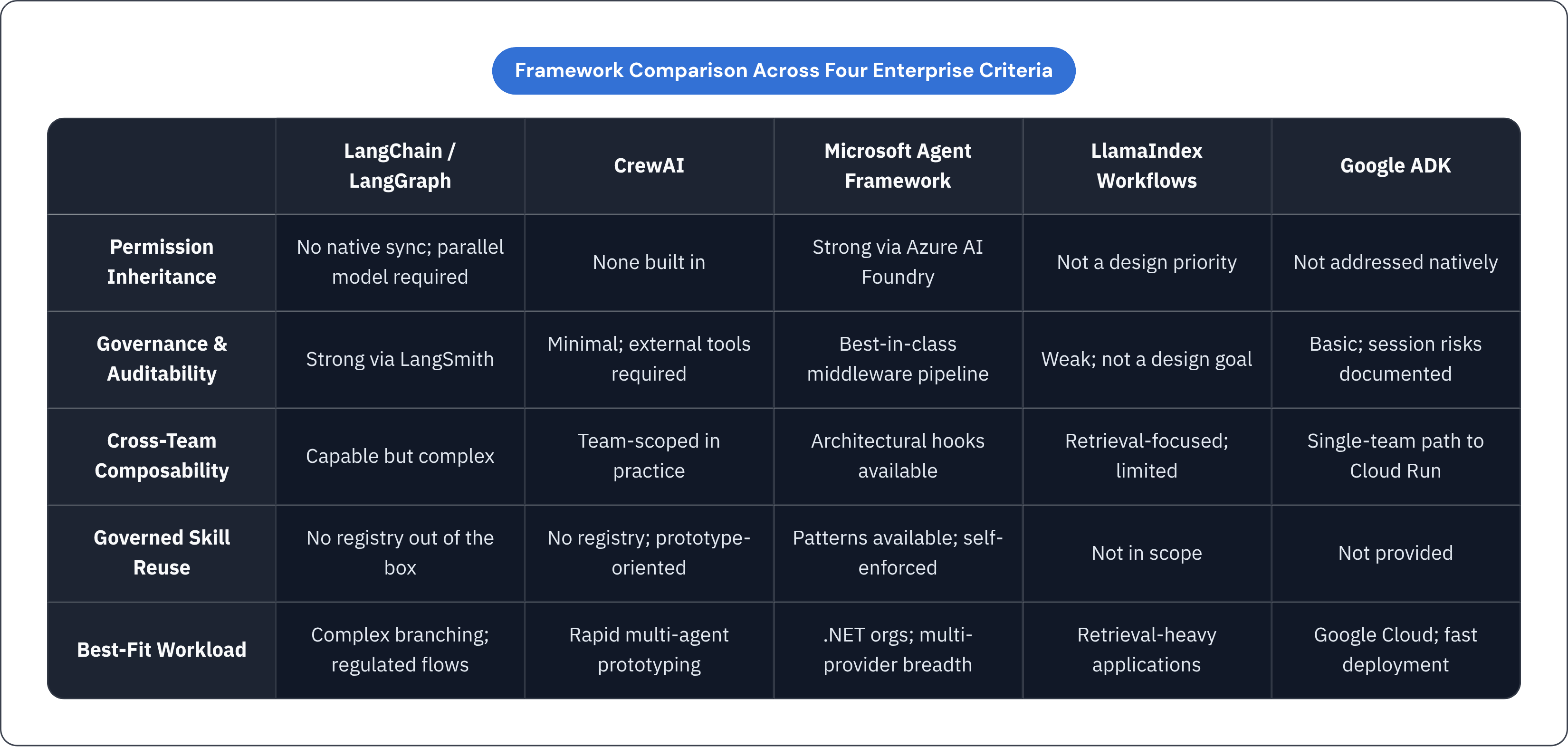
The picture against the four criteria is genuinely mixed, and anyone who tells you otherwise is selling something. Composability and auditability via LangSmith are real strengths. Permission inheritance is not. Enterprise identity systems have no native synchronization here, which means teams building on LangChain construct a parallel access model from day one, and then maintain it forever as the underlying systems evolve. Skill reuse has no governed mechanism out of the box. There is no registry where working agents get published and discovered organization-wide.
The complexity cost is real. Development teams consistently spend 30 to 40% of their time navigating the framework's abstraction layers rather than writing business logic, based on community forum reports and developer surveys. Twelve-week projects become 16 to 18 weeks in practice, based on the same sources. That is the direct cost of a design philosophy that prioritizes flexibility over convention. Neither choice is wrong, but you need to price it accurately before you commit.
LangChain and LangGraph fit best for workflows with unusual branching requirements, regulatory environments that demand precise data-flow control, or teams already invested in LangSmith as a governance foundation. Go in knowing what the complexity costs and plan the timeline accordingly.
CrewAI: Fastest Path to a Working Multi-Agent Prototype, With Production Tradeoffs
CrewAI's role-driven architecture lowers the barrier to entry more than any other framework in this review. Crews handle autonomous collaboration between agents; Flows handle deterministic orchestration. A developer can describe what they want in near-natural language and get a working multi-agent system running faster than any alternative here. Over 45,000 GitHub stars and the largest active community of any dedicated agent framework. The momentum is genuine.
The production friction points are specific and well-documented in community feedback, which means they are not edge cases someone encountered once. Hierarchical crews generate meaningful token overhead from manager-to-worker coordination, and at scale that overhead accumulates. Non-OpenAI integrations and memory system connections surface as friction points frequently enough to be considered structural limitations rather than configuration quirks.
Against the four criteria, CrewAI has the least native enterprise support of any framework reviewed. Minimal governance tooling, no built-in permission inheritance, no skill registry. Teams taking CrewAI into production typically bolt on external observability tools, which means assembling a governance stack from parts rather than inheriting one from the framework itself.
The pattern that emerges repeatedly in community feedback is "prototype with CrewAI, productionize with LangGraph." That is a reasonably accurate description of where it sits in the ecosystem. What it should be for enterprise buyers is a warning: speed-to-demo is not the same thing as production readiness, and CrewAI defers the hardest governance and reuse problems rather than solving them. Know that going in and plan the second phase before you celebrate the first one.
Microsoft Agent Framework: What the Unification of AutoGen and Semantic Kernel Means for Enterprise Buyers
Microsoft Agent Framework 1.0 shipped April 3, 2026, as the production-ready unification of AutoGen and Semantic Kernel. AutoGen is now in maintenance mode, receiving only bug fixes and security patches. Microsoft is consolidating its enterprise AI orchestration story onto one framework, and that consolidation matters for buyers: it signals where the investment and the roadmap are actually going, and it means you are not building on a foundation that gets deprecated in 18 months.
The multi-provider breadth is the widest of any framework reviewed. First-party connectors for Azure OpenAI, OpenAI, Anthropic Claude, Amazon Bedrock, Google Gemini, and Ollama ship out of the box. For enterprise risk frameworks that require provider optionality or need to avoid single-vendor concentration, that coverage matters structurally. It is not just a features checkbox.
The middleware pipeline is what separates MAF from the field on governance, and this is where the real architectural story lives. Teams can intercept and extend agent behavior at every execution stage: content safety filters, logging, compliance policies, custom logic, all without modifying agent prompts. Governance applied consistently across agents rather than embedded individually into each one is the difference between a maintainable compliance posture and an audit that surfaces seventeen different implementations of the same policy.
Against the four criteria, MAF has the strongest native governance story of any framework reviewed, particularly for teams already on Azure AI Foundry. The.NET runtime at general availability is a meaningful distinction that most framework comparisons gloss over as a footnote. Many large enterprises run primarily on C# and Java, and MAF is the only viable anchor framework for that environment. Every other major framework in this review assumes Python, which is not a minor technical detail when your engineering organization has a decade of institutional investment in the Microsoft stack.
The skill reuse caveat is honest: the middleware and registry patterns are available, but teams must build and enforce governance conventions themselves. The framework provides the architectural hooks. It does not provide the institutional structure. Enterprise buyers should not mistake framework capability for organizational readiness. Those are separate problems requiring separate investments.
LlamaIndex Workflows and Google ADK: Where Specialized Workloads Outperform General-Purpose Orchestrators
LlamaIndex Workflows is the clearest example in this review of a framework that wins decisively on a specific workload rather than competing on breadth. For retrieval-heavy applications, it is the strongest option among those reviewed. Native integrations with Arize Phoenix and Trulens provide RAG evaluation tooling that general-purpose orchestrators simply do not offer. Strong vector store support across Pinecone, Weaviate, Qdrant, and pgvector means the data layer does not require bespoke integration work before you can reach the actual problem you are trying to solve.
The weakness is proportionally clear. Governance and skill reuse are not design priorities here because they were never meant to be. LlamaIndex was built for retrieval, not as a multi-team agent sharing platform. A common resilient production architecture uses LlamaIndex for retrieval, LangGraph for orchestration, and specialized modules for specific agent roles. These frameworks are frequently more complementary than competitive, and forcing a single-framework constraint often makes the architecture worse in the name of organizational simplicity.
Google ADK offers a batteries-included path to Cloud Run deployment, built-in session management, and a browser-based debugging UI. For teams building on Google Cloud, it is the fastest path from agent to deployable service. The production caveat is not subtle and should not be treated as one: in-memory session states are lost when Cloud Run containers restart. Improper persistent storage configuration has caused session data to leak across users in production environments, per Google ADK's official release notes. That is not a known issue to monitor. That is a configuration requirement that must be addressed explicitly before any production deployment, full stop.
The OpenAI Agents SDK rounds out the landscape with the simplest mental model of any framework reviewed. Clean primitives for handoffs and tool calling make it genuinely easy to reason about. The constraint is proportionally simple: tight integration with OpenAI's hosted tools creates single-provider lock-in that most enterprise risk frameworks will flag on first review. For organizations that require provider optionality, that constraint is disqualifying regardless of how clean the API surface is.
How to Apply the Four Criteria as a Structured Decision Process
Start with constraints, not features. Language runtime, cloud platform commitments, and existing identity and permission infrastructure narrow the field before any feature comparison becomes relevant. If your enterprise runs primarily on.NET or Java, MAF is likely the only viable primary framework before you evaluate anything else. If the workload is retrieval-intensive, LlamaIndex belongs in the architecture before you consider orchestration options. Constraints eliminate more choices than comparisons do, and faster. Most evaluation processes get this backward.
Map explicitly how each candidate framework handles data access. Does it inherit permissions from connected data sources, or does it require building a parallel access model? Frameworks requiring parallel access models will diverge from your source-of-truth permissions over time, and that divergence is not dramatic when it happens. It accumulates gradually, then becomes an audit finding.
Require a working demonstration of governance, not a roadmap item. Audit trail, state versioning, and rollback should be demonstrable in the evaluation environment. Governance built after launch rarely meets the required standard, because the incentive to ship has already overtaken the incentive to build it correctly.
Run a concrete composability test: have an agent built by one team attempt to call a different team's orchestrator without reimplementation. That single test surfaces more architectural reality than any documentation review. Frameworks that pass it are genuinely composable. Frameworks that fail are team-scoped tools, regardless of what the documentation claims.
Ask whether the framework includes a governed registry where working agents and prompts can be published, discovered, and reused across the organization. If the answer is no, or "you can build that," then every team in the enterprise starts from a blank file. The most resilient production architectures combine frameworks by workload type rather than selecting one for everything, but that approach only works if there is a governance and registry layer above the frameworks enforcing consistency and enabling sharing across team boundaries.
What the Framework Evaluation Misses: The Governance and Registry Layer Above the Code
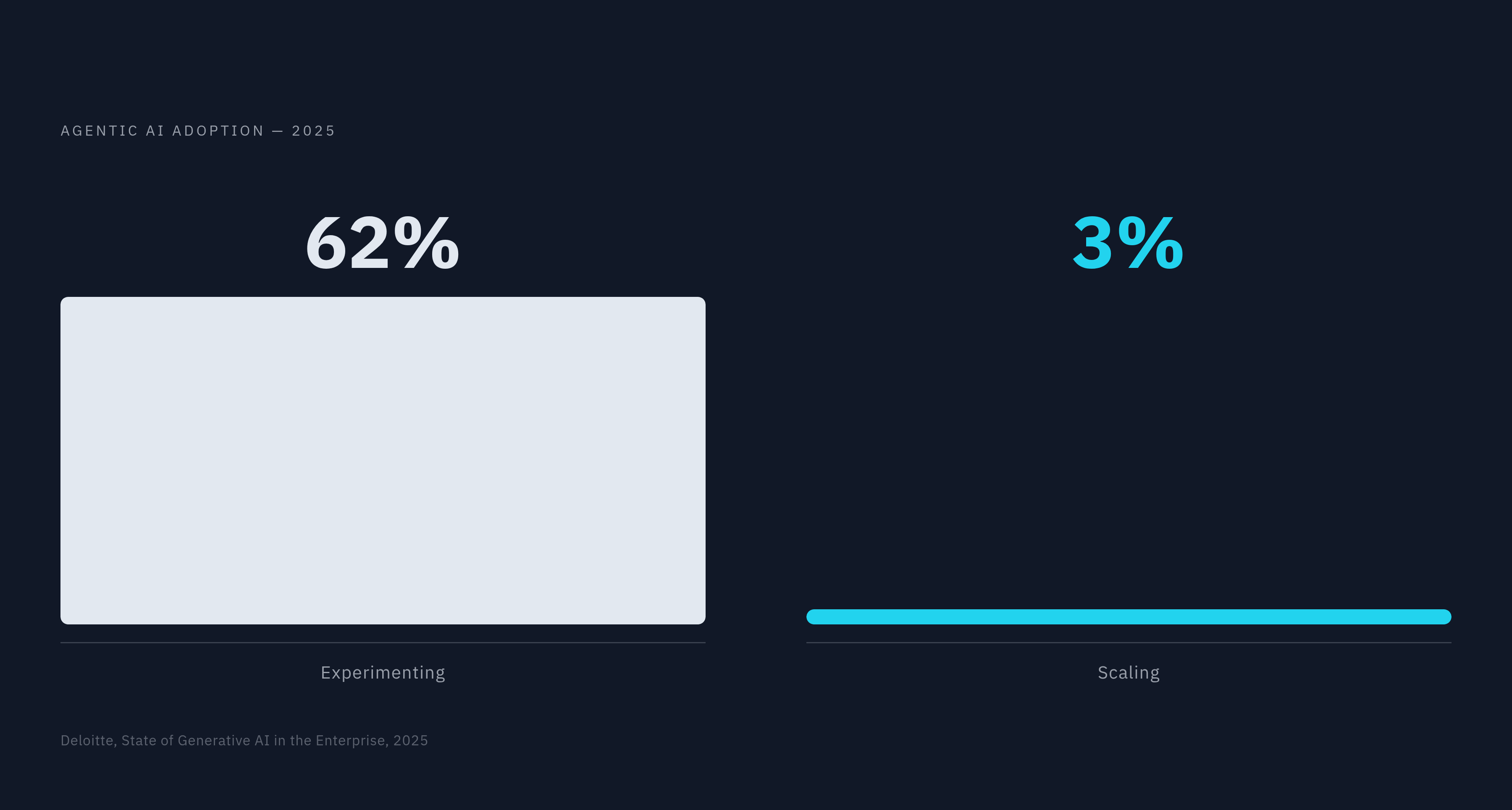
Every framework reviewed here provides orchestration primitives. None provides the institutional structure for governed skill sharing across teams. That gap is the practical distance between the 62% of organizations experimenting with agentic AI and the 3% actually scaling it, per Deloitte's 2025 State of Generative AI in the Enterprise survey.
The failure mode is not dramatic. It is mundane and expensive. Five teams rebuild the same prompt or agent independently because there is no governed place to publish working skills and no discoverable way to find what already exists. LangGraph's graph execution model does nothing to prevent five teams from independently writing the same document extraction agent. MAF's middleware pipeline does not prevent four teams from building the same compliance filter from scratch. The reuse problem lives above the framework layer, and solving it requires something that also lives above the framework layer.
What to look for in that layer is specific. Permission inheritance that synchronizes automatically with source systems rather than requiring manual redefinition. A versioned registry where skills are published once and reusable across teams without coordination overhead. Scoped access so the right people can invoke the right agents without requiring a separate UI build for every new use case.
Deloitte's 2025 State of Generative AI in the Enterprise survey found 74% of companies planned to deploy agentic AI moderately or more extensively within two years. Organizations making framework decisions now are simultaneously making architectural decisions about whether governed reuse is a first-class design goal or an afterthought. The right framework is not the one with the best demo. It is the one whose architecture makes the governance and sharing layer possible to build. Everything else is prototype infrastructure, and enterprises that do not recognize that distinction will eventually be forced to recognize it by a failed audit, a redundant rebuild, or a $7 million write-off that looked nothing like a risk on the original project plan.