Integrating AI Agents with Existing Enterprise Software Stacks
Enterprise systems built over decades resist integration, and MCP solves only the connectivity half.
When an agent tries to do something useful inside a real enterprise, it is not walking into a clean, interconnected system. It is walking into a city built across five decades, where the roads do not connect and nobody agrees on addresses. A meaningful share of the software running Fortune 500 operations was written before most current engineers entered the workforce, stored in proprietary formats that were never designed to be queried by anything other than their own interfaces.
A mid-size enterprise typically has a CRM, an ERP, an HRIS, project management tooling, and finance systems. None of them were designed to share context with each other. Customer history lives in Salesforce. Budget approvals live in NetSuite. Headcount data lives somewhere in HR. An agent answering a question that touches all three must synthesize context across systems with different authentication models, different data schemas, and different update frequencies — on every single request.
Middleware and integration layers are the dominant workaround, but they bridge connectivity gaps without solving what sits underneath: context assembly and permission inheritance. They get the agent to the door. They do not tell the agent what it is allowed to do once it is inside. Those are two different problems, and most early integration efforts treat them as one.
How the Model Context Protocol Changes the Connectivity Layer
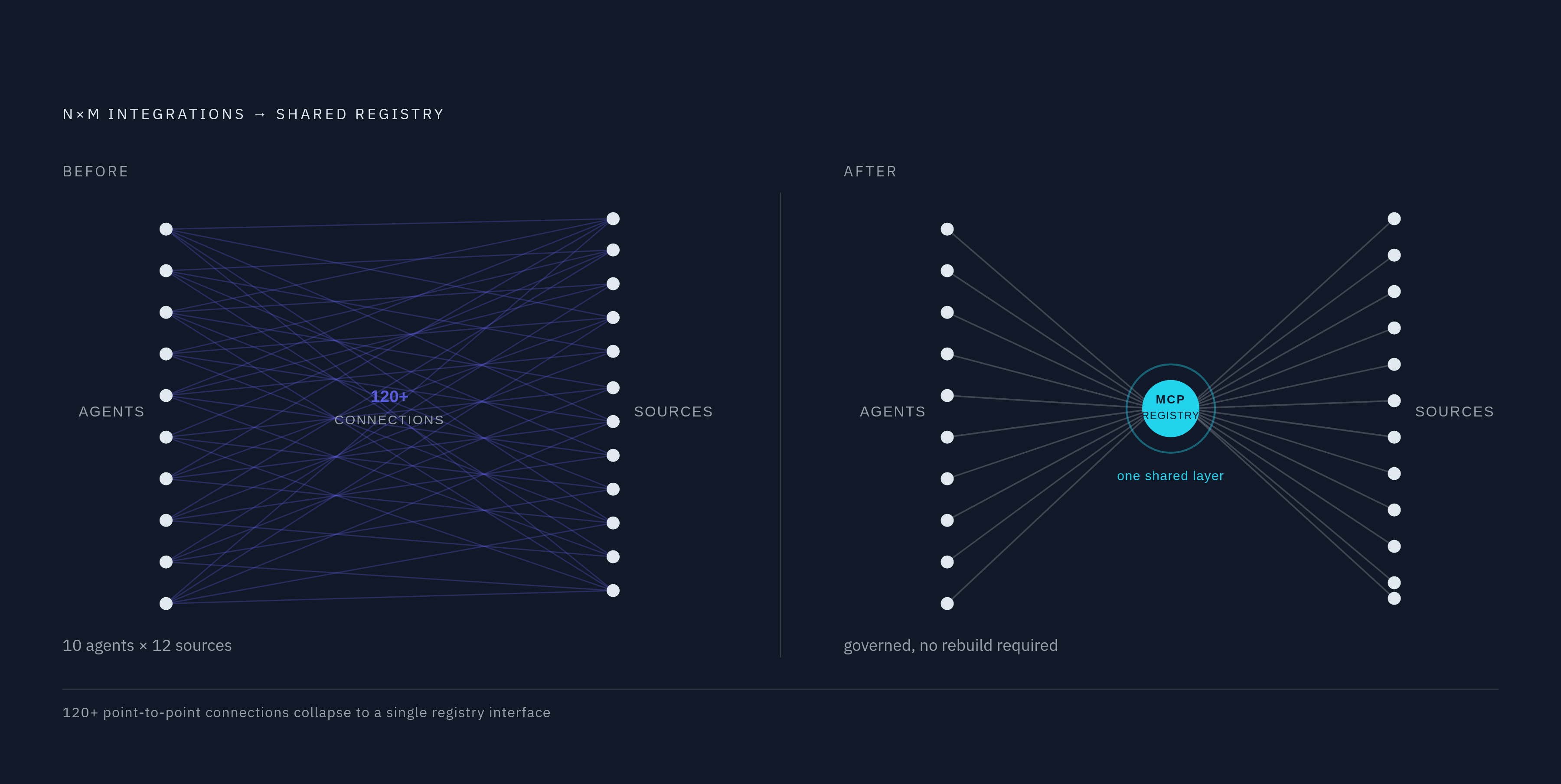
Before the Model Context Protocol existed, every new data source required a custom connector. Anthropic called this the N×M integration problem: each agent-to-system pair needed its own bespoke wiring. Ten agents, twelve data sources, and you were managing over a hundred distinct integrations, each with its own maintenance burden. Anyone who has lived through an enterprise integration project knows how fast that math becomes a headcount conversation.
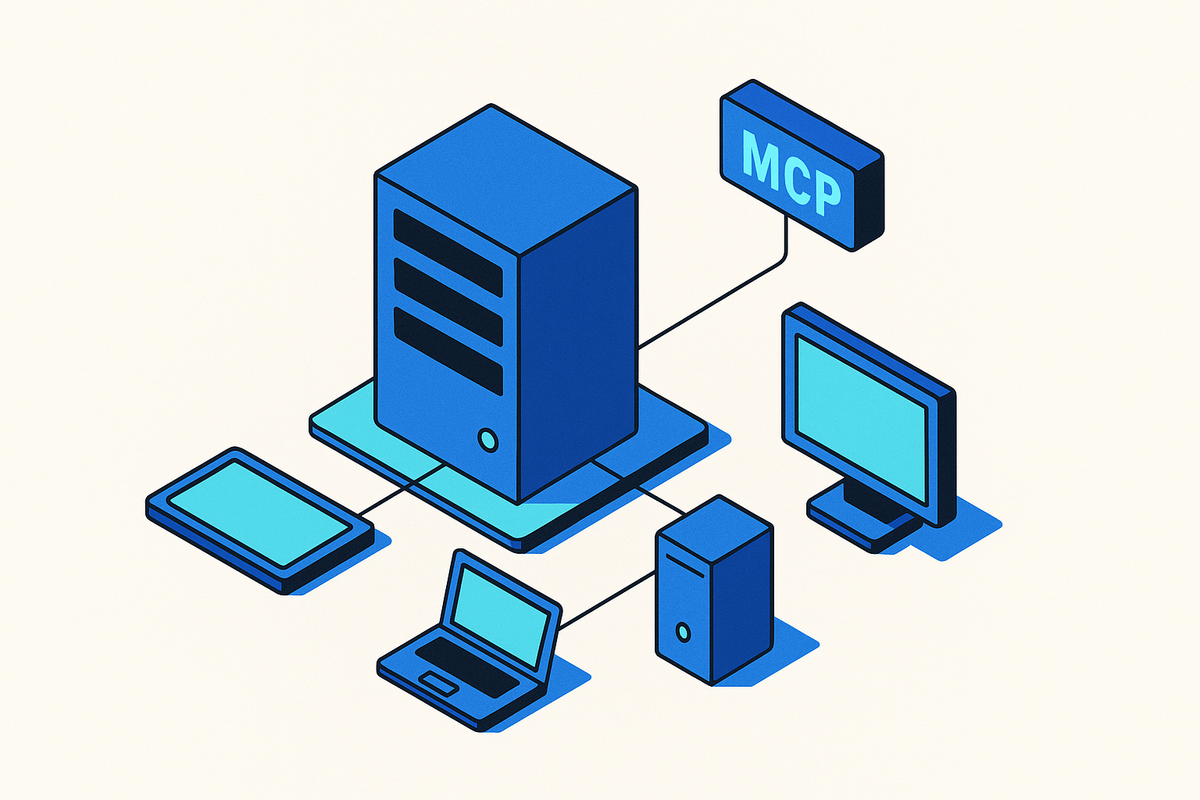
MCP, announced in late 2024, provides an open standard for connecting AI assistants to content repositories, business tools, and development environments through a single protocol. Instead of N×M connections, you get a shared interface layer. Anthropic subsequently donated MCP to the Linux Foundation's Agentic AI Foundation, with backing from AWS, Google, Microsoft, OpenAI, Bloomberg, and Cloudflare. That transition from vendor project to open infrastructure standard matters because when that many infrastructure players align behind a single protocol, the question is no longer whether it will be adopted. The question becomes what governing it actually requires.
Microsoft's Dynamics 365 MCP server illustrates the direction: evolving from static, predefined actions toward a dynamic framework that lets agents reason over live operational and financial data, not snapshots. Adoption is accelerating faster than the governance frameworks meant to contain it.
The honest part is this. MCP solves the wiring problem and introduces its own: malicious code execution, credential theft, and a lack of native authentication and authorization have all surfaced in MCP implementations. Adopting MCP without a governance layer does not eliminate the permission problem; it recreates it in a new form. Connectivity standardization is a precondition for integration, not the destination.
Why Permission Inheritance Is the Hardest Part of Agent Integration
Traditional identity and access management was built for human users and static service accounts. It has no native model for an agent acting on behalf of a user, delegating subtasks to a sub-agent, or querying five systems inside a single workflow. The architecture was never designed for these patterns, and retrofitting it is not clean work.
Privilege drift is the failure mode I keep seeing: agents accumulate permissions over time, and nobody reviews whether they are still warranted. Shadow agents get deployed outside IT oversight with no formal permissioning. Broken delegation chains leave downstream agents either over-inheriting access or losing context about what the originating user was allowed to do. These are not theoretical risks in organizations that moved fast on deployment and slow on governance.
Getting it wrong is uncomfortable in both directions. An agent that inherits too much access can exfiltrate data through queries that look entirely routine. An agent that inherits too little halts constantly and needs a human to re-explain what it is authorized to do, which defeats the purpose of automation. There is no tuning your way out of a structural permissions problem.
The design principle that resolves this is specific: permissions should be inherited from the user asking the question, synced automatically from connected sources, not redefined agent by agent. The integration architecture has to answer a concrete question at query time: which data sources can this agent draw from, and does it know, in that moment, exactly what this particular user can see across all of them?
Governance frameworks exist but remain thin relative to deployment velocity. Singapore's IMDA Model AI Governance Framework for Agentic AI, published in early 2026, is the first standard explicitly designed for agentic systems and the only one addressing multi-agent delegation risks. The EU AI Act does not. That gap will matter more as multi-agent deployments become routine.
What Agent Coordination Across Business Systems Actually Requires
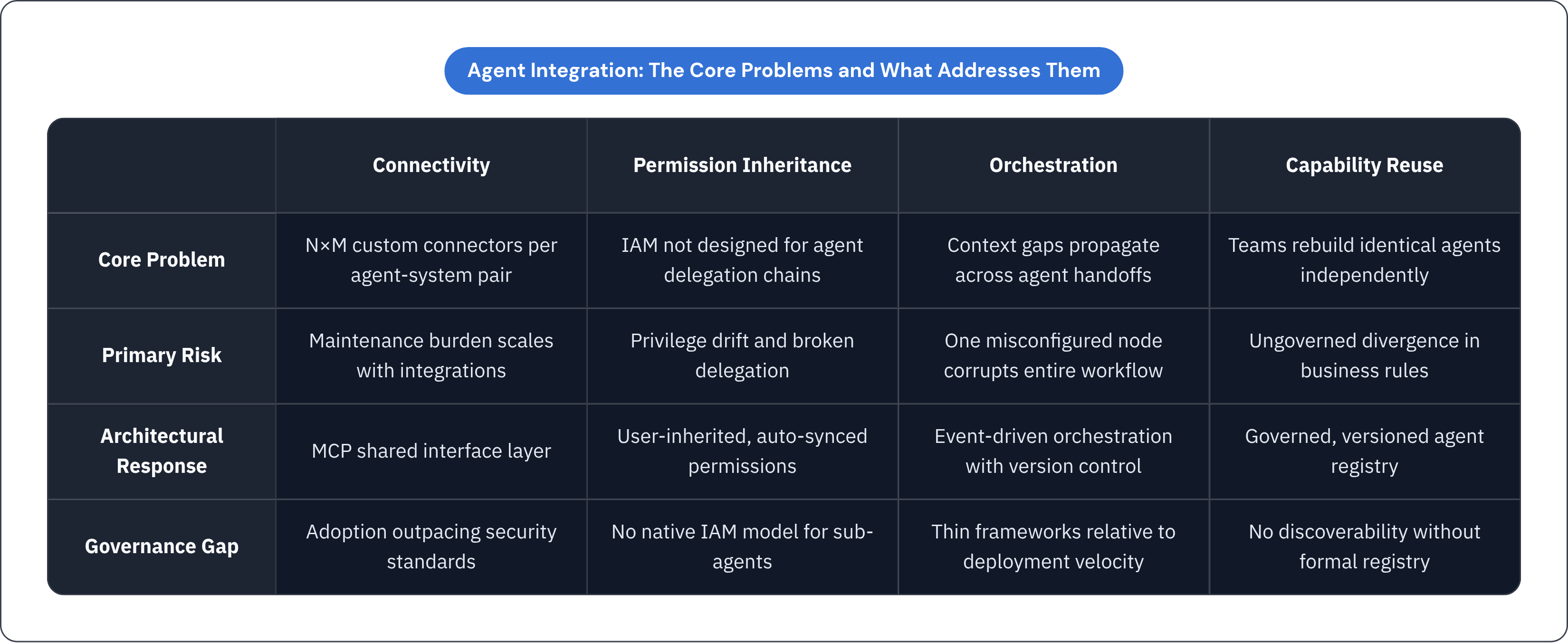
Most real enterprise workflows span multiple systems and require more than one specialized agent working in sequence. A procurement workflow involves a data retrieval agent, an approval-routing agent, and a notification agent, each touching different systems, each needing accurate context from the step before it. Multi-agent orchestration is not a niche experiment; it is where the work is going.
What that coordination requires architecturally is a way to chain specialized agents, control which agent can invoke which action, and version those configurations so changes are tracked and reversible. Event-driven integration is the practical trigger model: agents respond when a business event fires — an invoice approved, a new hire added to the HRIS, a support ticket escalated — rather than polling for updates. This reduces latency and reduces the need for manual intervention at every handoff.
The scale at which this works is visible in production. General Mills used agents to assess more than 5,000 daily shipments, producing over $20 million in savings. JPMorgan runs more than 450 AI use cases in production daily. Both depend on agents coordinating across operational data systems, not single-source queries.
The risk in multi-agent chains is that a permissions error or context gap at one node propagates downstream. If the first agent over-infers what the user can see, every subsequent agent inherits that error. Governance at the orchestration layer, not just the data layer, is what prevents one misconfigured handoff from corrupting the entire workflow.
The Hidden Cost of Rebuilding the Same Agent Logic Across Teams
This one compounds quietly until it becomes a real problem, and most organizations are not tracking it.
One team builds a well-functioning procurement agent. Six months later, another team builds a nearly identical one without knowing the first exists. They duplicate the prompt engineering, the integration work, the testing. Then, because they had no reference point, they introduce their own variations in how they interpret the underlying business rules, not out of malice but simply because nobody told them a version already existed. The result is not just redundancy but ungoverned divergence: two agents nominally doing the same thing, configured differently, with different permission scopes and different assumptions baked in. That is an audit problem layered on top of an efficiency problem.
The efficiency problem alone is substantial. Organizations with no formal AI strategy report significantly lower success rates than those with a coordinated approach. The difference is not better models. It is better organizational coordination around how capabilities get built, shared, and governed, and that coordination does not emerge on its own.
The fix is a governed registry where a working agent or skill, once built, is discoverable and reusable by any team — not a shared prompt document passed around in Slack, but a versioned, permissioned capability that any authorized team can invoke without rebuilding it from scratch.
How a Governed Agent Registry Makes Integration a One-Time Investment Per Capability
The registry model is straightforward in concept and genuinely difficult to execute well. When an agent or skill is built, tested, and permissioned, it gets published to a central registry. The integration work, the connector setup, the permission scoping, the context grounding, is done once. Not redone per team, per quarter, per reorganization.
A registry entry must contain the agent's data connections, its permission model, its configuration version history, and a clear description of what it does and what access it requires. That last element lets another team evaluate and reuse a capability without reverse-engineering it or extending it on faith.
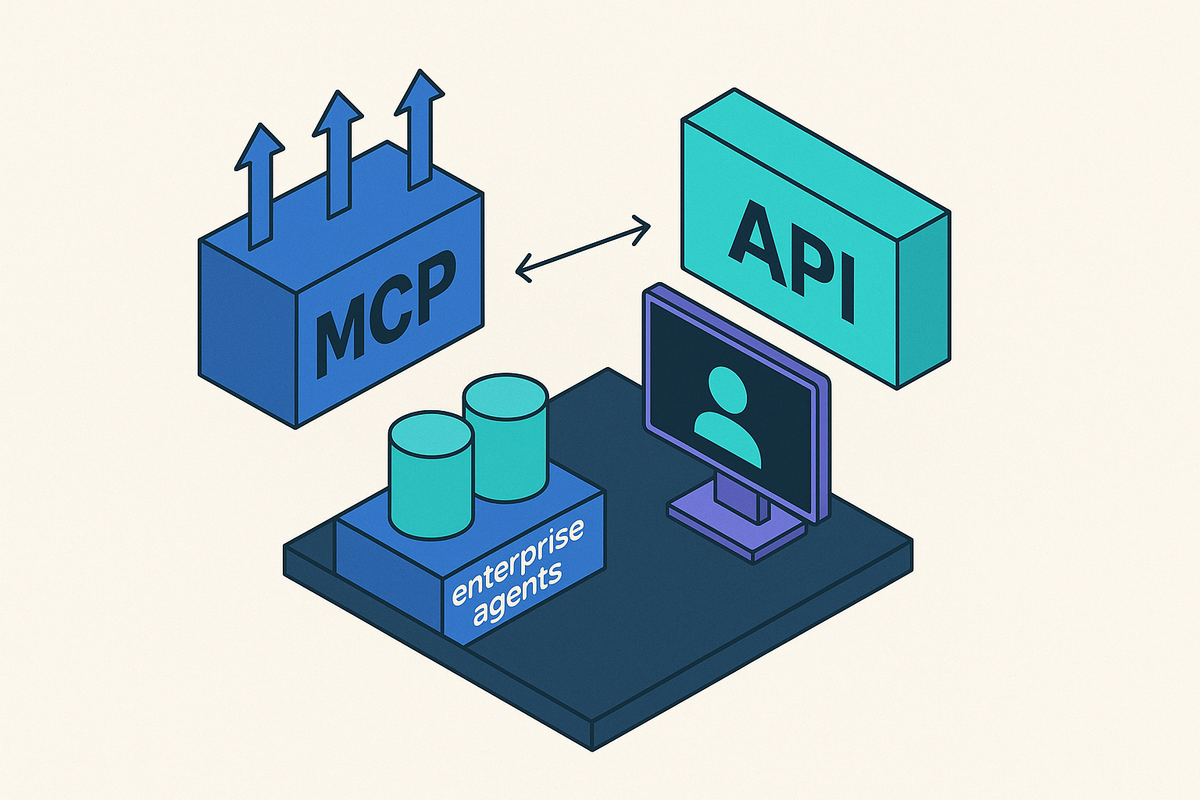
The scoped MCP server is the practical interface that makes this work. Each team or use case gets its own scoped connection surface that plugs into any agent or chat interface without requiring a new UI to be built. The registry publishes the capability; the MCP layer delivers it. Together they replace the N×M rebuild problem with a publish-once, invoke-many model. That is not a marginal efficiency gain. It changes how integration work accumulates over time.
A Forrester Total Economic Impact study of Microsoft agentic AI solutions found that organizations deploying on a properly built foundation realized substantial net benefit over three years. The foundation doing that work is shared infrastructure, not per-team builds.
Version control in the registry matters as much as discoverability. When a data source changes, when a permission policy updates, when a business rule evolves, the change propagates through versioned registry entries rather than requiring someone to manually chase down every team's independent implementation. That propagation is what keeps the registry a living system rather than a catalog that goes stale after the first reorganization.
The Organizational Conditions That Determine Whether the Architecture Actually Holds
The architecture can be right and still fail. Technical design does not resolve ownership disputes, accountability gaps, or change management failures. Those have to be designed alongside the architecture, not retrofitted after the first production incident.
Most organizations are running agents they cannot fully audit, cannot explain to regulators or stakeholders, and cannot confidently roll back when something goes wrong. That is an organizational problem, not a technology one. Organizations that cannot quickly answer which agents are running, what data they access, who owns each registry capability, and how permission changes propagate are not governing their agents — they are assuming things will hold together until they do not.
The skills gap shapes adoption speed more than tooling does. Across enterprise AI surveys, skills shortages consistently rank as the primary integration barrier, above model quality and above API availability. The dominant organizational response has been education rather than role redesign, which means teams often have the tools before they have the judgment to configure them safely. That sequence produces risk at scale, quietly, until a failure surfaces and makes it legible.
Gartner's projection of 40% of enterprise applications featuring task-specific agents by 2026 implies integration work happening at speed, not at the pace of careful architecture reviews. Registry structures and governance layers become more critical as velocity increases because the cost of divergence compounds. Skipping the foundation means each new deployment inherits the structural debt of every previous one. Building it means each subsequent deployment gets cheaper and safer, not more complicated.
Enterprises that treat integration as a one-time technical project will keep hitting the same scaling wall. Those that treat it as ongoing architecture, with shared registries, inherited permissions, and governed coordination, are the ones converting experiments into operations.