Knowledge Base Maintenance and Freshness for AI Systems
Stale data kills AI adoption, but data governance—not faster refresh—is the only real cure.
Knowledge base staleness is a governance failure. The real fix is permissions that travel with the data and sync automatically across every source an AI system touches, so a faster refresh job bolted on after the fact can't paper over the gap.
Nobody diagnoses the failure mode correctly. The AI has two versions of the same document, one current and one dead, and no way to tell which one it's serving.
Someone updates a policy doc. The old version doesn't vanish from the index; it sits there next to the new one, both retrievable, both looking equally authoritative to a system with no concept of "superseded." I've started calling this parallel truths, mostly because I needed a name for it when I kept seeing the same pattern across different clients. Retrieval picks one. Sometimes it's right. Sometimes it hands a user a pricing policy from two quarters back, and nobody notices until a customer calls asking why their quote doesn't match the website. This is widely cited as the reason enterprise RAG deployments lose adoption three to six months after launch. Users stop trusting the answers long before IT realizes there's a problem.
There's a quieter version of this too, and it's harder to catch. Semantic drift: the words stay the same, but what they mean underneath shifts. "Active customer." "Qualified lead." "Approved vendor." "Priority incident." Each term can mean something different depending on which team you ask, which quarter it is, which regulatory framework applies that month. Re-indexing, no matter how often it runs, will never catch this, because drift is a governance problem. Pipelines just move data around on a schedule. They don't ask what anything means.
The dollar figure attached to this isn't subtle either. Atlan's context layer research puts RAG accuracy on governed data at 85 to 92%. On ungoverned sources, that number drops to 45 to 60%. A spread of more than 40 percentage points, and it comes down to whether the system trusts what it's feeding into retrieval, more than any chunking strategy or embedding model choice.
Trust, once broken, doesn't come back easily. Stack Overflow's 2025 Developer Survey found 46% of developers actively distrust AI tool accuracy, versus 33% who trust it. Only 3% report "highly trusting" the output. Three percent, at a moment when enterprise workflows increasingly treat AI like a reliable coworker. Stale retrieval drives a good chunk of that distrust. Models keep getting better, so I don't think this is a model quality problem anymore. It's a data currency problem, and no amount of parameter scaling touches it.
How staleness at scale kills AI programs that survive the pilot
Pilots work. That's the trap, and I've watched it spring on three separate teams now.
They work because someone, usually a well-meaning analyst, hand-curated the dataset before the demo. Recent documents, clean permissions, no duplicates. Then the system goes to production, gets pointed at the live, sprawling, constantly-changing corporate data estate, and the wheels come off fast. Research on enterprise RAG deployments found that 60% of projects that fail after a successful proof of concept fail specifically because they can't hold data freshness at scale. The demo never tested the real problem in the first place.
MIT's 2025 research on enterprise generative AI found something even starker: roughly 95% of pilots deliver no measurable ROI, and integration failure drives most of it. Integration failure and staleness failure are, functionally, the same thing wearing different names. The AI is disconnected from whatever's actually happening in the business right now. It's reading yesterday's newspaper and getting asked about today's headlines.
Manual refresh can't close this gap, no matter how disciplined the team running it is. Enterprise data doesn't update once; it updates constantly. CRM records change hourly. Policies get versioned. Product docs ship on their own release cadence, often weekly. Every new source you plug into the knowledge base adds to the refresh burden, and that burden compounds fast. Teams hit a ceiling somewhere around the fourth or fifth connected source, where manual review just can't keep pace anymore. And manual review was never going to catch semantic drift anyway. Catching drift means knowing what a term used to mean well enough to notice it's changed, and that's institutional memory, not a checklist you can hand to a contractor.
What happens organizationally is almost worse than the technical problem. Five different teams build the same prompts, the same connectors, against the same underlying CRM or knowledge base, each one carrying its own staleness risk independently, none of them talking to each other. There's no shared registry, so there's no shared definition of what "fresh" even means, and no agreement on whose copy of the data counts as authoritative. The duplication doesn't spread the governance burden around. It multiplies it, quietly, until someone finally audits the mess.
Stale data is a symptom. The real condition is that AI adoption sprinted way ahead of the infrastructure needed to govern it.
What governed data access actually requires — and why permissions are the starting point
When an AI tool defines its own permissions separately from the source system, those permissions start drifting the moment anything changes upstream. They never resync on their own. That's the root issue, and it's simpler than most teams want it to be.
Someone leaves a team. Access to their old files gets revoked in the source system that afternoon. The AI's knowledge base, running on its own permission set, keeps retrieving against the old access list for weeks, sometimes indefinitely. A file gets moved into a restricted folder for compliance reasons. The source system knows immediately. The AI has no idea, and won't, until someone manually tells it.
Inherited permissions travel automatically from the source system: no separate access control list to maintain, no reconciliation job someone has to remember to run at 2am before an audit. Redefined permissions mean every new AI tool re-specifies, from scratch, who's allowed to see what. That creates a second access layer, and it starts diverging from the source the day it's built. Any enterprise running multiple AI tools without permission inheritance is running multiple access layers that disagree with each other, whether anyone's noticed yet or not.
Governance is the actual mechanism that keeps data fresh, even though plenty of vendors still sell it as a compliance checkbox bolted on after the fact. When access is governed at the source, freshness comes along for free, because the AI can only pull what the requesting user is currently allowed to see. Flip that around: ungoverned retrieval is a compliance risk, and it's also the exact pathway through which stale data gets into the response.
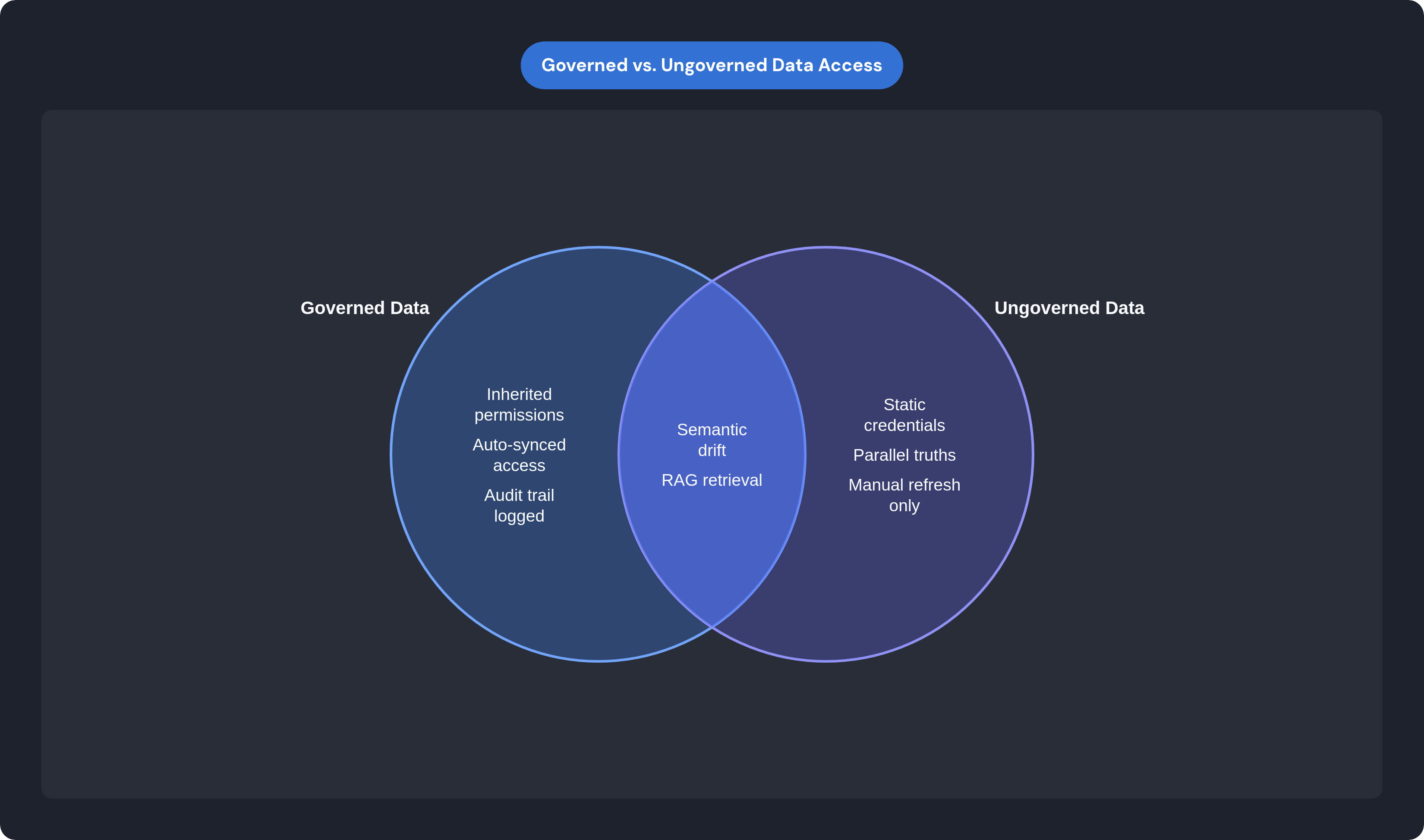
Practically, "governed" means three things. Permissions inherited and synced automatically from every connected source, no manual reconciliation step required. Every retrieval scoped to exactly what the requesting user already has access to in the source system, not some broader or narrower set defined somewhere else entirely. And an audit trail, logged as it happens: who asked, what got retrieved, what access rule applied.
That 85-to-92% versus 45-to-60% accuracy gap from Atlan comes down to trust more than chunking or embedding choices. Trust starts with knowing the data going in is the data that's actually supposed to be there.
How MCP creates a standard layer for connected, governed data access
Before MCP, every new data source meant a custom connector. Multiply that across a dozen sources and a handful of AI tools, and you get a fragile web of point-to-point integrations, each with its own authentication logic, its own refresh mechanism, its own particular way of breaking at 3am. Boston Consulting Group called this quadratic complexity: as AI agents spread across an organization, integration effort doesn't grow linearly, it multiplies with every new pairing of tool and source.
MCP, the Model Context Protocol, fixes the shape of that problem. Instead of M times N custom connections, you get M plus N: one standard interface per system, one protocol per AI client. Anthropic announced it as an open standard in November 2024, and it moved to the Agentic AI Foundation, co-founded by Anthropic, OpenAI, and Block, in December 2025, with platinum members including AWS, Google, and Microsoft. The governance is vendor-neutral from day one, so it travels with the organization rather than with whichever model happens to be popular this year.
What matters for freshness specifically: MCP servers connect to live systems. They pull current data at the moment of the query, rather than indexing a snapshot that starts aging the second it's created. There's dynamic discovery built in too, so an AI agent can ask an MCP server what it currently supports and get a real-time answer, not a description that was accurate back when someone last touched a config file. RAG and MCP work together rather than against each other. MCP is the governed access layer, and RAG retrieval runs on top of it, pulling from whatever the source is exposing right now, this second.
The adoption numbers back this up. MCP server downloads went from around 100,000 in November 2024 to over 8 million by April 2025. The SDK passed 97 million monthly downloads and 81,000 GitHub stars as of March 2026. Gartner projects 75% of API gateway vendors and 50% of iPaaS vendors will natively support MCP features in 2026.
MCP has become real infrastructure. It's what makes governed, fresh, permission-aware retrieval possible at scale, without rebuilding a custom connector every time someone wants to add a tool.
Why freshness breaks without permission inheritance — and how MCP servers can enforce it
MCP solves connector sprawl. It doesn't automatically solve governance, and this is where a lot of implementations quietly go wrong, usually without anyone noticing until it's too late.
Everything hinges on one question: does the MCP server inherit the requesting user's permissions from the source system, or is it running on a single static credential? With a static credential, the server has one fixed set of access rights, and every user gets the same retrieval surface regardless of what they're actually cleared to see. That's governed access erased right at the MCP layer, and it defeats the entire point of building one. With inherited permissions, the server passes the requesting user's identity through to the source, and whatever comes back is scoped to what that specific person can see.
This also happens to be the structural fix for parallel truths. When a document gets archived or superseded in the source system, a permission-synced MCP server just stops surfacing it, because access to it has changed underneath. Nobody needs a scheduled delete job to catch it. Access control does the retiring automatically, the moment the source system says so.
Multi-tenant isolation is where this gets tested hardest, and it's already failed publicly, not hypothetically. In June 2025, a bug in Asana's MCP server feature let project and task data belonging to one organization bleed into another organization's context. That's a documented incident, and it shows exactly what happens when tenant-scoped access isn't built in from the start: context from one invocation leaks into the next, and nobody catches it until someone notices data that shouldn't be there.
There's a gap scheduled refresh simply cannot close, no matter how tight the interval gets. Permission changes happen instantly in the source system. Scheduled refresh happens periodically, even at its fastest. The space between those two speeds is exactly where ungoverned or stale access sneaks through. Semantic drift still needs human oversight; that part doesn't go away no matter how good your MCP server is. But access-driven staleness is a category pipelines can't even see, and inherited permissions eliminate it outright.
The cost of skipping this is measurable, not theoretical. Research on stale embedding effects found retrieval accuracy degradation of up to 20% when embeddings are indexed against outdated access controls, with no uncertainty signal warning the user anything's wrong. The system just answers confidently, using data it should never have touched in the first place.
The security risks that undermine freshness if MCP governance isn't built in from the start
Adoption moved faster than the guardrails, and it shows. There are now over 5,800 MCP servers available, and they don't all meet the same security bar, not even close. Forrester projects 30% of enterprise SaaS vendors will ship their own MCP servers by the end of 2026, which means the toolstack is going AI-native whether or not governance keeps pace with it.
The rug pull attack is where freshness turns into an adversarial problem instead of just a maintenance one. A server gets approved and registered based on its original, legitimate behavior. Later, someone modifies its tool definitions to do something malicious, and because the approval was granted for the earlier configuration, the modified version inherits trust it never actually earned. Environments with strict change control but no re-validation trigger for post-deployment changes are especially exposed here. It's semantic drift, but deliberate: what the server does has changed, and the registry record hasn't caught up yet.
Tool poisoning and prompt injection attack the same seam. CVE-2025-6514, found in the mcp-remote package, compromised more than 437,000 developer environments through a shell command injection flaw. That's a production incident, not a lab exercise someone ran to prove a point. Malicious tool descriptions, or cross-server shadowing where one server's definitions bleed into another's context, can quietly redirect what an agent retrieves without the user ever noticing anything's wrong.
If the retrieval path itself can be poisoned, freshness guarantees stop meaning anything at all. You can have perfectly synced permissions, a fully governed data layer, and still hand a user corrupted context, because the server delivering it has been compromised somewhere upstream. Version control and change auditing on MCP server definitions have become a freshness requirement now, not just a security nicety you get to if you have time.
Practical defenses aren't complicated. They just require discipline: self-host servers where you can, or vet community servers thoroughly before adopting them; apply least privilege by default, always; require explicit approval for any consequential action a server can trigger; log every single invocation without exception; and treat any change to a server's definition as something that needs re-validation, never a quiet auto-approval.
What a governed MCP registry does that a shared drive or connector list cannot
A registry's job is narrow. It's the single source of truth for which MCP servers are approved, who's allowed to call them, and which version is currently live. It stores the metadata about reaching each server safely; it doesn't do the execution work itself. Without a registry, teams find servers through word of mouth or community lists, and approved servers sit right next to unapproved ones with no institutional way to tell them apart.
Version control on server definitions is what actually stops rug pulls and undetected drift in server behavior. Every change gets logged: who made it, when, what the previous version looked like. Without that history, a server that behaved perfectly at approval time can quietly turn into something else entirely, and nobody has a record to compare against when it happens.
Access scoping belongs at the registry level too. A sales team's MCP server has no business being callable from a finance workflow, and registry-level scoping enforces that boundary without requiring every individual server to build its own access logic from the ground up. This is also how domain experts keep ownership of the tools they build without losing organizational oversight. They control what their server actually does; the registry controls who's allowed to reach it.
This is where the duplication problem finally gets solved. Without a registry, five teams build five separate connectors to the same CRM, each with its own permission logic, each carrying its own staleness risk independently, none of them aware the other four exist. With one registry, there's a single approved server, discoverable by all five teams, governed centrally. Freshness gets maintained once instead of five separate times by five separate people who never knew to compare notes.
Running the sync job more often was never the whole answer. Freshness depends on making sure the data everyone's pulling from was never allowed to go stale, or unauthorized, in the first place.