Version Control Strategies for AI Agent Capabilities at Enterprise Scale
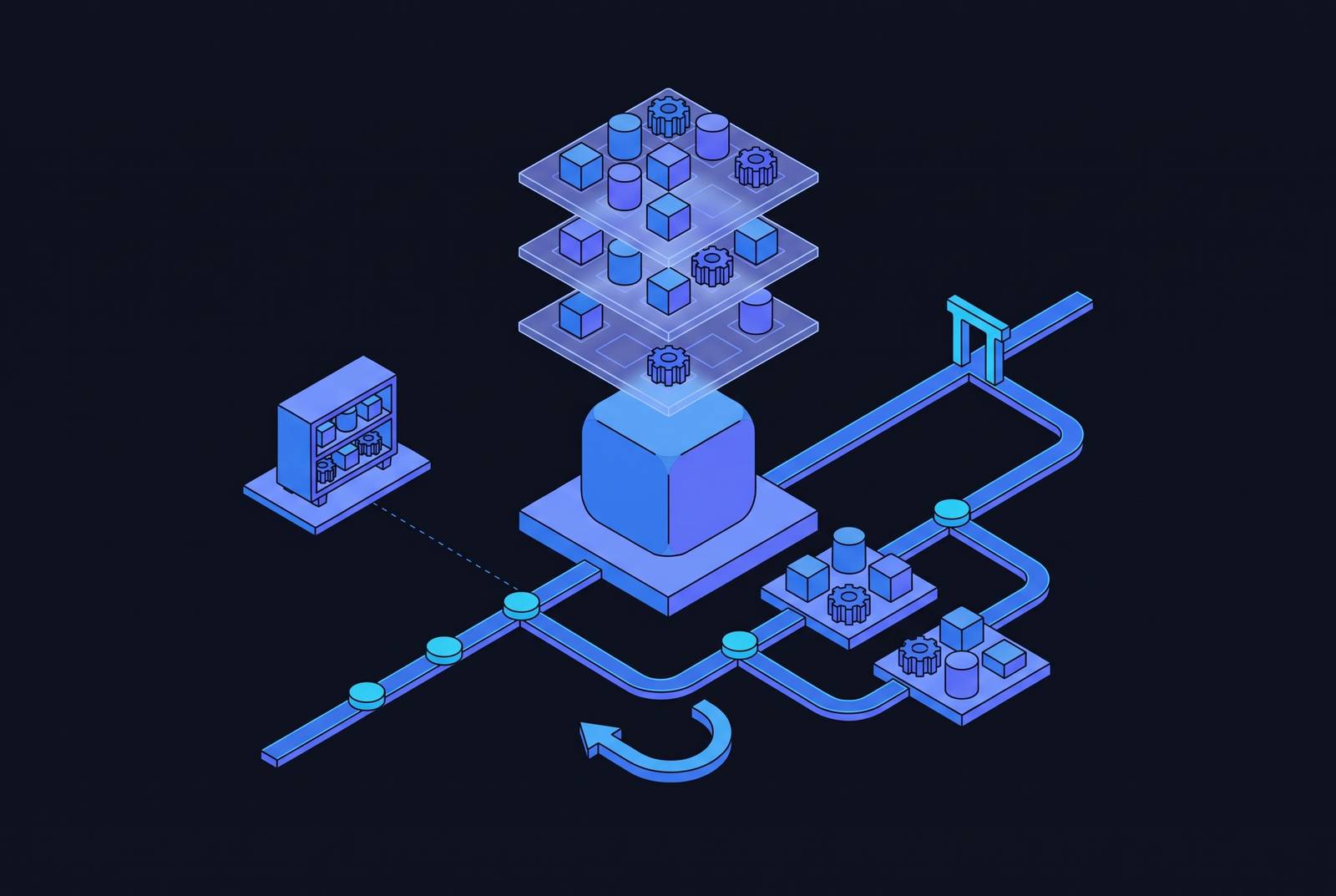
A governed AI agent skill registry for enterprises controls who can publish capabilities, which versions agents can use, and how to track and undo changes. At enterprise scale, versioning depends on the registry as well as the code. Ownership, change history, access scoping, and rollback must live in the system that distributes MCP capabilities, rather than depend on each team remembering the rules.
Why MCP changes the versioning problem for enterprise AI capabilities
Model Context Protocol, or MCP, makes tools, readable resources, and reusable prompts available to compatible AI clients. Instead of maintaining N×M custom connectors, organizations maintain separate client and server implementations. The integration becomes shared infrastructure. Before MCP, a team could version its own integration locally. With MCP, one server update can affect every team and client that consumes it.
The 2026-07-28 MCP specification completes the shift to a stateless, HTTP-native protocol, making servers ordinary horizontally scaled HTTP services. A stateless service can keep answering requests while a consumer with an old version relies, without knowing it, on behavior that has changed. Tools, resources, and prompts can also change independently, so tracking server code alone does not establish what an agent depends on at runtime. The publishing system must keep track of which versions of a capability consumers are meant to use.
The governance gap that emerges as MCP deployments grow across teams
The MCP project reported that downloads across Tier 1 SDKs had reached close to half a billion a month as of July 2026. The official MCP Registry held tens of thousands of active servers as of late October 2026. A platform team cannot govern distribution by remembering which server someone connected, which configuration was copied, or which release a department approved.
Most organizations have MCP servers running in production that security teams have not reviewed, while identity management and auditability remain barriers to moving pilots into production. This is not simply a failure of diligence. Governed distribution tooling arrived after teams had already started connecting servers. As a result, the unit security needs to review is no longer just an integration owned by one team, but a shared capability with multiple consumers and changing versions.
Why the standard MCP authorization model was not designed for multi-team enterprise deployment
The original MCP authorization model assumed an individual approving access through a browser. Repeated per-app OAuth prompts fit that model, but not centrally provisioned enterprise access. Enterprise-Managed Authorization, or EMA, fills this provisioning gap by using a trusted identity provider. Okta is the first supported provider. Asana, Atlassian, Canva, Figma, Granola, Linear, and Supabase support EMA, with Slack in progress.
That is progress, but provisioning is not runtime authorization. EMA does not decide whether a particular agent action is allowed after access has been established. Organizations still need to control each tool call, including actions that change records or move data. There is also no standard for packaging and distributing MCP configurations across teams and surfaces, so a working configuration in one client does not automatically transfer to another. A registry fills that distribution gap and supplies the policy needed to enforce rules at runtime.
The August 2026 MCP roadmap names agent identity and enterprise-ready security as priorities because callers increasingly run as cloud workloads. The protocol recognizes the changed deployment model. Until those gaps are closed, enterprises need more than user consent or provisioning to govern access and use.
What does a governed AI agent skill registry do that a shared drive cannot?
A discovery catalog tells agents what exists. A governed registry controls how those capabilities reach them, including who published a version, whether it is approved, and who may use it. Those are different jobs. A list of server addresses may help a team connect, but it does not establish a managed release process for the capability behind each address.
Early deployments often rely on shared drives or configuration files checked into repositories. Those arrangements can store information, but the file itself does not enforce approval, consumer access, or the lifecycle of a running capability. Repository history is not a complete capability audit trail. A registry makes development, testing, publishing, versioned release, and retirement explicit states, with only approved versions available to production agents.
That lifecycle also separates publication from migration. Two versions can coexist while selected agents test a new release and production consumers remain on the approved one. Access is enforced. Every publish, promotion, access grant, and rollback becomes a logged event, so release governance does not depend on someone remembering to document it afterward.
The gateway-plus-registry pattern and what production implementations look like
The registry governs publication, while the gateway governs execution. The registry owns version records, ownership, approval state, and discovery permissions. The gateway routes requests and enforces policy when an agent calls a tool. Neither layer replaces the other. A catalog cannot stop an unauthorized call by itself, and a gateway needs an authoritative source for which versions and consumers are approved.
The 2026-07-28 specification enables header-based routing through Mcp-Method and Mcp-Name, allowing gateways to authorize and route requests without parsing JSON bodies. This gives enforcement a practical protocol hook. Runtime controls include tool allowlists per agent and OAuth 2.1 identity binding so agents inherit scoped user permissions, replacing standing credentials. A centralized gateway also gives security one inventory, with human approval gates for destructive or irreversible actions such as database deletions, financial transactions, bulk record changes, and outbound data transfers.
AWS Agent Registry reached general availability August 31, 2026, and has a record type for MCP servers as well as for agents and skills. It validates MCP records against the MCP protocol schema and agent records against the A2A protocol schema. The agentic-community MCP Gateway and Registry on GitHub provides an open-source single control plane for MCP servers, AI agents, skills, and custom assets. These implementations establish concrete options for the architecture. Their presence does not make every governance feature interchangeable, so the useful comparison is which publication and runtime responsibilities each implementation covers.
Applying version control practices to MCP capabilities — ownership, history, scoping, and rollback
Ownership starts with a named team for every server. It cannot fall to a shared account or to the platform team just because nobody else volunteered. The team closest to the domain owns publication, the changelog, and promotion authority. RevOps owns the CRM server, while Engineering owns code search. Without that assignment, a breaking change has no accountable owner and a rollback has no clear decision-maker.
Change history needs an immutable record each time a capability is published. That record includes what changed, who approved it, when it was promoted, and which agents pointed at it then. This makes incident response a traceable investigation. Unexpected agent behavior can be compared with changes in the servers it calls. The specification adds a formal deprecation policy with a twelve-month minimum window, so registries have lifecycle signals they can show consumers before a breaking change.
Access scoping means a server is not globally visible by default. Teams and agents see and use only what they have been granted, with permissions inherited from source systems for every consumer. Environment boundaries belong here too. A staging publication must not be made available to production agents just because it has been published. Claude Code’s local, project, and user MCP configuration scopes, including project configuration in.mcp.json checked into version control, make this boundary tangible at the client level. The registry extends that principle across the organization.
Rollback requires retained versions and explicit agent version pointers. With dual-version publishing, the old and new releases remain available while consumers migrate on their own schedules. Reversal is then a pointer change. These four practices depend on one another, because history without an owner leaves decisions unresolved, and retained releases without scoping cannot protect production. Missing any one weakens the whole release process.
Why multi-surface deployment makes registry-level versioning more urgent, not less
Engineering may use Cursor while business teams use ChatGPT, with other teams working through Claude or Microsoft Copilot. Each client still needs its own setup and authentication, along with checks that its capabilities work. A release therefore needs consistent governance even when the clients consuming it differ, and no single client’s configuration can serve as the organization-wide authority.
The stateless architecture lets one MCP server sit behind a load balancer and serve multiple clients. It does not decide which release each consumer may call. The registry supplies those approvals, while the gateway applies the same authentication, access controls, and observability across surfaces. That separation reduces a business risk as well as a technical one. If governance lives inside each client’s configuration, teams have to rebuild access controls when they add or switch a model surface, rather than keep those controls independent of the client.
Scaling the registry across teams without rebuilding the same capabilities department by department
When other teams have no trusted way to find a working capability, it often stays with the team that built it. The next department rebuilds the prompt or server configuration because it has no governed way to find and trust the existing version. Duplication then becomes a maintenance problem. When Five teams rebuild the same capability, each makes its own governance decisions and has its own points of failure when the underlying system changes.
RevOps looks after its CRM server, Engineering its code-search server, Support its knowledge-base server, and Sales its deal-intelligence server. Each team publishes versioned updates for consumers who are allowed to use them. Other departments can use those capabilities without understanding how they were built, while reusable prompts can be centrally managed through the same approved publishing process.
The team-level experience is a scoped MCP surface. Teams see what they are authorized to consume and publish what they own, without building a separate interface or asking a central team to mediate every access request. The registry absorbs that coordination work. Because the scoped surface connects to the agent or chat tools teams already use, sharing does not require every department to adopt the same client.
A practical framework for enterprises starting or maturing their MCP registry
Most enterprises are between Stage 1 and Stage 2, with deployed servers but incomplete ownership, review, and governed distribution. The next step depends on which foundation is missing. A team in that position should establish reliable inputs before choosing more sophisticated tooling. Otherwise, the registry becomes a better-looking collection of orphaned servers.
Stage 1 is inventory and ownership assignment. Audit every production MCP server, including those security has not reviewed, name a team to own each one, and retire servers with no owner. Establish separate development, staging, and production environments. This work makes later enforcement possible.
Stage 2 is versioned publishing and access scoping. Introduce a purpose-built registry, an extended internal catalog, or an open-source implementation that enforces testing and approval before production release. Use dual-version publishing to preserve rollback without redeployment, and bind access to existing identity systems. Permissions should not be rewritten from scratch. The specification’s authorization mechanisms and issuer-bound credentials are the protocol foundation, while the registry adds enterprise policy.
Stage 3 makes discovery, reuse, and auditability organization-wide. Publish the catalog across teams so discovery precedes new development, make human approval for destructive actions a registry policy, and expose logs showing who called which version, when, and with what result. Plan for the registry to consume emerging identity standards, including Workload Identity Federation, rather than building proprietary identity solutions now. The registry then becomes organizational infrastructure shared beyond the platform team. Version control for agent capabilities becomes as non-negotiable as version control for code.