Real-World Agentic AI Deployment Examples in Enterprise Operations
MCP protocol solves enterprise AI's connector bottleneck.
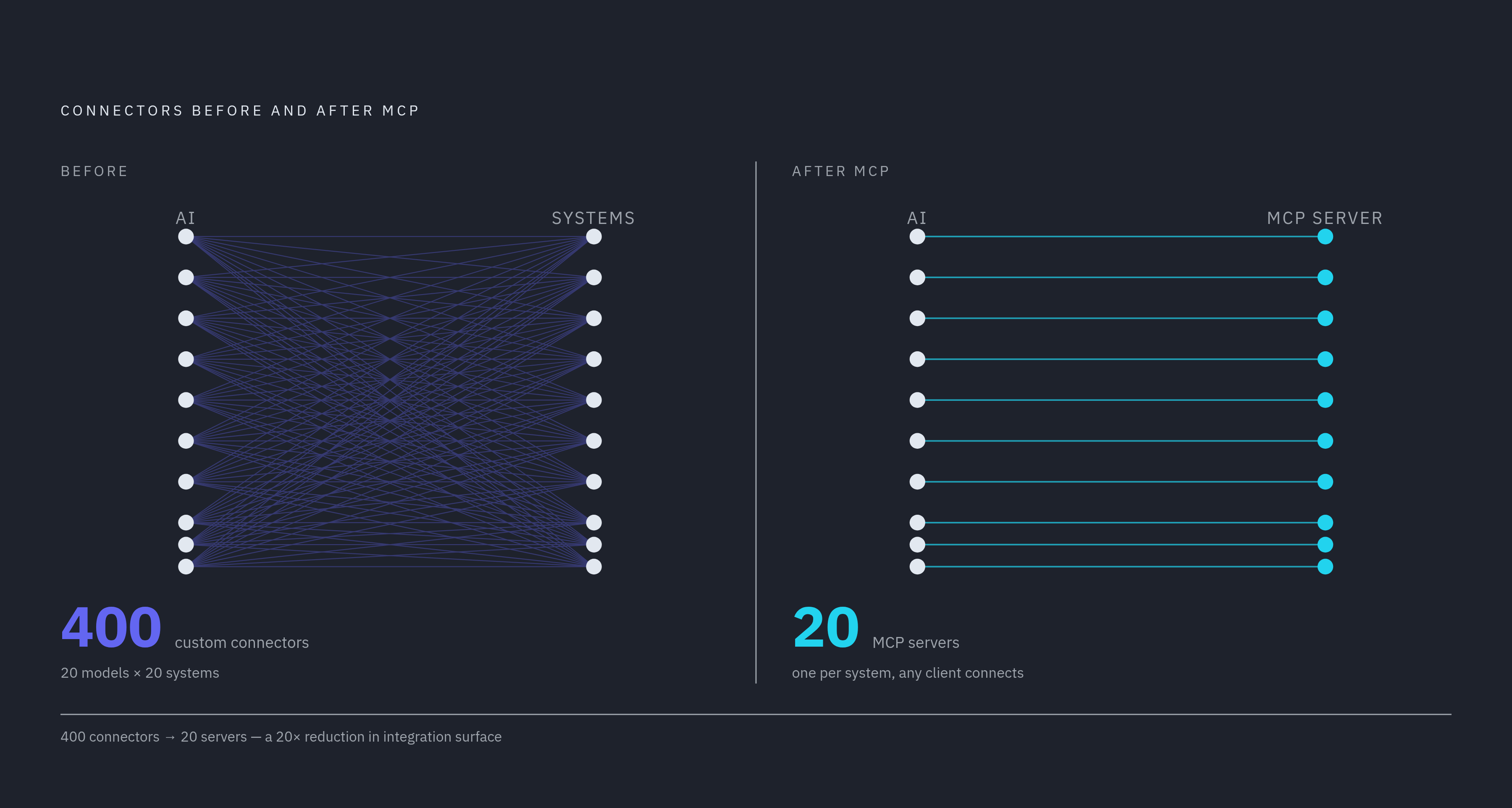
Enterprise AI agents hit a wall before they could do real work, and that wall was plumbing. Before the Model Context Protocol (MCP) existed, hooking up multiple AI models to multiple business systems meant building a custom connector for every single pair. Twenty AI models and twenty enterprise systems, without a shared protocol between them, could add up to 400 separate connectors. Each one needed its own login setup, its own rules about who could see what, and its own upkeep, so the connection work itself became the bottleneck long before any agent touched a real task.
That's the quiet reason so many early enterprise AI pilots stayed small and boxed in: one team, one model, one system, one custom build, with no path to anything bigger. The wiring around it just didn't carry over from one use case to the next, so nothing scaled.
There's a useful comparison from an older corner of software: the Language Server Protocol, or LSP, solved almost the same problem for programming languages and development tools years earlier. LSP gave the industry one shared way for a language and a tool to talk, so the integration got built once and every editor could use it. MCP does the same job for AI and the tools it needs to reach.
MCP's Architecture
MCP is an open protocol that gives AI systems a common way to connect to outside tools, data, and services. None of that is academic. Those are the exact properties that make MCP workable across a large company running many AI tools on many systems at once.
Anthropic released MCP as open source in November 2024, and in December 2025 handed it over to the Linux Foundation's Agentic AI Foundation, where OpenAI sits as a co-founder alongside support from Google, Microsoft, and AWS, among other Platinum members.
The math changes in a simple but important way. So instead of a connector for every model-system pair, a company builds one MCP server per system, and any MCP-compatible AI client can use it. Security also gets handled per server: MCP uses OAuth 2.1, and each server manages its own login scope, so if one connection gets compromised, it doesn't hand over the keys to every other system in the building. By the time these sources were gathered, Claude, ChatGPT, Gemini, and Microsoft Copilot all had native MCP support built in. A server built today can serve every major AI tool a company is likely to put in front of employees.
Access rules get enforced at the gateway, not inside each AI client, and someone just points the new client at the gateway that's already there.
Enterprise MCP Adoption and the Governance Gap
MCP has moved well past experiment and into mainstream infrastructure, at least by the numbers. Anthropic's December 2025 ecosystem update counted 97 million monthly SDK downloads and more than 10,000 active public MCP servers. Every major AI platform, Anthropic, OpenAI, Google, and Microsoft, now ships native MCP support, and on the enterprise software side, CRM platforms, developer tools, and marketing automation vendors have all added MCP support of their own.
None of that traction means companies are actually running MCP safely in production. An estimated 11 to 14 percent of enterprise agentic AI pilots make it to production. The obstacles companies report are consistent across the board: the technical headache of mapping MCP tools onto old internal systems, friction between IT, security, and the business side over who signs off on what, and, most often, no registry, no approval process, and no audit trail in place before an agent gets write access to anything that actually matters.
Security hasn't caught up with how fast MCP has spread, either.
Adoption and governance maturity are two different measurements, and treating them as one is how a lot of companies get stuck. The organizations that make the jump from pilot to production are the ones that track both separately and close the governance gap on purpose. That gap is proof that the companies closing it are building a real edge over everyone still stuck in pilot.
Pinterest's production architecture as a blueprint for what governed MCP deployment looks like
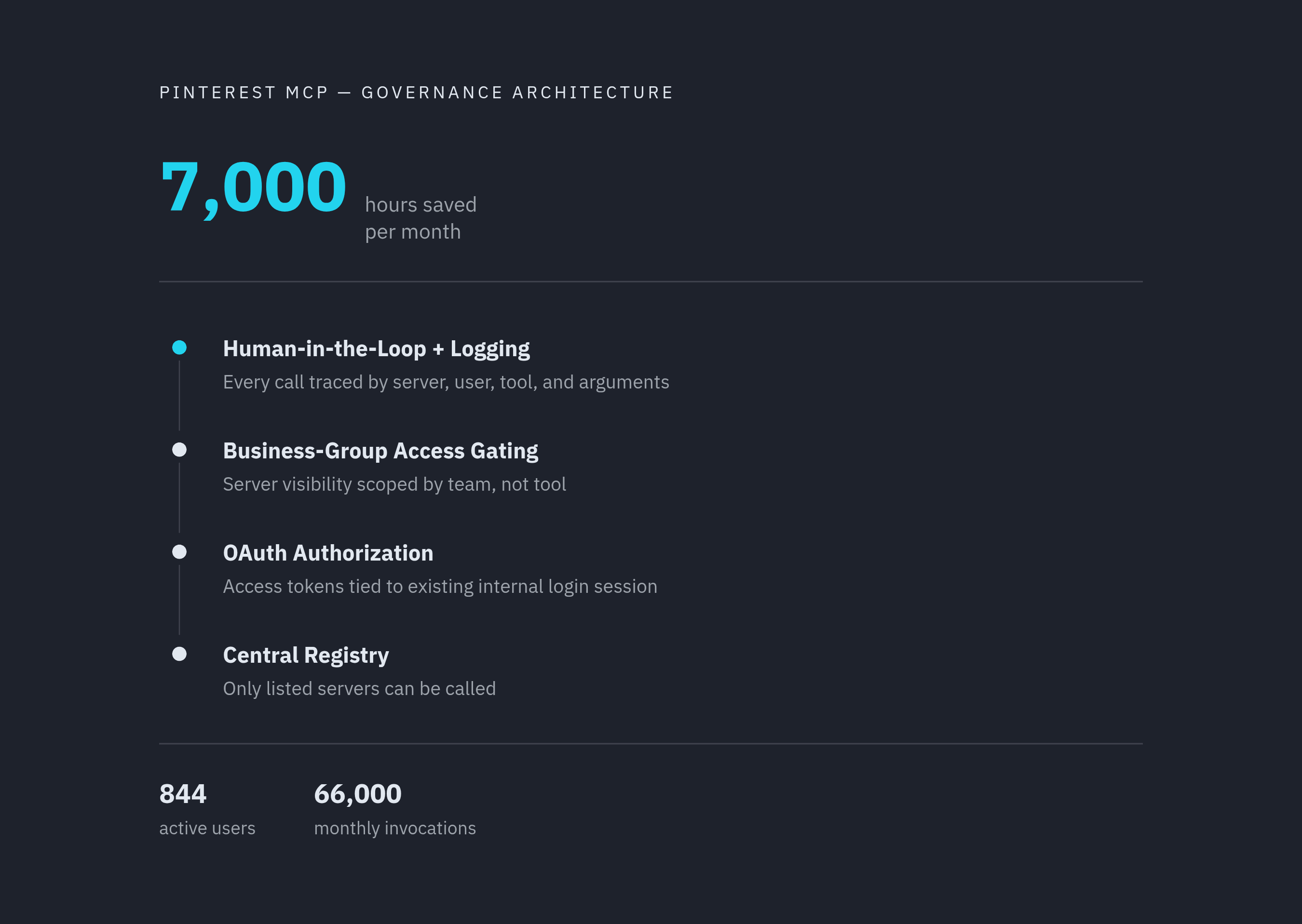
Pinterest's production MCP setup shows what closing that gap actually looks like in practice. The numbers are concrete: 844 active users, 66,000 monthly invocations, and an estimated 7,000 hours saved per month. What got Pinterest there wasn't a bigger model or a flashier agent. It was the governance work underneath a whole fleet of narrow, purpose-built servers.
Pinterest built separate, domain-specific servers for each tool domain. Keep an agent's data queries pointed only at Presto tools, with no Airflow pipeline-management commands cluttering the same connection, and the whole exchange stays lean. That split also helps because a team can actually manage access control: a Presto server can be locked down to data engineers, so it doesn't accidentally open up through some broad company-wide chat tool.
Four governance pieces hold the whole thing together. A central registry acts as the single source of truth, and a server that isn't listed there simply can't be called. Authorization runs through access tokens that ride on an employee's existing internal login session by way of an OAuth flow, not a separate SSO token, so nobody has to face a fresh login screen every time they touch a new server. Access gets gated by business group, so if a server shows up in a wide-audience chat tool, it doesn't quietly open sensitive data to people who shouldn't see it. And human-in-the-loop checks sit alongside detailed logging, so Pinterest can trace exactly which server got called, by whom, from which tool, and with what arguments. Regulated industries need that kind of audit trail, so the MCP 2026 roadmap lists it as a top priority for enterprise readiness.
How Atlassian's MCP deployment demonstrates cross-surface consistency at scale
Atlassian's MCP deployment makes a different but related point: the same work context, Jira issues, Confluence pages, project status, becomes reachable by an engineer inside Cursor, a product manager inside Claude, and an ops team running a custom script, all without rebuilding the connection for each one.
The scale here is hard to overstate: Atlassian's MCP deployment sees more than 15 million calls a day, putting it among the most heavily used public MCP integrations on record. No company runs its AI work through a single tool, so the value of an MCP server grows with every new client that can call it, and each new client adds that value without requiring any new integration work on Atlassian's end.
Pinterest and Atlassian sit on opposite sides of the same coin. Atlassian built a customer-facing server, so outside companies can reach it through whatever AI tool they already use. Both prove the same point: build it once, and it works everywhere, just in different settings. And the governance holds across both: when Atlassian enforces a permission boundary at the server level, that boundary applies no matter whether the request comes from Claude, ChatGPT, or Cursor. Access control travels with the context itself, not with any one tool, which is exactly the property that makes department-level servers worth building next.
Department-specific MCP servers in RevOps, Engineering, Support, and Sales
The companies getting the most out of MCP right now aren't betting on one all-purpose agent. They build narrow servers instead, and each one hands a team's AI the live, working context that team deals with every day.
In RevOps, an MCP server connects AI tools to a CRM, data enrichment sources, outbound tools, and reporting systems, giving agents live numbers to work from directly. Salesforce added MCP support back in June 2025, and it's now a standard way for AI agents to work inside Salesforce orgs, used by SDR teams, RevOps, and sales engineering alike. The sharpest use case occurs when a question needs data from several vendors at once, customer health, support tickets, and payment signals together, pulled through a warehouse that holds all of it in one schema instead of chaining together a dozen separate tool calls.
Engineering teams tend to move fastest with MCP because the integration is light and the payoff appears almost immediately in code review help, watching CI/CD pipelines, and generating tests straight from a spec, the most common uses. Pinterest's own numbers back this up directly. Its Presto MCP server, which lets engineers pull data in seconds instead of waiting several minutes per lookup, is the busiest server in its whole fleet and the biggest single contributor to the time savings Pinterest measured.
Support servers usually chain together a ticketing system like Zendesk or Intercom, an internal knowledge base, and a payments platform, giving an agent a customer's full case, account, and transaction history in a single call.
Sales use cases lean toward meeting notes and follow-ups, keeping CRM data clean, and tracking how deals move through stages, the kind of work that eats a rep's day without needing much judgment call by call. An MCP gateway that inherits those permissions keeps a rep's AI tool access limited to their own territory, matching what they could already do through the CRM's own interface.
A governed registry versus a fleet of ungoverned scripts
Building a stack of domain-specific MCP servers without a registry to track them doesn't produce governed infrastructure. Instead, you get a faster way to pile up ungoverned integrations, scattered credentials, and the same work rebuilt five separate times by five separate teams. Pinterest ran into exactly this before it built its registry: early MCP use there ran on local configuration files, and once hundreds of agents were running across the engineering fleet with no central visibility into any of them, tool sprawl, leaked credentials, and unauthorized access to systems followed close behind.
A registry fixes that by giving the company one place to check which servers are actually approved for production, with a server left off the list simply unable to be called. It ties every server to a team that owns it, so someone is accountable when a server starts behaving differently. It tracks changes to a server's tools or scope over time, catching a regression or an unplanned expansion of access. It records who's allowed to call which server, so a tool built for one team's narrow use doesn't quietly become available to the whole company. And teams can search and find servers that already exist, so five different departments don't each rebuild the same prompt against the same CRM.
The MCP 2026 roadmap, published by the AAIF in March 2026, names standardized audit trails and enterprise login integration, including a move toward OAuth 2.1 and SAML or OIDC, as top pre-RFC priorities for enterprise readiness, and the registry is where a company actually puts those controls into practice.
Once a skill lives in a governed registry, any team in the company can find it and reuse it instead of building the same integration over again from scratch, and that compounding effect is worth sitting on. That turns a single team's productivity win into infrastructure the whole organization can draw on. A well-built MCP registry gives every team its own scoped slice of context that plugs into whatever agent or chat tool they're using, with no custom interface to build or maintain per team, and with permissions pulled automatically from the source systems instead of redefined from scratch every time a new AI tool shows up.
The organizational conditions that determine whether an MCP deployment reaches production
What separates the companies stuck in pilot from the ones running MCP in production isn't which AI model they picked. It comes down to four organizational conditions getting resolved before anyone tries to scale: permission inheritance, domain ownership, registry governance, and audit coverage.
Ownership matters just as much as access. The teams that built servers people actually used, in RevOps, in support, in engineering, were the teams who understood the operational details, not a central IT group working from the outside. Central IT, on its own, can't know what a Presto query agent or a deal-stage analysis tool should and shouldn't be allowed to touch. That judgment belongs to the people doing the work.
A registry has to exist before a deployment spreads wide. Companies that skipped this step are the ones turning up in the security incident reports.
Audit coverage needs to go down to the level of each tool call: who called it, with what arguments, and what came back, mapped against standards like SOC 2 and GDPR and whatever internal risk review a company runs.
None of this means MCP itself is immature. Getting there early is an advantage that keeps compounding as the standard itself keeps changing.