platforms for connecting AI agents to enterprise knowledge sources
MCP solves the M times N integration problem by inheriting permissions instead of rebuilding them.
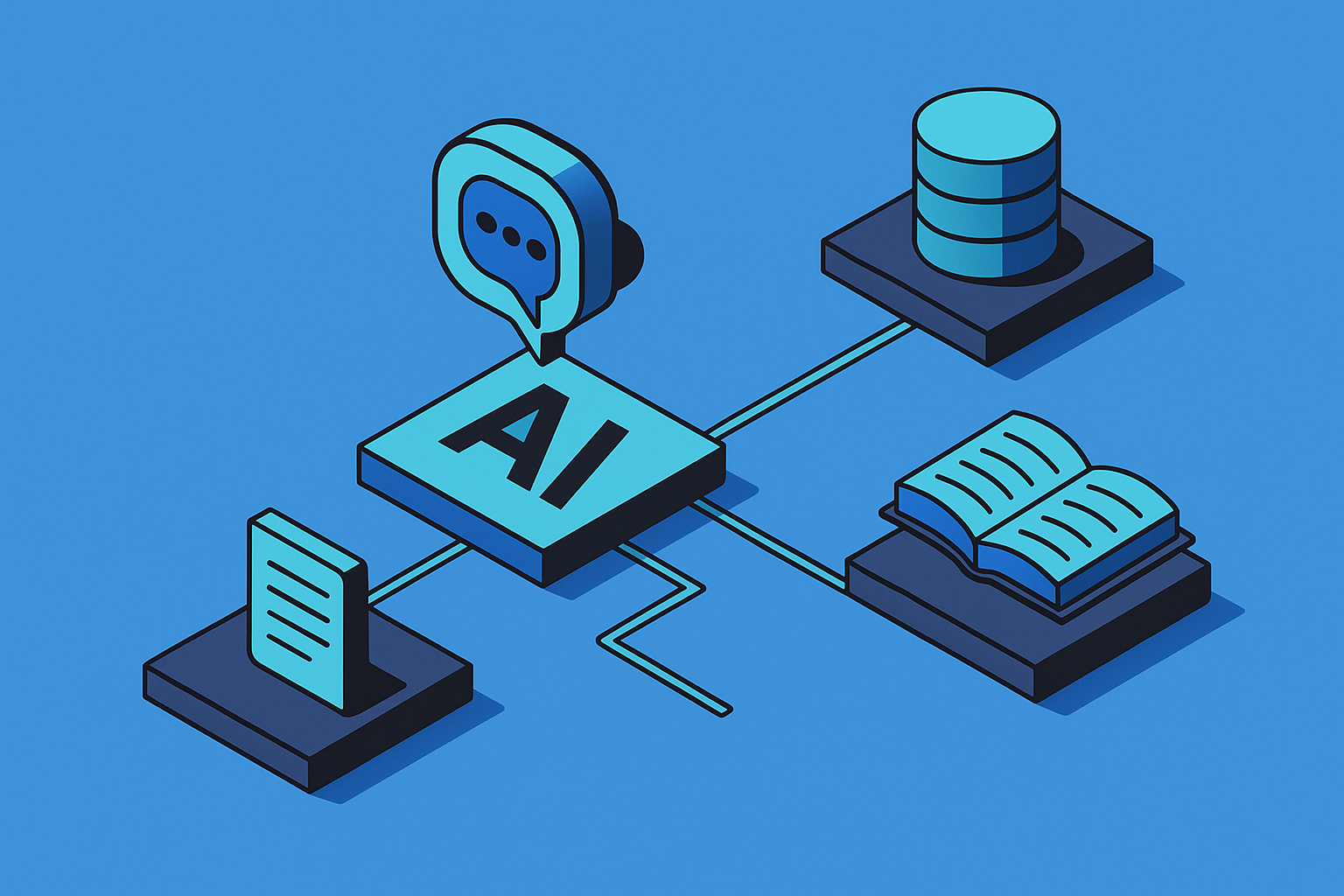
AI agents connecting to enterprise knowledge sources looks like a technical problem on the surface. Underneath, it's a governance problem wearing an integration costume. Model Context Protocol, or MCP, was built to solve both at once: it gives agents one common way to reach company data, and it inherits the permission structure already sitting in the underlying systems instead of inventing a new one from scratch.
Most teams nail the first part and botch the second. Things fall apart right there.
Sure, an agent is only as good as the context it can pull from, but that's the easy half. The harder question is what happens when five teams connect five different agents to the same CRM, each one writing its own integration, each answering "who can see what" a little differently. One team locks customer records down tight. Another leaves them wide open because nobody thought to ask. Multiply that across every team, every tool, every rollout, and the integration surface grows faster than anyone can track, while the permission model ends up belonging to no one in particular.
BCG has a name for the pre-MCP landscape: integration complexity rises quadratically as agents spread. Every new agent times every new data source is one more thing to build and one more thing to secure. Shadow AI creeps in, undocumented connections pile up in corners nobody's watching, and data leaks through gaps nobody knew existed because nobody had the whole picture, just their own slice of it. MIT's 2025 research on enterprise generative AI found that most pilots delivered no measurable return, and integration failures were a big reason why. Fix one half of this problem and skip the other, and the failure point just moves downstream.
What MCP is and the specific gap it was built to close
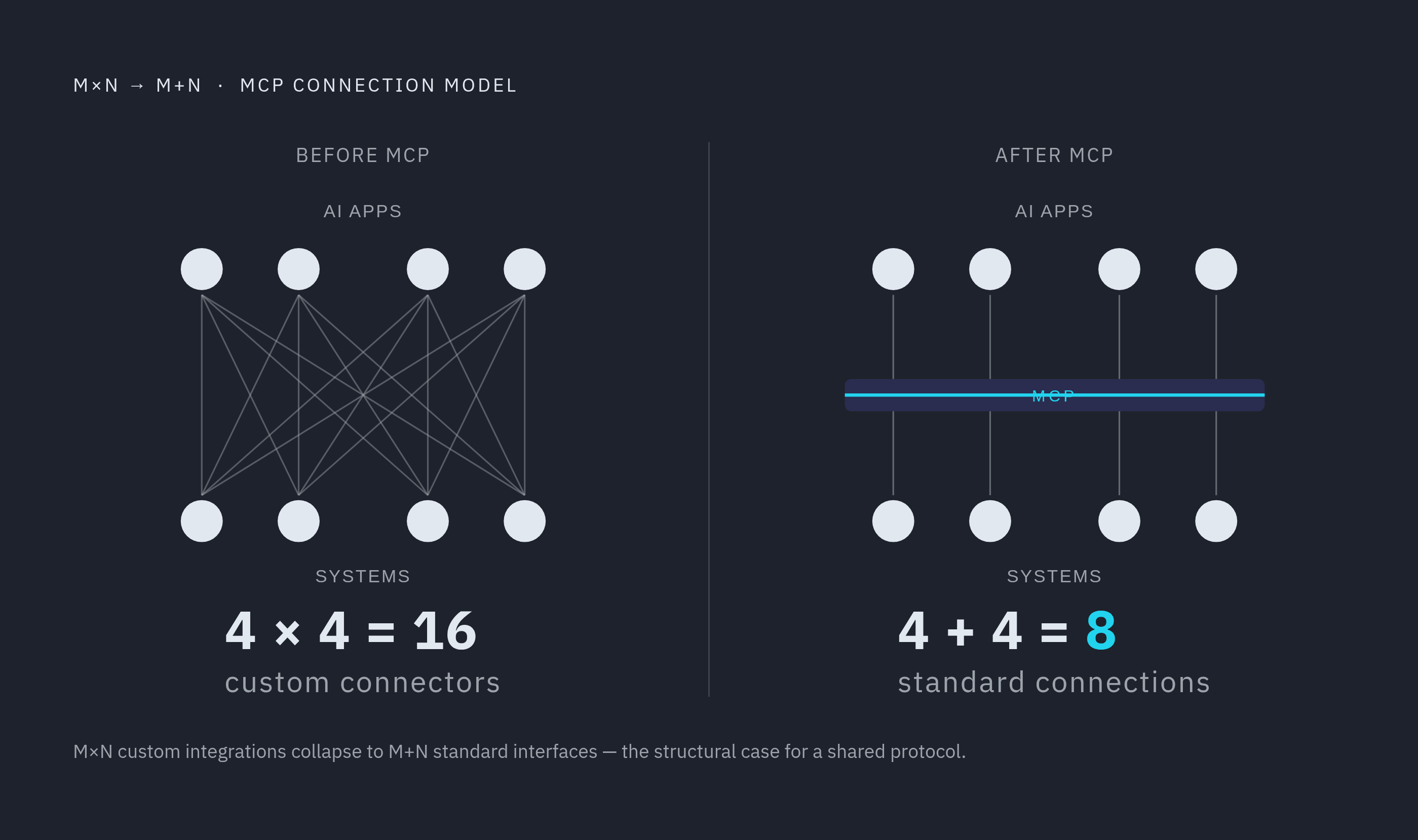
Anthropic put MCP out as an open-source project in November 2024, aiming to kill off the mess of custom, one-off integrations every company was building between AI tools and business systems. Before MCP, an agent that needed to talk to Salesforce, or Jira, or an internal wiki needed its own connector, built from scratch, with nothing left over for the next team to reuse.
People compare MCP to USB-C, which standardizes the physical connection. MCP standardizes something harder: the permission conversation that has to travel alongside the connection. That part is what actually matters once you're handling customer data, financial records, and internal documents.
Do the math on it. With M different AI apps and N different business systems, and every pairing needing its own integration, you're building something close to M times N connections. Add one system and you've added M new integrations; add one AI app and you've added N more on top of that. This is exactly what BCG means by complexity rising quadratically without a shared protocol.
MCP changes that math. Each system exposes one standard interface, each AI client speaks one protocol, and M times N becomes M plus N. That gap is the difference between a problem that gets worse every quarter and one that scales in a straight line.
The pieces break down simply enough:
- Host: the app the person actually sees, like Claude Desktop, Cursor, or some internal tool the sales team put together
- Client: the piece inside the host holding one connection open to one server
- Server: the program exposing the tools, resources, and prompts the agent can call on
The model never talks to a server directly. The host runs the conversation, the model decides what it needs, and the protocol carries the messages back and forth. Underneath, MCP runs on JSON-RPC 2.0, using STDIO for local connections and HTTP for remote ones. None of that is exciting to look at, but it's the plumbing holding the whole thing up.
What you get out of it, in plain terms: one permission model that follows the agent everywhere instead of getting redefined every time someone bolts on a new connection. That redefinition, over and over, is exactly what a pile of custom integrations tends to produce.
How quickly MCP became the default standard
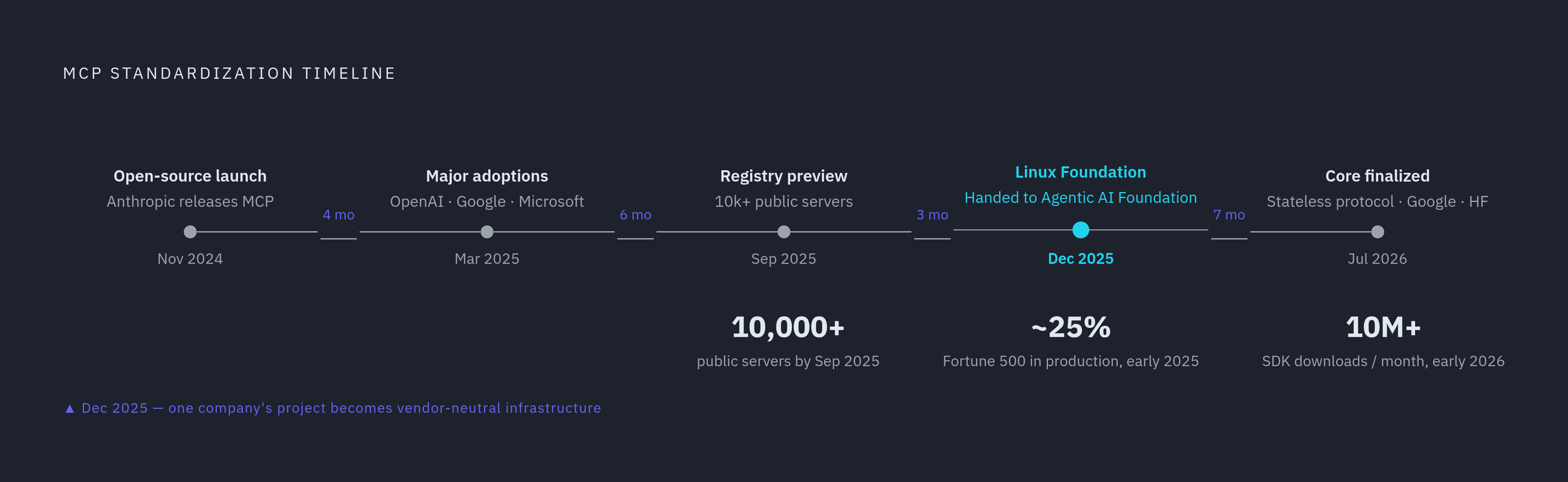
The timeline moved fast. An Anthropic side project became a Linux Foundation standard in under 18 months, and standards don't usually move like that.
November 2024 brought the open-source launch. By March 2025, OpenAI had adopted it, with Google DeepMind and Microsoft close behind. September 2025 brought an official MCP Registry into preview. Then, in December 2025, Anthropic handed MCP to the Agentic AI Foundation under the Linux Foundation, co-founded with Block and OpenAI, locking in vendor-neutral governance instead of leaving the protocol under one company's thumb. By July 2026, the stateless protocol core was finalized, co-developed with Google and Hugging Face, so MCP now runs on ordinary HTTP load-balanced infrastructure instead of needing anything exotic bolted on.
The ecosystem numbers back the timeline up. Early 2026 counts put active public MCP servers above 10,000, and the SDK, across Python and TypeScript combined, was clearing tens of millions of downloads a month. Client support now spans Claude Desktop, Claude Code, Cursor, ChatGPT, Codex, GitHub Copilot, Gemini, Windsurf, and Goose, which covers pretty much every major AI surface a company might already have running.
On the enterprise side, roughly a quarter of Fortune 500 companies had MCP servers running in production as of early 2025, more than double the quarter before. That's about as fast as adoption curves get in enterprise software. Fintech leads the pack, which tracks: financial firms live and die connecting to a dozen systems at once, and they've always been heavy API users.
Gartner's forward projection is worth noting: most API gateway vendors and roughly half of iPaaS vendors are expected to natively support MCP features in 2026. Once infrastructure vendors bake something in by default, it's stopped being optional. It's the floor now.
Why permission inheritance is the governance principle MCP gets right
A well-built MCP server inherits the identity and permission model already governing the system it connects to. It doesn't ask you to redefine access rules you spent years getting right in Okta, or Entra ID, or whatever your company runs.
Look at how the serious implementations actually work. Atlassian's remote MCP server uses OAuth 2.1 and respects whatever's already set in Jira, Confluence, and Compass. Azure's MCP server authenticates through Microsoft Entra ID, the same identity system the org already manages. GitLab's MCP server supports OAuth registration and honors whatever permissions already exist in that GitLab environment. The pattern holds across all of them: a server that works around identity instead of through it ends up working around governance too, and you can't pull those two apart.
Server-level access alone isn't enough, though. You need tool-level role-based access control, checked every single time a tool gets called, not just once at the door. A support agent should read CRM records but shouldn't delete them. A finance agent should query payment history without being able to trigger an outbound wire. Different permissions for different actions inside the same server, checked at the moment of invocation, every time, not waved through because the agent already cleared one gate earlier.
There's a newer pattern worth watching too: session-scoped authorization. Access gets time-limited to one task, the agent can't renew its own session, and a person has to sign off on anything new. For high-stakes agentic work, anything touching money or legal exposure, that limit isn't bureaucratic overhead. It's the difference between an agent making one mistake and an agent making the same mistake five thousand times before anyone catches it.
Skip this principle, and permissions get redefined per tool, per team, per deployment. That's the same proliferation problem sitting at the top of this piece, just rebuilt one server at a time.
The organizational failure mode: what happens when teams build MCP servers in isolation
Here's a pattern that keeps showing up: individual teams spin up their own MCP servers without telling anyone, integrations go undocumented, and IT loses track of what's even running. This is the same shadow-AI problem that existed before MCP showed up, just wearing a standard protocol now, which makes it look more official than it actually is.
Five teams rebuilding the same CRM integration five separate times isn't flexibility. It's duplicated work with five different, inconsistent sets of access controls, and no one responsible for reconciling any of it.
There's a concrete technical tell that shows up once this goes too far: the context window. With 5 to 7 active MCP servers connected, tool definitions alone start eating a real chunk of the model's available context. Past roughly 10 servers, performance and cost both get noticeably worse. You'll see it in truncated responses, slower processing, and cost spikes that seem to come from nowhere, until someone finally traces it back to twenty MCP servers nobody remembers approving.
Running this well takes a few things at the org level. A registry, so people can see what already exists before rebuilding it. Version control and clear ownership on every server, including the ones IT didn't build. Role-scoped architecture too, so sales can't wander into the HR database just because both servers happen to sit on the same network.
Audit logging matters more than most teams realize going in. Enterprise-grade audit trails aren't fully baked into the MCP spec yet, and teams that skip building structured logs of tool calls, arguments, and results now are going to have a compliance gap to close later, probably at the worst possible time.
The case for a centralized MCP layer rather than team-by-team server proliferation
The fix isn't complicated to describe, even if it takes real work to build. A centralized MCP server, or a governed registry of servers, gives every team shared access to the same tools and resources. Teams get to focus on building with AI instead of babysitting integrations. AWS's own machine learning blog makes this point directly: centralizing MCP implementation speeds up production readiness because it removes the per-team infrastructure burden that would otherwise get rebuilt five separate times over.
A governed registry gives you things a shared drive full of config files never will. Version control and ownership, so every change traces back to a person and a reason. Access scoping, so you know exactly who can call which server, under which conditions, without guessing. Discoverability, so a team can reuse a skill someone else already built instead of starting from zero. And auditability covering every invocation, not just whether someone got through the front door.
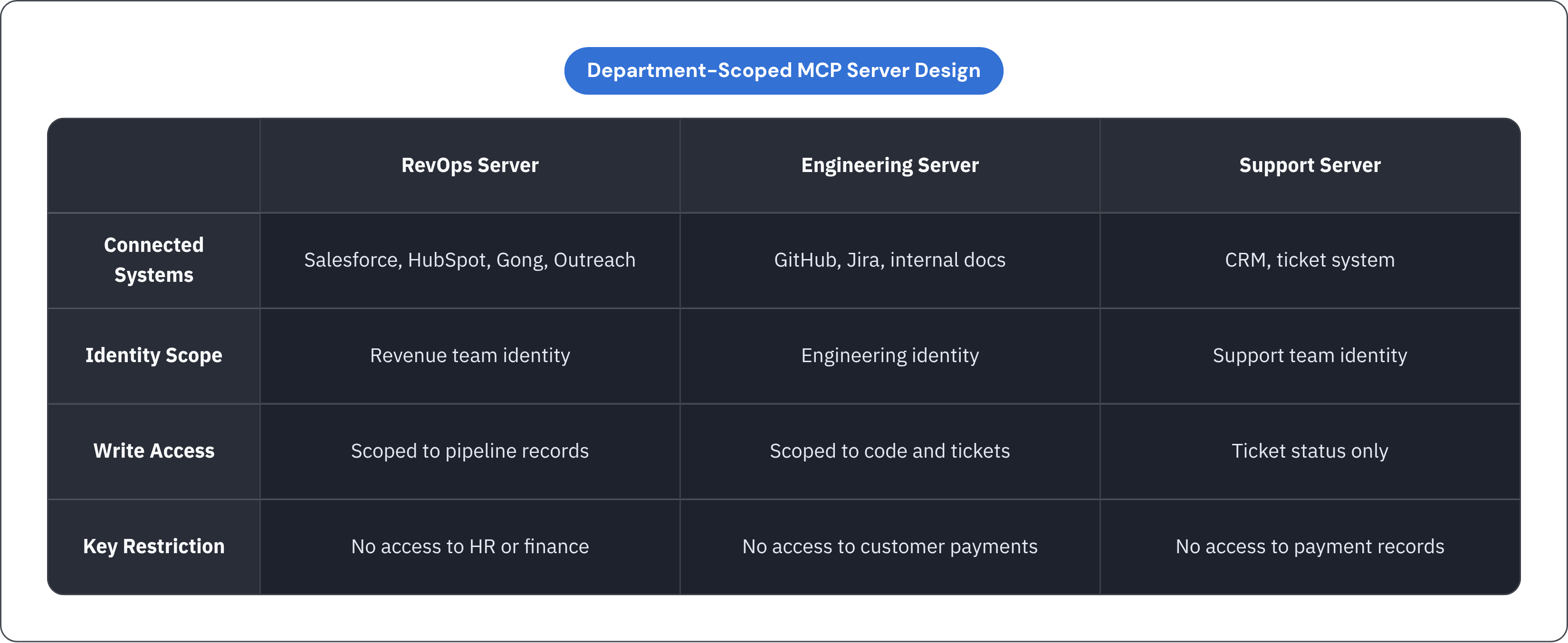
Department-scoped servers are the right unit here: smaller than company-wide servers, bigger than one-off personal ones. Each department gets a server exposing only what its function actually needs, with permissions inherited from the systems of record that department already relies on.
A RevOps server might connect Salesforce, HubSpot, Gong, and Outreach, giving real-time access without a custom integration for each tool. An engineering server connects GitHub, Jira, and internal docs, scoped to engineering identity rather than blanket company access. A support server gets read access to the CRM and ticket system, with write access limited strictly to ticket status, nowhere near payment records.
The payoff for this kind of structure shows up in real numbers, not just tidier architecture. Organizations implementing MCP with this level of discipline report returns north of three and a half times their spend, and the top performers following a structured rollout reach ten dollars back for every dollar in.
How to sequence MCP implementation without creating the fragmentation it's meant to prevent
Start with read-only access on systems that aren't mission-critical, and prove the thing works before anyone gets write permissions. Split read and write into separate action types from day one, so that distinction is baked into the architecture rather than bolted on after something breaks.
Some timeline benchmarks from teams that have actually done this: an initial pilot, including infrastructure setup, authentication, and training, runs 2 to 4 weeks. Full rollout across an organization takes 3 to 6 months, depending on how tangled the integrations are and what compliance rules apply. Teams using managed infrastructure instead of self-hosting cut deployment time by more than half.
On transport, design for remote servers using Streamable HTTP from the start. Zuplo's December 2025 State of MCP survey found close to 60% of MCP builders now use Streamable HTTP, against roughly a third still on stdio. Local subprocess connections are where the ecosystem used to live, not where it's headed.
Authentication has a short, non-negotiable list. OAuth 2.1 for anything remote, role-based access enforced at the tool level rather than just at the server's front door, version pinning so nothing updates without someone signing off, and trust domain isolation, meaning servers from different trust domains shouldn't be sharing session context with each other.
Context window discipline needs to be an actual habit, not a one-time cleanup. Keep the active server count in the 4 to 7 range, and use an MCP gateway with dynamic tool loading instead of preloading every tool for every conversation whether it's needed or not.
On build versus buy: MCP servers turn into long-term infrastructure the moment they hit production. They need to scale, stay secure, and keep pace with a spec that's still moving. For most teams, managed infrastructure should be the default, unless the MCP layer itself is what makes your product different from a competitor's.
What platforms for governed MCP actually provide
The right question when you're evaluating a platform goes beyond "does it connect agents to data," since plenty of things do that now. The harder question is whether the connection is auditable, scoped by permission, and reusable across teams, without every team rebuilding the same plumbing from zero, again.
Governed MCP platforms separate themselves from basic integration tools in a few specific ways. Permissions inherit automatically from the connected source systems, with no manual redefinition needed per agent. There's a real registry, with version control, clear ownership, and discoverability, not a shared folder full of server configs nobody maintains. Role-based access gets enforced at the tool level, at the moment of invocation, not just as a gate at the server's front door. Audit logging is built into the platform itself, rather than depending on whether each team happened to implement it on their own. And the whole thing is model-agnostic, so the business context and permission rules travel with the company instead of getting locked to one AI provider.
Other platforms show up in these evaluations too, each with its own angle. Amazon Bedrock offers a centralized MCP server architecture with AWS-native identity and scaling, a good fit for companies already deep in the AWS ecosystem. Kong brings strong API gateway support for MCP at the transport and authentication layer, in line with Gartner's projection about gateway vendors broadly supporting MCP natively in 2026. Atlassian and Azure's native MCP servers handle permission inheritance well inside their own ecosystems, but get weaker once a use case spans multiple vendors or needs a registry that works across teams. Gateway products like Zuplo tackle the context window and dynamic tool loading problems head-on, though they're less focused on the organizational registry and reuse layer that governance actually depends on.
Ask any vendor this directly: does it solve the registry and reuse problem, or only the connection problem? Most point solutions solve connection. The governance gap, the part that actually stops fragmentation, tends to sit unaddressed at the organizational layer until somebody notices, usually too late.
What enterprises should actually be deciding right now
MCP is no longer a bet on some emerging technology. With roughly a quarter of the Fortune 500 already running it and climbing, a Linux Foundation home, and every major AI vendor building support for it, the protocol question is settled. What isn't settled, at most companies, is the governance question sitting underneath it.
Enterprises right now are choosing between adopting MCP through a centralized, governed layer, or letting it spread team by team the way shadow IT always has, just with a standard protocol giving it cover this time. On one side sits a registry, inherited permissions, and audit trails from day one. The other path leads to the same fragmentation described up top, dressed up in newer language.
Companies that get this right treat MCP servers as infrastructure, owned deliberately rather than left to whichever team happened to move fastest. They centralize discovery, scope access by department, and log everything, because eventually someone in compliance is going to ask who an agent talked to and what it was allowed to touch. Those that get this wrong find out during an audit, usually later than they'd like. Credal, an enterprise platform for building and governing AI agents that provides permissioned MCP servers with audit logging and centralized policy control across 1,000+ connectors, is one infrastructure option built around that centralized-registry model.