Taxonomy and Metadata Standards for Enterprise AI Retrieval
Structured metadata stops enterprise AI retrieval from failing before inference begins.

I've spent enough time in that gap to know where it lives: not in model quality, but in what the model gets fed.
Below is the corrected text with the "Not X, It's Y" constructions removed or reworked, while preserving structure, headings, names, and factual content.
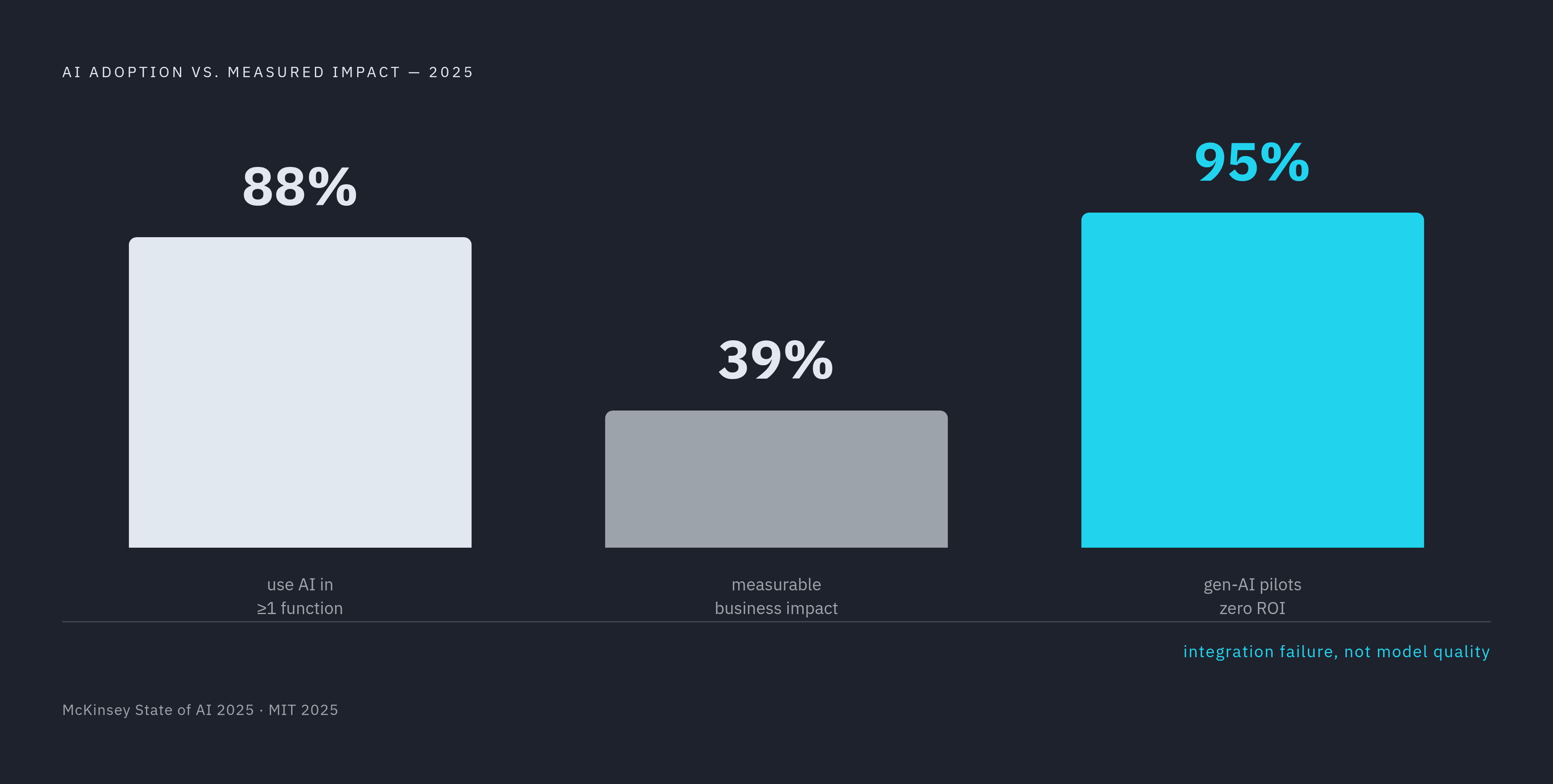
Enterprise AI retrieval breaks before a query ever reaches the model. It breaks upstream, in the messy layer of document tagging, ingestion, and indexing that nobody wants to own. McKinsey's 2025 State of AI survey found 88% of organizations use AI in at least one business function, but only 39% report measurable business impact. I've spent enough time in that gap to know where it lives: the problem sits less in model quality and more in what the model gets fed.
MIT's 2025 research on enterprise generative AI pilots put a number on it that made me stop and reread the paragraph twice. Roughly 95% delivered no measurable ROI, and the cause traced back to integration failures more than anything else. Capable models kept getting the wrong context, or none at all. In a RAG pipeline, everything that determines whether an answer is right happens before inference, during ingestion, chunking, tagging, and indexing. Garbage in, garbage out applies here with more force than almost anywhere else in software I've worked with.
Three failure modes keep showing up, over and over, across every deployment I've looked at. Missing metadata means the system has no idea who authored a document, what department owns it, or whether it's still current. Inconsistent taxonomy means "Sales" in one system, "Revenue" in another, "GTM" in a third, and the retriever has no way to know they're the same thing. Permission blindness means the retrieval layer hands users documents they shouldn't see, because access controls never made it into the index to begin with. MuleSoft's 2025 Connectivity Benchmark found organizations run an average of 897 applications, with only 28% integrated. Semantic definitions scatter by default. This piece is about the fix: a taxonomy and metadata standard that closes the gap before the model ever sees a query.
What vector search alone cannot tell a retrieval system
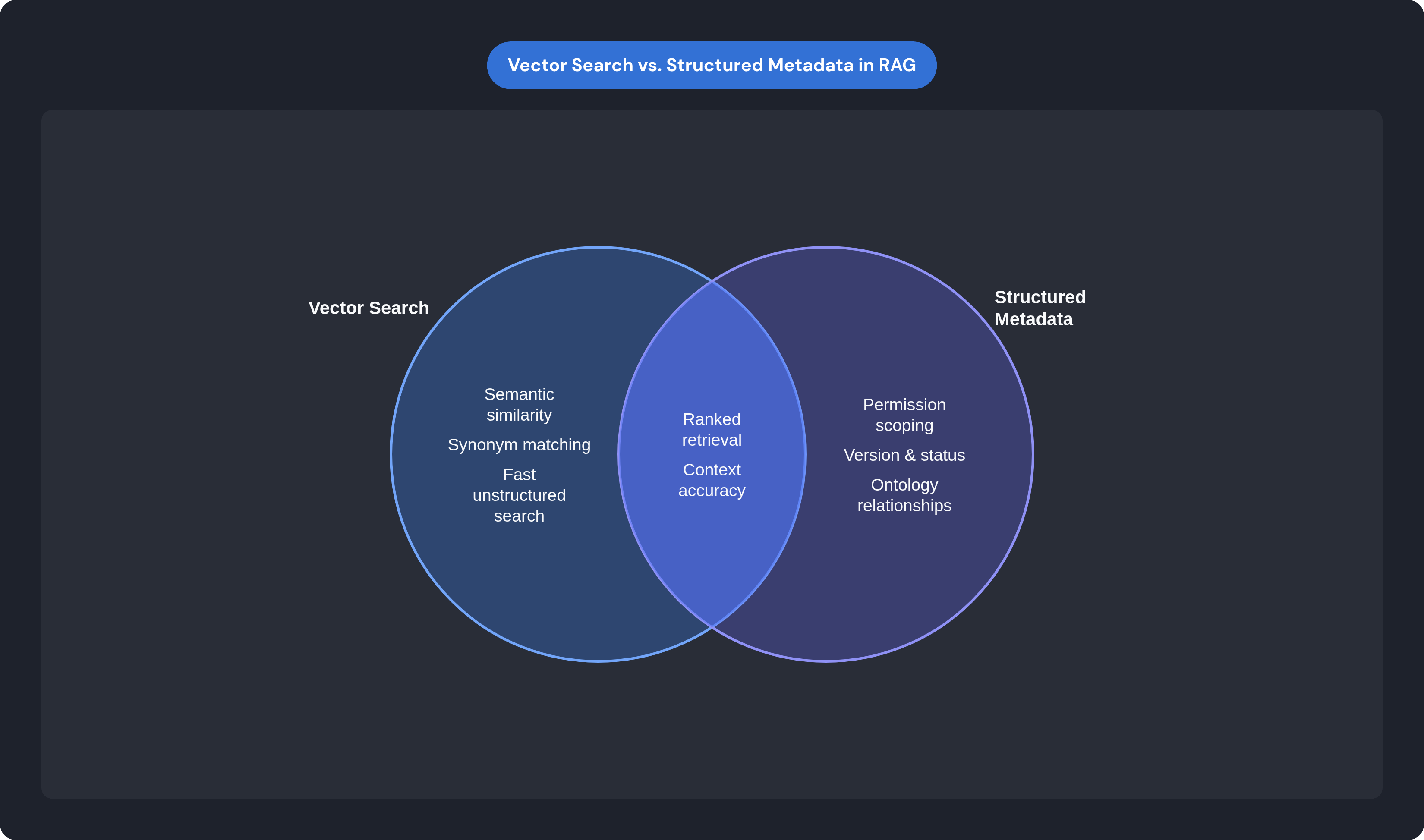
Vector embeddings are genuinely good at one thing: finding text that means roughly the same thing as your query, fast, across messy unstructured content, even when the wording doesn't match. Paraphrase, synonym, loose semantic overlap; embeddings handle all of it well.
But they can't do three things that matter a lot once you're inside an actual enterprise.
They don't understand relationships. A vector has no concept of product hierarchies, org charts, or process flow. It doesn't know "EMEA pricing" sits inside "global pricing policy" as a subset; it just sees two chunks of text sitting close together in vector space.
They favor recency of ingestion over recency of truth. A policy uploaded last week can outscore its own replacement from last month if the older document happens to sit closer to the query. The vector doesn't know which one is authoritative. It only knows which one it saw.
And embeddings flatten everything into the same kind of object. I call this context collapse: turning text into a vector strips away the surrounding signal, audience, authority, purpose, that tells you what you're actually looking at. A draft and its approved final version can produce nearly identical vectors. So can a legal memo and a customer-facing FAQ covering the same ground.
Here's what that costs in practice. A sales rep asks an internal agent about discount limits. The retriever pulls back a superseded pricing policy, because the draft-versus-approved distinction never got encoded anywhere the vector search could see. The model answers confidently, with outdated numbers, because nothing told it otherwise.
Atlan's work on enterprise ontology requirements gets at the root cause. Without a formal model defining concepts, properties, and relationships, an AI system treats every query like a brand-new problem, with no shared understanding of what the terms even mean. Vector search matters, but it can't do this alone; it needs structured metadata to filter, rank, and permission-scope what it finds.
A three-category metadata taxonomy that gives retrieval systems structured context
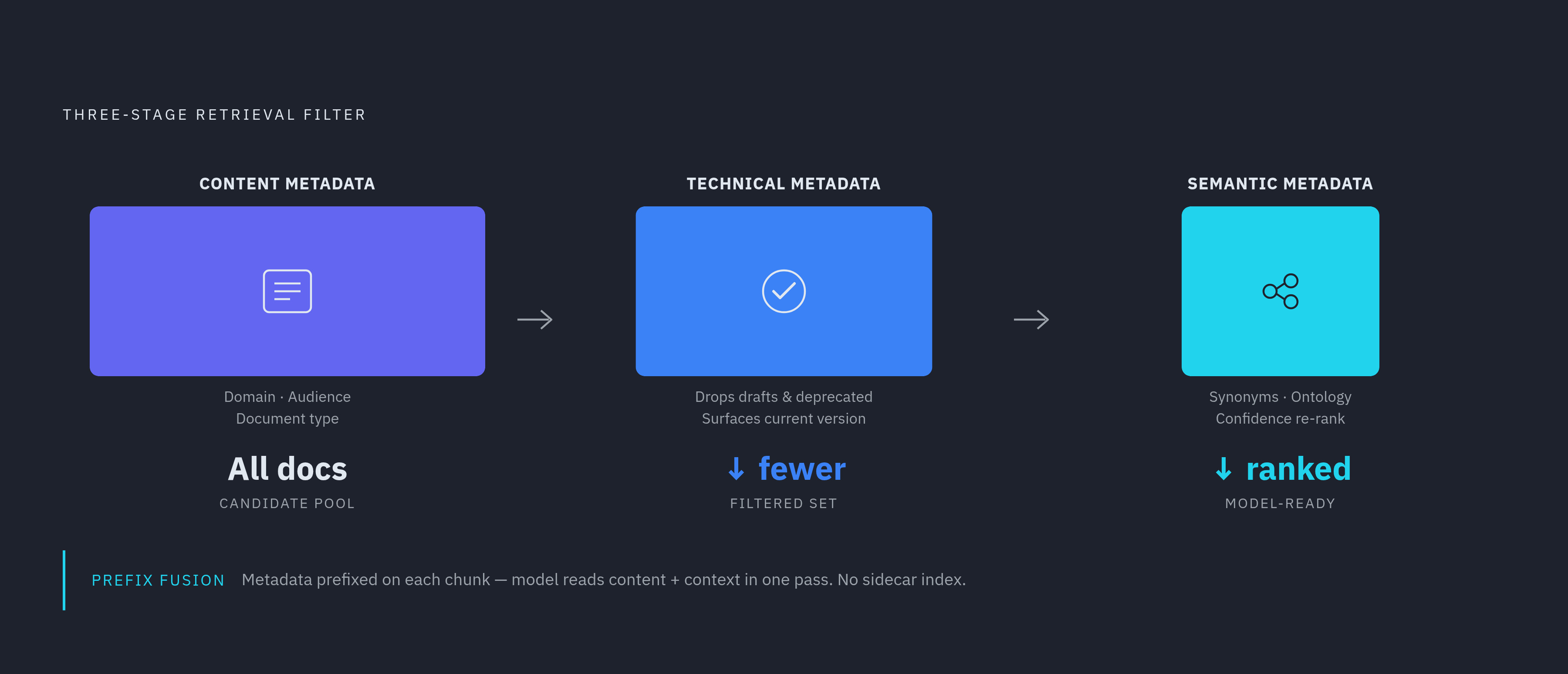
Research accepted to the 2026 IEEE Conference on Artificial Intelligence proposes a three-category metadata taxonomy for enterprise RAG systems, generalizable enough to apply across industries. The approach fuses metadata as a prefix to each document chunk while keeping the three categories separable enough to test and tune independently.
That separability matters more than it sounds like it should. Each category does a different job in retrieval, and because they stay distinct, a team can adjust or remove one without breaking the other two. Try that with a flat list of fifteen undifferentiated fields, and you'll find out fast why nobody bothers.
Content metadata describes what a document is about and who it's for: topic, domain, product line, intended audience, document type (policy, reference, runbook, contract).
Technical metadata describes the operational state of the artifact itself: version, creation date, last-modified date, status (draft, approved, deprecated), owning system, format.
Semantic metadata encodes meaning and relationships: ontology tags, synonyms, related concepts, confidence scores, cross-references to other documents.
In an actual retrieval step, they run in sequence. Content metadata narrows the candidate pool to documents matching the query's domain and audience. Technical metadata filters out the stale or draft material and surfaces whichever version is actually authoritative. Semantic metadata re-ranks what's left, resolves synonym collisions, and pulls in related context that vector similarity alone would never catch.
The prefix-fusion detail is the one I'd flag if you only remember one thing from this section. Rather than building a separate sidecar index the model has to cross-reference, the structured metadata rides along as a prefix on the chunk itself. The model reads the content and the context about that content in the same breath.
This taxonomy is a retrieval-specific standard, built for what an AI model needs to consume rather than what a human needs to browse. It's a different animal from a data catalog schema, a search engine's field list, or a document filing convention borrowed from SharePoint.
Content metadata: helping retrievers know what a document is and who it is for
Four fields do most of the work here.
Document type tells the retriever what kind of answer it's even capable of supporting. A runbook answers "how do I do this." A policy answers "what's allowed." Mix those up in a response and you get an agent explaining company rules in the wording of a troubleshooting guide.
Domain, or business unit, scopes the candidate set to Finance, Legal, Engineering, Sales, whatever fits, without forcing the user to specify it themselves. Intended audience matters just as much: internal-only, executive, customer-facing, partner. A sales rep's question shouldn't surface an internal legal memo just because the vectors happen to sit close together.
Topic tags are where things fall apart most often. This is supposed to be a controlled vocabulary pulled from a shared taxonomy. In practice it's usually ad hoc, and that's exactly where the "Sales" versus "Revenue" versus "GTM" problem lives. With 897 applications average per organization, per MuleSoft's numbers, and only 28% integrated, the odds that any two systems tag the same concept the same way are low.
The fix is a governed controlled vocabulary rather than a folksonomy of free-text tags typed in by whoever happened to ingest the document that week. Maintain it centrally, and map it to each source system's native labels at the point of ingestion.
Here's what it looks like when that discipline is missing. A retrieval agent gets asked about "deal approval thresholds." It returns three documents: one tagged "discount authority" from Finance, one tagged "pricing exceptions" from Sales Ops, one tagged "sales governance" from Legal. All three are relevant. None of them are connected, because no shared topic tag ties them together, so the model has to guess whether it's looking at one policy from three angles or three separate policies entirely.
Content metadata narrows the field. It can't tell you whether a document is current, and it can't tell you whether the person asking is allowed to see it. That's the next two sections.
Technical metadata: filtering for currency, authority, and operational state
Version and status is the single most important field in this category. Draft, under-review, approved, deprecated. Without it, every chunk in the corpus looks equally authoritative to a retriever, and a deprecated pricing policy can outscore its own replacement purely on vector similarity, because nothing marks it as retired.
Creation and last-modified dates let a system filter for genuine recency, instead of leaning on the embedding model's built-in bias toward whatever got ingested most recently. "Recently modified" and "recently ingested" are two different things. Most pipelines treat them as the same signal anyway, which is how stale documents keep winning.
Owning system and source matters too, and not just for bookkeeping. Knowing a document came from Confluence versus SharePoint versus a contract management platform tells you which permission system governs it, and that becomes critical once you hit the access-control layer.
Retention and expiry fields round this out for anything regulated: a field flagging when a document stops being authoritative, or when it's due for review, keeps stale material from quietly becoming load-bearing.
Picture a support agent pulling a product spec tagged "approved, v3.2, owned by Product." The technical metadata does two jobs at once: it tells the retrieval agent this is the current version, and it tells the access layer which permission set applies, without anyone manually re-tagging the document at query time.
Strip this metadata out, and a retrieval system is left with two options, both bad. Return everything and accept the permission risk. Or return nothing and accept that the tool is now useless. Neither survives contact with an actual enterprise deployment.
Semantic metadata: encoding meaning and relationships that embeddings don't capture
This is the category that does the work content and technical metadata structurally can't reach.
Synonym and alias resolution handles the fact that "ARR," "annual recurring revenue," and "subscription revenue" are the same concept wearing three different names. Encode that mapping once, at the metadata layer, and every future query benefits, instead of hoping the prompt happens to land on the right phrasing.
Ontological relationships capture parent-child links (a product line and its individual SKUs), lateral links (two policies governing the same process from different angles), and supersession, where document A was replaced by document B and nobody should be citing A anymore.
Confidence and authority scores acknowledge that not everything written about a topic carries equal weight. A published, approved policy should outrank a Slack thread where someone summarized that policy from memory two years back.
Cross-reference links point explicitly to related material, a pricing policy that references a discount approval workflow, connections a vector search would never surface on its own because the wording doesn't overlap at all.
None of this works without an ontology underneath it: a formal model defining what a "product" or a "customer" or a "deal" actually means across the organization. Skip that step, and every field in this category loses its common referent; each team's version of "product" ends up describing a slightly different thing.
This is also the hardest category to keep current. Business relationships shift constantly, and an ontology that isn't actively maintained drifts out of sync with reality faster than content or technical metadata ever would, because nobody notices the drift until a query returns something wrong in front of the wrong person.
The market is responding at scale. Grand View Research estimated the metadata management tools market at multiple billions of dollars in 2024, projected to reach tens of billions of dollars by 2030. That curve tells you enterprises are taking this seriously, even though most are still nowhere close to solved.
For most organizations, full ontology maintenance is a multi-year investment, not a sprint. A realistic starting point looks like synonym tables, a controlled vocabulary for topic tags, and explicit supersession links between document versions. That floor alone meaningfully improves retrieval over pure vector search, well before anyone builds a formal ontology.
How permissions must travel with metadata through the retrieval pipeline
Here's where a tagging problem turns into a security problem. Even a corpus with perfect content and technical metadata will return wrong answers if the retriever surfaces documents the querying user has no business seeing. Metadata narrows results. Permission-scoped retrieval is what makes the system safe to actually use.
A retrieval system that doesn't inherit permissions from its source systems has two paths, and both are bad. It can rebuild access controls from scratch, which is expensive, error-prone, and guaranteed to drift out of sync over time. Or it can skip access controls entirely, which is a compliance problem waiting for its moment.
Inheritance, done right, looks like this: when a document gets ingested, its access policy, SharePoint group membership, Google Drive share settings, Confluence space permissions, travels with it into the index as part of its technical metadata. At query time, the retriever checks the requesting user's identity against that inherited policy and filters accordingly.
Rebuilding access controls independently fails for a specific reason. Permissions in the source system change constantly. Someone leaves the company, a project wraps, a contractor's access expires, and if the AI index doesn't track those changes, the result is stale access rather than no access at all, which is arguably worse, because it looks like the system is working correctly right up until it isn't.
This only functions if the retrieval system knows who's actually asking, which means resolving the querying user's identity against the same identity provider that governs the source system. MCP's specification update in November 2025 added two relevant pieces: SEP-1046, bringing OAuth client credentials for machine-to-machine authorization, and SEP-990, adding enterprise identity provider policy controls for MCP OAuth flows. Together, these let a user authenticate once and get access to every server they're authorized for, without re-prompting at every step.
Permission-aware retrieval needs technical metadata to carry source-system provenance from day one, and ingestion pipelines that preserve access signals instead of quietly stripping them out for convenience. This isn't something you bolt on later. Once metadata is structured this way and permissions travel with the documents, the real question is whether it holds up consistently across every place employees actually go to ask questions.
Why consistent metadata standards break down across teams without a governed registry
Here's the pattern that shows up almost every time, even in organizations that did the work to define a taxonomy centrally: it drifts. Teams ingest their own sources, apply their own tags, and stand up their own retrieval pipelines. Without a shared enforcement point, the standard becomes a suggestion nobody's actually bound by.
The symptoms are easy to spot once you know to look. Five different teams rebuild the same document-type taxonomy from scratch, each landing on slightly different labels for the same concepts. Ingestion pipelines quietly strip out technical metadata because whoever built the pipeline never knew it was required. A semantic synonym table gets built and maintained by one team, invisible to everyone else in the company.
I think of this as the same failure pattern that produced shadow IT, just one layer up. Shadow IT gave organizations undocumented integrations nobody could govern. Shadow metadata gives you undocumented tagging conventions a retrieval system can't trust, and the damage stays invisible right up until a retrieval result turns out wrong in a moment that actually matters.
A governed registry fixes this by giving the standard somewhere to live. One place where metadata schemas get published and versioned, so teams pull from a single source instead of reinventing their own version each time. Visibility into which sources are connected, what metadata they carry, and which retrieval skills depend on them. And ownership: every schema, every ontology term, every ingestion pipeline needs a named person responsible for keeping it current, because "everyone owns it" means no one does.
Versioning matters here in a way that's easy to skip past. A metadata standard that isn't versioned can't be evolved safely; teams building retrieval agents on top of it need to know exactly when the schema changed and what might break as a result. A registry turns the three-category taxonomy from a policy document sitting in a wiki somewhere into infrastructure.
Putting the taxonomy into practice
None of this works as a one-time project. Standing up content, technical, and semantic metadata categories, wiring permission inheritance through the pipeline, standing up a governed registry, that's an operating model, not a checklist you complete once and walk away from.
Start narrow. Pick one domain, Sales or Finance usually has the clearest document boundaries, and build the full three-category schema out for that domain first. Get the controlled vocabulary right. Get version and status fields flowing straight from the source system. Get permission inheritance tested against real user identities, not a demo account with admin access to everything.
Then expand one domain at a time, reusing the registry and the schema patterns you already proved out. Resist the urge to design the perfect universal taxonomy before you've shipped anything real; a working synonym table and a status field beat a beautiful ontology diagram that never made it into production.
The organizations getting real ROI from enterprise AI retrieval, the ones inside that 39% McKinsey found reporting measurable impact, fixed what happens before the model ever sees the query. A better model wasn't the answer. Fixing the plumbing everyone else was avoiding was.