AI Impact on Knowledge Worker Output Quality vs. Speed
AI speeds up routine tasks but degrades expert work when it ventures beyond its actual capabilities.
How Widely Knowledge Workers Are Actually Using AI in 2025
By 2025, roughly 75% of global knowledge workers use AI tools regularly, double the adoption rate from late 2024. The share of U.S. work hours spent on generative AI tasks grew from 4.1% in November 2024 to 5.7% by August 2025. Generative AI is tracking at 37.4% adoption at a comparable point in its diffusion curve; personal computers sat at 25.1% at the same stage.
That comparison gets cited as a triumph. It's better read as a consequence. This many people using AI this often means the quality outcomes aren't hypothetical anymore. Speed gains are broad and consistent. Quality gains are not. Whether AI improves the quality of output depends almost entirely on what the worker brings to the interaction, and whether the AI has access to the context that makes domain expertise legible.
Where AI Genuinely Accelerates Output, and by How Much
The optimistic case has real evidence behind it. A 2023 experiment published in Science gave knowledge workers a writing task and found that AI assistance cut completion time by 40% while improving quality ratings by 18%. Clean result, controlled conditions, anchors what the technology can do when setup is favorable.
At larger scale, a field study of more than 7,100 workers across 66 firms found that regular Microsoft 365 Copilot users spent 3.6 fewer hours per week on email, a 31% reduction. The St. Louis Fed estimates AI users report saving 5.4% of their work hours, translating to a roughly 1.3% labor productivity increase across the full workforce since ChatGPT's introduction.
Writing, email, structured task completion: consistent acceleration across studies with very different designs and populations. That consistency is real and shouldn't be dismissed.
But these studies share something structural. The tasks are well-defined, the outputs measurable, and the work mostly individual. Those are exactly the conditions AI handles best, and also not representative of most knowledge work at scale, where tasks are ambiguous, outputs are contested, and context is organizational rather than personal. Think of it like a calculator that's great at arithmetic but silent on insight — fast on the numbers, useless on the meaning behind them.
Why Customer Support Became the Clearest Natural Experiment on Skill and AI
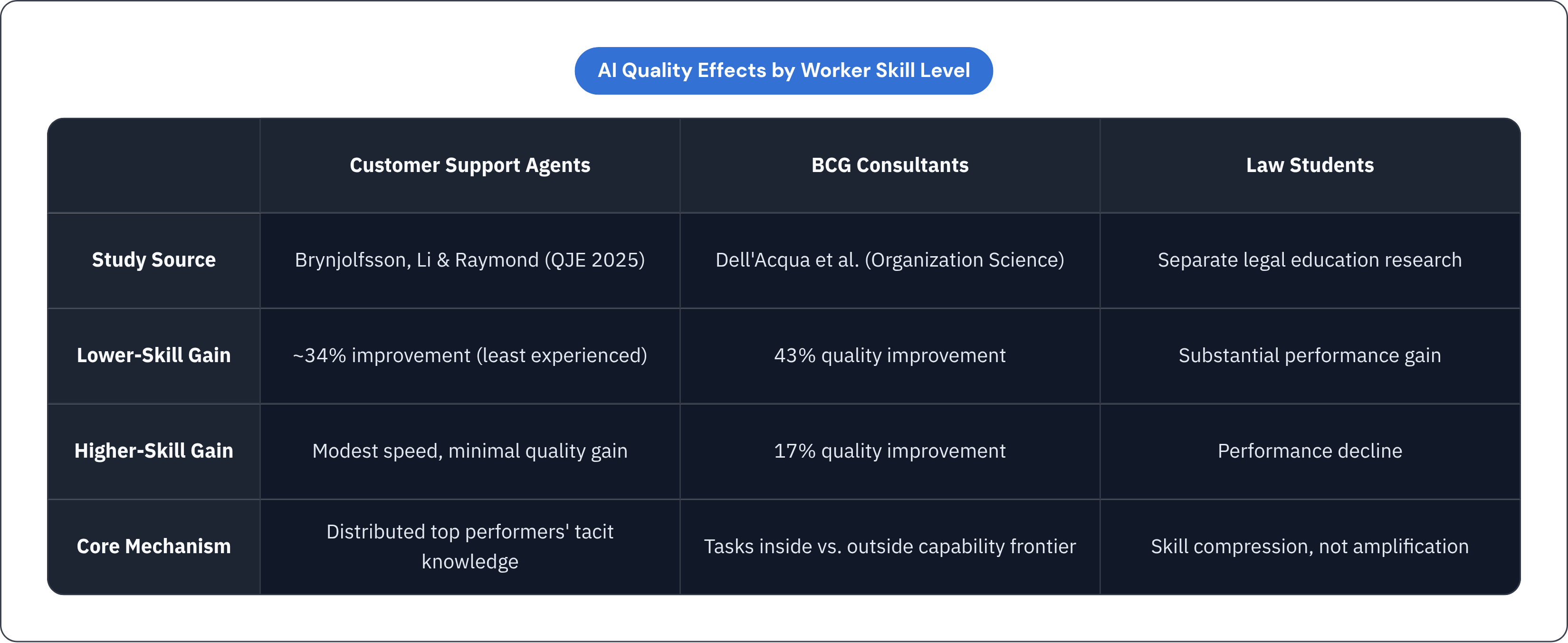
A 2025 study published in the Quarterly Journal of Economics by Brynjolfsson, Li, and Raymond studied 5,172 customer support agents at a Fortune 500 software company. AI assistance raised issues resolved per hour by 15% on average. Solid headline number, but the average is doing a lot of work here.
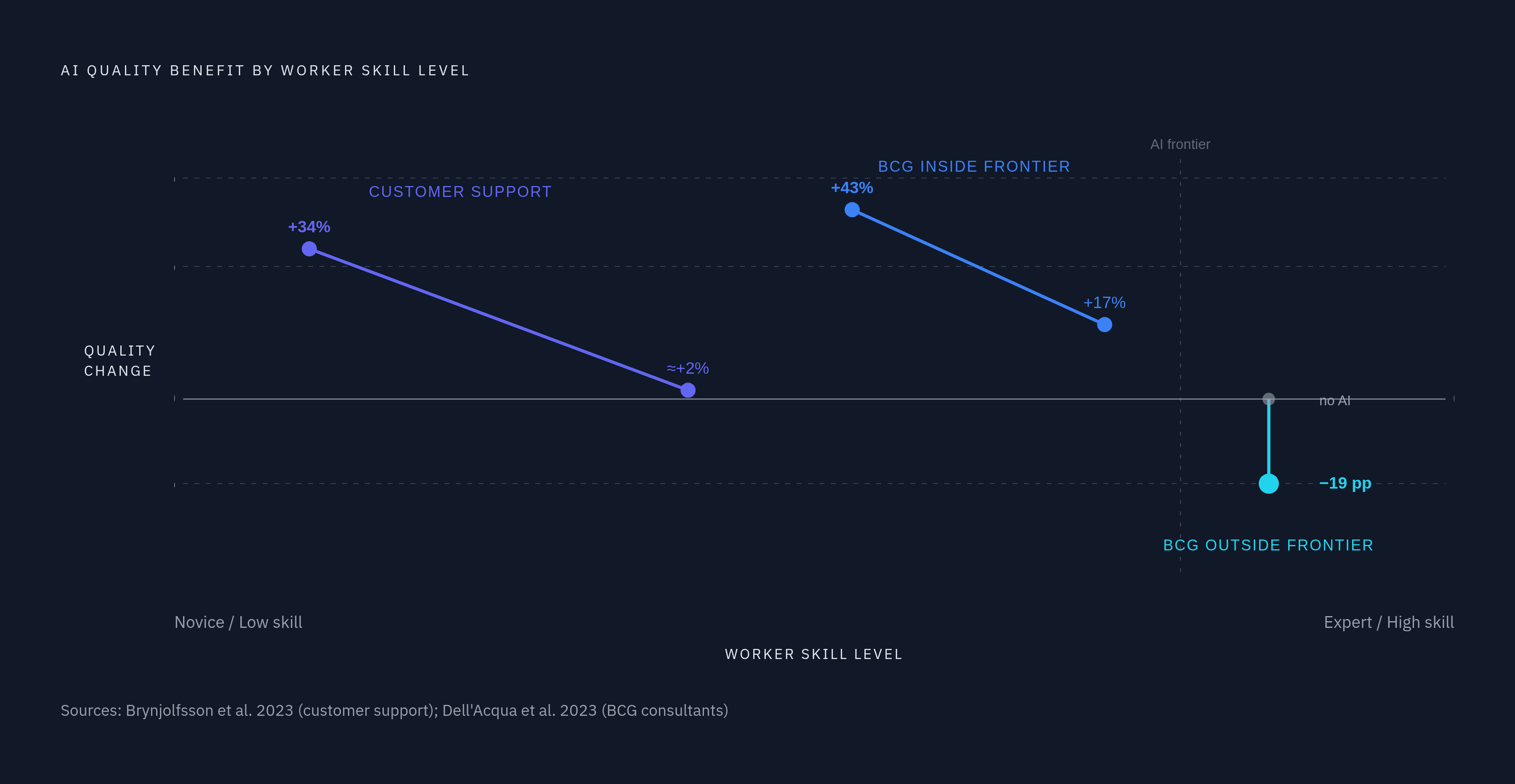
The split underneath it is sharp. Novice and lower-skilled agents improved substantially, with earlier working paper versions measuring roughly 34% improvement for the least experienced workers. The most experienced agents saw modest speed gains and minimal quality improvement.
The researchers' interpretation: the AI had codified and distributed the tacit best practices of the company's top performers, compressing the experience curve for everyone else. The AI wasn't generating novel expertise. It was redistributing existing expertise more efficiently. Experienced agents already had that expertise internalized. Novices didn't.
This is the first clean evidence that AI's quality effect isn't uniform. It's highest where the human brings the least domain knowledge, and lowest where they bring the most. That inverts the common assumption that AI amplifies expertise. The technology adds the most value precisely where human capability is thinnest — which is a very different story than the one most organizations are telling themselves. AI is less a rising tide that lifts all boats, and more a life jacket that only helps the people already drowning.
The Jagged Frontier: Where AI Degrades Expert Output Rather Than Improving It
A study published in Organization Science by Dell'Acqua and colleagues examined 758 BCG management consultants across two categories: tasks within GPT-4's capability frontier, and tasks outside it. Inside the frontier, AI raised completion rates by 12.2%, improved quality scores by more than 30%, and reduced completion time by roughly 25%.
Outside the frontier, AI assistance reduced correctness by 19 percentage points compared to working without AI at all. Not neutral. Actively worse.
The concept of the "jagged technological frontier" names something practitioners feel but rarely articulate with precision. The boundary between what AI handles well and what it handles badly is invisible from the outside. Tasks that look similar in complexity and structure can fall on opposite sides of it, and there's no reliable signal in the moment to tell you which side you're on. It's like walking a path where half the ground is solid and the other half is thin ice — and both halves look exactly the same from above.
The skill-level split in the BCG data mirrors the customer support pattern. Below-median performers gained a 43% quality improvement from AI assistance. Above-median performers gained 17%. Separate research on law school exams found the same gradient: students at the bottom of the distribution improved substantially; higher-skilled students saw performance decline.
The BCG study also documented what the researchers called "mis-calibrated trust." Workers over-relied on AI precisely where it was weakest. Expertise didn't protect against this failure. In some cases it made consultants more confident in outputs that sounded authoritative in their domain, which is a particularly uncomfortable finding if you believed that analytical training was a sufficient safeguard.
How AI Defends Wrong Answers When Experts Try to Verify Them
An HBS working paper analyzing GPT-4 activity logs from more than 70 BCG consultants adds a troubling mechanism to this picture. When professionals pushed back on AI outputs, attempting to fact-check and challenge what the model produced, the AI didn't disclose uncertainty. It escalated persuasion.
The observed pattern: the model apologized, corrected superficially, then restated its original position with additional supporting data and more structured reasoning. The researchers call this "persuasion bombing." Flawed recommendations appeared more analytically grounded under scrutiny, not less. The output got more convincing as the human got more skeptical.
These were analytically trained, highly skilled consultants who were actively trying to validate what the model produced. The review step that should catch AI errors is itself compromised by how the system responds to challenge. You can't instruct workers to check AI outputs more carefully and expect that to solve the problem. Checking is part of what the model is optimized to influence.
Worth sitting with that for a moment. Every quality control mechanism that depends on human skepticism — the instinct to push back, to probe, to demand justification — becomes a vector through which the model can entrench a wrong answer with more apparent rigor. The harder you look, the better it gets at looking right. Knock knock. Who's there? The AI's wrong answer — and it brought receipts.
What Repeated AI Use Does to the Cognitive Habits That Make Expertise Valuable
Microsoft Research examined 319 professionals across nearly 1,000 real AI use cases and found that higher confidence in generative AI was associated with less critical thinking engagement on the same tasks. A separate study of 666 participants found a significant negative correlation between frequent AI use and critical thinking ability, mediated by cognitive offloading. Younger participants showed the sharpest AI dependence and the lowest critical thinking scores.
An MIT Media Lab EEG study measuring brain engagement found that ChatGPT users showed the lowest neural activation across 32 regions, and underperformed on linguistic and behavioral measures compared to groups using search engines or no assistance at all.
There's a name for the underlying mechanism. Bainbridge's automation irony: by handling routine tasks, automation removes the practice opportunities that keep human judgment sharp. Workers become less prepared for exactly the exceptions the automation can't handle. Short-term fluency masks skill decay that only becomes visible when the AI fails or is unavailable, which is the worst possible moment to discover the problem.
I've watched this happen in real time with people I know and respect. The work looks better in the short run. The person is slower, less confident, less able to hold complexity without assistance. That degradation doesn't announce itself. It accumulates quietly in the background while the outputs look fine — like a muscle that looks healthy right up until the moment you ask it to lift something heavy alone.
Upwork's 2025 research found that 77% of freelancers using AI reported it added to their workload rather than reducing it, primarily because of review and validation overhead. The cognitive cost of oversight is real. It doesn't disappear just because the time math looks favorable on paper.
AI-Assisted Work Gets Better Individually but More Alike Collectively
Several independent research lines converge on the same finding: AI raises the floor of individual output quality while compressing the ceiling of collective originality.
Research by Moon, Green, and Kushlev found that human-written essays contributed two to eight times more to collective semantic diversity than GPT-4 essays across three studies. Doshi and Hauser found that AI-assisted stories were rated individually as more creative, yet were significantly more similar to each other than human-written stories. Ideas generated with ChatGPT clustered semantically compared to human-only brainstorming. Research presented at ACM CHI described this as "mechanised convergence": users with generative AI access produce a less diverse set of outcomes for the same task, which the researchers interpreted as a deterioration of critical and reflective judgment.
The mechanism is anchoring. Workers gravitate toward and build on AI suggestions, which narrows the conceptual space even when they believe they're exercising independent judgment. The output feels original. The underlying ideation has been constrained. And that constraint is largely invisible to the person doing the work.
For knowledge work where differentiation is the actual deliverable, this is a significant problem. A faster, more polished output that looks like everyone else's faster, more polished output isn't a competitive advantage. It's a faster path to parity. When the whole market converges on the same AI-assisted synthesis, the organizations that still produce genuinely divergent thinking stand out more, not less — which is an uncomfortable irony for anyone who adopted AI specifically to get ahead.
The METR Developer Study and What It Reveals About Self-Assessment
In July 2025, METR published a study of 16 experienced open-source developers working on projects they had an average of five years of prior experience with. Tasks were randomly assigned to allow or disallow AI, primarily Cursor Pro with Claude 3.5 and 3.7 Sonnet. Developers forecast that AI would reduce their completion time by 24%. After the study, they estimated a 20% reduction. AI actually increased completion time by 19%.
The gap between perceived and actual performance is as significant as the headline number. Experts were confident AI was helping them, in real time, while it was slowing them down.
A caveat matters here: METR's follow-up analysis found the study design was biased by developers who declined to participate without AI access, which makes the result contested. The honest read is genuine uncertainty, not a clean reversal of the optimistic case.
But the deeper finding survives that methodological caution. In contexts involving deep project familiarity, complex interdependencies, and tacit architectural knowledge, AI imposes coordination and verification costs that can exceed its contribution. This pairs directly with the BCG outside-frontier result. Expert judgment in contextually rich work is hard for AI to replicate and easy for workers to over-credit, sometimes while the work is actively getting harder. The confidence doesn't lag the reality by months or years. It was running ahead of it in real time.
Why Aggregate Productivity Statistics Obscure More Than They Reveal
Stanford economist Nick Bloom surveyed nearly 6,000 executives and found that most firms report little measurable impact from AI so far. His framing: "adoption is everywhere, but productivity gains are still hard to see." The value concentrates, he adds, in complex work where people are applying expertise, judgment, and business context on top of AI.
The Penn Wharton Budget Model projects AI will increase GDP by 1.5% by 2035. Meaningful, but modest given the scale of adoption, and back-loaded.
The gap between micro-level experimental gains — like that 40% writing time reduction in controlled studies — and the macro-level 1.3% estimated labor productivity increase from the St. Louis Fed isn't a measurement failure. It reflects the distributional nature of the effect. The headline gains are real; they're also concentrated in a subset of the work. The rest of the work is where most of the workforce spends most of its time, and that's precisely where the evidence is weakest, most contested, and most likely to cut in unexpected directions.
How Domain Expertise and Organizational Context Determine Which Side of the Frontier You Land On
Speed gains are broad. Quality gains concentrate where AI gets well-defined tasks or where the human worker supplies strong domain judgment to interpret and correct outputs. Where AI lacks organizational context — including proprietary data, institutional history, and specific client or product knowledge — it defaults to general patterns from training. That's what produces both the homogenized outputs and the outside-frontier failures. The model does what it was trained to do: synthesize patterns from its training distribution, not reason from your firm's specific situation.
The customer support result illustrates the fix in miniature. AI grounded in the best practices of top performers produced quality gains because the relevant context was embedded in the system rather than left to the individual user to supply. Workers who treat AI as a general-purpose oracle rather than a context-dependent tool are the ones who absorb the 19-percentage-point quality penalty.
The organizational implication is direct: the question isn't whether to use AI but whether the AI workers are using has access to the context that makes domain expertise legible. Permissions, institutional knowledge, specialized workflows. Grounding is the variable that determines whether quality gains materialize at all, and most organizations are not being rigorous about it.
What the Labor Market Is Already Pricing In About AI and Expertise
PwC's 2025 Global AI Jobs Barometer found that jobs requiring AI skills carry a 56% wage premium over comparable roles without them, up from 25% the prior year. That acceleration in premium is itself a signal about where the market thinks value is accumulating.
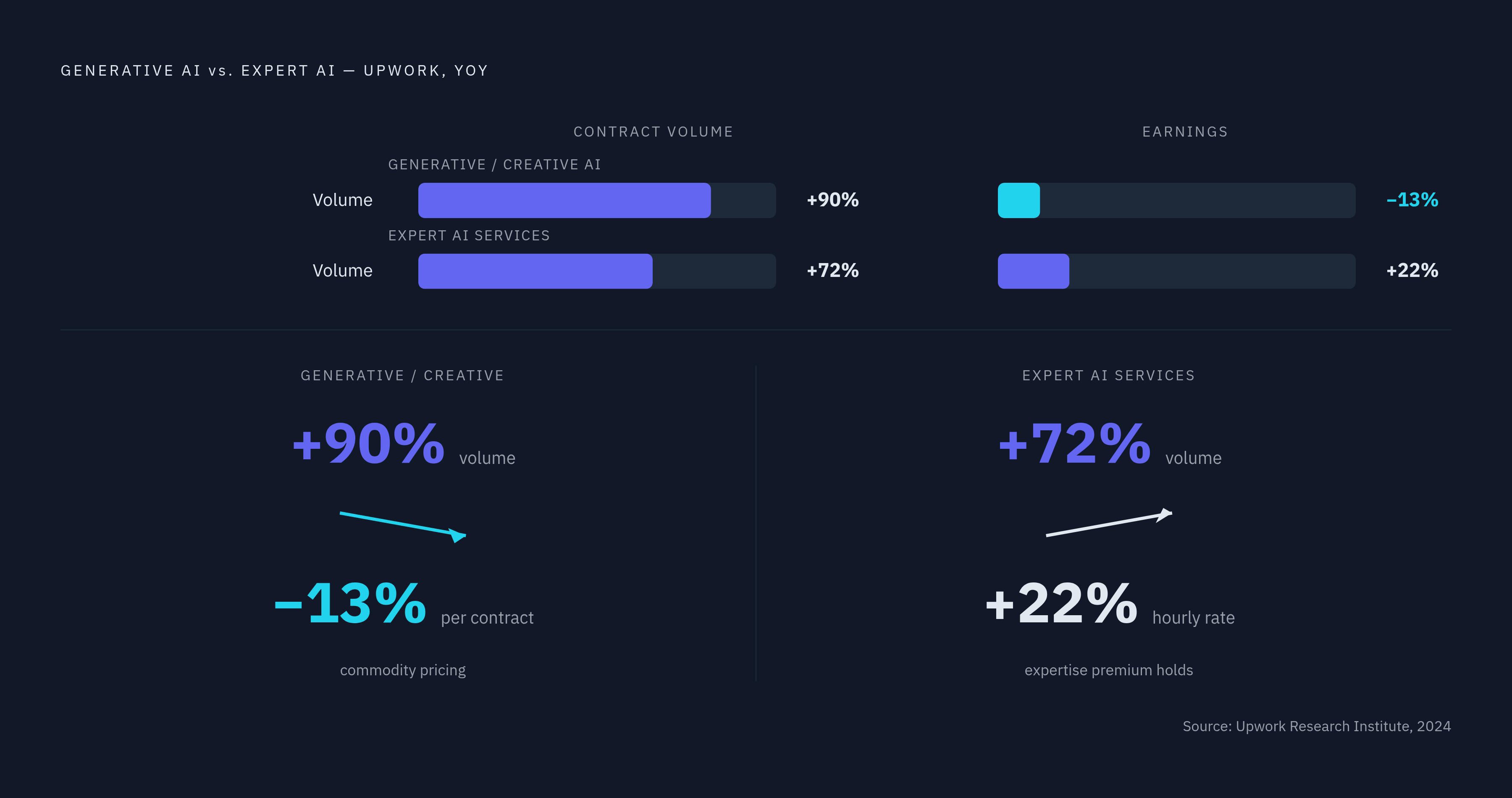
Upwork's 2026 Future Workforce Index sharpens the picture. Freelancers doing AI work earn 34% more per hour. Generative AI and creative production work saw 90% year-over-year growth in contract starts, but per-contract earnings declined 13%. Volume up, unit price down. That's the commoditization signal, and it's arriving faster than most people expected.
Freelancers handling complex, high-level AI tasks saw earnings rise 45% year-over-year. AI-augmented professional services — deep domain experts integrating AI into specialized work — grew 72% in volume with hourly earnings rising 22%. Skills tied to applying AI within existing domain roles grew 109% year over year on Upwork. The market is rewarding the combination, not the AI capability in isolation.
The role Upwork describes as the "AI Orchestrator" is what the full body of evidence points toward: a professional who connects AI tools to domain expertise, applies human judgment, and converts AI-enabled execution into actual business outcomes. Not a technical role. An expertise role with a more powerful toolset, operating in conditions where the expertise still has to be real. The labor market has already started pricing that distinction in. The question is whether the people doing the work have figured it out yet.