Chaining Specialized Agents for Complex Enterprise Workflows
Specialized agents working in sequence outperform single generalists on complex enterprise tasks.
Why Enterprises Are Moving from Single Agents to Networks of Specialized Ones
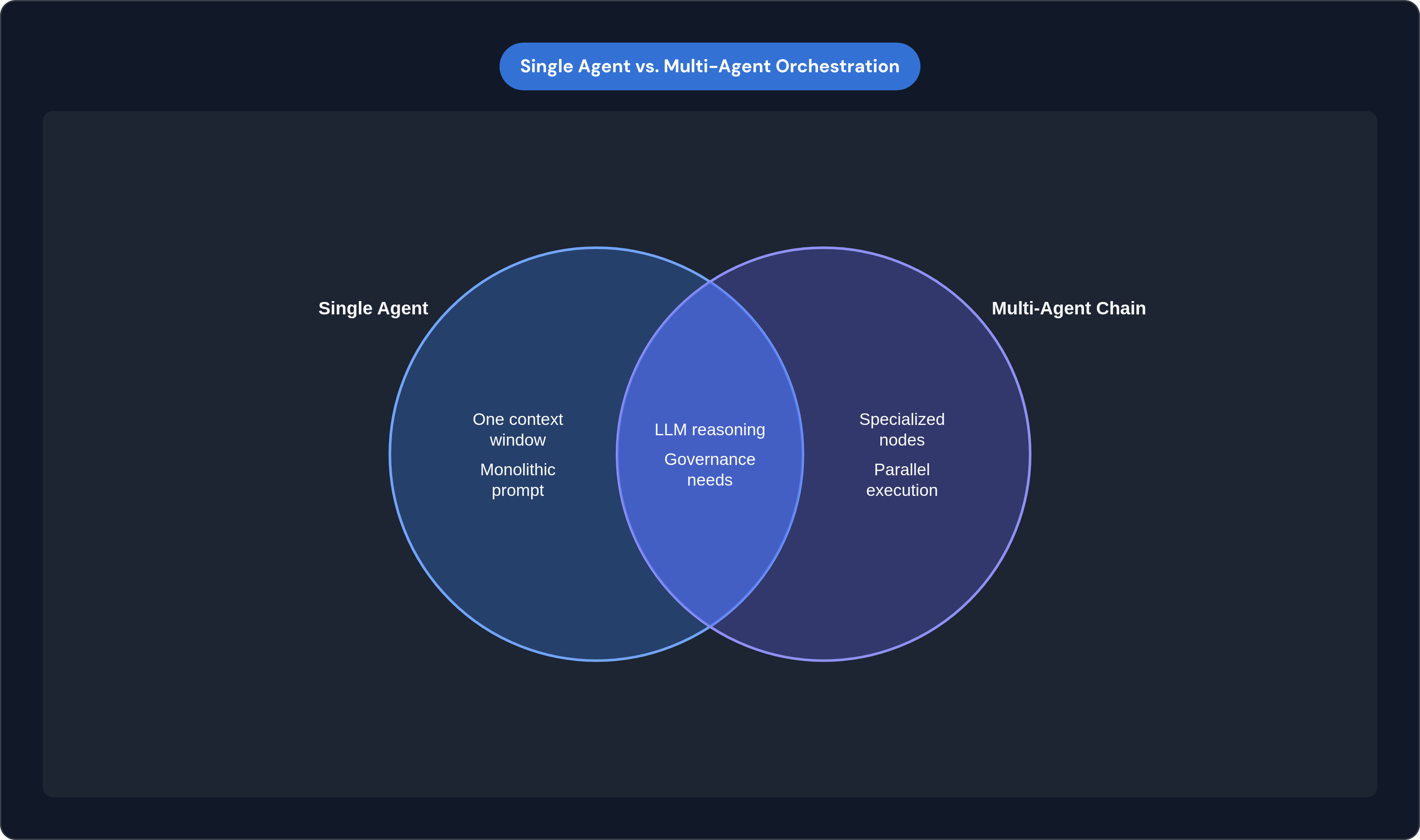
The "one smart assistant" model hits a ceiling fast. Push a general-purpose agent through a 15-step procurement workflow or a multi-jurisdiction compliance review and you feel exactly where that ceiling is. The agent knows a little about everything and not enough about anything. It cannot hold the regulatory depth of a compliance specialist while simultaneously reasoning about financial exposure and drafting a board-ready summary. Asking it to do all three sequentially, within a single context window, produces output that is broad and shallow at every step.
Specialization is the structural fix. Break the work into discrete concerns: data retrieval, compliance verification, financial risk analysis, report generation, system action. Assign each to an agent optimized for that concern. Each unit stays narrow, improvable, and replaceable without destabilizing the rest of the system. Failures isolate to a single node rather than cascading through a monolithic prompt. You scale by adding agents, not by bloating a single instruction set past the point of coherent reasoning.
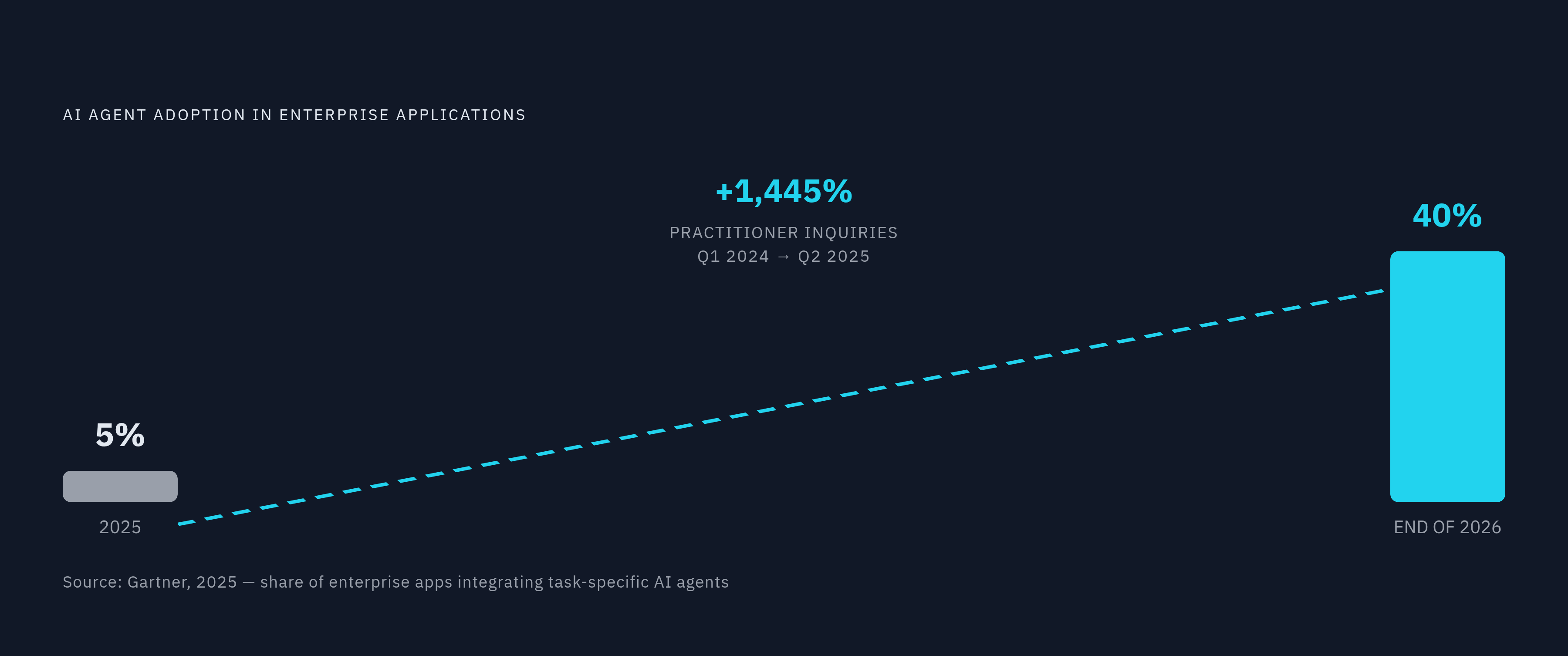
The shift is already in production. Gartner's August 2025 data puts fewer than 5% of enterprise applications integrated with task-specific AI agents in 2025, rising to 40% by end of 2026. More telling: Gartner also recorded a 1,445% increase in practitioner inquiries about multi-agent systems between Q1 2024 and Q2 2025. When the people actually building systems start asking about a pattern at that volume, the transition from theory to production reality has already happened.
Chaining creates power, but it also creates coordination surface area. Every handoff between agents is a place where context can be lost, errors can compound, and accountability can dissolve. The rest of this piece is about designing that surface area deliberately, before you discover its failure modes six weeks into a production rollout.
What Agent Chaining Actually Means in Practice
An agent, defined precisely enough to be useful: a software system that perceives context, makes decisions, and takes autonomous action. Not a static prompt. Not a rule-based script with a language model bolted to the front. An agent reasons about its environment and acts on that reasoning without requiring a human to approve every step.
Chaining connects agents so that one agent's output becomes the next agent's input, with an orchestration layer managing the handoffs. That framing understates the complexity, though, because any functioning chain must handle two integration axes simultaneously. The first is agent-to-agent: horizontal coordination between agents. The second is agent-to-tool: each agent's vertical connection to the data sources and external systems it needs to act on. Get one axis right and neglect the other and the chain breaks in ways that are genuinely hard to trace.
Shared state is what separates a functioning chain from an elaborate relay race. The next agent in the sequence needs to see the reasoning that produced the previous output, not just the output itself. When you pass only the conclusion, errors compound without anyone noticing. The downstream agent accepts a flawed premise as fact and builds confidently on a foundation that should have been challenged.
A concrete example makes this tangible. Consider a contract review workflow: one agent checks legal compliance, a second analyzes financial risk, a third evaluates operational feasibility, and an orchestrator synthesizes their findings, surfaces conflicts, and produces a consolidated recommendation. Each specialist goes deeper than any single agent could. The orchestrator resolves genuine disagreements between them. The output is richer precisely because the reasoning was distributed and then deliberately recombined.
The Five Orchestration Patterns and When Each One Applies
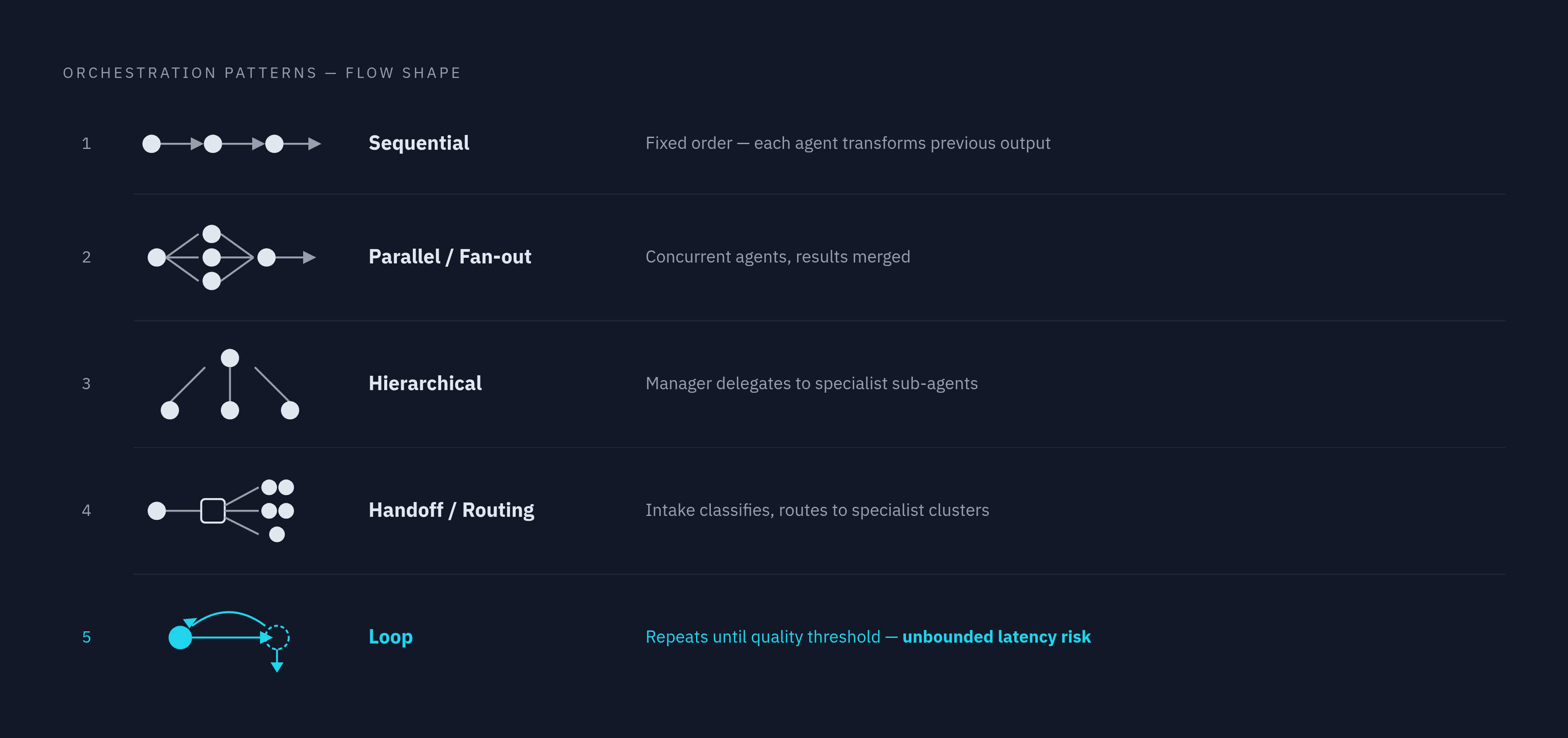
Production systems almost never use a single pattern. The useful question is not which pattern to choose, but which pattern applies at which layer of the system.
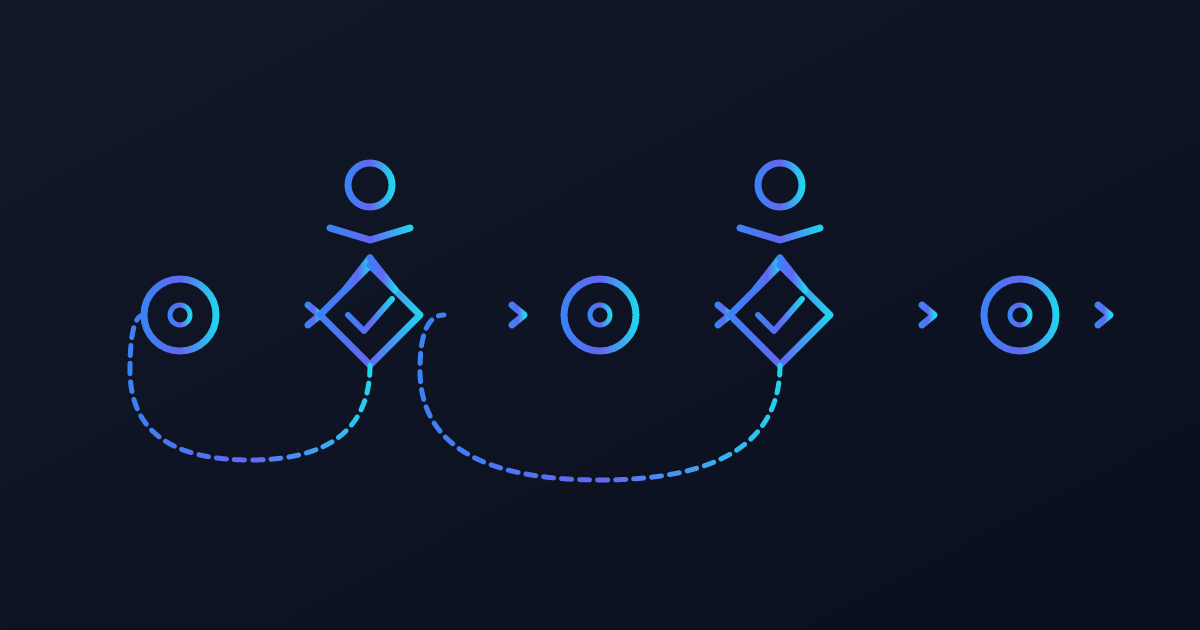
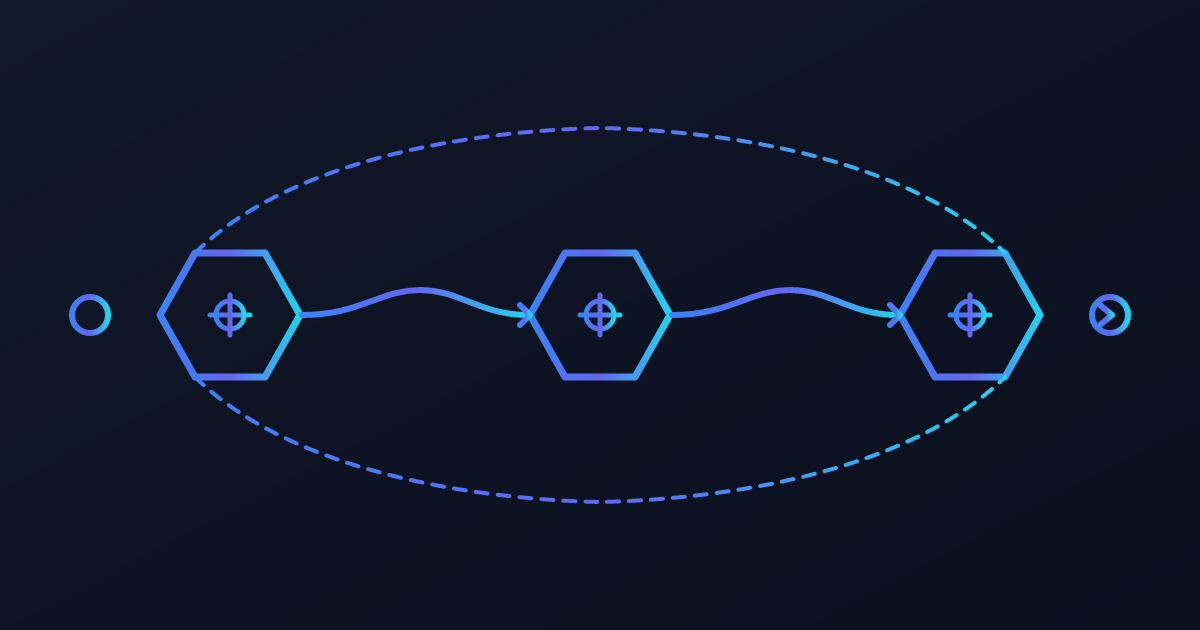
Sequential (chain or pipeline): Agents execute in fixed order, each transforming the output of the previous one. Simplest to reason about, most predictable, appropriate when task order is non-negotiable. Data normalization followed by analysis followed by report generation is the canonical example. The constraint is also the feature: you know exactly what ran and in what sequence.
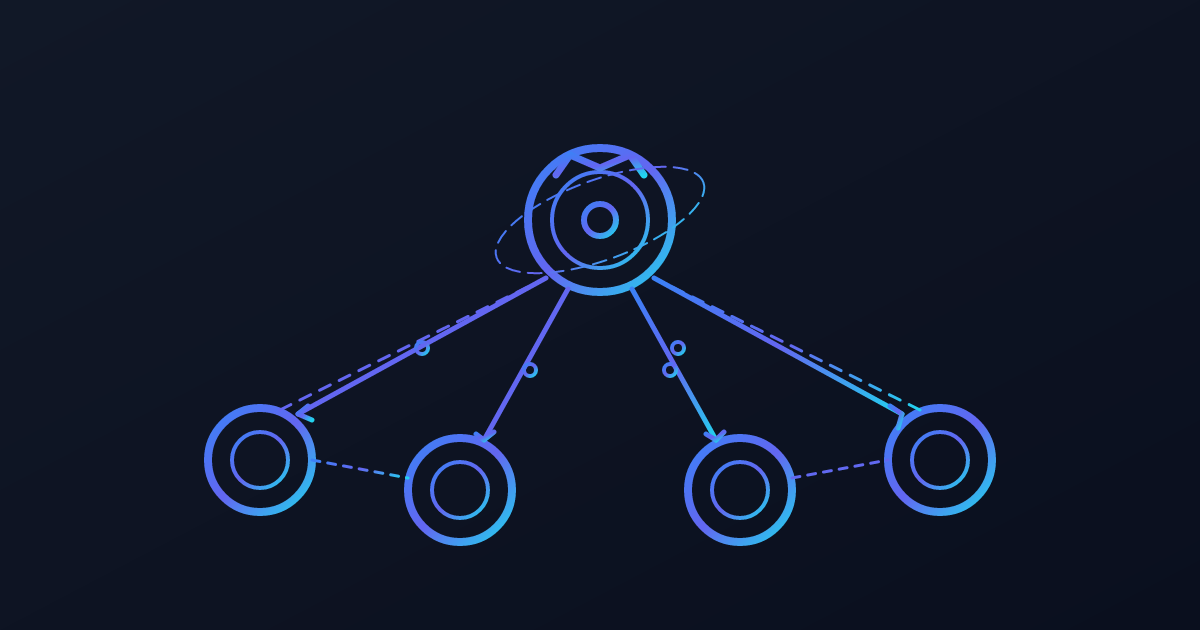
Parallel (fan-out / fan-in): Agents run concurrently and their results are merged. Best when breadth and speed matter more than strict sequencing. A revenue intelligence workflow illustrates this: one agent checks CRM notes, a second pulls product usage data, a third reviews renewal history, all simultaneously, and a synthesis agent combines their outputs. The workflow that would have run serially in several minutes completes in the time of its slowest constituent agent.
Hierarchical: A manager agent decomposes the goal and delegates to specialists, which may themselves manage sub-agents. IBM's research identifies this as the standard approach for large-scale enterprise systems. It mirrors how human organizations handle complex work, which is not accidental. The pattern is intuitive to map onto existing organizational structures and scales naturally as the problem grows.
Handoff (routing): An intake agent classifies the incoming request and routes it to the appropriate specialist cluster. Essential when a single entry point must serve multiple domains. A customer service chain receives every inbound request through one intake agent, which routes to billing specialists, technical support agents, or account management clusters depending on the classification. The router does one thing; the specialists do everything else.
Loop (iteration with evaluation): An agent runs, an evaluator scores the output, and the cycle continues until a defined quality threshold is met. Appropriate for drafting, code generation, and any task where "good enough" needs to be specified programmatically. The risk here is real: if the threshold is too high or the evaluator's rubric is poorly calibrated, you get unbounded latency. One loop deployment I watched grind to a halt had a well-intentioned quality bar that no output could consistently clear. Nobody had defined what "done" actually looked like before they shipped it. The exit condition had been treated as an implementation detail.
Most production systems combine patterns. Microsoft's healthcare implementations are a useful reference: a central orchestrator manages patient flow at the top level, while specialized agents handle individual task types autonomously within that structure. Handoff at the entry point, hierarchical within each domain cluster, sequential or parallel within individual workflows. The architecture reflects the shape of the work.
How Context Fragmentation Silently Kills Orchestration Projects
Here is the failure mode that kills more orchestration projects than coordination bugs or model quality combined, and it rarely shows up in post-mortems because it presents as something else, usually "the agents aren't smart enough" or "the outputs are inconsistent."
Customer history lives in Salesforce. Project context lives in the project management tool. Budget constraints live in the ERP. Approval hierarchies live in HR. Agents operating without synthesized organizational memory treat every workflow as if it is the first one, missing the accumulated context that would allow them to make genuinely useful decisions. What you get is agents that require constant human re-explanation of business rules, prior decisions, and constraints. You end up explaining your own organization to a system that processes your explanation and then discards it. That experience kills adoption faster than any technical failure.
What the system actually needs is a persistent shared memory layer where agents can both read and write state, rather than merely passing outputs as strings. String passing produces a relay race. Shared state produces something that behaves like a team.
Permissions are a dimension of context that gets overlooked until it causes a compliance problem. An agent synthesizing data from multiple systems must respect the access rights of the human who initiated the workflow. If a junior analyst triggers a chain, that chain should not silently surface data the analyst is not authorized to see just because one of the constituent agents has broader system access. Confidentiality boundaries collapse in ways that are genuinely difficult to audit after the fact, and by the time you find the gap, the breach has already occurred.
The design implication is direct: context infrastructure must be architected before any individual agent is built. What sources are connected, how permissions are inherited, what state is retained across agent calls. These are foundational decisions. Every team that has tried to retrofit context infrastructure after agents were already in production has paid in rework, and most of them still had gaps when they were done.
The Two Emerging Standards That Make Agent Interoperability Possible
Two distinct integration problems require two distinct standards. The first is how agents talk to each other. The second is how agents connect to tools and data sources. Conflating them produces architectures that solve one problem elegantly and the other poorly.
The Agent-to-Agent protocol, announced by Google in April 2025 and now governed by the Linux Foundation under Apache-2.0 licensing, addresses horizontal coordination. A2A enables agents built by different vendors to discover each other, delegate tasks, and coordinate across organizational boundaries without custom integration work for every pairing. The standard launched with more than 50 technology partners and grew to more than 150 participating organizations by April 2026. That trajectory suggests genuine ecosystem momentum rather than vendor-managed endorsement, which looks different and tends to flatten faster.
The Model Context Protocol, developed by Anthropic, addresses vertical connection. Before MCP, connecting agents to databases, APIs, and data sources was an N-by-M custom integration problem: every new agent needed bespoke connectors for every new tool. MCP converts that into a single standardized interface. The reduction in integration overhead compounds as the number of agents in the organization grows.
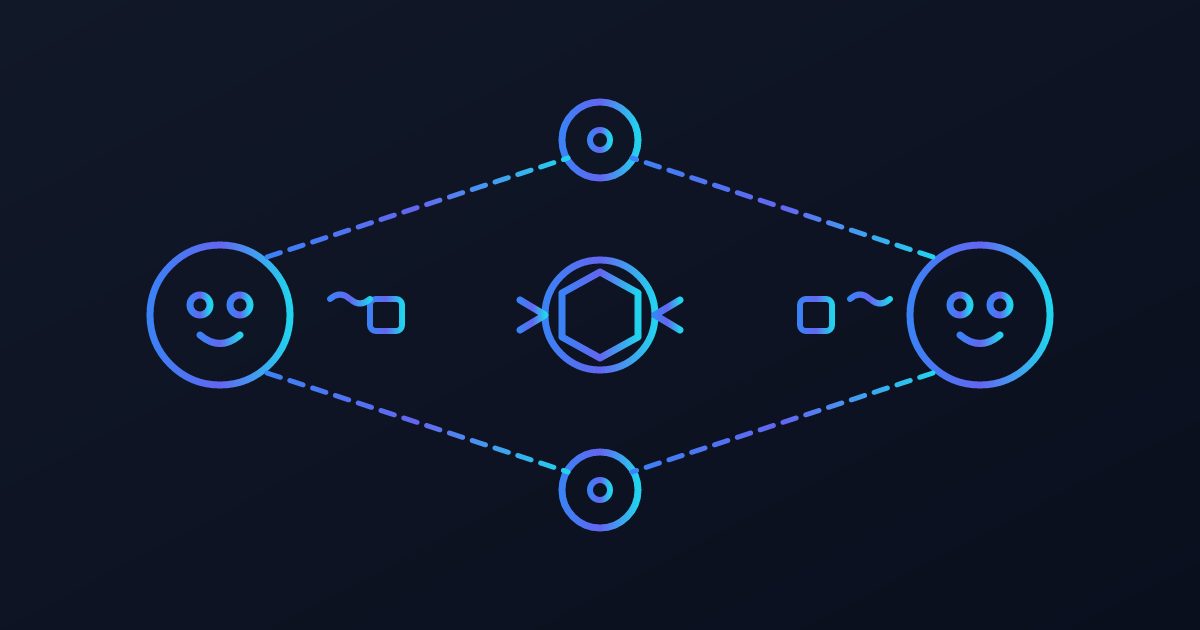
The combination of both standards in the same system is where the genuine value surfaces. In an IT incident response workflow, multiple specialized agents can collaborate via A2A while each independently accesses its own diagnostic tools, runbooks, and monitoring systems through MCP. The two protocols handle different layers of the same architecture without competing.
The practical implication for any enterprise making tooling decisions now: choose frameworks and platforms that support both protocols. Organizations building on proprietary integration approaches will face expensive re-integration work as this consolidation completes. And it is completing faster than most roadmaps anticipated.
What Measured Results from Production Deployments Actually Look Like
The gains from well-designed multi-agent orchestration are real, but they are not uniform, and the average across deployments obscures something important: the gap between organizations that redesigned their processes before automating them and organizations that layered agents onto workflows built for human execution.
BCG's 2025 research found that organizations implementing sophisticated agent control planes report 40% improvement in process efficiency and 35% reduction in decision latency. The broader range across enterprise deployments runs from 40 to 60% efficiency gains in well-orchestrated systems, with even two-agent orchestrations producing gains in the 20 to 30% range.
A European investment firm's deployment illustrates the mechanics concretely. Five specialized agents covering functions including KYC and compliance review reduced a client onboarding process that had previously stretched across 15 business days. The workflow became tractable through specialization and chaining, not through a better single model. That distinction matters because it tells you where to invest.
Function-level ROI concentrates most strongly in software engineering and IT, where McKinsey's 2025 analysis documents cost reductions in the 10 to 20% range, and in marketing and product development, where revenue uplift above 10% appears in the data. Google Cloud's September 2025 study of more than 3,400 senior leaders across 24 countries found that 74% achieve ROI within the first year of AI deployment.
The pattern across all of it is consistent. Automation applied to a broken process produces a faster broken process. The organizations capturing the largest returns did the harder work of redesigning the process first.
The Governance and Oversight Failures That Derail Agent Chains at Scale
The failure statistics deserve direct attention. IBM's 2025 CEO study found that only 25% of AI initiatives delivered expected ROI. Gartner projects that more than 40% of agentic AI projects will be canceled by 2027. Deloitte's 2025 research found that only 11% of organizations are actively running agentic systems in production, while 35% have no formal agentic strategy at all. Most enterprises are earlier in this journey than their public statements suggest, and the distance between a successful pilot and a reliable production system is where most projects fail.
Chaining introduces failure modes that simply do not exist in single-agent deployments. A bad classification in the first agent poisons every downstream decision, quietly, without anyone flagging it until the final output is already wrong. Accountability becomes genuinely diffuse when six agents contributed to a flawed result and no single one is clearly responsible. Communication overhead between agents can create bottlenecks that slow workflows below their pre-AI baseline, which creates a particular kind of organizational embarrassment that tends to end programs.
Prompt injection deserves specific attention because it is underappreciated as a risk. When chained agents accept inputs from external sources, adversarial content can redirect an agent mid-chain without the user or operator having any visibility into what happened. The risk grows with chain length: each additional agent is another potential injection point. Most security reviews of agentic systems focus on data access and largely ignore this vector until something goes wrong.
Hallucination and data leakage risks are both amplified in multi-agent systems. Each agent interaction is another point where a model can confabulate with apparent confidence, and each tool call is another point where data can cross a boundary it was never meant to cross. McKinsey's 2025 data shows that 51% of firms report AI-related incidents. The organizations that mitigate these risks most effectively share common practices: human-in-the-loop rules at defined checkpoints, centralized oversight of agent behavior, and explicit executive accountability for AI outcomes. These are the mechanisms that make autonomous action auditable after the fact, not bureaucratic constraints.
Designing Orchestration, Permissions, and Governance into the Chain from the Start
Orchestration, context-sharing, and governance determine whether a chain produces reliable, auditable output or an opaque, unaccountable one. They are not features to add later. By the time you discover you need them, the cost of retrofitting is already prohibitive, and the political will to pause and rebuild is usually gone.
Permissions must be inherited and synchronized at the orchestration layer, not re-defined per agent. When a user triggers a chain, every agent in that chain should automatically operate within that user's access rights. This cannot be left to individual agents to figure out independently, because they will not figure it out consistently, and inconsistency in access control is indistinguishable from a vulnerability.
A governed skill registry changes the economics of agent development at the organizational level. A specialist workflow built once and published to a shared registry is reusable across teams. Without a registry, each team independently reconstructs the same logic, and the organization never accumulates the compound benefit of its own expertise. The registry is not an administrative artifact; it is the organizational memory the individual agents lack.
Versioning every agent and every chain is a compliance and debugging necessity. When a workflow produces a wrong answer six weeks from now, you need to know which version of which agent was running, what inputs it received, and what it was permitted to do. Without version records, root cause analysis becomes speculation, and regulators have noticed that agentic systems make auditability harder rather than easier.
Human-in-the-loop checkpoints should be designed at the chain level, not delegated to individual agents. Identify in advance which decisions require human review before the chain proceeds, and build those gates into the orchestration logic explicitly. An agent that surfaces a decision for human review because its orchestration layer mandates it is fundamentally different from an agent that surfaces a decision only when its internal confidence threshold happens to trigger. One is a governance control. The other is a coincidence.
Scoped interfaces, where each team's agents are exposed through a defined, governed surface rather than open access, allow reuse without giving every consumer visibility into internal implementation. The right abstraction for sharing skills across an organization is a well-defined interface that exposes the capability without exposing the implementation.
PwC's 2025 research found that only 42% of companies are redesigning processes around AI agents, yet those that do report measurable cost savings and meaningfully faster decisions. The design investment pays. And it starts with governance, not model selection, not framework choice, not the number of agents in the chain. Get the governance architecture right first, and everything else has a foundation to stand on.