Preventing Knowledge Silos in AI-Augmented Organizations
AI skills treated as isolated assets duplicate work and fragment returns across organizations.
Why AI adoption is making knowledge silos worse rather than dissolving them
The central problem with AI adoption in most organizations isn't that teams are doing too little. It's that too many teams are doing the same things, separately, without knowing it. Until organizations start treating AI skills the way they treat data or software, as governed, shareable, versioned assets with discoverable registries and access controls that travel with the asset, the financial and strategic returns of AI investment will stay fragmented, and the silos will keep compounding.
The majority of organizations now use AI in at least one business function. And yet most of them aren't capturing enterprise-wide financial impact. Value appears in pockets. Individual teams get faster, individual functions get smarter, and somewhere in the aggregate, the ROI story falls apart.
The default adoption pattern explains why. Departments adopt AI tools independently, optimize locally, and generate fragmented gains that never cohere into strategic impact. Sometimes those gains actively conflict. Consider what happens when a bank's risk management AI flags certain customers as too high-risk at the exact same moment the marketing AI is targeting those same customers for growth campaigns. Two AI systems, both functioning correctly, both undermining each other. Neither team knew what the other had built. That's not a coordination failure. That's two separate knowledge silos colliding in production.
The intuition that AI is a silo-breaker turns out to be wrong at the deployment level. AI only dissolves silos if it's intentionally governed that way. Left to the default, it deepens them.
How knowledge silos form in the first place, and why the AI-era versions are structurally different
Silos aren't new, and the forces generating them are depressingly consistent. Some emerge from misaligned departmental goals. Others form when teams hoard knowledge as a status mechanism. Still others arise from fear of losing competitive standing internally. Remote and hybrid structures add geographical variants on top of these, and all of them widen with organizational complexity.
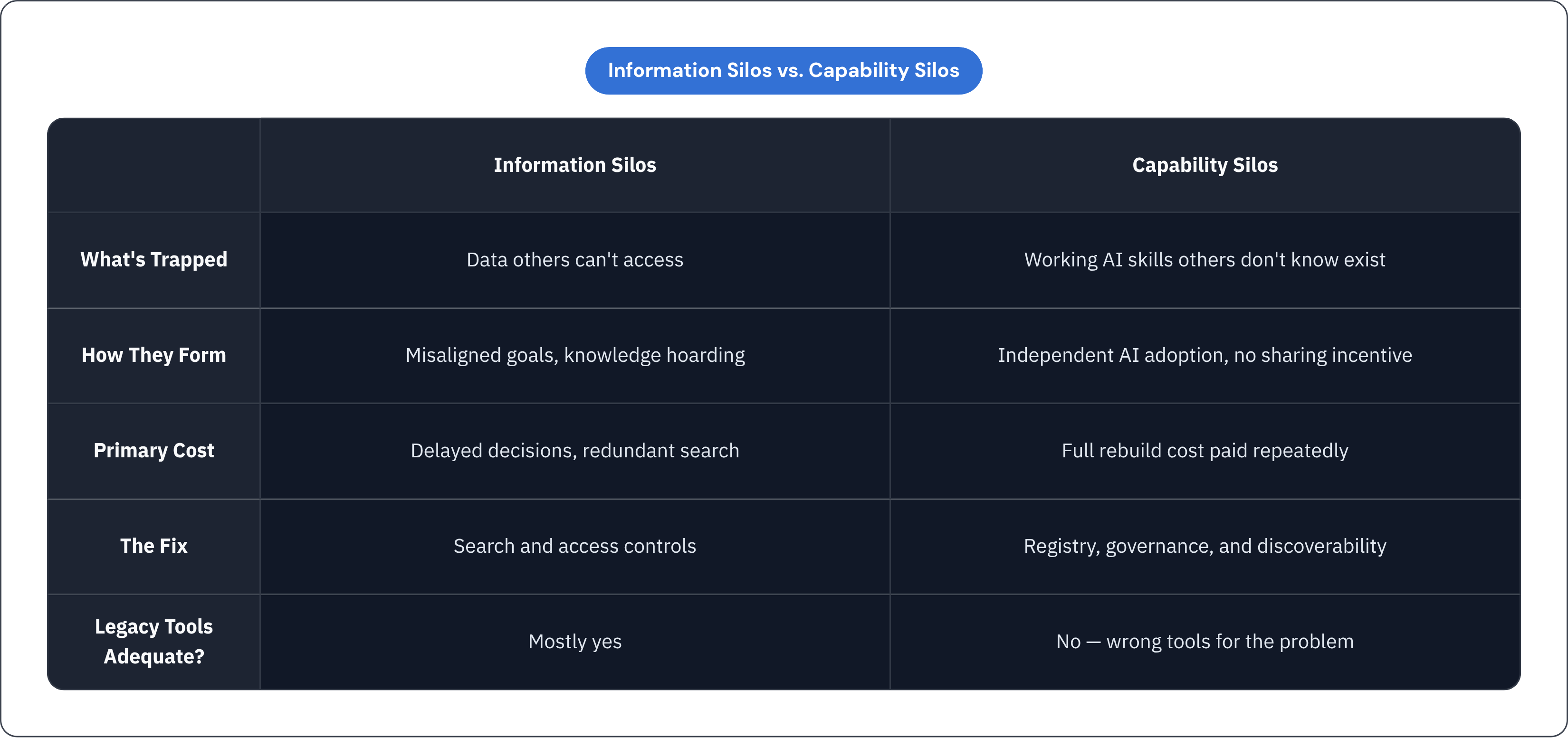
Traditional silos trap information. Someone holds data others can't see, and the fix is access: better search, shared drives, information governance. AI-era silos trap something categorically different. They trap capability. A team doesn't just hold data others can't reach; it holds a working AI skill, a prompt library, a fine-tuned agent, a retrieval pipeline, that others don't know exists and will rebuild from scratch.
Here's what that actually looks like. A team spends three months iterating on a document-processing pipeline. They get it working, and they're proud of it. But there's no mechanism to share it, no reward structure for doing so, and honestly, no one has asked. Six months later, a different team starts from zero on the same problem. The first team's hard-won edge cases, the failure modes they hit in weeks two and four, the vendor limitation they only discovered by accident: none of that transfers. The organization pays for the same lesson twice, in full.
That distinction changes the remedy entirely. Information silos need search and access. Capability silos need a registry and governance. The knowledge management practices organizations developed for document silos don't automatically transfer to prompt libraries or agentic workflows, and most organizations are reaching for the wrong tools because nobody has named the difference clearly enough.
What it costs when teams hoard and duplicate AI capabilities
Conservative industry estimates put duplicative AI investment in use-case-specific tooling somewhere around a quarter of total spend. Redundant AI functionality drives meaningful budget overruns. At Fortune 500 scale, the annual cost of failing to share critical information runs into the tens of billions. These are not rounding errors.
There's a compounding factor beneath those figures. Knowledge workers already spend a significant portion of their workday just finding what already exists. AI duplication adds rebuild cost on top of that search cost. The framing I keep coming back to: imagine hiring five employees when only four of them are productive. One full person's worth of capacity, every day, spent looking for or recreating things that already exist somewhere in the organization.
The less visible cost is the one that never shows up in waste calculations at all. Every team rebuilding the same AI capability from scratch is simultaneously forgoing the next new one. That's opportunity cost, not just inefficiency, and it doesn't appear on any dashboard. You can't measure the capabilities you didn't build because you were too busy rebuilding the ones you already had.
The fragmentation is structural: most organizations run on more than five different platforms for documenting and sharing information, which is the breeding ground for duplicative capability development. The invisibility is the problem, not the platform count.
How AI tools erode the informal knowledge transfer that used to compensate for silos
Organizations have always had a partial workaround for silos. An engineer would grab coffee with a senior colleague and leave with a mental model that no documentation ever captured. A new sales rep would workshop the pitch with a manager and learn, implicitly, what actually lands versus what just sounds good on paper. These moments were inefficient by any productivity metric, and they were load-bearing. They moved tacit knowledge across organizational boundaries in ways formal systems never quite replicated.
AI-assisted workflows bypass exactly those moments. Engineers prompt AI instead of asking a senior colleague. Sales reps draft outreach with AI instead of workshopping the message with a manager. Each shortcut is locally rational. Each one is organizationally costly, because the informal transfer happening inside those conversations simply doesn't occur when a language model steps in as intermediary.
Research surfaced this risk structurally: by allowing senior workers to accomplish more independently, AI-driven automation reduces entry-level opportunities and erodes the implicit contract through which tacit knowledge transfers to younger workers. The agentic era extends this further. Tacit knowledge no longer lives only in people. It lives in data, processes, and models, raising governance questions that personnel policies were never designed to answer.
The informal transfer channel is narrowing precisely when the formal channel most needs to expand. That timing is not coincidental. It's the consequence of optimizing for individual convenience without accounting for what that optimization costs the system.
The governance debt accumulating under shadow AI deployments
Most enterprises adopted generative AI tools, copilots, chatbots, code assistants, before any governance policy existed to manage them. The result is governance debt: a growing backlog of unaddressed risk that compounds with every new tool deployed without oversight. Shadow AI follows the same pattern across departments. Useful tools, unclear rules, sensitive data moving outside approved systems, nobody auditing the flow.
Only about one in five companies has a mature model for governing autonomous AI agents. That gap is about to matter considerably more. Agentic AI usage is poised to rise sharply, and the governance structures organizations built for copilots are inadequate for autonomous agents that take action in the world rather than merely generate text. A copilot suggests. An agent executes. Those are different risk profiles, and most governance frameworks haven't caught up.
Governance debt is self-reinforcing in a way that makes it politically sticky. The longer unmanaged AI skills accumulate across teams, the harder retroactive auditing becomes, and the less likely teams are to surface what they've built. Disclosure creates accountability, so teams avoid disclosing. The shadow system grows, the official one stays thin, and the gap between them becomes too politically fraught to close honestly.
The silo problem and the governance problem are ultimately the same problem: both are solved by treating AI skills as shared, auditable organizational assets rather than local experiments nobody is required to report.
Why treating AI skills as governed, shareable assets changes the dynamic
Organizations have learned this exact lesson before, with different asset classes. Data became a governed asset, with stewardship roles, access controls, and lifecycle management. APIs followed, with registries and versioning. Software has code repositories, review processes, and deployment pipelines. AI skills, meaning prompts, agents, RAG pipelines, fine-tuned models, and retrieval configurations, are the next asset class requiring the same treatment.
The organizational muscle already exists. The pattern is familiar. What's missing is the decision to apply it here.
Without a registry, the default is duplication rather than reuse, because reuse requires discoverability, and discoverability requires infrastructure nobody has built yet. That's less a cultural failure than a design gap. People reuse what they can find. They rebuild what they can't. You could paper your office walls with memos about collaboration culture and it wouldn't move the needle if the underlying infrastructure makes rebuilding easier than reusing.
Governed sharing needs three properties to function. Discoverability, so teams can find what exists before they build. Portability, so the skill operates in a new team's context without a full rebuild. And access control that travels with the asset, not configured separately per deployment. Without all three, the shared registry becomes another underused system that teams route around because the friction of using it correctly exceeds the friction of building their own.
The organizations capturing the greatest AI value are redesigning workflows end-to-end rather than applying AI to individual tasks within individual departments. That distinction matters. The gap between efficiency gains and genuine transformation is largely a governance and sharing gap, not a model capability gap.
What a cross-functional AI governance structure actually needs to do
A hub-and-spoke AI Center of Excellence, a central body that connects AI activity across the organization and ties it to shared enterprise purposes rather than individual team metrics, is the structural anchor worth building toward. The failure mode this structure prevents is one most organizations are already living: ad-hoc AI teams form around a project, operate without enterprise governance authority, dissolve when the project ends, and leave behind fragmented knowledge, inconsistent standards, and no institutional memory.
Here's what most CoE implementations get wrong: they position the CoE as a gatekeeper rather than infrastructure. Instead of serving as the approval body for AI activity, the CoE should make responsible AI activity structurally easier than irresponsible AI activity. That's a fundamentally different design brief, and it produces a fundamentally different organization.
The most underappreciated CoE function is dissemination: structured learning programs, playbooks, and advisory support that give business units the confidence to apply AI responsibly without rebuilding governance from scratch each time. Practically, this means measuring reuse rate of shared skills, not just deployment count. Tracking how many teams pulled from the shared registry versus built independently. Making the waste of duplication numerically visible to leadership is how you generate organizational pressure to stop it.
Shared exercises that put multidisciplinary teams through simulated decision-making scenarios expose misaligned assumptions before they harden into entrenched practice. Separate registries and separate reporting lines will never surface those gaps on their own. You have to put people in the same room working the same problem before you find out they're operating on incompatible definitions of success.
Governance is ultimately what makes sharing safe. Without it, teams have entirely rational reasons to hoard. They don't trust the provenance of others' work. They can't verify permissions. They can't version what they inherit. Fix the governance structure and you change the calculus, not through persuasion, but through design.
The technical infrastructure that makes governed sharing possible at scale
Retrieval-augmented generation is the most consequential technical layer for governed AI sharing. It combines large language models with access to current organizational information, replacing reliance on static parametric memory with source-cited retrieval from verified documents. This grounds shared agents in current organizational context and represents the most effective technical control for reducing hallucinations in enterprise deployments. The infrastructure investment is following the organizational need, and the market trajectory reflects it.
Enterprise cognitive search forms the discovery layer. Shared AI skills are worthless if nobody can locate them, and close to half of digital workers currently struggle to find information needed for their jobs. This isn't a search quality problem. It's an indexing and governance problem, and the platforms addressing it are maturing quickly.
The permissions problem is persistently underestimated, and I want to dwell here for a moment because I've seen it kill otherwise well-designed systems. When a shared AI skill queries organizational data, it must respect each requesting user's access rights in real time. Answers cannot surface information the asker is unauthorized to see. Permissions need to travel with the shared asset, not be reconfigured separately each time the skill is deployed in a new context. If the administrative overhead of maintaining separate permission configurations per deployment falls on the receiving team, adoption stalls at exactly the moment you need it to accelerate. I've watched teams abandon registries they actually liked because the permissions maintenance was just enough friction to make rebuilding locally feel rational again.
Semantic layers add the organizational meaning that prevents AI from generating technically correct but contextually wrong answers. Defining metrics, relationships, and terminology consistently across departments ensures that shared agents don't produce conflicting outputs because one function defines "revenue" differently than another. This sounds like a documentation problem. It is actually a trust problem, and trust is what makes shared infrastructure stick.
Where organizations typically stall when trying to move from isolated tools to shared capability
The incentive problem is the one most implementation plans quietly skip. Teams that invested significant effort in building an AI skill have little structural reason to contribute it to a shared registry unless reuse is tracked, credited, and rewarded. Governance structures that ignore incentives will fail regardless of how well-designed the registry is. This isn't a cultural deficiency. It's a rational response to a system that hasn't made sharing worth the effort.
The technology-first trap catches organizations at scale the same way it catches teams on individual projects. Deploying a shared registry or standing up a CoE without linking it to enterprise goals produces another layer of infrastructure that nobody uses. AI anchored to team-local metrics will stay team-local regardless of what shared infrastructure exists above it. The field is littered with beautifully architected systems that nobody bothered to populate.
Tacit knowledge embedded in a working agent is genuinely hard to transfer, even when the intent to share is sincere. The prompt logic, the data assumptions, the edge cases the team learned to handle over months of iteration: these are rarely documented and often invisible to the receiving team. Sharing the artifact without sharing the reasoning means the receiving team inherits something they can't maintain or adapt. What looks like a contribution is actually a liability, and the team that inherits it will break it and blame the platform.
Speed asymmetry creates persistent pressure to stay local. Teams can ship a new AI tool in days. Governance review, registry onboarding, and cross-functional coordination take weeks. That gap is not incidental. It is the structural reason shadow AI exists. Governance design needs to reduce friction at the point of contribution, not just at the point of use, or the path of least resistance will always run around the shared system. Build for that reality explicitly, or build something that fails on a predictable schedule.
How organizations can start shifting AI skills from team-local to company-wide assets
Audit before building anything new. Map what AI skills already exist across teams, identify duplicates, and make the waste numerically visible. Industry estimates of duplicative investment represent averages; in many organizations the real number is considerably higher, and nobody has looked because nobody had reason to. A structured inventory creates that reason and usually surfaces enough redundancy to justify the governance investment on its own terms.
Start the shared registry with high-reuse candidates. Skills that multiple teams have independently built versions of are the best first entries, because they eliminate active duplication rather than preventing hypothetical future duplication. Early wins matter for adoption. This is easy to underestimate when you're designing the system in theory and nobody has used it yet.
Build permissions into the asset at publication, not around it at deployment. Shared skills need to inherit access controls from connected data sources automatically. If the administrative overhead of maintaining separate permission configurations per deployment falls on the receiving team, adoption stalls. This is a solved problem technically. It remains an ignored problem organizationally, which is a different kind of failure and a more embarrassing one.
Measure reuse, not just deployment. Deployment counts tell you how busy teams are. Reuse rates tell you whether the shared system is actually working. The governance metric that makes the ROI of shared infrastructure legible to leadership is how many teams pulled from the registry versus rebuilt from scratch. That number should be on someone's quarterly review, and if it isn't, the shared system will drift toward irrelevance without anyone noticing until the next audit.
Treat tacit knowledge capture as a publication requirement. When a team contributes a skill to the registry, the documentation should include the reasoning behind design decisions, the known edge cases, and the data assumptions embedded in the pipeline configuration, not just the prompt or the code. The artifact without the reasoning is what gets inherited, misapplied, and blamed on the platform. Make the reasoning non-optional.
The knowledge management software market is growing fast and the enterprise investment behind it will continue to expand. The question for each organization is whether governance is built ahead of that investment or assembled after the debt has already accumulated. Most are still choosing the latter. The organizations that choose differently will find the gap between themselves and the rest widening faster than any single AI capability can close it.