AI Coding Assistants in Regulated Industries
Governance and data boundaries matter more than speed in regulated coding.
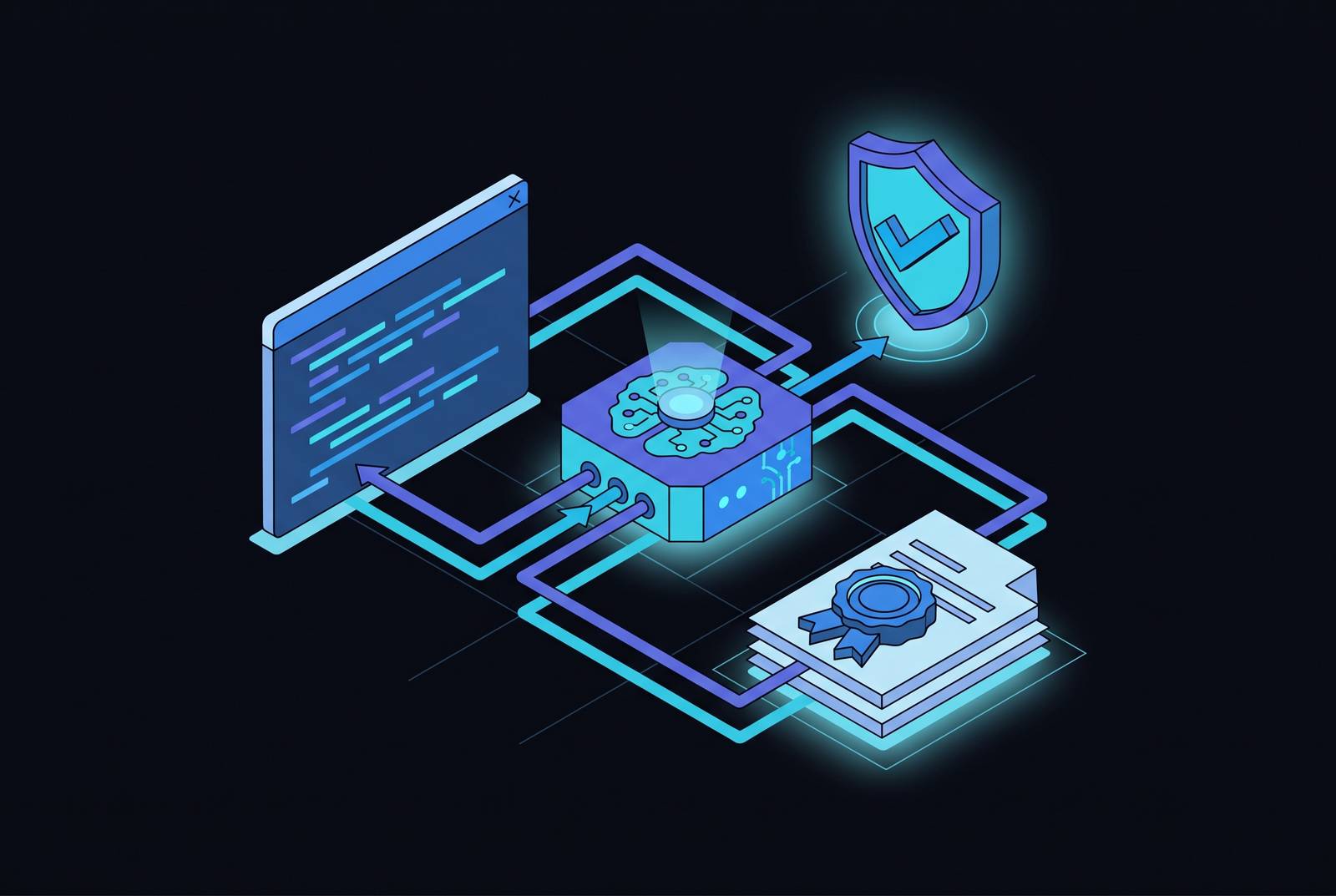
AI coding assistants in regulated industries are not just productivity tools. Their use must keep data within its boundaries, leave evidence for an audit, and follow the permissions already in place. Meeting those duties requires governance built into how assistants receive context and reach internal systems. The model is only part of that decision.
Why regulated industries cannot treat AI coding assistants as ordinary productivity tools
Regulated organizations have legal duties that follow their data. Protected health information under HIPAA, cardholder data under PCI DSS, and nonpublic financial information retain their obligations when an AI tool touches them, regardless of where the model runs. Those duties still apply when code is written faster. Instead, it can outpace the review, provenance, and evidence practices meant to keep changes accountable. The gap is structural.
The regulatory backdrop also demands careful distinctions. The Federal Reserve, OCC, and FDIC issued SR 26-2 on April 17, 2026, superseding SR 11-7, the April 2011 model risk management guidance. The EU AI Act applied in general by August 2026, while the Digital Omnibus moved the date when it would apply in full to high-risk systems under Annex III to December 2027. The Act introduces conformity assessments, technical documentation requirements, and penalties reaching up to 7% of global annual turnover. These obligations cannot be reduced to a developer-productivity comparison.
FINRA's 2026 report flags agents acting on their own without human validation, doing more than they were meant to do, and using multi-step reasoning that makes it hard to trace how they reached an outcome. Those concerns apply directly to agentic coding assistants. Teams therefore need to check whether AI-assisted changes fit within controls that can be audited, as well as whether developers finish work sooner.
The specific compliance risks AI coding assistants introduce in regulated codebases
Data residency is a boundary problem. Tools that send prompts and code context through external model APIs can move PHI, PII, or proprietary financial logic outside the organization's network perimeter. HIPAA's data-handling duties and PCI DSS's cardholder data scope follow that information into a completion request. Sourcegraph Cody offers a fully self-hosted deployment option because finance, healthcare, and government organizations can treat external routing as a non-negotiable blocker.
Auditability is a different problem, concerning evidence. Version control alone does not resolve the record of what context an assistant used, what it suggested, and what a developer accepted. SR 26-2 explicitly excludes generative AI and agentic AI from its scope, while covering traditional statistical and quantitative models and non-generative, non-agentic AI models. That distinction is important when an assistant modifies risk calculation logic. Excluding the assistant from the guidance does not exempt an otherwise covered model that the assistant helps change.
Access control concerns what the integration permits. An assistant connected to internal systems can bypass boundaries that those systems otherwise enforce. OX Security's April 15, 2026 advisory described command injection through MCP JSON configuration in AI IDEs and coding assistants. A tool can keep data inside the network and still expose capabilities a user should not reach.
How the MCP integration layer expands the attack surface for regulated teams
MCP connects coding assistants to enterprise systems, so teams must also govern the integration layer. Cursor and VS Code Copilot ship native MCP client support, so installing an approved assistant may already introduce an MCP client. Gartner projects that most API gateway vendors will have MCP features by the end of 2026. Adoption can therefore arrive through ordinary enterprise procurement. It does not depend on a separate decision to launch an agent program.
Without a server registry under their organization's control, developers decide on their own which MCP servers to trust. That leaves the organization without a governed inventory of approved capabilities or a reliable boundary between user groups. The public MCP registry has no access control, environment separation, or audit trail. It is a discovery directory. Choosing a compliant model cannot close that gap.
The July 2026 MCP specification made genuine security improvements. Its authorization changes include RFC 9207 issuer validation and a shift away from Dynamic Client Registration toward client metadata documents. Those changes strengthen the protocol, but they do not determine which servers an organization approves, who owns them, or which employees may use them. The protocol and the governance layer do different jobs.
What a compliance-oriented evaluation of AI coding tools actually looks like
Cody's fully self-hosted option keeps code inside the organization's network, so external code routing is no longer part of the residency problem for that deployment. Tools that require cloud routing instead create data-handling obligations that need BAAs, DPAs, or other agreements. Those agreements must withstand audit. Neither deployment choice, by itself, answers the separate questions about evidence and access.
Compliance tiers describe another part of the comparison. Kiro is in Tier 2, which covers tools built on strong technology but with gaps in their AI-Act-specific coverage. Documentation gaps can signal missing conformity assessment artifacts where the EU AI Act requires them. A capable assistant and a complete compliance package are different things.
A useful evaluation asks whether the tool records what context was used, what was suggested, and what was accepted. It also asks whether access can be scoped by role, team, and data sensitivity. Permission inheritance deserves its own examination. A tool that redefines permissions independently creates a separate control system to maintain. Formal deprecation policies and version histories also belong in the evaluation, because compliance teams need to assess changes before they reach production.
Pinterest's governed MCP deployment as a working model for regulated teams
Pinterest has shared a detailed account of how it governs its production MCP deployment across its engineering teams. It runs a fleet of cloud-hosted servers dedicated to domains including Presto, Spark, and Airflow. That separation limits context exposure and supports access control by domain. Every server beyond a one-off experiment must have an owning team, appear in the internal registry, and pass Security, Legal/Privacy, and, where applicable, GenAI review before production use.
Those reviews decide which user groups may access each server and leave a record of that decision. Pinterest's agent guidance also requires agents to propose actions through MCP tools for humans to approve or reject before execution. Elicitation confirms dangerous actions, while the July specification makes Multi Round-Trip Requests a formal part of the protocol so that confirmation can happen mid-call without a held-open stream. This provides a concrete mechanism for addressing FINRA's concern about autonomy without human validation.
The deployment also shows that governance need not halt adoption. Hundreds of active engineers use it to run a large volume of agent tool calls each month against production data infrastructure, and the estimated time they save each month is substantial. The case shows what bounded adoption looks like in practice, with domain separation, named owners, review gates, and human approval.
The governance architecture that makes AI coding assistants viable in regulated environments
The general principle is that source-system permissions must survive the AI integration. Access boundaries belong at the integration layer, rather than in each assistant's independent configuration. One MCP server per trust boundary supports that structure. Mixing tools with different sensitivity levels on a single server collapses the separation needed for fine-grained access. Context design is therefore part of access control.
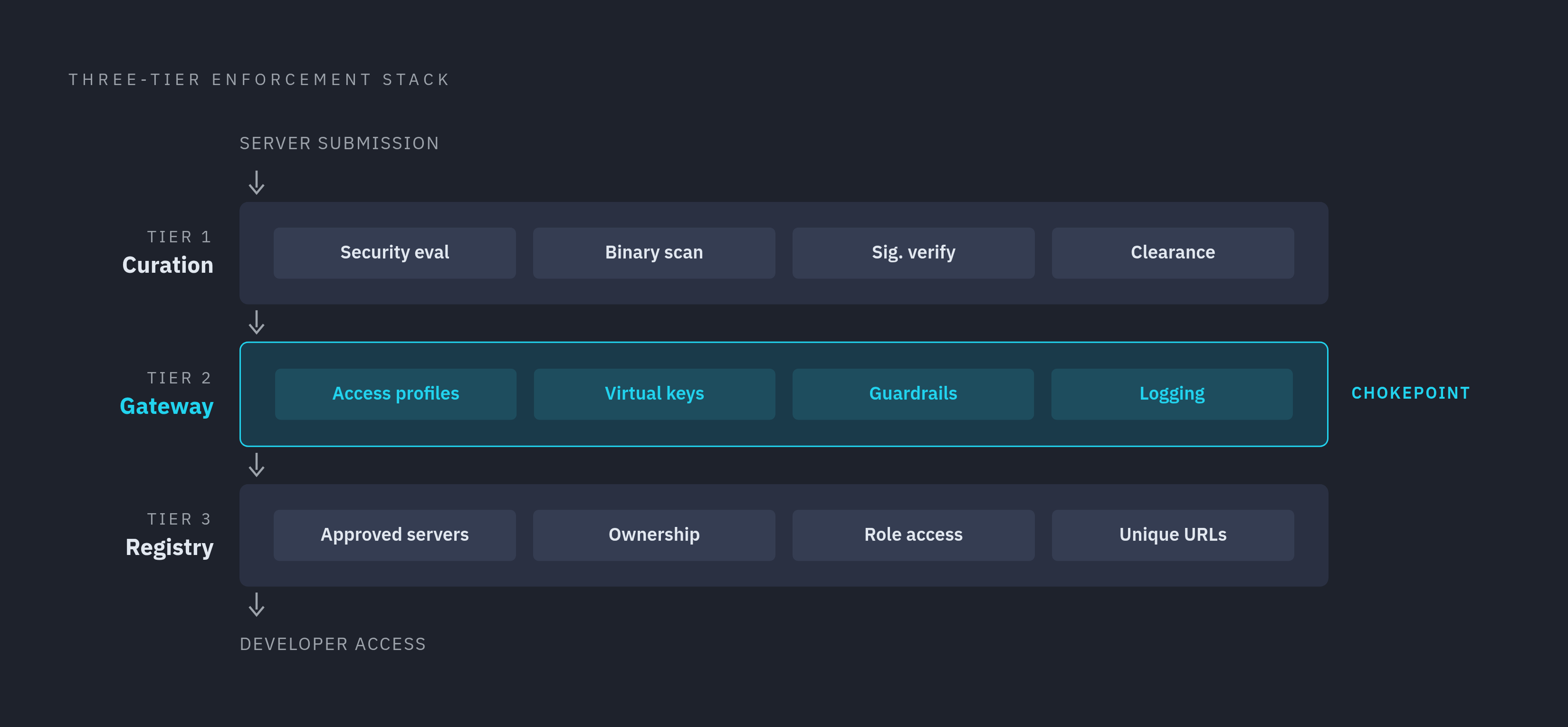
A three-tier architecture gives that principle a practical shape. Tier 1, curation, covers security evaluation, binary scanning, signature verification, and internal clearance before servers reach developers. Tier 2, the gateway, maps approved tools to internal access profiles and attaches virtual keys, content guardrails, and logging rules. Tier 3, the registry, records approved servers, owners, live documentation, role-based access, and connection details, with unique URLs per client or tool. Each tier has a distinct enforcement role. Together, they turn an approved-tool policy into infrastructure capable of applying it and producing evidence.
A GitOps onboarding workflow lets teams submit server metadata through a pull request, trigger automated review, and add the server to the registry after approval. A Virtual MCP Server pattern then composes curated tool subsets from registered servers without new infrastructure. This supports controlled acceleration, where assistance changes with the regulatory sensitivity of the codepath. Unlike blanket bans, which push developers toward unsanctioned tools, that approach gives engineering access within a bounded, reviewable environment.
How a governed MCP registry enables AI coding assistants across departments without fragmenting permissions
Independent integrations create duplicate work as well as exposure. Without a shared registry, teams needing a Jira integration or database query tool can each rebuild context and controls that another team has already developed. Compliance teams then face separate trust decisions across an unbounded set of installations. A governed registry gives those teams reusable, approved capabilities instead. They can share the integration while keeping their permissions separate.
Permission inheritance makes that distinction concrete. A developer querying a database through an MCP-connected assistant should receive only information that developer already has access to. A support assistant should not get an engineer's internal API access just because both use the same registry. Scoped surfaces let engineering, RevOps, support, and security use the capabilities they need for their work. The common infrastructure does not expand their source-system boundaries.
The July specification reduces the operational friction of this model. Its stateless protocol core, header-based routing through Mcp-Method and Mcp-Name, and cacheable list results support running many servers behind a gateway. Header-based routing lets the gateway authorize directly on headers. Enterprise Managed Authorization also moves into the formal extensions framework, providing a standardized mechanism for enterprise authorization. These features support scale without replacing internal policy decisions. The same infrastructure that makes permissions enforceable also makes approved AI capabilities reusable across departments.
What regulated engineering teams should do before deploying an AI coding assistant
Confirm whether code context passes through external APIs, then establish the necessary BAAs or DPAs, or require self-hosted deployment for regulated codepaths. Verify that logs capture context used, suggestions made, and changes accepted, and that retention meets the organization's evidence requirements. Check permission inheritance on its own, apart from licensing or user provisioning. Access must be scoped by role and data sensitivity for every approved seat.
Establish a governed MCP registry before permitting developer-installed servers. Maintain an allow list of approved servers and tools, requiring security review and approval from the owner of each application a new server touches. Start with a GitOps onboarding workflow even at small scale, so approval records exist before the inventory grows. For high-sensitivity codepaths, place approval before agent tool calls execute.
Teams should then tier assistance by the regulatory sensitivity of the code being modified. That means changing the context an assistant may access, the actions it may propose, and the approval it requires without defaulting to a blanket ban. Evaluate compliance coverage before procurement, including the documentation relevant to the EU AI Act, SR 26-2, and FINRA's guidance within their respective scopes. Coding performance cannot substitute for required evidence. Building these controls into deployment is operationally lighter than reconstructing permissions, records, and approval paths under audit pressure.