AI Coding Agent Monitoring in Enterprise CI/CD Pipelines
Enterprises are deploying AI agents in CI/CD without proper authentication controls.
AI coding agents are no longer bystanders in the software pipeline. They write code, review pull requests, and in a growing number of shops, merge changes without a human touching the keyboard. That shift changes what monitoring has to mean. Watching for bugs isn't enough anymore, the question now is whether every action an agent takes is scoped, permissioned, and traceable back to a specific identity, before, during, and after it happens.
Older automation ran scripts someone already wrote and tested. What's different now is that agents write and modify the scripts themselves: build configs, CI/CD configuration files, Dockerfiles, package manager hooks. These are files that execute automatically the moment they're merged, in contexts that already carry trust. A CI pipeline doesn't ask twice before running what's in .github/workflows. If an agent has standing write access to that file, and to production secrets or deployment config alongside it, then one bad prompt or one hallucinated dependency turns a code review problem into an incident.
The "Clinejection" attack is the clearest public case of this playing out. It worked because the agent had broad tool access and could be steered into actions well outside what it was supposed to do. That's the blast-radius problem in miniature: give an agent wide permissions, and any successful manipulation inherits that width. Security researchers have flagged CI/CD prompt injection as a particularly serious attack surface in agentic systems for exactly this reason. The pipeline already touches the codebase, the package registry, cloud credentials, and the deploy step. Inject into the pipeline, and you've injected into everything downstream of it, in one move.
None of this is a knock on model quality alone, though quality is part of the picture. Veracode's Spring 2026 findings put the security failure rate of AI-generated code at 45%, meaning just over half of it passes clean. A 55% pass rate is tolerable when a human reviews every line before it ships. It's a very different number when that code can merge itself. The governance gap here is about what permissions the agent carries once it's wrong, and whether anyone can see what it did after the fact. It's about what permissions the agent carries once it's wrong, and whether anyone can see what it did after the fact.
How MCP became enterprise AI agents' connective tissue
Model Context Protocol, or MCP, is the open standard that lets AI applications talk to outside tools, data, and systems using one shared interface instead of a pile of custom ones. Anthropic introduced it in November 2024. By December 2025 it had been handed off to the Agentic AI Foundation under the Linux Foundation, and OpenAI, Google DeepMind, and Microsoft had all built in native support over the course of 2025. That's a fast climb for a protocol barely two years old, and it says something about how badly the industry needed a shared way to solve integration.
Before MCP, wiring an AI agent into ten different systems meant building ten different connectors, each with its own auth flow, its own schema, its own error handling and permission logic. Every new system multiplied the work. MCP flips that math: a system exposes one MCP server, an agent speaks one MCP client, and the connector problem that used to scale as N times M collapses down to roughly N plus M.
That difference isn't academic. MIT research found that around 95% of enterprise generative AI pilots produced no measurable return, and pointed to a "learning gap" as the main culprit, tools that didn't integrate cleanly, didn't adapt to how the business actually worked, didn't stick. MCP is a direct answer to that specific failure mode.
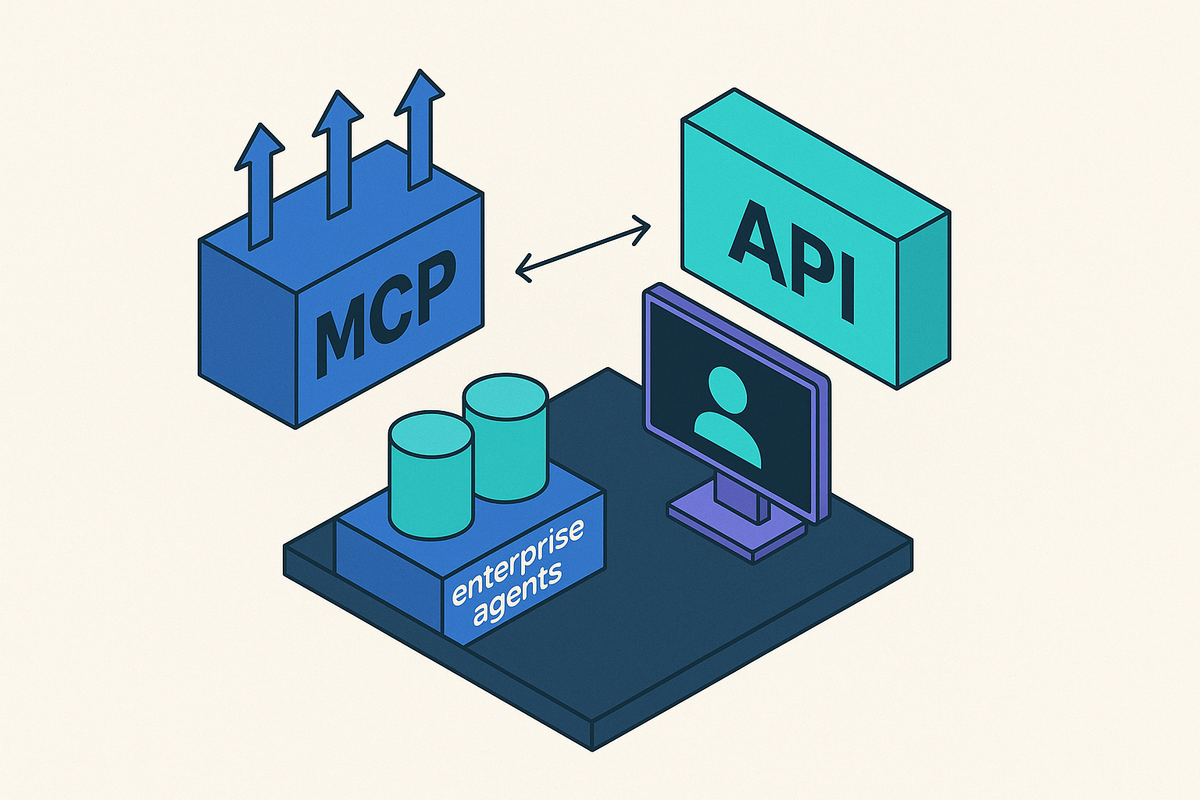
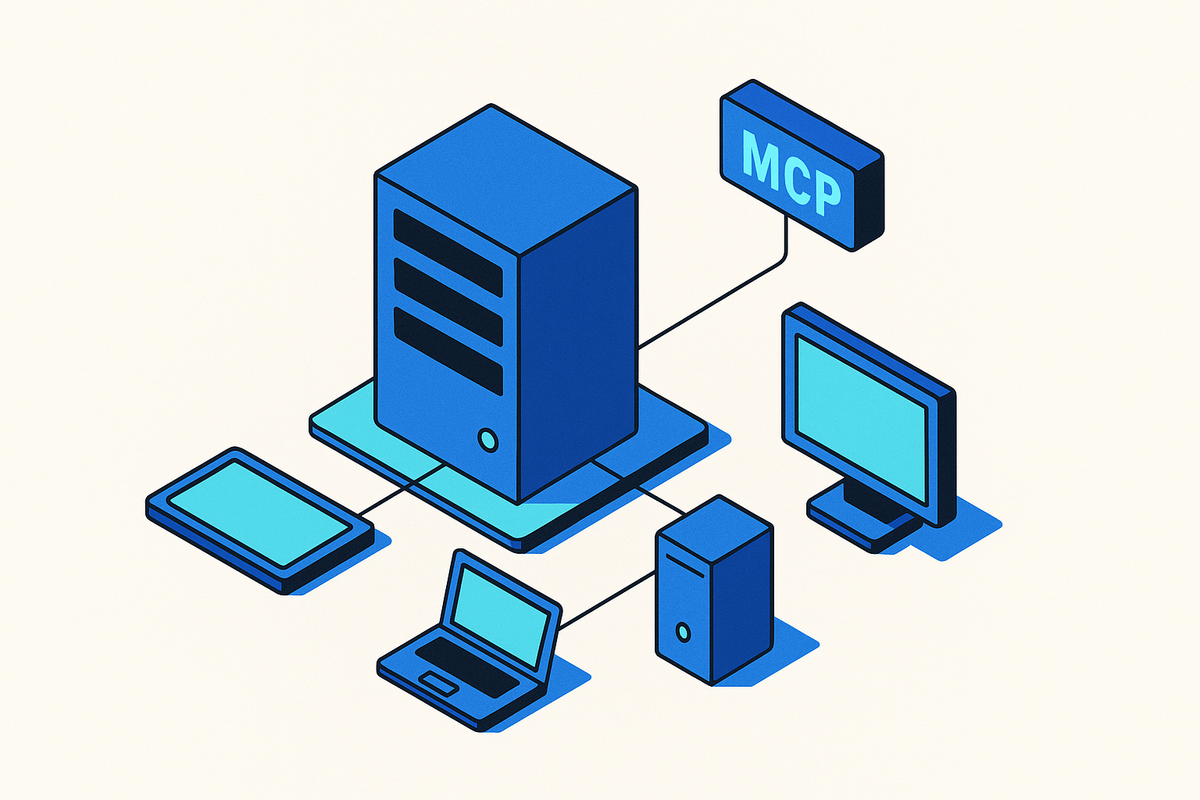
For CI/CD, the architecture breaks down cleanly. The agent is the MCP host. The connection it uses is the MCP client. The system on the other end, whether that's a repo, a CI runner, or an issue tracker, is the MCP server, and it exposes capabilities through four types: Resources, Tools, Prompts, and Sampling. The server, not the agent, decides what's exposed and enforces who's allowed to touch it, which matters most for governance. Permission logic lives with the system that owns the data. That means access can be scoped, logged, and versioned at the server layer, instead of scattered across a dozen agent config files that nobody's tracking.
This isn't a fringe pattern anymore, either. By mid-2026, production deployments had crossed 10,000 MCP servers, with SDK downloads running around 97 million a month.
The authentication reality most enterprise MCP deployments have not caught up to
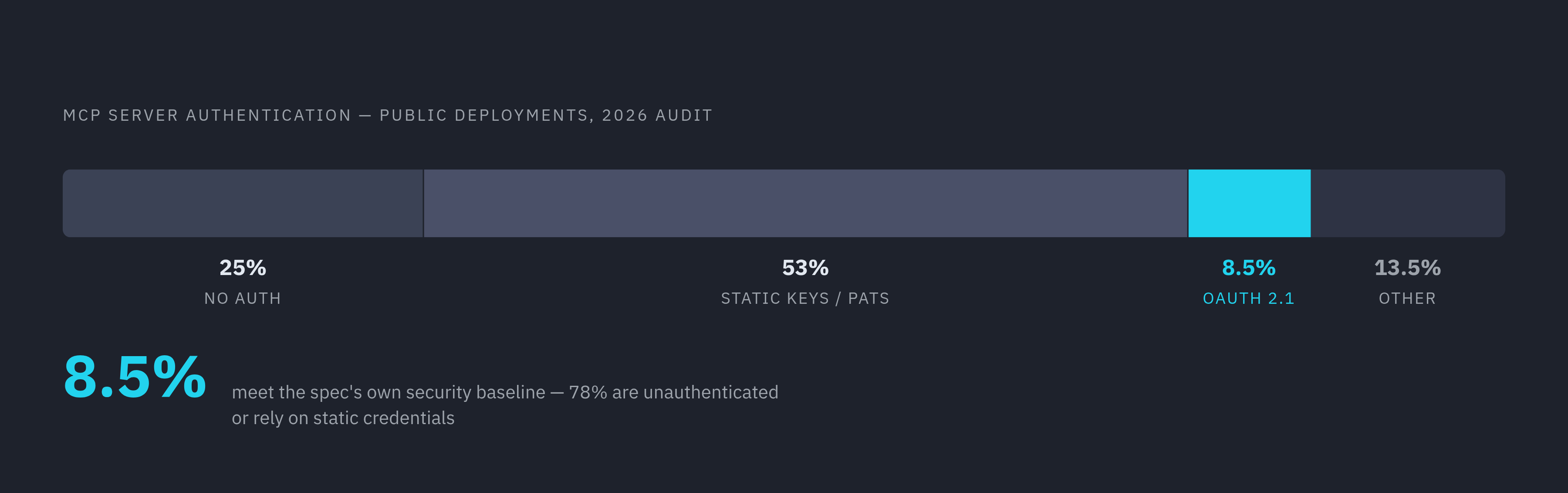
Adoption numbers are one story. Authentication practice is a much less comfortable one. A 2026 security audit of public MCP servers found that 25% run with no authentication. Another 53% rely on long-lived static API keys or personal access tokens, credentials that, once they leak, hand over indefinite access with no expiration and no forced rotation.
Only 8.5% of servers currently run OAuth 2.1, despite it being the protocol's specified security baseline for remote deployments. That gap between spec and practice is the single biggest blind spot in enterprise MCP right now.
The spec itself is specific about what's required: OAuth 2.1 with PKCE for remote servers, along with supporting standards for client registration and authorization server metadata. None of that is optional language. It's the baseline the protocol assumes teams are running.
A bigger identity problem underlies how OAuth is used to authenticate MCP credentials. MCP credentials are their own category of non-human identity, the same class of thing as a service account or a machine identity, and they need the same lifecycle discipline: issuance, rotation, expiration, revocation. Skipping that means an agent effectively operates under the developer's full set of credentials. There's no audit trail distinguishing what the human did from what the agent did, and no way to scope the agent's access down to just the tools it actually needs. Every coding agent should carry its own registered identity, bound to (but distinct from) the developer's permissions, so every AI-generated commit and every tool call logs against the agent, not the person.
A 2026 spec update moved the ball forward here. Enterprise-Managed Authorization, or EMA, is now stable, and it streamlines how clients obtain access tokens through an enterprise identity provider during SSO, skipping the per-server consent dance. For any enterprise already running SSO and an identity provider, that's a meaningful shortcut.
A few other changes in that same update matter for anyone building CI/CD architecture on MCP:
- The protocol core is now stateless, so session management no longer lives inside individual server instances, which makes horizontal scaling behind a load balancer far less painful.
- RFC 9207 issuer validation is now part of the spec, closing a mix-up vulnerability that older authorization flows were exposed to.
- Streamable HTTP transport is standardized for remote servers, using Server-Sent Events over a persistent connection, so a cloud-hosted agent can stream real-time data from an enterprise server using plain HTTP POST and GET.
An architecture that's compliant with what the spec actually calls for looks meaningfully different from what most companies have running today. That gap is measurable. It isn't hypothetical: that gap is measurable.
A governance-first agent identity model in a CI/CD pipeline
Permission scoping is what determines blast radius. The goal isn't to make the agent less capable, it's to make sure that when the agent makes a bad call, the damage stops somewhere close to where it started.
That means giving each coding agent its own registered identity, separate from the developer who deployed it. It means tool-level scoping: an agent might read and write to a repo but have zero path to production secrets, with separate scopes defined per resource, per verb, per sensitivity level. repo:read and repo:write are meaningfully different grants. A blanket dev:access scope collapses that distinction and hands over far more than most tasks need.
One rule sits above the rest: an agent must never be able to modify its own permission set. That's the direct lesson out of the Clinejection incident, an agent that can grant itself new capability is an agent that turns any successful manipulation into an open-ended one.
The spec's own scope design pattern makes the tradeoff explicit. Fine-grained scopes, split by resource and verb, take more setup time on day one. They move faster everywhere else, through procurement, through audit, through incident response. A CRM integration built around customers:read, customers:write, and customers:delete is slower to configure than one built around a single crm:access grant, but the fine-grained version is the only one that survives a security review without a lot of uncomfortable questions.
Repository boundaries need the same discipline. Left unconstrained, agents will traverse whatever the operating environment lets them reach. Locking an agent to specific repos or directories, and blocking cross-repo writes unless someone explicitly signs off, limits accidental damage and, just as important, cuts off the lateral movement a compromised agent would otherwise have.
MCP server placement matters too. Endpoints shouldn't sit on the public internet. They belong on an internal network, a VPC or private subnet, reachable only through a gateway that owns external authentication. Configured that way, a misconfigured or forgotten server still can't be reached from outside without passing through the gateway's own auth layer first.
All of this ties back to one governance rule: every AI-generated commit gets logged under the agent's identity, not the developer's. Missing that creates a compliance gap. It's a compliance gap: it appears during an audit or after an incident, when the trail doesn't lead anywhere useful.
Pipeline controls that make agent actions auditable before, during, and after a merge
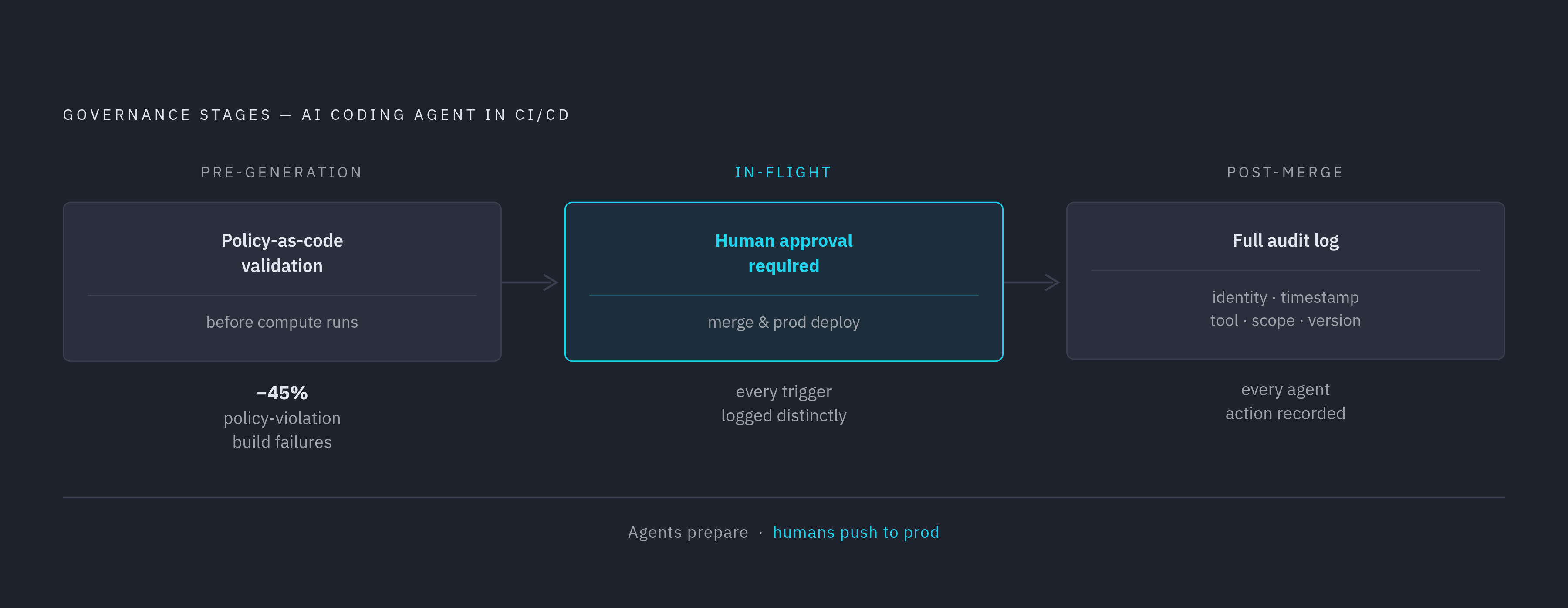
Governance here is three separate stages, pre-generation, in-flight, and post-merge, each catching something the others can't. It's three separate stages, pre-generation, in-flight, and post-merge, each catching something the others can't.
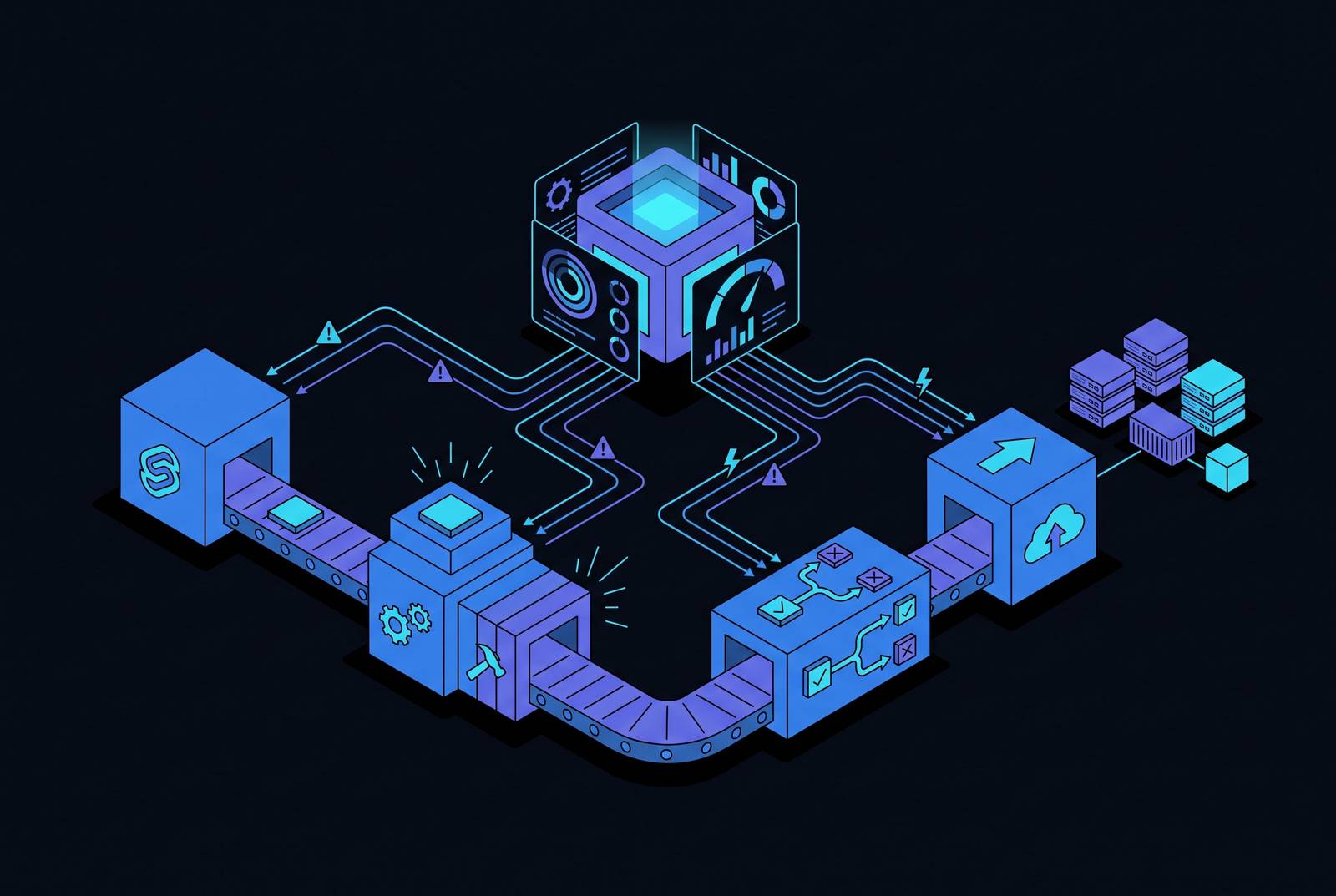
Pre-generation is where policy-as-code earns its keep. Teams that run pre-plan policy validation, using tools like HashiCorp Sentinel, have reported a 45% drop in policy-violation-related build failures compared to teams that only check policy after the plan stage runs, according to devops.com. That's a meaningful number, and it argues for catching problems before compute gets spent, not after. CI checks that diff configuration files, Dockerfiles, GitHub Actions workflows, package.json scripts, deployment manifests, deserve the same scrutiny a team would give a production access request. Any AI-generated change to a file that executes automatically in a trusted context should require a human sign-off, not just a passing CI check.
In-flight, the control that matters most is simple: a human approves the merge, and a human approves the prod deploy. Autonomous agents can prepare a change, run the tests, and stage a deployment. They don't get to push the button that sends it live. Every trigger, whether it came from a person or from the agent itself, needs to be logged distinctly, so the audit trail can tell the two apart later without guesswork.
Post-merge is where the paper trail either holds up or doesn't. Every action needs to log the agent's identity, a timestamp, which tool got called, and what scope it used. Every change needs a version attached, not just what merged, but which version of which agent skill produced it. That level of detail is what turns "something in the pipeline broke" into "this specific skill, version 4.2, approved by this person, on this date, produced this change."
Regulation is catching up to this expectation, too. The EU AI Act's Article 26 deployer obligations, originally due August 2, 2026, have been pushed to December 2, 2027 for Annex III systems under Regulation (EU) 2026/1744. That regulation, the Digital Omnibus proposal, has formally been adopted and took effect July 27, 2026. The deadline moved. The requirement didn't: organizations deploying high-risk AI systems will still need to retain logs, monitor operation continuously, and keep a human in the oversight loop.
Several existing frameworks already map cleanly onto this work, and each one applies in a distinct place:
OWASP Top 10 for Agentic Applications covers the current threat taxonomy specific to agent-based systems. NIST SP 800-218, along with the 800-218A generative-AI profile, covers secure software development practices. NIST CSF provides a framework for structuring cybersecurity risk management. ISO 27001 provides standards for information security management. CIS Benchmarks cover security hardening for the infrastructure agents execute on. PCI-DSS sets security standards relevant to automated actors with access to sensitive systems.
Scaling AI coding agents across teams requires a registry, not a shared drive
Here's what tends to happen once more than one team starts using AI coding agents: duplicate MCP servers pop up across the org, credentials end up scattered across a dozen configs nobody's tracking, and there's no single place to see which tools are talking to which agents. It's the shadow IT pattern from a decade ago, just wearing an agent costume this time.
The risks that come with that sprawl are concrete. Visibility into tool usage drops to near zero. Access to external services goes uncontrolled because nobody's tracking who granted what. Credential management fragments across teams that each built their own thing. And delivery pipelines end up without policy checks, because each team stitched together its own integration instead of using a shared one.
The financial case against this sprawl is already documented. Research from Agile Software Labs found that teams spend 60% to 70% of AI project time building and maintaining integrations rather than improving AI capabilities. That's not a marginal efficiency gain, that's the difference between a sustainable platform strategy and a pile of one-off scripts held together with duct tape.
A centralized gateway is the structural fix. Securing servers one at a time means every developer building every server has to get security right on their own, which more or less guarantees inconsistency somewhere in the stack. A gateway puts the controls in one place, at the trust boundary MCP's architecture already defines, and enforces them once instead of N times. Done right, this doesn't slow teams down: platform teams set the guardrails, and developers work freely inside them. Governance here isn't a brake pedal, it's a lane.
That's also the argument for a registry over a shared drive. A skill or server sitting in a shared folder carries no version history, no clear owner, no access scoping, and no audit trail. The same skill sitting in a governed registry carries all four. Once it's in the registry, any team can find it and reuse it instead of quietly rebuilding the same MCP server or prompt from scratch, which is exactly the kind of duplicated effort that racks up wasted engineering hours nobody notices until someone adds it up. And if a pipeline failure ever traces back to a specific agent skill, the registry needs to answer which version ran, who approved it, and when, without anyone digging through Slack history to reconstruct it.
MCP Server Cards, on the roadmap for 2026, extend this further: structured metadata exposed at well-known URLs, so an agent or a registry can see what a server does without opening a full connection to check. For a company building internal discovery across dozens of governed servers, that's a meaningful convenience.
None of this means centralizing control into one IT function. Domain experts, the people who actually work with a given system every day, should own the skills relevant to their team. That ownership just needs to live inside governed infrastructure. Not in a personal config file. Not in a team's private repo that nobody else can see.
Deploying governed coding agents consistently across surfaces, IDE, CI runner, chat, and review tool
An agent doesn't run in one place anymore. It runs in the IDE, in a CI runner, in a Slack thread, and in a code review tool, sometimes doing four different jobs in four different surfaces before lunch. The same skill, called from any of those surfaces, needs to behave the same way every time. Same permissions, same audit trail, same policy enforcement, no exceptions carved out because a particular surface felt lower stakes.
Coding tools like Cursor, Claude Code, and Continue already let developers plug in MCP servers directly inside their editor. CI runners use agents to generate infrastructure code, run test suites, and stage deployments. Chat surfaces, Slack, Claude, ChatGPT, let agents answer questions or kick off workflows straight from a conversation. Review tools use agents to flag policy violations and comment on configuration diffs before a human even opens the file.
Without a shared governance layer under all of that, permission configs drift apart across surfaces, and that drift is where the risk hides. A developer's IDE session should never carry more privilege than the same skill running inside a CI job. If it does, the surface with the weakest controls becomes the one an attacker (or just a careless prompt) goes looking for.
The fix is permissions that inherit automatically from the source system, rather than getting redefined by hand for every new surface, tool, or deployment. Setting the scope once, at the server, means every surface calling that server inherits the same rule. Each team gets its own scoped MCP surface that plugs into whichever agent or chat interface it needs, and the registry entry, the versioned skill, and the inherited permission set stay identical no matter which door someone walked in through.
Model-agnosticism belongs in this same conversation. Permissions, business context, and guardrails should travel with the organization, not get welded to one vendor's model. Swapping models, or running Anthropic, OpenAI, Google, and Microsoft models side by side, shouldn't force anyone to rebuild the permission or audit layer from scratch just to keep the lights on.
There's a clean test for whether any of this actually holds up: if an action is fully auditable when a CI runner triggers it, but the same action loses its audit trail when a Slack bot triggers the identical skill, the governance architecture isn't finished. It just looks finished from one angle.
Building the monitoring layer: what to measure, log, and alert on for AI coding agents in production
Monitoring an AI coding agent isn't the same job as monitoring a service for uptime and latency. The question isn't just "is it running," it's "is it doing what it's scoped to do, and can someone prove that after the fact."
At minimum, that means logging identity, action, scope, and timestamp on every single tool call, not just the ones that touch production. It means alerting when an agent requests a scope it's never used before, when a commit lands without a matching human approval where one was required, and when a server outside the registry shows up making calls. A spike in agent-initiated pull requests deserves the same scrutiny a security team gives a spike in failed login attempts: not proof of a problem on its own, but a signal that warrants a second look.
None of this replaces the human approval gates or the scoped permissions covered earlier. It's what confirms, continuously, that those controls are actually holding under real traffic rather than just looking good in the architecture diagram. A pipeline can be designed correctly and still drift out of compliance six months later if nobody's watching the logs for exactly this kind of change. Monitoring is what catches that drift before an incident does it for you.