Standardizing Agent Skills Across Decentralized Enterprise AI Teams
A shared MCP protocol only scales when governance controls its use.
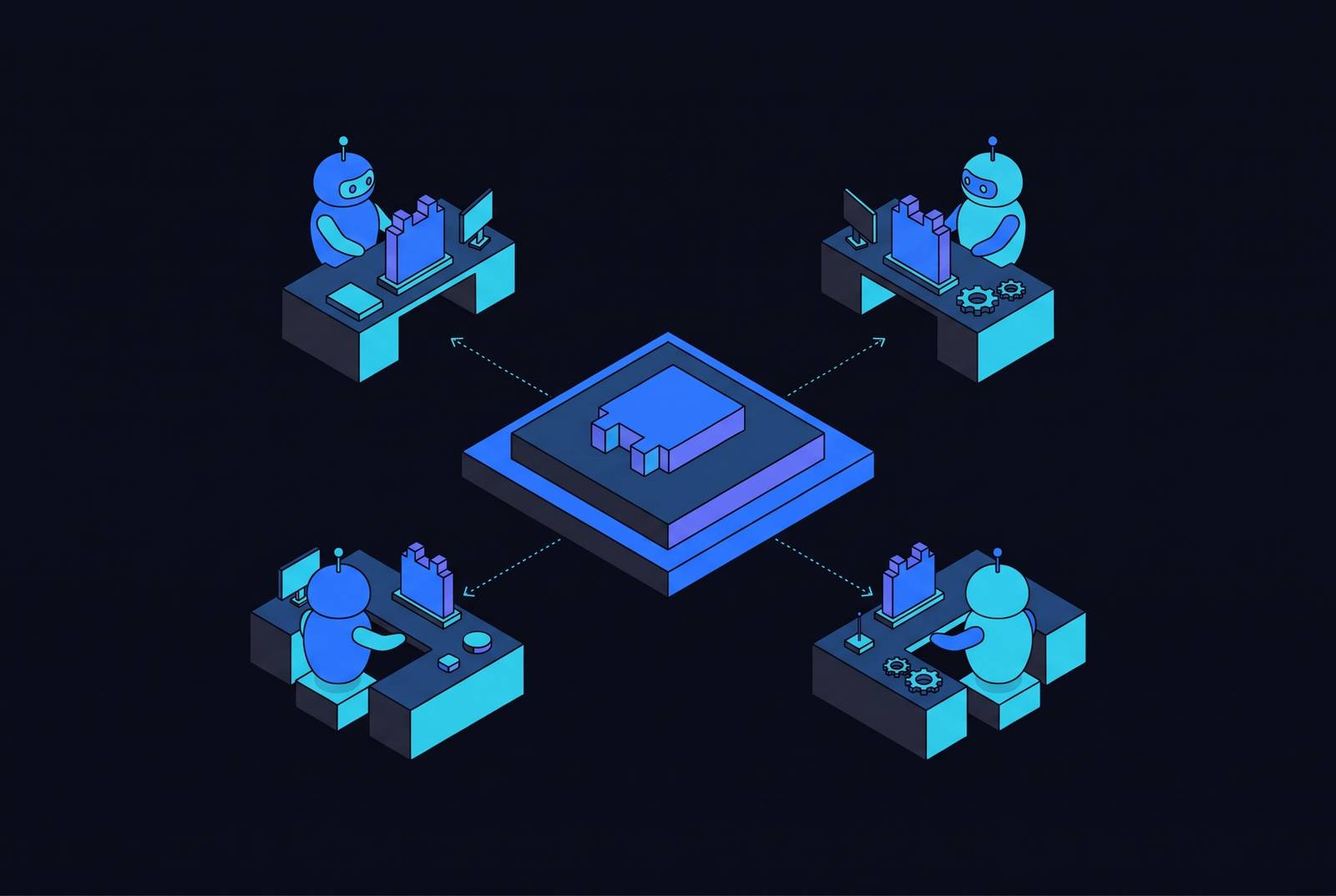
A governed AI agent skill registry for enterprises is infrastructure for approving, finding, sharing, and retiring agent capabilities, backed by runtime access controls and audit trails. Standardizing agent skills across decentralized teams means standardizing how those capabilities are governed. MCP supplies the common protocol, while the enterprise supplies the permissions, ownership, and lifecycle controls that make reuse safe.
Why decentralized AI development produces a skills fragmentation problem, not just a tooling one
Distributed teams are valuable because sales, engineering, and support have different work to do, and their domain experts understand that work. The trouble begins when each team has to build its own connectors, prompts, and authentication wrappers to give an agent useful context. Without a shared skills layer, local development produces separate versions of the same capability.
A sales team's CRM connector and an engineering team's CRM connector may do the same job while remaining entirely separate. Their permissions do not line up, and there is no shared registry or audit trail. Each new integration adds another piece to look after. This is the classic N×M integration problem repeated department by department, below the model layer.
Sharing is difficult when there is no common protocol, and risky when there is no common control over access. A good agent cannot fill that gap on its own. Whether a useful pilot can become a production service other teams trust depends on the infrastructure for identity, audit, and access-control.
What MCP actually is and why it became the protocol layer enterprises are converging on
The Model Context Protocol, or MCP, gives AI clients a common way to discover and call compatible servers. Teams build each side to use the same protocol, which saves them from building a custom connection for every pair of application and service. The number of integrations goes from N×M to N+M. Teams across the enterprise can then reuse that work while choosing different AI applications.
MCP separates the work into three roles. The host is the AI application a person uses, the client manages the connection, and the server exposes capabilities. Those capabilities include tools for actions such as creating records or triggering workflows, resources for reading documents and other data, and prompts that supply reusable task templates. A shared skill can therefore include both access to business context and a standard way to approach the task.
The protocol is not tied to one vendor. Anthropic, OpenAI, Google, Microsoft, and AWS support MCP, and compatible clients include Claude, ChatGPT, Gemini, Cursor, and VS Code. The July 28, 2026 specification revision also moves MCP to a stateless, request-and-response core. Remote servers can run behind ordinary load balancers without sticky sessions, which makes horizontal scaling easier while keeping the same benefits of reuse.
Why adoption speed has outrun governance, and what that costs organizations right now
A common protocol makes connections easier to build. It does not, by itself, decide which connections an enterprise should permit. Many deployments lack standardized rules for agent authentication, approved access scope, credential management, and audit-aligned review. Decentralized teams can therefore adopt the same protocol while retaining separate, incompatible approaches to trust.
The U.S. National Security Agency stated in a May 2026 report that MCP's “rapid proliferation has outpaced the development of its security model”. Security researchers filed many CVEs in January and February 2026, including path traversals and a critical remote-code-execution vulnerability. These concrete risks make authentication, bounded access, and deployment review production requirements.
The immediate cost is stalled deployment as well as exposure. Pilots with useful agent logic can still fall short of production when they lack identity, audit, and access controls. Meanwhile, Slack's Claude integration and Salesforce's MCP servers put agent access to real business data within employees' reach. Governance is already a live operational question. A written policy cannot enforce those boundaries alone, so the solution has to include infrastructure between the agent and the capabilities it invokes.
The four-layer architecture that makes governed MCP skill sharing work in production
Governance in production has four jobs, split among registry, gateway, identity, and audit. The registry is the authoritative record of approved servers, including their owners, access scope, authentication methods, approval status, and restrictions. The gateway controls access, routes requests, and logs tool calls. Discovery and enforcement are separate jobs, and a metadata catalog cannot do both.
Identity gives those controls a reliable subject. OAuth 2.1-based authorization is mandatory for remote HTTP-based MCP servers, so agents use short-lived, scoped access tokens. An enforced tool allowlist per agent is the highest-leverage single control in this design. It bounds the actions available to that agent instead of treating server access as unrestricted permission to use everything exposed.
Audit then records who invoked which tool, with which arguments and outcomes, at tool-call granularity. Those trails support SOC 2, GDPR, and internal risk review cycles. But logs need a map to be useful. An agent-to-MCP mapping identifies which agents connect to which servers, the permissions on each connection, and the owner responsible for it.
Pinterest engineering published its production deployment details on March 19, 2026. Its domain-specific servers for Presto, Spark, Airflow, and institutional knowledge sit behind a central registry, with human-in-the-loop approval for sensitive operations. The deployment recorded substantial monthly invocations from hundreds of active users and saved significant engineering time per month. Governance did not prevent use at that scale. Human approval for sensitive writes was part of the architecture that made it workable.
How do enterprises run a governed AI agent skill registry?
A production registry needs more than server names and descriptions. Each entry should include an owner team, data access scope, authentication method, approval status, connection parameters, approved user groups, rate limits, and an expiry date. Version, risk level, and business rationale make the approval record more useful. Data classifications such as PUBLIC, INTERNAL, and CONFIDENTIAL tell reviewers clearly what kind of information is involved.
Higher-risk servers should have sooner expiry dates so that access needs a fresh review and cannot last forever just because no one checks. Versioning, expiry, and revocation belong in the lifecycle from the outset. Servers that fail review should enter a denied list with specific reasons, so a rejection is an explicit governance decision.
These requirements distinguish an enterprise registry from an external directory. Glama, PulseMCP, and Smithery are upstream discovery feeds and should supply candidates for internal review. The official MCP Registry under the Agentic AI Foundation, or AAIF, is developing as an authoritative source. It still cannot define an individual organization's acceptable risk.
Platform engineering should own the registry as a core part of the runtime, while domain experts own the servers it lists. That division preserves local expertise without leaving approval rules to each team. The workflow must also be fast enough that teams do not route around it. For buyers assessing enterprise AI skill catalogues with role-based access control, the decisive distinction is whether approved groups, access scope, expiry, and revocation connect to runtime enforcement or merely appear as descriptive fields.
What permission-aware skill sharing looks like across surfaces, including Claude, ChatGPT, Cursor, and Slack
The user-facing payoff is a skill that does not need rebuilding for each application. A CRM server built once can serve MCP-compatible clients such as Claude, ChatGPT, Cursor, and VS Code. Its tool definitions, authentication, authorization, and audit trail stay the same when the model beneath them changes. The model can move without taking the organization's governed capabilities with it.
That portability also answers how enterprises can centrally manage and share agent prompts across teams. MCP prompts provide reusable templates, while the governed registry provides a place to approve and discover the servers exposing them. The surrounding controls remain essential to reuse. A common prompt does not, on its own, grant permission to read the resources or invoke the tools needed to complete its task.
Anthropic's Claude integration lets team members bring Claude into conversations in channels that administrators have approved, but only on Enterprise and Team plans. Access is bounded by Slack's permissions and the MCP servers the enterprise has configured. The channel boundary needs an explicit decision. If no one has defined which channels can invoke Claude against which data domains, the deployment has moved ahead of its governance.
ChatGPT, Claude, and Cursor do not share memory with one another, so each surface can accumulate a separate fragment of business context. Memory backends and shared context stores connected through MCP address that separate problem. The protocol connects the applications, but shared context still needs a home beneath them with rules for its use.
Department-specific MCP servers, with governed context in RevOps, Engineering, and Support
Domain experts give these servers their practical value. They know which information a task needs and which actions should be available, while the shared registry makes their work discoverable beyond the original team. Central governance creates a boundary within which departments can own their capabilities and share them beyond one person's laptop.
Salesforce's MCP servers reached general availability in April 2026 for Enterprise Edition orgs and above. Its standard servers cover SObject CRUD operations, split across SObject Reads, SObject Mutations, SObject Deletes, and SObject All, as well as SOQL queries and search. Clay's Claude connector arrived in early 2026 with a different focus, including verified contacts, account research, and mapping buying centers. The distinction is research versus execution. Registry scope needs to show how these sales connectors differ in what they can do.
Engineering has equally specific connections to share. Linear's MCP server lets an engineer supply an issue link so Cursor or Claude Code can read the ticket context and use it to guide the work. Sentry's server brings debugging context into an agent, making a Sentry issue link a starting point for troubleshooting and fix planning inside Cursor. Registration and versioning turn those connections into assets the next team can use.
Support belongs within the same ownership model. Its domain experts should control the skills relevant to their work, with access bounded by the shared governance layer. Cross-department reuse then becomes possible without erasing departmental boundaries. When the RevOps Salesforce server and engineering Linear server are both governed and discoverable, an orchestrator can compose them so pipeline data informs a prioritization decision in Linear, without either team rebuilding the other's connection.
From duplicated effort to a compound organizational capability, with a governed skills layer
Duplicated effort consumes resources without enlarging the shared capability. Five teams rebuilding the same CRM connector with different permissions models and no audit trail produce more maintenance. A registered skill has a different trajectory. Each new team can reuse an owned, versioned capability.
As a product capability, a governed skills registry is therefore more than a searchable catalog. Its value comes from combining discovery with approval workflows, ownership, access scoping, and lifecycle controls connected to enforcement. A shared drive can hold prompts and connection notes. It cannot substitute for the runtime decisions that make a capability trustworthy beyond the person who built it.
The lesson for platform engineering is to apply production-service rigor to the registry. For domain teams, it is to build skills into that registry from the start rather than retrofit governance after a personal tool succeeds. Gartner projects sharp growth in enterprise applications with task-specific AI agents, from less than 5% in 2025 to a much larger share by the end of 2026. At that volume, unregistered skills become an efficiency problem and an audit and security liability.
The durable investment sits beneath the changing models. MCP's vendor-neutral governance under the AAIF, a directed fund within the Linux Foundation, supports that separation. Organizations with registry, gateway, identity, and audit infrastructure can absorb new agents and surfaces without rebuilding their governance each time.