Standard Operating Procedures as Context for Enterprise AI Agents
SOPs become governance when agents access them as live context, not static documents.
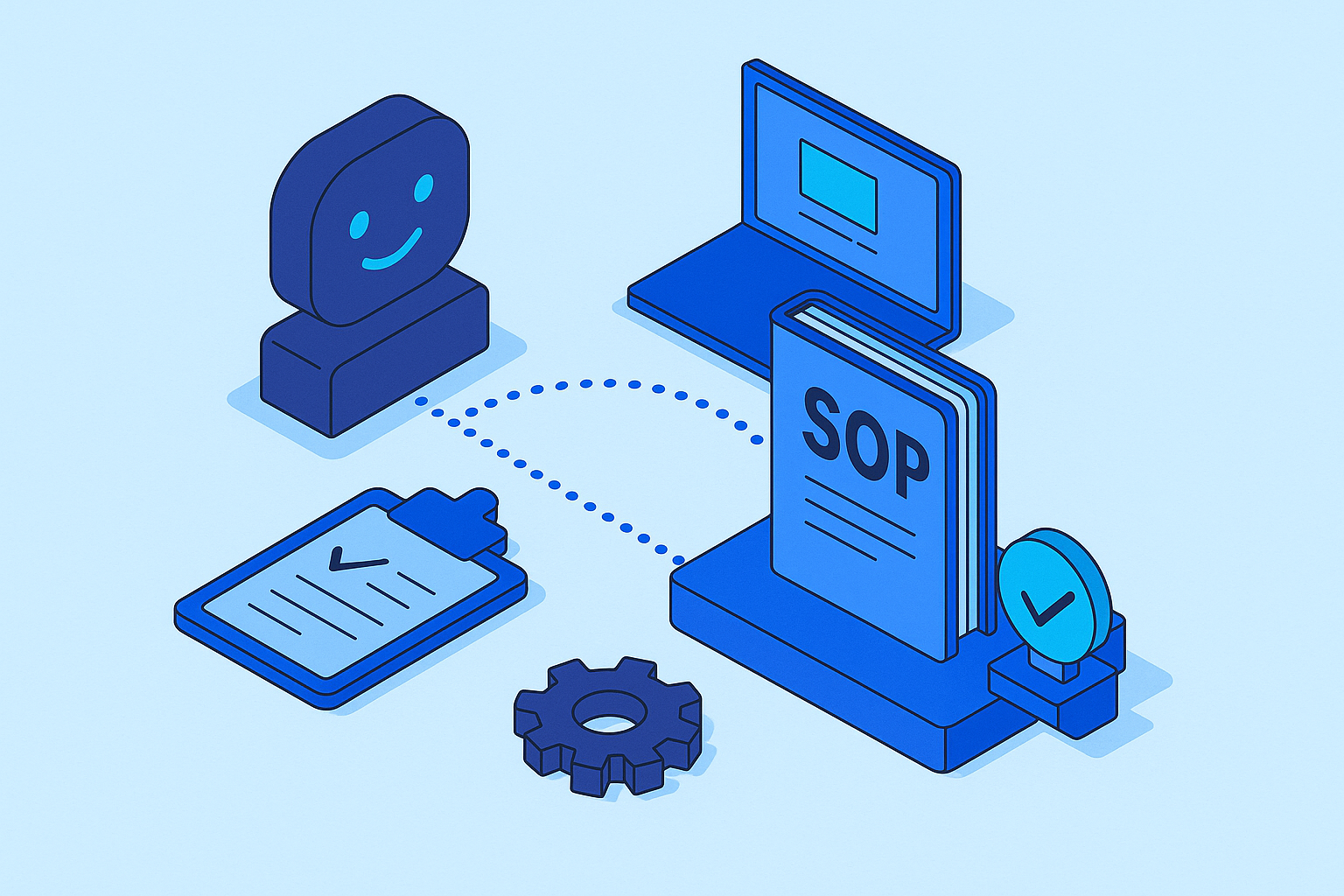
Standard operating procedures already encode how a company thinks. When they are surfaced as structured context for AI agents, they stop being static documents and start functioning as active governance, keeping agent behavior aligned with real business rules rather than the generalized reasoning an LLM brings out of the box.
SOPs are not compliance paperwork. They are the codified reasoning of a business: who decides what, under what conditions, using which systems. They contain decision trees, approval chains, escalation thresholds, system-specific instructions, exception handling, and role-based responsibilities. They represent accumulated expert judgment compressed into structured text, the kind of institutional knowledge a new hire absorbs through months of osmosis. The problem is where that knowledge lives: PDFs, wikis, SharePoint folders. Accessible in theory, consulted rarely in practice, almost never updated in sync with actual process changes. The gap this creates is predictable. Employees improvise, escalate unnecessarily, or apply general judgment in situations where specific business rules exist and should have governed the outcome.
How AI agents currently fail without business-specific context
LLMs bring sophisticated general reasoning. What they do not bring is knowledge of your refund policy, your approval thresholds, your regional compliance rules, or your vendor hierarchy. Without structured business context, agents default to plausible-sounding answers that directly contradict internal policy. Think of it like hiring a brilliant consultant who has read every business book ever written but has never once read your employee handbook — confident, capable, and occasionally catastrophically wrong.
The failure modes are consistent. An agent advises a customer using a return policy that was revised six months ago. A procurement request gets routed through the wrong approval chain because the agent applied a general understanding of how procurement works rather than how this organization's procurement works. A support ticket gets escalated when a well-grounded agent would have resolved it in one step. These are not exotic edge cases; they are the ordinary consequence of deploying agents without the institutional context that governs real decisions.
PwC research puts AI agent adoption at 79% of organizations, but measurable productivity gains depend on whether agents can act on real business logic, not just handle surface-level queries. The bottleneck is not model capability. It is context. Agents lack access to the institutional rules that govern every meaningful decision in the organization.
This is structurally similar to the integration problem MCP was designed to solve at the data layer, but SOPs represent a distinct class of context: procedural, conditional, and role-specific. Connecting an agent to a database is one kind of integration. Teaching an agent how your company thinks about a decision is another.
What it means to surface an SOP as structured agent context
There is a meaningful difference between dumping an SOP PDF into a vector store and deliberately structuring it as agent-readable context. Unstructured retrieval gives an agent relevant paragraphs; it does not give the agent the ability to reason about branching conditions or role-specific rules. Structured context decomposes an SOP into discrete, queryable units: conditions, actions, responsible roles, exceptions. Units an agent can actually traverse.
MCP functions as the natural delivery mechanism here. An MCP server can expose SOP content as tools, prompts, or resources, which are standardized interfaces an agent calls at runtime. The agent does not need to know where the SOP lives. It calls the server, which returns the relevant procedure for the current task and the current user's role. Permissions travel with the SOP: a junior analyst sees the steps available to their role; a manager sees additional approval paths. The scoping is structural, not advisory.
MCP's dynamic discovery model is particularly important in this context. Agents can ask what procedures govern a specific action and receive a real-time, scoped answer, not a static document dump that is or is not current. Consider a customer support agent handling a refund request. It calls the SOP server, retrieves the current refund policy for that product category, and applies the correct threshold, rather than reasoning from training data that is months stale. That is the difference between an agent that knows things in general and an agent that knows how your company handles this specific situation.
The governance problem SOPs solve when they become active context
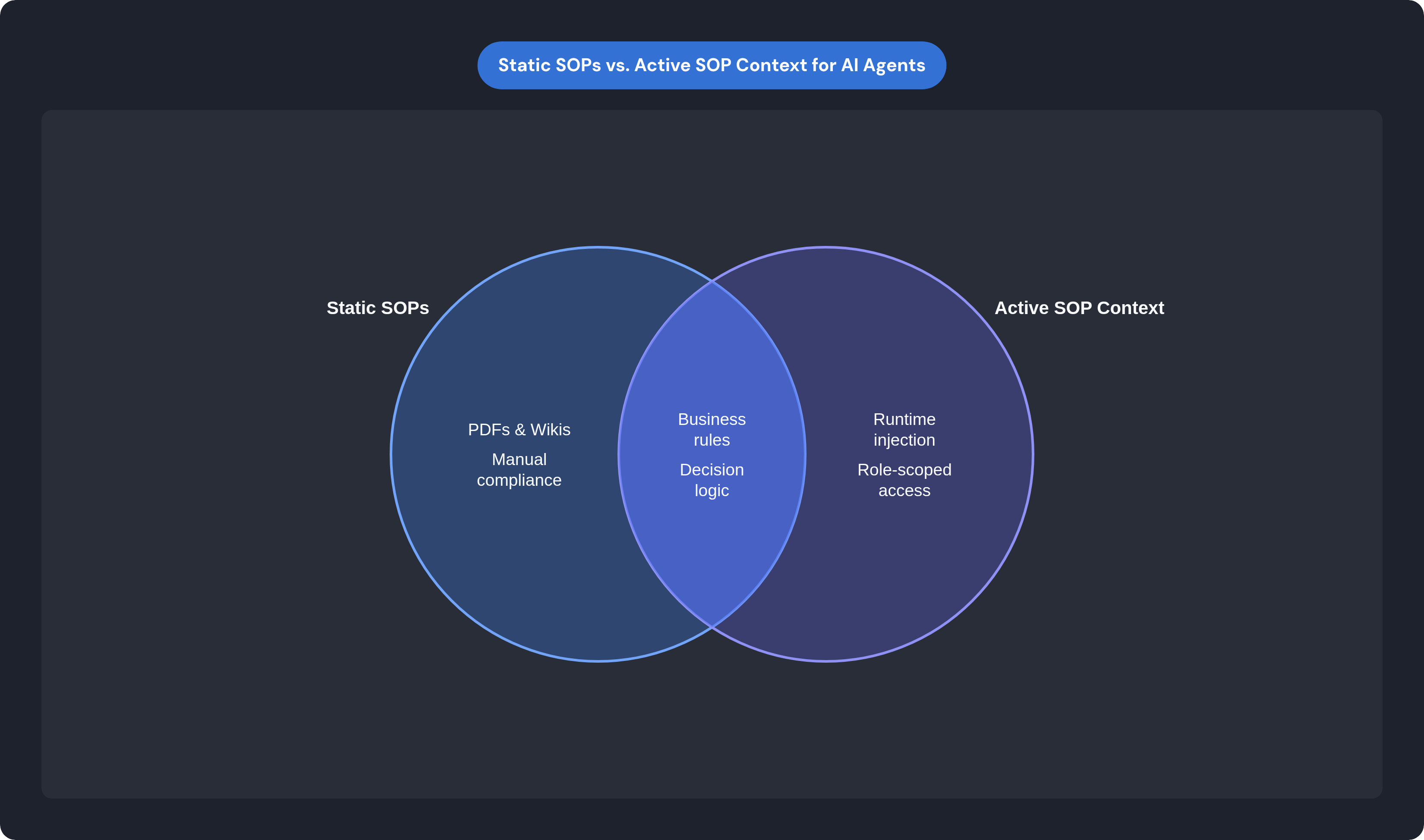
Static SOPs govern humans through documentation. Active SOPs govern agents through runtime context injection. This is a fundamentally different and more reliable enforcement model, and the distinction matters enormously once agents are making decisions at scale.
When an agent's output is grounded in a versioned SOP retrieved at the moment of action, every output carries a traceable rationale. The audit trail captures what procedure was in effect, which version, what role triggered it, and what the agent returned. That is the kind of auditability enterprise governance teams actually require. Not "the model said X," but "the model said X because it applied procedure Y, version 3.2, scoped to role Z."
OWASP's Top 10 for LLM Applications identifies excessive agency as a critical risk, specifically agents taking high-impact actions beyond what the task requires. SOP-grounded context is a structural check on this, because the procedure defines what actions are in scope. The agent is not reasoning freely about what it could do; it is applying a defined procedure about what it should do.
The alternative approaches are brittle by comparison. Encoding business rules in system prompts means rules change, prompts drift, and there is no versioning or access control on what the model operates from. Fine-tuning bakes rules into the model itself, making updates expensive and rollback nearly impossible. SOPs as context make the governing logic externalizable, updateable, and permission-scoped, separate from the model entirely. Business rules travel with the organization regardless of which LLM is in use.
Why SOPs become more valuable when they are scoped by role and team
A single SOP document often contains procedures for multiple roles. Surfacing the entire document to every agent is both inefficient and a permission failure in its own right.
Role-scoped SOP context means the agent retrieves only the procedures that apply to the user's role, department, and the current task. A support tier-one agent sees resolution steps and escalation triggers; it does not see the internal compensation approval matrix that tier-three managers access. A finance team's procurement agent applies the approval thresholds relevant to their cost center, not company-wide limits that do not apply to their budget authority. This is not a user experience concern. Exposing procedures beyond a user's role is itself a governance failure, equivalent to granting read access to files the person should not see.
The practical architecture that follows from this is a set of virtual MCP environments scoped per team, each exposing only the SOP procedures relevant to that team's workflows and the roles within it. A finance virtual server handles budget policies, approval chains, and vendor selection criteria. A support virtual server handles resolution procedures, escalation thresholds, and refund limits. A RevOps virtual server handles deal desk rules, discount approval tiers, and contract exceptions. Each team's agents operate within a defined procedural perimeter.
Critically, permissions should propagate from source systems. If the underlying document management system already scopes access by role, that scoping should flow automatically to the agent layer, not be redefined manually for each new tool. Manual permission re-mapping is exactly the kind of work that introduces inconsistency over time.
The stale SOP problem — and why versioning changes the equation
The most common objection to SOP-grounded agents is the state of the SOPs themselves: outdated, inconsistent, not trusted. This is a real problem. It is also an argument for better SOP infrastructure, not an argument against using SOPs as context.
When an agent is caught giving wrong advice, the failure is usually traceable to a stale document. That traceability creates organizational pressure to keep SOPs current in a way that no compliance audit has ever quite managed to sustain. The agent makes the consequences of stale documentation visible and immediate, which changes the incentive structure around maintenance.
Versioned SOP context makes staleness visible and consequential in a specific, useful way. Every agent action references a specific SOP version. When a procedure changes, the version number changes, and every downstream agent call reflects the update automatically. Contrast this with the current state in most organizations: a rule buried in a system prompt, updated by one person, with no change log and no way to know what agents were operating under the previous rule.
The discipline of structuring SOPs for agents also forces a kind of specificity that improves the document for human readers. Vague language — "use judgment" — must be replaced with explicit conditions: "if order value exceeds $500, escalate to manager." That precision benefits everyone who consults the document, not just the agent.
A registry model, where SOP-derived tools are published, versioned, and ownership-assigned, closes the governance loop. The team that owns the procedure owns its maintenance, with clear accountability when the procedure is wrong or outdated. The loop runs like this: an agent surfaces a wrong answer, it traces back to an SOP version, the owner updates the procedure, and all agents consuming that procedure update automatically.
What happens when the same SOP logic runs across multiple agent surfaces
Enterprise teams do not operate on one AI surface. The same employee interacts with an agent in Slack, uses Claude or ChatGPT directly, works in Cursor, and triggers automations through a workflow tool. As of 2026, MCP is supported across every major AI client, including Claude, ChatGPT, Cursor, GitHub Copilot, and Gemini.
Without a shared context layer, each surface applies its own interpretation of business rules, or none at all. The Slack agent applies the refund policy it was last told about. The Claude instance applies something different. The Cursor-based internal tool applies nothing specific. This is not a model problem; it is an infrastructure problem. The model is capable; the governing context is not being delivered consistently.
Slack has seen a 25x increase in both real-time search queries and MCP tool calls, which means it has become a live execution layer for enterprise agents, not a messaging app where governance can be deferred. The volume and consequence of decisions being made through these surfaces demands that the governing context be uniform.
A single governed MCP server exposing SOP context solves this at the infrastructure level. The same procedure is applied whether the query arrives from Slack, Claude Desktop, or a RevOps automation. The surface is irrelevant; the governing context is the same. The security dimension reinforces the point: a public advisory found Anthropic's original Slack MCP implementation vulnerable to data exfiltration via link unfurling, illustrating that ungoverned, casually deployed MCP surfaces create real exposure. SOP-grounded servers with scoped permissions reduce the attack surface by limiting what any agent can access or return.
The duplication tax — what it costs to rebuild SOP context team by team
The typical enterprise pattern unfolds predictably. One team structures its SOP logic for an agent. It works. Six months later, three other teams have rebuilt equivalent logic independently, with slight variations, no shared versioning, and incompatible permission models. By the time the fourth team starts, someone in IT is maintaining four partial, diverging implementations of the same underlying business rule. Call it the copy-paste tax — you pay it once per team, and it compounds.
CData's 2026 State of AI Data Connectivity Report found that 71% of AI teams spend more than a quarter of their implementation time on data integration alone. SOP context structuring compounds this cost when done redundantly across teams. Each independent rebuild is also a governance fork: the finance team's version of the approval procedure diverges from the procurement team's version, creating real operational inconsistency that surfaces only when an agent makes a decision that contradicts another team's agent, usually in front of a customer or an auditor.
The cost is not only engineering time. It is the opportunity cost of new capability that never gets built because capacity is consumed re-encoding what already exists somewhere else in the organization. Organizations that capture SOP logic once and share it through a governed registry shift from rebuilding to composing. Each new agent draws on existing verified procedures rather than starting from scratch.
A governed registry as the infrastructure for shared SOP context
A shared drive is not a registry. Without version control, ownership assignment, and access scoping, shared SOP documents replicate the PDF-in-a-folder problem at a slightly different layer. The format changes; the dysfunction persists.
What a registry adds is specific and consequential. Version history ensures every change to an SOP-derived tool is recorded, with previous versions available for audit. Ownership assignment means the team that knows the procedure is responsible for the tool, accountable for its correctness. Access scoping ensures a published SOP tool is available to the teams and roles that should have it, and not globally accessible by default. Discoverability means other teams can find and reuse existing SOP tools rather than rebuild equivalent logic independently.
Forrester's 2025 analysis found integration cost reductions of 60 to 70% in teams that moved from point-to-point API connections to MCP-based architectures. A registry model for SOP context applies the same structural logic: one maintained artifact replaces many redundant implementations. The governance payoff follows directly. Every agent action grounded in a registry-managed SOP tool is auditable: what procedure, which version, who owns it, who approved the last change.
Credal's registry approach operationalizes this model directly. SOP-derived skills are published once, scoped by team and role, with permissions propagating from source systems rather than being redefined manually. Those skills are available across any agent surface without rebuilding. The governed registry becomes the mechanism that turns a document library into something that actually functions as a company brain.
Practical starting point — what structuring SOPs for agents actually requires
The first question is not technical. It is this: which SOPs actually govern the decisions agents are making or will make? Start with high-frequency, high-consequence procedures where agent error is most costly or most visible. Customer-facing resolution procedures, procurement approvals, and compliance-sensitive workflows are the typical starting points, because the cost of getting them wrong is immediate and traceable.
Structuring SOPs for agents requires explicit conditions. SOPs written for human interpretation often use language agents cannot traverse reliably. "Exercise discretion" becomes a liability in this context. The equivalent structured form specifies the conditions under which each path applies, with explicit thresholds and named outcomes. This is editorial work, not engineering work. The domain expert who owns the procedure is the right person to do it, because accuracy depends on institutional knowledge the IT team does not have.
Context window discipline matters more than most teams anticipate. Perplexity's CTO noted that some MCP implementations consumed 40 to 50% of the model's context window before agents performed any meaningful work. A sprawling SOP server that loads every procedure at once reproduces this problem. The design principle is to expose only the procedures relevant to the current agent's task, not the entire policy library. Purpose-built, scoped SOP servers avoid the context budget problem before it starts.
Ownership must be assigned from the first day of structuring. Central IT cannot maintain the accuracy of hundreds of department-specific SOPs. The team that knows the procedure must own the tool, because that team is the one that knows when the procedure changes and what the change means.
The right measure of success is not how many SOPs are loaded into an agent. It is whether agent decisions in a given domain are consistently aligned with the procedures that are supposed to govern them. That alignment is what separates an agent that performs a task from an agent that performs it the way your organization has determined it should be performed.