RAG Pipeline Evaluation Metrics for Production Systems
Measure retrieval and generation separately to pinpoint where RAG systems actually break down.

An engineer pulls up a bad answer, checks the retrieved chunks, and finds them reasonable enough. The document looks right. The model's response doesn't match it. At that point there's no way to tell, from a single accuracy number, whether the retriever missed something the answer depended on or whether the model had everything it needed and ignored it anyway. That's the gap a composite score leaves open, and it's the reason production RAG systems need to be measured in two places instead of one. A RAG call breaks down into at least three steps: embed the query, retrieve the top-k chunks, then ask the model to answer using those chunks. Failure can enter at step two, before the model has generated a single word, or it can enter at step three, after the model has been handed exactly the right material and done something else with it. Those are two different failure surfaces: retrieval, where the wrong chunks get pulled, the right chunks get missed, or the right chunks get ranked too low to matter; and generation, where the model hallucinates, drifts from the context it was given, or uses only part of what it had available. Older NLP metrics like BLEU and ROUGE were built to measure surface-level similarity between two pieces of text, and that tells you almost nothing about whether a RAG response is actually grounded in what was retrieved. Treating retrieval and generation as one undifferentiated output collapses two independent problems into a single number, and that number can't point back to its cause. The fix is to measure each failure surface with metrics built for it, then read those metrics as a diagnostic panel.
The retrieval layer metrics: context recall and context precision as complementary diagnostics
Context recall and context precision look at the same retrieval step from two different angles, and a retriever can score well on one while failing badly on the other. Context recall asks whether the retriever surfaced everything the answer needed. It's measured by taking each piece of information in a reference answer and checking whether some retrieved chunk actually supports it. Picture a question whose answer has three parts: the retriever nails part one, pulling back a chunk that covers it cleanly, but misses the chunks for parts two and three. Recall drops even though the one chunk that did come back was exactly on target. That's a different failure from a retriever that returns ten chunks and only one of them is useful. That second case is a precision failure: the context window fills up with material that doesn't help, tokens get spent for nothing, latency and cost climb, and the model now has extra noise it could anchor on. Low recall tends to trace back to chunk size that's too small for answers spanning multiple chunks, an embedding model that doesn't capture the domain's own vocabulary, or a top-K setting that's simply too conservative. One useful signal here: if recall barely moves after raising K, the problem isn't the retrieval depth, it's upstream in the chunking or the embedding model itself. Low precision with the right documents still showing up in the candidate set usually means the ranking step needs work rather than the retrieval step, and a cross-encoder re-ranker layered on top of vector search is the standard fix for that. Two more metrics round out the retrieval picture. Precision@K and Recall@K require labeled relevance judgments and measure the retriever in isolation, before generation ever enters the picture. Mean Reciprocal Rank checks whether the first relevant chunk shows up early in the ranked list, since a chunk buried at position nine does the model far less good than the same chunk at position one. A retriever can look strong on precision and still fail on MRR. These numbers need to be tracked separately.
The generation layer metrics: faithfulness and answer relevance are not the same failure
A response can be fully grounded in the retrieved context and still fail to answer the question that was asked. Faithfulness and answer relevance need to be tracked as two separate scores. Faithfulness checks whether every claim in the generated answer is actually supported by what was retrieved. A low faithfulness score means the model reached into its training data to fill a gap instead of sticking to the supplied context, hallucination in the strict technical sense of the word. The fix for a faithfulness problem sits on the generation side: lower the temperature, tighten the system prompt, or improve retrieval so the model has less reason to improvise. Answer relevance checks something else entirely: does the generated answer address the actual question? One standard way to measure it is to generate alternative phrasings of whatever question the answer seems to be responding to, then compare those alternatives back to the original question with cosine similarity. The combination that catches people off guard is high faithfulness paired with low relevance. That pattern means the model produced a response that's completely accurate relative to its context and still off-topic, because the context itself was tangentially related to the question. The model did its job faithfully; the retrieval step handed it the wrong material to be faithful to. That reverses the usual assumption that faithfulness is the hard problem and relevance is the easy one. In regulated settings, legal, healthcare, and finance applications among them, a low faithfulness score is a condition that blocks the response from reaching a user. At the production-monitoring level, hallucination rate is just faithfulness expressed as a proportion: the share of responses falling below the faithfulness threshold. A spike in that rate right after a document ingestion update is a strong signal that the new chunks are lower quality than what they replaced, which points the investigation straight back to the retrieval surface.
Reading the four metrics together as a diagnostic panel, not individual pass/fail gates
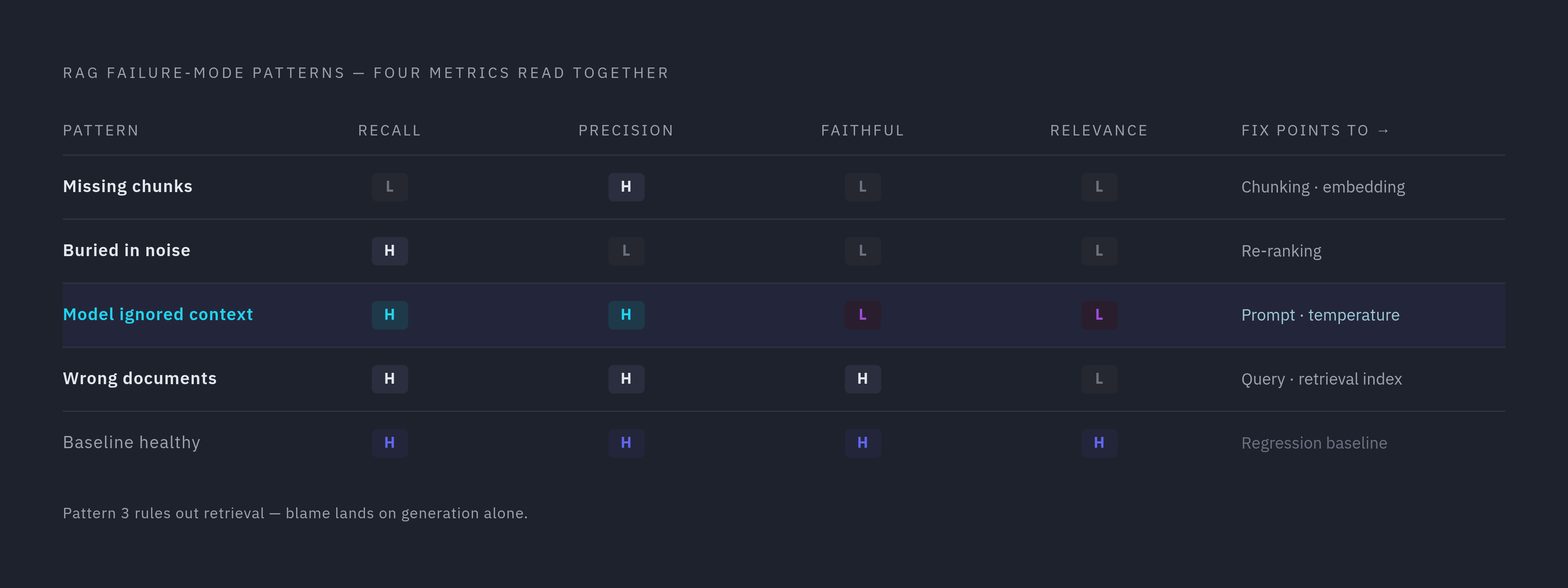
Context recall, context precision, faithfulness, and answer relevance only become useful once they're read together, because each distinct failure mode leaves its own signature across all four numbers at once. Low recall paired with low faithfulness points to a retriever that missed critical chunks, with the model hallucinating to cover the gap, and the fix belongs in chunking or the embedding model. High recall combined with low precision and low faithfulness describes a retriever that found the right content but buried it in noise the model latched onto, pointing to work needed on the re-ranking step. High recall and high precision together with low faithfulness rules out retrieval as the culprit entirely: the model had everything it needed and ignored it, so the fix is a tighter system prompt or a lower temperature. High faithfulness alongside low answer relevance describes the counterintuitive pattern from the previous section, a model being faithful to the wrong documents because retrieval handed it topically adjacent content. When all four metrics come back high, the system is working as intended for that class of query, so that combination belongs in the baseline used to catch future regressions. No single number can tell these patterns apart. A response with weak overall quality could be sitting at any one of several distinct failure points, and without the four scores broken out, there's no way to know which one. A fifth signal that runs alongside the core four is context relevance, scored by an LLM judge on a 0 to 1 scale per chunk for topical fit. It's cheaper to run at scale across live production traces than precision or recall, since those require labeled relevance judgments that aren't always available for traffic as it comes in. The panel also catches trade-offs that are specific to a given retrieval technique. HyDE, which embeds a hypothetical answer before running retrieval, tends to improve recall on vague queries by giving the retriever a richer target to search against. That same hypothetical answer, when it hallucinates, pulls in the wrong chunks and drags precision down. An end-to-end accuracy score would show HyDE as a mixed result at best and never explain why. The four-metric panel shows exactly which part of the trade-off is active for a given query pattern, which is the entire point of measuring retrieval and generation apart from each other.
How to set production thresholds for each metric
Thresholds for each of these metrics need to reflect what a failure actually costs in a given deployment, not a default pulled from a framework's documentation. Some teams run faithfulness and groundedness scoring directly at inference time, with deployment gates that block a response before it ever leaves the API boundary, catching the problem before it reaches the user. A common pattern splits groundedness into two tiers: responses below a stated threshold get flagged for human review, while responses below a lower, stricter threshold get blocked outright before reaching a user. That two-tier structure effectively builds a human-in-the-loop checkpoint into the pipeline that treats low scores differently depending on severity. In regulated domains, legal, healthcare, and finance among them, that soft gradient collapses into something closer to binary: a single unsupported claim is enough to disqualify a response, and a sliding threshold doesn't fit that requirement. For most other contexts, calibrating a threshold is an ongoing process. Start from whatever default a framework publishes, run it against a representative golden set, and find the point where the false-positive and false-negative rates match what the domain can actually tolerate. Fix that point as the gate in continuous integration. None of this is a one-time setup. A system that scored well at launch can regress months later without a single code change behind it: embedding models get updated and shift retrieval behavior, thresholds that once filtered noise start letting noisier candidates through, and the source documents themselves drift as the corpus is updated. A faithfulness score that suddenly drops after a document ingestion update is rarely a measurement glitch. It usually means the new chunks are worse than what they replaced, which makes threshold monitoring an ongoing diagnostic practice.
Building the golden dataset that makes offline evaluation meaningful
None of the four metrics mean anything without a golden dataset built to support them, since the dataset is what determines whether a given score reflects real system behavior or just noise. The strongest golden sets come from real production logs. Synthetic questions have a place as a backstop when real traffic is thin, but they shouldn't be the foundation a system's evaluation rests on. Real user queries carry the edge cases, the ambiguous phrasing, and the domain-specific vocabulary that a synthetic generator tends to smooth over, and a golden set built only from synthetic questions will often pass cleanly in a demo and then fail once it meets actual production traffic, which is the opposite of what the evaluation was supposed to catch. Each question in the set needs labeled must-have chunks attached to it, since recall and precision can't be calculated without knowing in advance which chunks a correct answer actually depends on. The corpus underneath a RAG system doesn't stay still, so the golden set shouldn't either: refreshing it on a quarterly basis keeps the test questions aligned with whatever the system is currently being stressed by, instead of testing against a document landscape that no longer exists. For the more qualitative metrics, faithfulness, completeness, and coherence among them, LLM-as-judge has become the standard evaluation pattern: a separate model scores each response against the golden answer. That judge model and the prompt driving it need to be pinned in place, because drift in either one silently invalidates months of trendlines without ever throwing an error. Changing the judge model partway through is equivalent to swapping the measuring instrument in the middle of a study, and it calls for explicit versioning and a full re-baseline.
Sources
- RAG Evaluation: Metrics, Tools, and the Context Gap (2026)
- Cross-Document Topic-Aligned Chunking for Retrieval-Augmented Generation
- Automating Multi-Hop RAG Evaluation via TRIAD: From Context Extraction to Validated Dataset Generation
- RAGXplain: From Explainable Evaluation to Actionable Guidance of RAG Pipelines
- Capital Markets LLM Reliability Score (CM-LRS): From Plausible to Bankable
- LayerRAG-Bench: A Cross-Layer Reliability Benchmark for Agentic Retrieval-Augmented Generation
- GitHub - sherwin28/rag-evaluation-pipeline: RAG evaluation pipeline with Ragas, LangSmith, LangFuse. Golden dataset pattern, CI quality gates, multi-LLM support. · GitHub
- GitHub - FlorianMartins/rag-eval-pipeline: Lightweight, CI-first evaluation pipeline and quality gate for RAG systems and AI agents — golden dataset, deterministic metrics, JSON/Markdown reports, GitHub Actions.