Preventing Prompt Drift Across Decentralized Agent Owners
A governed registry makes prompt drift visible and reversible before it spreads.
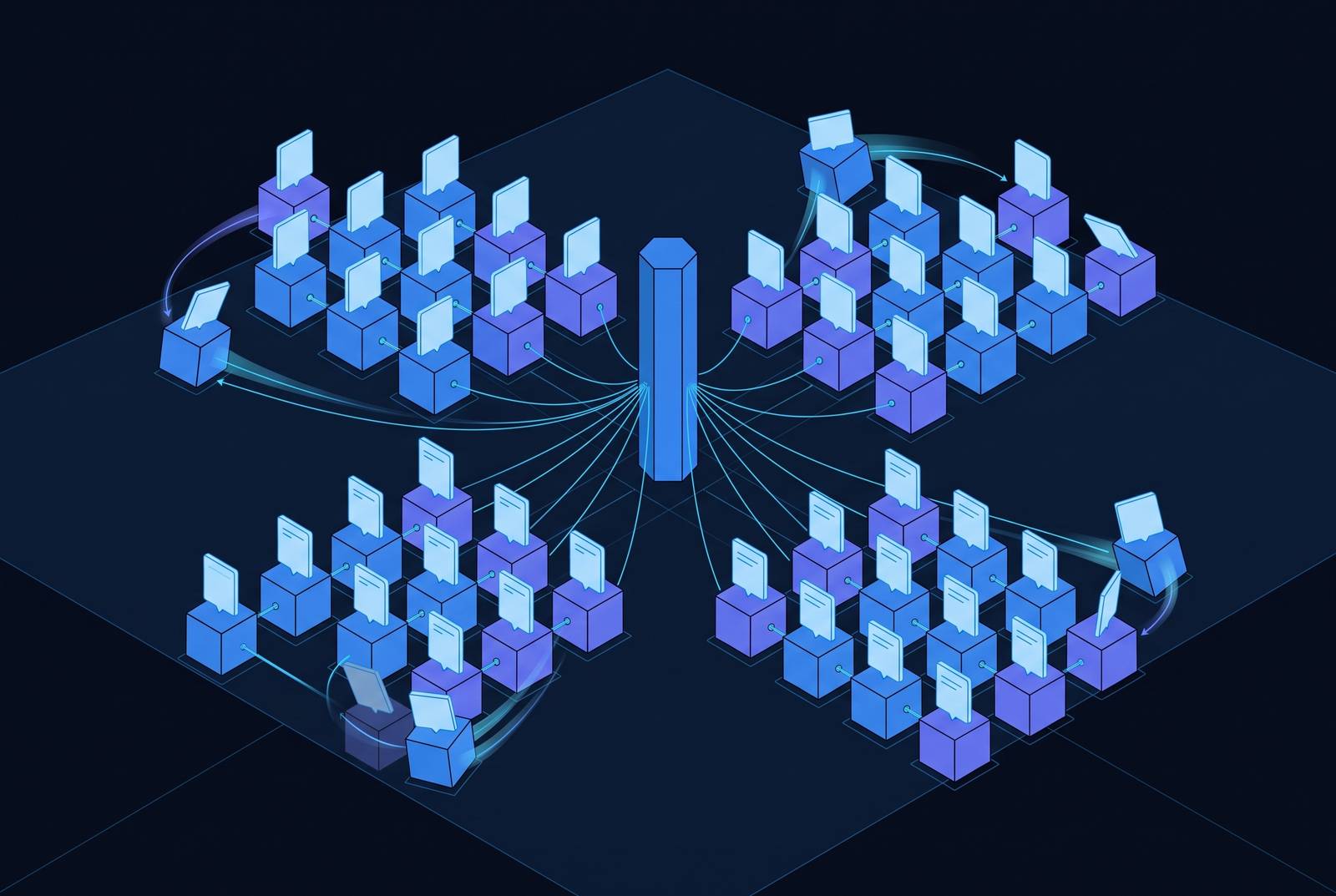
Prompt drift is a structural property of language models, not a sign of careless writing. Teams that own their agents independently cannot see it happening from where they sit. The fix is treating prompts as versioned, auditable artifacts in a governed registry, a change that makes drift visible and reversible before it compounds.
Why prompt drift is harder to detect than most teams expect
A single clause moved in a system prompt changes which tools an agent calls. The change is behaviorally consequential in ways no linter or compiler catches, because instructions are natural language, not formal syntax. The forthcoming agentic technical debt framework, cited in research as forthcoming in Communications of the ACM in October 2026, identifies prompt drift as a manifestation of semantic ambiguity accumulation in multi-agent trajectories. It is not sloppy writing. It is a property of the medium.
Constraint drift compounds across the agent chain. An agent can run a tool-call sequence that was logically correct six weeks ago and still be semantically wrong today. When one agent touches several MCP servers, each carrying its own drifted configuration, the reasoning layer absorbs and amplifies each error. The question is not whether safety-critical constraints were stated at the start. The question is whether they stay operative when the system summarizes context, delegates work, calls tools, and optimizes for task success. Credal's governed agent registry addresses precisely this gap by treating prompts and configurations as versioned artifacts with named ownership, making every change visible and traceable to the team that made it.
Decentralized ownership accelerates the problem. Domain teams owning their own agents is both the right governance model and the dominant enterprise pattern in 2026. But five teams can each quietly change the same base prompt, and no one sits in a position to notice.
Why the governance gap exists even in organizations that think they have it covered
The organizations most exposed to prompt drift are often those that moved fastest on AI adoption. Most organizations are not failing to build agents. A common failure mode is treating prompt management the way early software development was treated before version control. Debugging drift requires archaeology, not tooling.
The MCP protocol itself has moved ahead of most organizations' governance posture. The 2026-07-28 specification introduced header-based routing so gateways can route and meter on method and tool names directly, without parsing JSON bodies. Enterprise-Managed Authorization, known as EMA, is now a formally recognized official extension. EMA allows central provisioning of MCP server access through an identity provider, so users get connected servers on first login. Teams default to managing prompts as shared documents instead of auditable artifacts.
What a governed registry actually does that a shared document cannot
A governed registry is not a directory of prompts. It is the mechanism that makes prompts and agent configurations behave like versioned software artifacts: owned, auditable, and reproducible. Four properties separate it from a shared document or folder.
Version control with rollback is the first. Every change to a prompt or agent configuration is a commit, not an overwrite. Second is ownership and approval workflow. Each skill or configuration has a named owner and a defined approval path. Third is access scoping. Fourth is auditability. The registry records who approved what and when.
Moving constraints out of prompts and into the protocol layer strengthens this model. The 2026-07-28 specification makes this more tractable: method and tool names travel in HTTP headers, so gateways can route and authorize without parsing JSON bodies. The gateway enforces it mechanically.
Team-based provisioning replaces ad hoc server URL sharing. Administrators define team profiles in the registry. Developers discover available servers through an internal portal, not by managing raw URLs or inheriting a colleague's configuration.
How the MCP protocol's own evolution is making registry-backed governance more tractable
The structural conditions for governed registries are better in 2026 than they were at MCP's launch. The protocol itself has been redesigned around the properties governance requires. The 2026-07-28 specification shifted MCP from a stateful, session-based protocol to a stateless request/response protocol. Any request can land on any server instance behind a load balancer without shared storage. This eliminates the invisible state problem. List responses now carry cache hints with ttlMs and cacheScope values. Servers should return tools in a deterministic order, which lets clients cache tool catalogs and keep upstream prompt caches stable across reconnects. This reduces the surface area for drift introduced by inconsistent tool discovery.
Enterprise-Managed Authorization is a stable extension. It plugs into a registry model directly: the registry defines team profiles, and EMA enforces them at the identity layer. Access scoping becomes provisionable policy, not manual process. The MCP roadmap published 2026-08-22 identifies agent identity and enterprise-ready security as a named priority area, with work covering Demonstrating Proof of Possession, Workload Identity Federation, the ID-JAG grant behind EMA, and standard token exchange. The protocol is moving toward agent identities that can be governed the same way human identities already are. The current gap is real: MCP authorization is built around a person approving access in a browser. As agents act on behalf of users who are not present or delegate narrower authority to sub-agents, the protocol needs a standardized way to recognize and trust those agent identities. That work is in progress, not yet solved.
How Atlassian's MCP deployment illustrates what registry-backed context sharing looks like at production scale
The Atlassian MCP case shows that the multi-surface, governed-context model is operational at enterprise scale. It now handles more than 15 million calls a day. The redesigned server delivers more than 220 tools without bloating context. Internal benchmarking on Claude models shows it saves up to a quarter of tokens compared to the previous version on the same Jira and Confluence work. Kaplan North America's Jose Ramirez reported that agents built on Rovo and Atlassian MCP can summarize a month's worth of work across five different platforms in ten seconds. The benefit is elimination of context switching, not raw speed.
The architectural point is that the same context, a Jira ticket, a Confluence page, a Rovo skill, is reachable from any MCP-compatible surface with the same permissions. The server governs access, not the client. That is the multi-surface consistency a registry-backed model enables. When context is served through a governed server rather than copied into each team's prompt, changes propagate from one place. A team that changes its prompt without updating the server configuration creates a detectable inconsistency, not an invisible drift.
Who should own prompts in the registry: domain teams, not central IT
Central IT ownership of all agent skills is a governance failure mode in the other direction. It creates a bottleneck that slows deployment without improving quality, because IT lacks the domain knowledge to write or review prompts that make a sales agent or a support agent useful. The correct model is domain ownership with registry governance. Sales owns the prompts that encode sales context. Engineering owns the CI integration skills. Support owns the escalation logic. All of them publish to and update through a shared registry that enforces version control, approval, and auditability.
A skill that works on one person's laptop should not have to be rebuilt for the next team. The registry captures it once and makes it available to every team granted access, with permissions inherited from the source systems the skill touches. The difference between a shared drive and a governed registry is structural: a shared drive has no version history, no approval workflow, no access scoping, and no audit trail. It is a file system, not governance infrastructure.
Each team needs its own scoped context, its own MCP server profile, its own tool set, its own permission boundary, without having to build or maintain a UI for it. The registry provides that scoping as configuration, not as custom engineering work per team. Credal's model addresses this directly. Each team gets a scoped MCP server that plugs into any agent or chat surface, with permissions inherited and synced automatically from connected sources. Domain teams teach agents their context without redefinition work each time a new surface is added. The anti-pattern replaced is five teams each rebuilding the same prompt because there is no governed path to share a skill. The result is duplicated effort, inconsistent behavior across teams, and no single version to govern or audit.
What a practical registry implementation looks like, from single team to company-wide
Organizations that successfully scale governed agents start with one high-value integration, prove the pattern, and expand. They do not begin with a company-wide rollout of registry infrastructure before any team has used it. Stage one is a single team with a single integration. Pick a RevOps team querying CRM data or an Engineering team reading CI pipeline state. Build one MCP server for it. Require every prompt and configuration change to go through the registry with a version number and an approver. The goal is not capability. It is establishing the habit and the tooling. Does the team know how to commit a prompt change? Does the approval workflow have a named owner? Can you roll back to the prior version in under five minutes?
Stage two is a cross-team registry. Once one team's skills are in the registry, the governance infrastructure exists to share them. A second team with a related workflow can discover and reuse existing skills rather than rebuilding them. Support can share escalation context with Sales. Engineering can share SAML customer data with Product. Administrators define team profiles: Sales gets CRM read/write and Slack, Engineering gets GitHub, Jira, and CI. Access is provisioned through EMA at the identity layer, not managed per user manually. The developer-facing surface is an internal MCP server portal where teams discover available skills. The governance layer is invisible to them if it is working correctly.
Stage three is a governed company-wide registry. The registry becomes the single source of truth for all agent configurations. Every production agent has a registered owner, a version history, and an audit log of every change. No agent ships a configuration change that has not passed through the registry's approval workflow. The official MCP Registry, as of October 2026, is moving toward a curated, verified server directory with security audits, usage statistics, and SLA commitments. An enterprise should apply these same standards to its own server catalog. A governed registry replaces the manual coordination burden. Credal and similar platforms turn duplicate governance work into a one-time infrastructure investment that every team inherits. What the registry must enforce at each stage is consistent: version control on every artifact, named ownership per skill, approval workflow before any change reaches production, an audit log of who changed what and when, and rollback to any prior version without coordination overhead.
The multi-surface consistency problem that only a shared registry solves
The same governance problem that causes prompt drift within a team becomes an order of magnitude harder when the same underlying context is reached from multiple AI surfaces. That is the normal enterprise deployment pattern in 2026, not an edge case. MCP matters here because it separates the question from the tool that asks it. The same query pattern that works for a developer in a Cursor session works for a CSM in a custom agent, because the same server, governed by the same registry, serves both.
Without a shared registry, each surface accumulates its own prompt copy, its own tool list, and its own version of the constraints. Drift across surfaces is even harder to detect than drift within a single team, because no individual surface owner sees the divergence. With a shared registry, a change to the underlying skill propagates to every surface that calls it. The registry is the single point where drift is either prevented or detected. Consider a developer who opens a Linear ticket. Cursor queries the product decision layer through MCP and pulls customer data, deal values, and security requirements from sales calls. The agent reads across surfaces without any of those surfaces carrying their own copy of the data or their own version of the permission model.
Credal's governed registry model is built for this multi-surface, multi-team reality. Permissions are inherited and synced automatically from connected sources. Every team gets its own scoped MCP that plugs into any agent or chat surface without a UI to build or maintain. Skills published to the registry are available company-wide rather than siloed to the team that built them. The structural answer to drift is that there is only one versioned, auditable artifact to drift from.