Connecting Enterprise Knowledge Sources to AI Agents
Enterprise AI agents fail without reliable access to the organization's actual knowledge.
Why AI agents stall without access to enterprise knowledge
Most organizations have discovered, often expensively, that a smarter model pointed at the wrong data is still a useless one. The dominant investment has gone into model capability: bigger context windows, better reasoning, faster inference. The actual work of deploying agents at scale, solving the connection, permission, and context problems that separate a capable model from a genuinely useful organizational tool, has been consistently underestimated and underfunded.
The numbers are hard to argue with. The majority of enterprises have experimented with agents, but fewer than one in ten have scaled them to deliver tangible value. Most of those organizations point to data limitations as the primary obstacle. That's not a model quality problem. It's an access problem.
This connects to a structural failure that predates agents entirely. Nearly half of digital workers struggle to find information needed to do their jobs effectively. Agents inherit that same dysfunction. They don't transcend the organizational knowledge infrastructure; they depend on it entirely. A model that cannot reach a company's contracts, its CRM records, or its internal wikis will produce confident-sounding answers grounded in nothing relevant to that business. You cannot hallucination-tune or prompt-engineer your way around a connection that has never been made.
What enterprise knowledge actually looks like at scale
The phrase "enterprise data" conjures an image of a tidy database somewhere, versioned and searchable, waiting patiently to be used. The reality is considerably messier. Any serious attempt to inventory what a large organization actually knows, and where it actually lives, produces something closer to an archaeological dig than a filing system.
Enterprise knowledge spans structured records in CRMs and ERPs, unstructured documents like contracts and email threads and wikis, real-time data streams, and embedded human expertise that has never been written down anywhere. The unstructured portion accounts for the vast majority of an enterprise's total data footprint, and most of it has never been classified or made machine-readable. This isn't primarily a technology gap. It's an organizational one. The information exists. Getting at it coherently is an entirely different problem.
AI is already touching this knowledge in several common forms: agent add-ons inside existing enterprise software, conversational tools embedded in Slack or Teams, centralized AI-enhanced knowledge portals. The surfaces exist. What's underneath them is where things get complicated.
A significant share of organizations cite searchability and reusability as active barriers to AI automation. Pointing a model at a file share doesn't solve either problem. It requires deliberate architectural choices about how knowledge is indexed, chunked, and surfaced, and those choices have substantial downstream consequences for what agents actually produce. Ignore them and you get a system that technically connects to data but still returns garbage. The connection isn't the accomplishment. The quality of what comes back through it is.
How retrieval-augmented generation grounds agents in live organizational context
Retrieval-augmented generation, almost universally called RAG, has become the default answer to this problem. The mechanism is straightforward: rather than relying solely on what a model learned during pre-training, an agent queries external knowledge sources at the moment a question is asked, pulling from document stores, vector databases, APIs. The model then generates its response using both trained knowledge and retrieved content.
The majority of enterprise AI teams deploying large language models in production use RAG as their primary knowledge-grounding technique, and the reason is practical rather than theoretical. Hallucination rates drop substantially when retrieval pipelines are introduced. That reduction is what makes RAG viable for compliance, clinical, and procurement workflows, contexts where fabricated information carries real consequences and where traceability to the source isn't a nice-to-have but a functional requirement. A financial institution that can't point to the exact policy clause its agent cited has a liability problem, not just an accuracy problem. A hospital surfacing clinical guidelines at the point of care needs the citation chain, not just the recommendation.
RAG is not a switch you flip. Naive implementations routinely underperform. Well-tuned pipelines can reach accuracy rates that make the technology genuinely reliable, and the distance between those two outcomes is wide enough that organizations routinely mistake a bad implementation for a bad approach. Closing that gap requires real investment in pipeline architecture, chunking strategies, and retrieval evaluation. It requires ongoing maintenance. RAG is necessary for any production deployment that depends on current organizational knowledge. It is also not, on its own, the complete answer.
Where RAG alone runs into limits and why knowledge graphs extend it
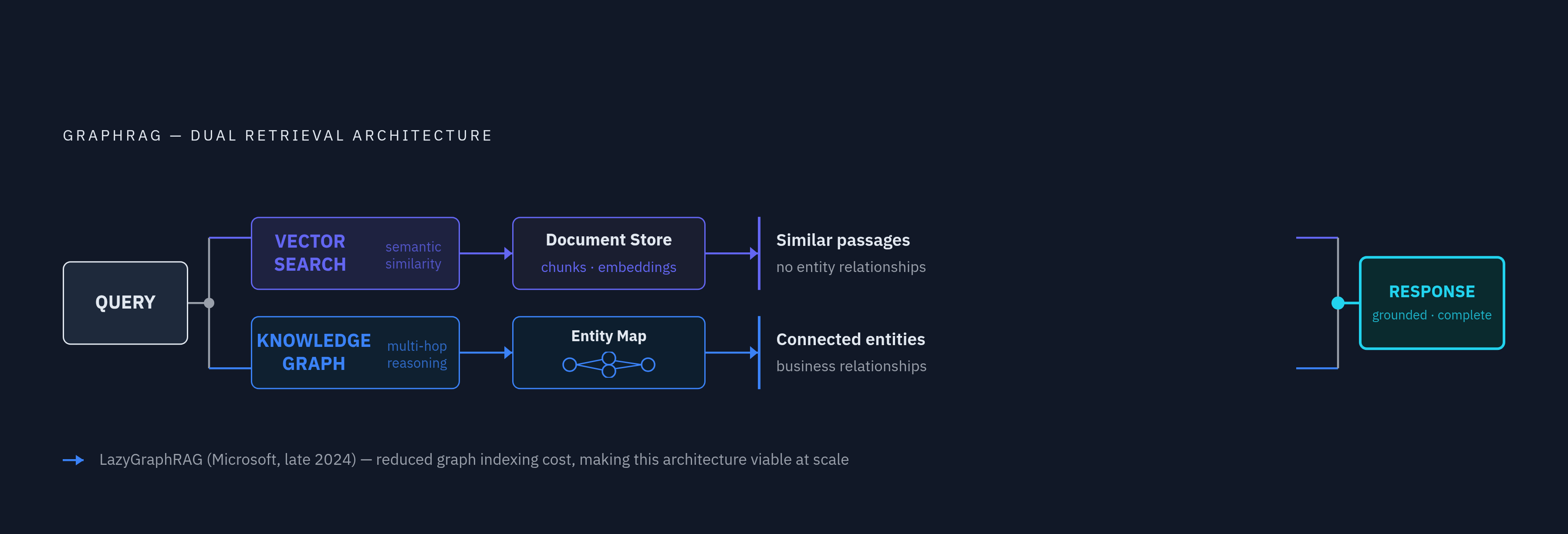
Vector search, the retrieval mechanism underlying most RAG implementations, finds semantically similar text. It does not model relationships between entities. This distinction matters more than it initially seems.
Questions like "who owns what," "what changed when," or "which systems were downstream of this incident" require a different kind of memory, one that understands not just what a document says but how entities connect to each other across the organization. A vector search engine cannot answer those questions reliably, regardless of how well-tuned it is. It will retrieve the most semantically proximate passages and still miss the relational chain that makes the answer meaningful. I've watched this play out in production environments where teams were genuinely confused about why their retrieval was returning plausible-sounding but structurally incomplete responses. The retrieval was working fine. It was just the wrong retrieval mechanism for the question being asked.
Knowledge graphs provide the structure that vector search lacks. They give agents a queryable map of business relationships, allowing them to chain facts across connected entities in real time rather than retrieving isolated passages. The accuracy gains on multi-hop reasoning tasks are meaningful, and the reduction in hallucination rates compared to vector-only approaches is significant enough that organizations running complex relational queries should take this seriously.
The emerging architecture is called GraphRAG: vector search for semantic retrieval combined with a knowledge graph for structural reasoning. It handles complex enterprise queries more robustly because it can do both. The historical limitation has been cost; full graph indexing runs substantially higher than vector RAG alone. Microsoft's LazyGraphRAG, introduced in late 2024, reduces that indexing cost dramatically while maintaining comparable answer quality. That changes the calculus for organizations that had previously decided the tradeoff wasn't worth it.
How MCP is replacing custom connectors as the standard way to wire agents into enterprise systems
Before a standard emerged, every new enterprise data source required its own custom integration. The combinatorial math gets ugly fast: twenty systems and twenty agent surfaces meant potentially hundreds of custom connectors to build, maintain, and eventually inherit when the person who built them left. That approach doesn't scale. It also creates a fragile, undocumented web of bespoke integrations that becomes progressively harder to govern as the agent count grows. Technical debt compounds silently until someone tries to audit it.
The Model Context Protocol, introduced by Anthropic in late 2024, addresses this directly. MCP is an open standard that gives any AI system a single, consistent interface for connecting to any data source or tool. First-class support has arrived across the major platforms: Claude, ChatGPT, Cursor, Gemini, Microsoft Copilot, VS Code. Enterprise platform integrations followed. Microsoft incorporated MCP into Azure AI Agent Service with authentication and access to both external and internal data sources. IBM built MCP tooling into watsonx.ai with audit logging and multi-tenant security. These are not peripheral additions. They represent foundational infrastructure choices by vendors whose platforms underpin large portions of enterprise IT, and those vendors don't make foundational choices casually.
Anthropic donated MCP to the Linux Foundation's Agentic AI Foundation. That's the clearest possible signal that this is becoming infrastructure rather than a vendor feature. Most enterprises are still managing the transition from bespoke integrations and all the technical debt accumulated in the meantime. But organizations still investing heavily in custom connectors are building toward a wall, and the wall isn't getting farther away.
Why permissions and data governance can't be bolted on after the fact
Connecting an agent to enterprise knowledge is not the same as connecting it safely. An agent that can read anything in a connected system can expose data to users who are not authorized to see it. This isn't an edge case or a paranoid hypothetical. It's a predictable consequence of architectures that treat permissions as a secondary concern, something to be addressed after the capability is proven. It creates incidents before it creates policy.
A striking minority of organizations have a mature agentic AI governance model. The majority are deploying agents faster than they are governing them. That gap closes the hard way, through the kind of event that generates retroactive urgency.
The permissions problem is structural. If an agent dynamically inherits a user's access rights, it surfaces only what that user is already authorized to see. That sounds straightforward. In practice, most connection architectures require this to be explicitly designed into the system from the beginning, not assumed. Governance also extends beyond exposure prevention to auditability: regulated industries need agents that can identify which source a response came from and confirm that source was authorized at the time of retrieval. That's a technical requirement, and meeting it after the fact requires dismantling and rebuilding significant portions of a production deployment.
As agent deployments scale, any manual permission-management approach becomes untenable. Permissions need to be inherited from existing access controls and synced continuously, not redefined agent by agent by whoever happens to be building the next one. Organizations that treat governance as an architectural constraint from the beginning spend far less remediating problems later. The ones that treat it as a compliance checkbox at the end spend considerably more time explaining what happened, and to whom.
The compounding cost of rebuilding the same knowledge connections across teams
The pattern repeats across nearly every large enterprise attempting to scale agents. One team builds a working agent connected to a specific knowledge source. Another team needs the same connection, doesn't know the first one exists, and rebuilds it independently. A third team does the same thing six months later. Nobody intended this outcome. It happens anyway, reliably, because knowledge connections are being treated as team-level deliverables rather than shared organizational infrastructure.
This duplication isn't just inefficient. It produces divergent implementations that behave differently from one another in ways that are difficult to trace until something goes wrong. When those implementations need to be governed or audited, there's no single version to evaluate. Quality control becomes a forensics exercise, and the forensics are expensive.
The compounding problem is structural. Without a governed registry where connections are captured once and made discoverable to any team, with access controls applied at the registry level rather than reimplemented per deployment, the organization keeps paying the full cost of building each connection every time it's needed. The cumulative drag on velocity is substantial, and it's largely invisible because no single team sees the full cost. Each team only sees its own build.
The return on well-built retrieval infrastructure is real, but that return assumes the pipeline is built once and reused, not reconstructed team by team from scratch. Most organizations are not yet structured to realize that assumption. The fix is organizational as much as technical: treating knowledge connections as shared infrastructure rather than local solutions requires someone, somewhere, to own the registry and make reuse the path of least resistance.
What an enterprise knowledge connection layer looks like when it works
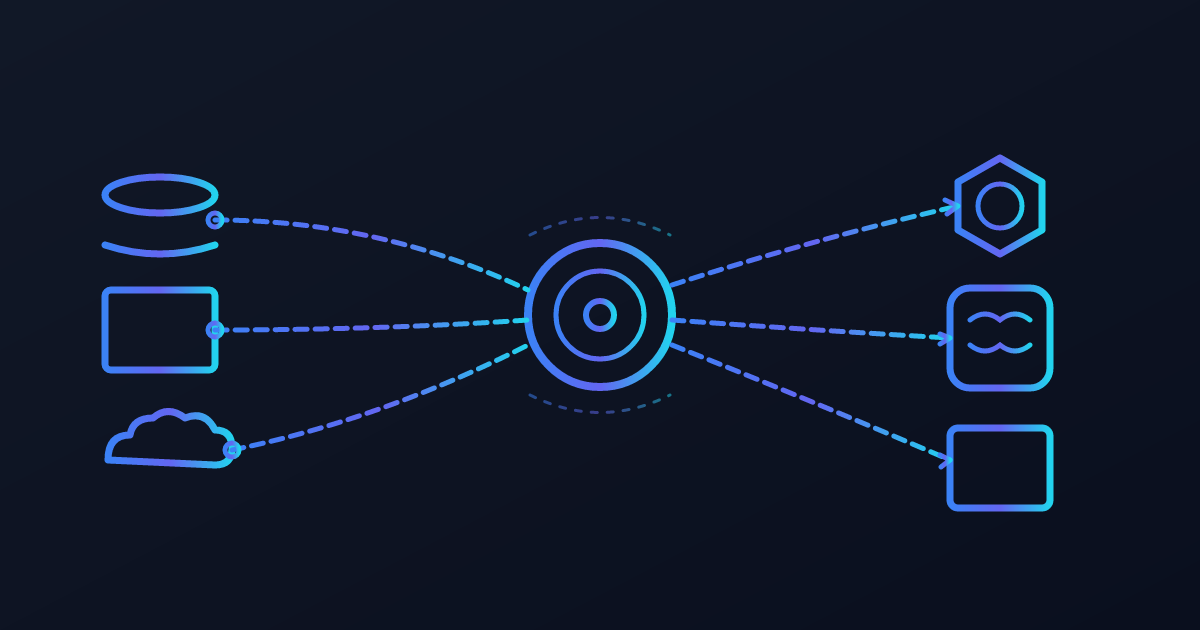
A functioning knowledge connection layer has several discrete components, and each one matters. Sources connected through a standard protocol so integrations don't require bespoke engineering for every new system. A retrieval architecture matched to the actual query complexity, RAG for document access and graph layers for relational reasoning, so the mechanism fits the task rather than the task being bent to fit the mechanism. Permissions inherited from existing access controls rather than redefined per agent. A shared registry so any team can discover and reuse what has already been built, without knowing who built it or when.
Querying live systems at inference time preserves data freshness and avoids the lag that ETL pipelines introduce. For CRM records, ERP data, or real-time risk information, that freshness isn't a preference. It is a functional requirement. Stale data in a risk system is not merely imprecise; it's actively misleading in a way that can persist undetected until it causes a concrete problem.
Established enterprise vendors are embedding retrieval directly into existing platforms, which means enterprises don't always need a greenfield build to get there. What they do need is a clear-eyed understanding of what an embedded layer can and cannot do, because the defaults are rarely sufficient for complex organizational queries, and the gap between what a demo shows and what a production deployment requires is consistently larger than anticipated. That's where a lot of pilots quietly die: not in the proof of concept, but in the transition to something the organization actually relies on.
The measure of whether a knowledge connection layer is working is concrete. Agents return answers traceable to specific, authorized sources. Access controls reflect the organization's existing permissions without manual redefinition per deployment. Teams share and reuse connections rather than rebuild them. Responses are consistent enough to be trusted in workflows where errors carry real consequences. When those four things are true simultaneously, you have infrastructure. Until then, you have experiments.