AI Maturity Model for Enterprise Adoption Stages
Real AI value requires redesigned workflows, not bolted-on tools.
Most enterprises already use AI somewhere in the business, but most have not pushed any single initiative into production with returns they can measure. That gap between using AI and getting value from it is where transformation actually fails, before anyone talks about stages or roadmaps.
The gap persists because buying a tool and handing it to a team does not change how that team works. An enterprise crosses into real maturity when it redesigns the workflow itself around what AI can do, not when it bolts a chatbot onto the side of an existing process and calls it transformation.
There's also a reporting problem that makes the gap harder to see from inside the organization. Enterprises tend to rate themselves higher on an AI maturity scale than their actual practices support, because the stage labels describe a ceiling of capability, not what people actually do day to day underneath that ceiling. A company can own every AI tool on the market and still operate like it's on day one if nobody has changed how work gets done.
Most maturity assessments make this worse by measuring the wrong things. They count governance policies on paper, tools purchased, and the quality of data infrastructure. None of those inputs reliably predicts whether the organization gets business value out of AI. Behavior is the constraint that actually matters, and it's the one most scorecards skip.
The five stages enterprises move through
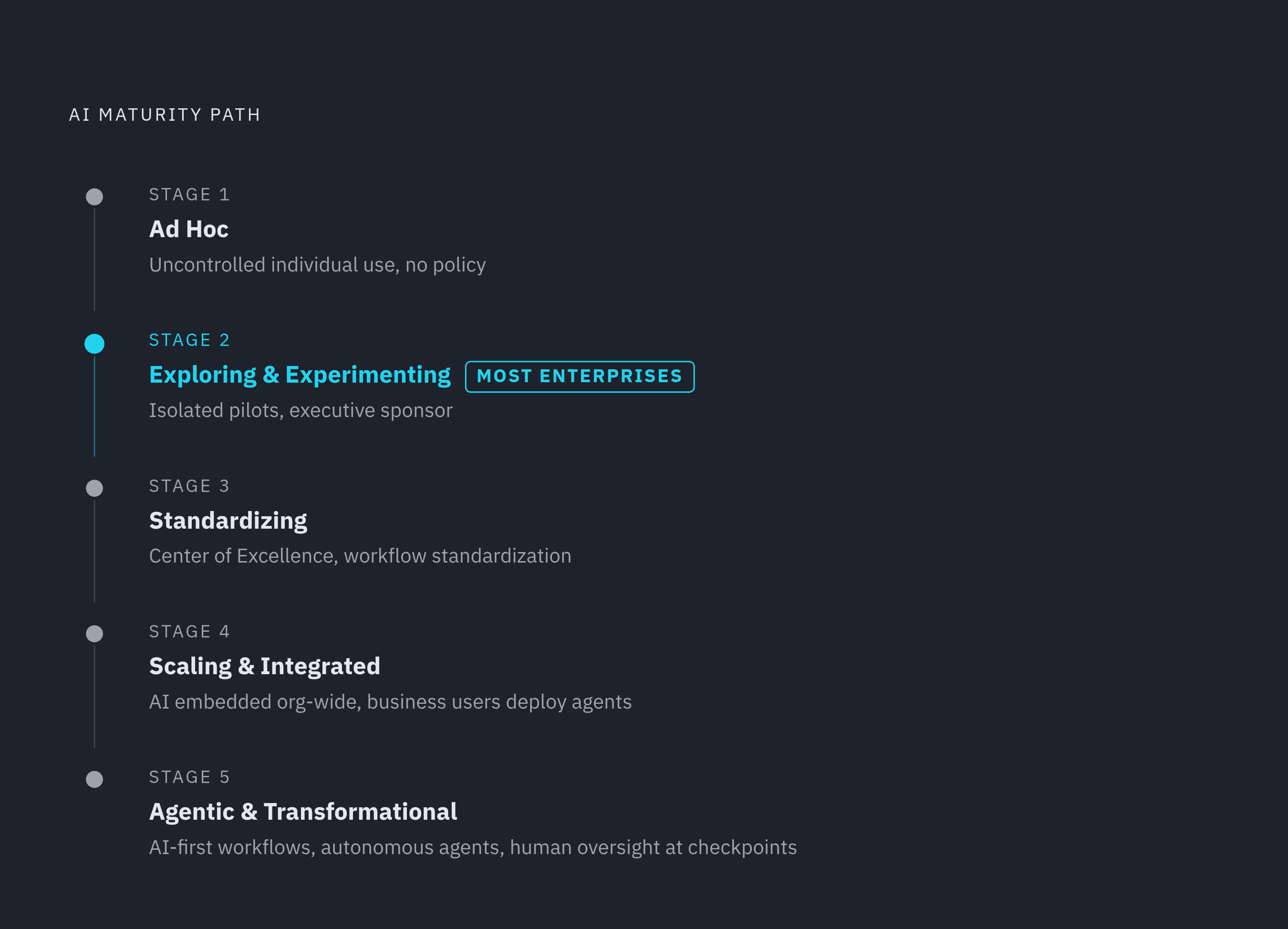
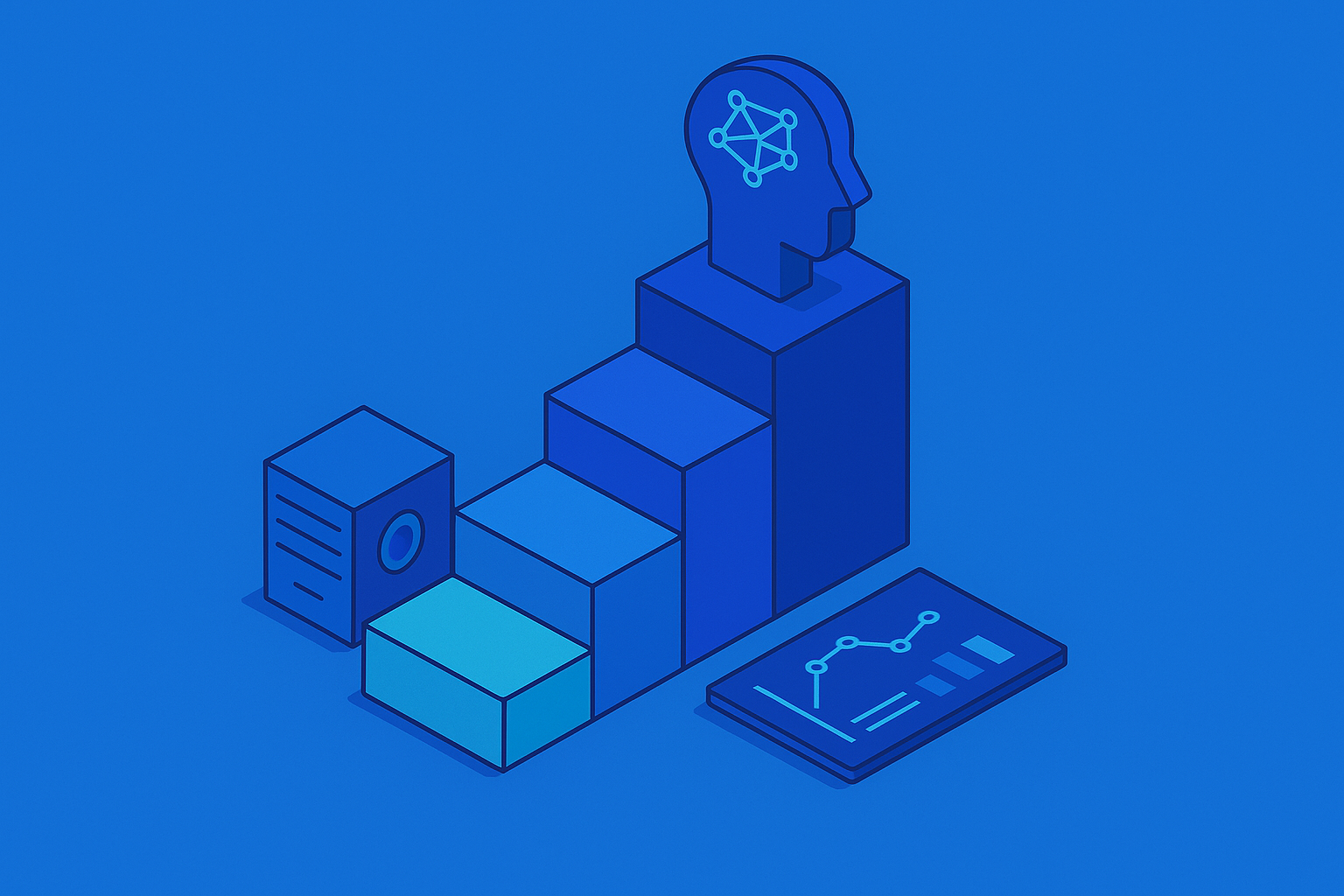
Enterprises move through a recognizable five-stage path, running from scattered individual experimentation to operations built around AI from the ground up. The value of naming these stages is a shared vocabulary that lets an organization say where it stands and what it will cost to move forward, as long as the assessment is based on what teams actually do.
Stage 1 is Ad Hoc. AI activity exists, driven by individual curiosity. Nobody owns it, no policy governs it, and employees regularly put company data into consumer AI tools with zero oversight. The exposure this creates on the security and compliance side compounds every month it goes unaddressed.
Stage 2 is Exploring and Experimenting. Pilots start popping up, and some of them work. The trouble is that the wins stay isolated from each other. An executive sponsor usually exists by this point, and there's some budget behind the effort. Most enterprises today sit at this stage, and most enterprises get stuck here.
Stage 3 is between experimentation and true scale, where organizations start standardizing workflows and stand up a Center of Excellence to coordinate AI efforts across departments. That stage carries its own failure mode, covered next, but first the map continues upward.
Stage 4 is Scaling and Integrated. AI is embedded across the organization, not confined to a few departments. Cross-functional collaboration becomes the norm. Business users get the ability to build and deploy their own agents, and the Center of Excellence grows from a policy group into a strategic function. Getting here requires connecting AI systems to enterprise applications and data sources in a way that Stage 3's architecture usually can't support.
Stage 5 is Agentic and Transformational. AI agents act on their own and take real actions in production systems. Workflows get designed AI-first from the start. Human attention appears only at defined checkpoints, and AI shapes decisions and even new business models. One enterprise AI maturity framework from Cohere describes this stage as one where the organization is built around AI capability, rather than one where AI gets added on top of an organization that was built for something else.
The governance failure that keeps enterprises at Stage 1: shadow AI and uncontrolled data access
Enterprises stuck at Stage 1 are short on access control, not ambition. Employees feed company data into consumer AI tools every day, and no policy exists to say what's allowed to leave the building or who answers for it when it does.
The mechanism here is ordinary shadow IT, just wearing an AI costume. Individual curiosity moves faster than any policy process can keep up with, so by the time leadership notices how much AI activity is happening across the company, uncontrolled data exposure has already piled up for months.
Getting out of Stage 1 doesn't require buying a platform. It requires a usage policy, a named owner accountable for AI activity, and a baseline data classification that tells every employee, in plain terms, what can and can't go into an AI tool. That's a governance decision, not a procurement decision.
For organizations under GDPR, HIPAA, or other sector-specific compliance rules, Stage 1 carries extra weight. Shadow AI use sits outside any compliance review by definition, so every uncontrolled interaction is also an uncontrolled compliance risk, stacking on top of the security risk.
The structural fix is permissions inheritance: access controls that travel with the data itself, rather than getting redefined every time an employee picks up a new tool. If an employee isn't allowed to hand a file to a coworker, that same employee shouldn't be able to hand it to an AI system either. The rule should follow the data, not the tool.
The governance failure that keeps enterprises at Stage 2: permissions fragmentation as pilots multiply
Stage 2 doesn't stall because enterprises run out of good pilots. It stalls because every pilot builds its own data connections and its own access controls from scratch, so the organization ends up with a pile of one-off integrations that can't be shared, can't be audited, and can't be extended without starting over each time.
Picture a marketing team and an engineering team that both connect an AI tool to the same CRM. Each team defines its own permissions independently. Over time those two setups drift apart, and neither team can see what the other configured. The organization now runs two different access environments on top of one shared system, and nobody owns the difference.
That duplication costs real money. Rebuilding the same prompt or the same data connection five separate times across five teams wastes engineering time and eats the budget that should fund the next pilot.
Enterprises that push past Stage 2 start building a governed registry of approved AI connections that any team can find and reuse. A connection or a skill one team builds becomes shared infrastructure for the next team, instead of disappearing back into that team's own silo. That registry concept becomes central again once MCP enters the picture, but even without new technology, the principle holds: the fix for Stage 2 is a shared permissions layer that inherits access controls automatically from the source system, so a new AI connection doesn't require inventing a new access control scheme every time.
The governance failure that keeps enterprises at Stage 3: workflow standardization without accountability
Stage 3 organizations usually have governance policies written down somewhere. A policy with no enforcement mechanism and no audit trail is a promise, not a control, and that gap in verifiable accountability keeps Stage 3 from turning into Stage 4.
A Center of Excellence that writes standards but can't see whether departments are actually following them has built governance theater, not governance infrastructure. The documents exist. Nobody can prove compliance with them.
Version control is often the weak point. When AI workflows and prompts live on a shared drive instead of a versioned registry, there's no record of what changed, who changed it, or whether anyone reviewed the change before it went live. Rolling back a bad update or auditing a past decision becomes close to impossible under those conditions.
There's also a bottleneck problem baked into how a lot of Stage 3 organizations centralize control. Routing every AI decision through IT slows the whole organization down. A better model gives domain experts, the people who actually understand the context of their own team's work, ownership over the AI skills relevant to that team, inside boundaries the organization sets centrally. Real auditability means a record of every agent action: who approved it, what version of the workflow ran, and what data it touched. A policy document describing what should happen isn't a substitute for that record.
MCP and the Infrastructure Problem at Stage 3 and 4
Model Context Protocol, known as MCP, tackles the integration proliferation problem that governance policy alone can't solve. By standardizing how AI models connect to enterprise tools and data, MCP makes permissions, audit trails, and tool definitions portable across different models instead of something that has to get rebuilt for each one.
Without a shared protocol, connecting many AI models to many enterprise systems means building a custom connector for every single pairing, the N×M problem. MCP collapses that into one server definition that any compatible model can call, which removes a huge amount of redundant integration work.
MCP is model-agnostic by design. When the underlying model is swapped, the tool definitions, authentication, authorization, and audit trail all stay intact. The business context stays with the organization.
Enterprise authentication has caught up to the protocol's ambitions. The Enterprise-Managed Authorization extension went stable in June 2026, implementing what's called the Identity Assertion JWT Authorization Grant, or ID-JAG. That replaces per-server consent prompts with a single-sign-on flow that needs no manual click-through. Anthropic and Microsoft, through Visual Studio Code, have adopted it, with Okta as the first supported identity provider. That closes the per-user OAuth fragmentation that used to make MCP impractical to roll out at enterprise scale.
The protocol itself is still evolving fast. A spec revision dated July 28, 2026 removed protocol-level session tracking, making MCP stateless at the protocol layer. Anthropic technical staff member David Soria Parra called it the most substantial change to the protocol since authorization was added, and it reduces friction for deploying agentic workflows at scale.
Adoption has moved quickly since MCP launched in November 2024. A significant share of surveyed software organizations already run MCP servers in limited or broad production, a ramp that shows the protocol has crossed from early-adopter territory into mainstream enterprise evaluation.
None of that makes MCP automatically safe. The U.S. National Security Agency said that MCP's rapid growth has outpaced the development of its own security model, and research has found a substantial share of MCP servers vulnerable to command injection. Adopting the protocol doesn't hand an organization security for free. The governance layer around MCP has to be built deliberately, not assumed as a side effect of using the standard.
The governance failure at Stage 4: unmanaged MCP sprawl and duplicate server proliferation
Enterprises that deploy MCP well at Stage 3 often walk into Stage 4 with dozens of MCP servers running with no coordination between them: duplicate credentials, overlapping tool definitions, and no central view of any of it. That recreates, at the infrastructure layer, the same fragmentation problem the organization thought it had already solved at Stage 2.
Managing a handful of MCP servers by hand is manageable. Once that number grows across teams and departments, organizations lose track of which servers are actually approved, who's responsible for each one, what tools each server exposes, and whether its credentials are even still valid.
Credentials scatter the same way access controls did back at Stage 2. When every team provisions its own MCP servers, authentication credentials spread across the environment with no central inventory tracking them, and the attack surface grows with every new server someone stands up.
There's a trust boundary risk too. Letting a read-only analysis agent and a production deployment agent share the same MCP server connection opens the door to a data breach. Each MCP server should serve exactly one trust boundary, and getting there takes deliberate architectural governance, not just good intentions from the team that built it. Managing MCP server access across a growing organization takes the same discipline that solved the Stage 2 permissions problem, applied now at the infrastructure layer where the servers themselves live.